

Deffuant-Weisbuch Bounded Confidence Model: Simulating Opinion Dynamics in Polarized Societies
Opinion polarization is one of the defining challenges of modern social science. How do populations of individuals, each updating their views through local interactions, end up fragmented into ideological clusters — or converge on consensus? The Deffuant-Weisbuch (DW) bounded confidence model provides a mathematically tractable, computationally efficient framework for exploring exactly this question. Originally published by Guillaume Deffuant and colleagues in 2000, the model has become a cornerstone of computational social science and is actively used in policy research, media studies, and network science.
Core Model Mechanics
The DW model represents each agent $i$ as holding a continuous opinion $x_i \in [0, 1]$. At each time step, two agents $i$ and $j$ are selected at random. They interact — updating their opinions toward each other — only if their opinion difference falls within a confidence threshold $\varepsilon$:
$$|x_i - x_j| < \varepsilon$$

When the condition is met, both agents move toward each other by a convergence parameter $\mu$ (typically $\mu = 0.5$):
$$x_i(t+1) = x_i(t) + \mu \cdot (x_j(t) - x_i(t))$$
$$x_j(t+1) = x_j(t) + \mu \cdot (x_i(t) - x_j(t))$$
This deceptively simple rule produces rich emergent behavior. The key control parameter is $\varepsilon$:
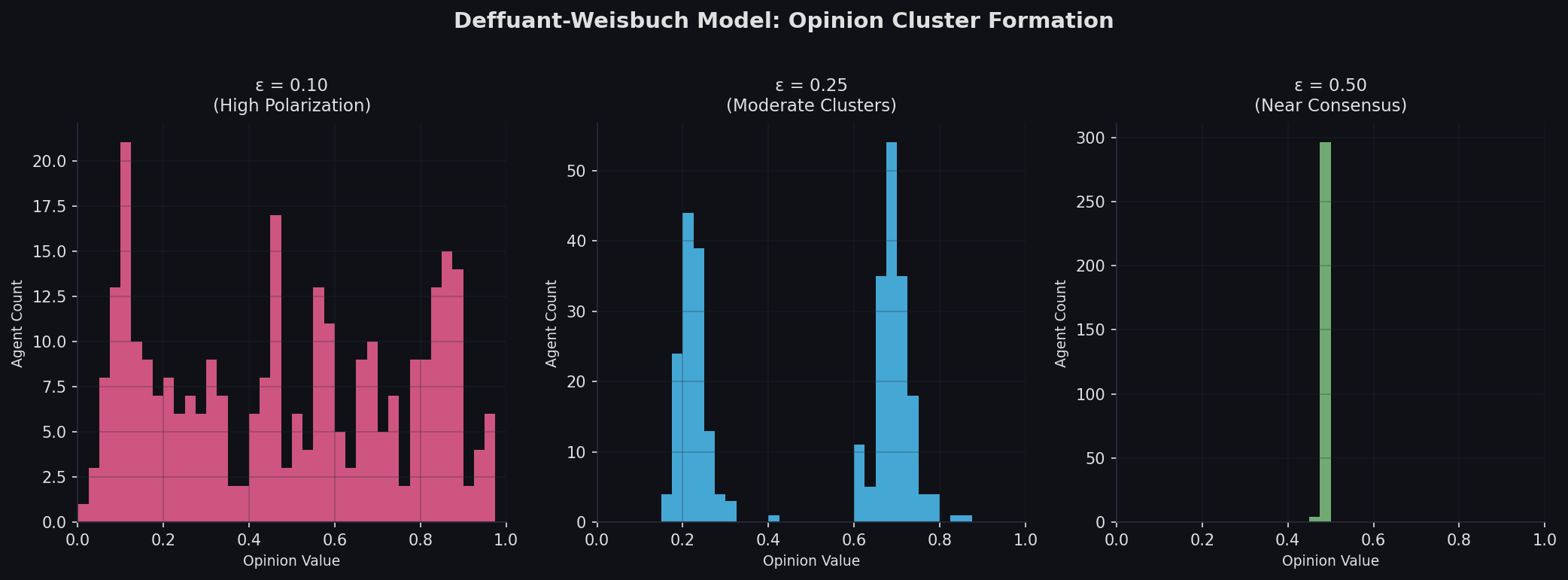
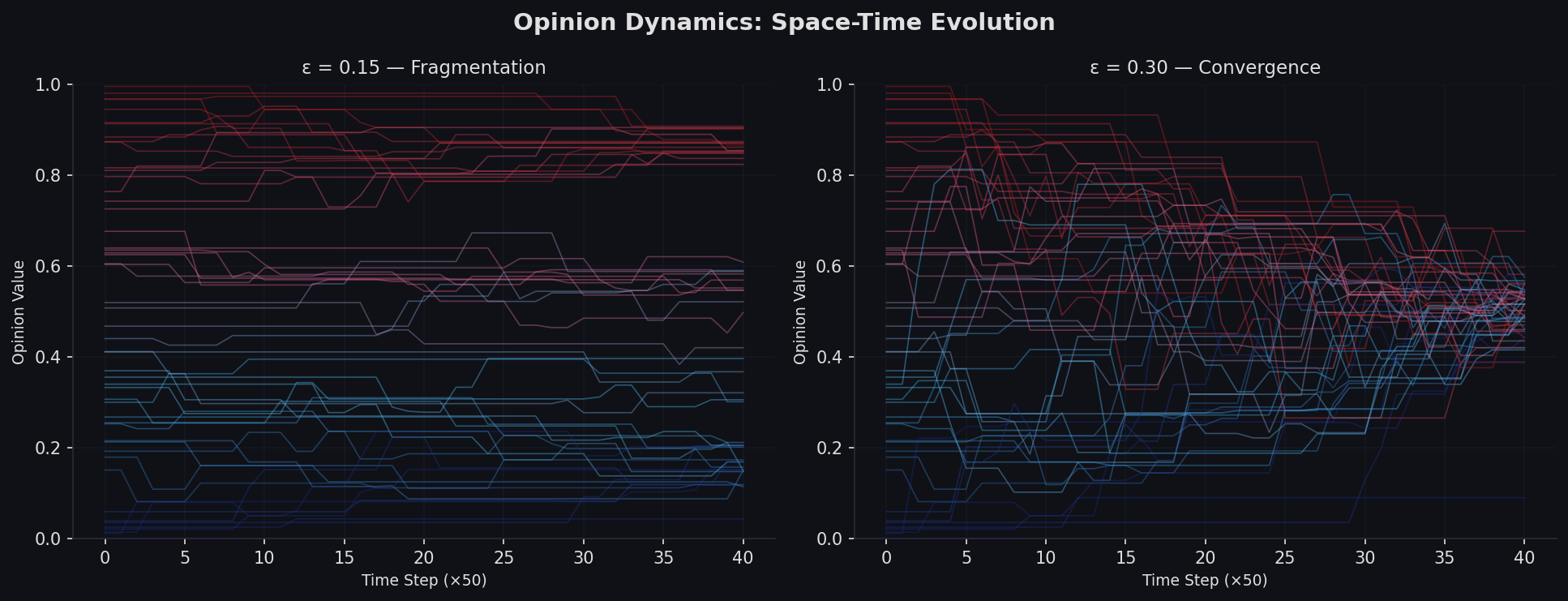
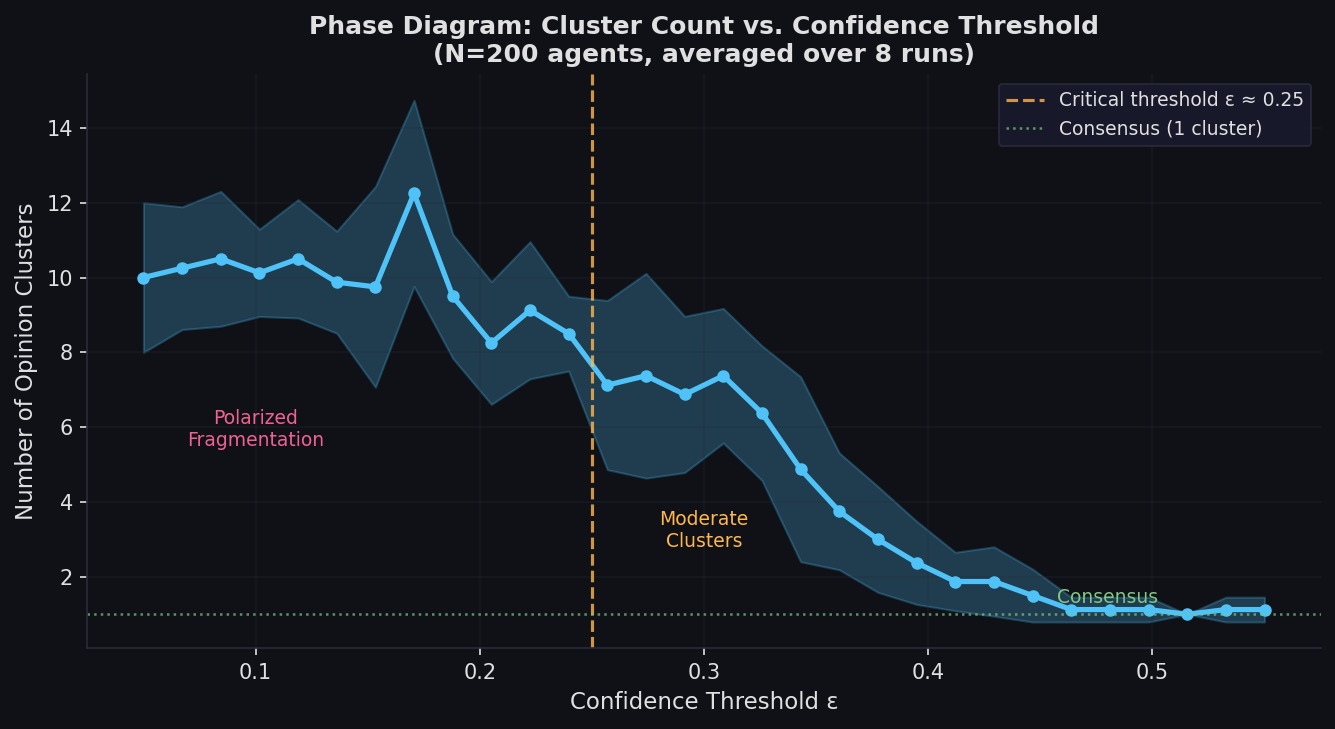
- $\varepsilon < 0.1$: The population fragments into many small opinion clusters — extreme polarization.
- $\varepsilon \approx 0.2–0.3$: Two or three stable clusters emerge — moderate polarization resembling real political landscapes.
- $\varepsilon > 0.5$: Full consensus is reached — all agents converge to a single opinion.
The critical transition near $\varepsilon \approx 0.25$ (for uniform initial distributions) is a phase transition analogous to those studied in statistical physics.
Implementing the DW Model in Python with Mesa
The Mesa agent-based modeling framework provides a clean Python implementation path. Below is a production-ready skeleton:
import mesa
import numpy as np

class OpinionAgent(mesa.Agent):
    def __init__(self, unique_id, model, opinion=None):
        super().__init__(unique_id, model)
        self.opinion = opinion if opinion is not None else self.random.random()

    def step(self):
        # Select a random neighbor
        other = self.random.choice(self.model.schedule.agents)
        if abs(self.opinion - other.opinion) < self.model.epsilon:
            delta = self.model.mu * (other.opinion - self.opinion)
            self.opinion += delta
            other.opinion -= delta  # symmetric update

class DeffuantModel(mesa.Model):
    def __init__(self, N=500, epsilon=0.25, mu=0.5):
        self.epsilon = epsilon
        self.mu = mu
        self.schedule = mesa.time.RandomActivation(self)
        for i in range(N):
            self.schedule.add(OpinionAgent(i, self))
        self.datacollector = mesa.DataCollector(
            agent_reporters={"Opinion": "opinion"}
        )

    def step(self):
        self.datacollector.collect(self)
        self.schedule.step()
Run the model for 2,000 steps and collect opinion distributions to observe cluster formation. The DataCollector makes it straightforward to export results to pandas DataFrames for downstream analysis.
Network-Structured Variants
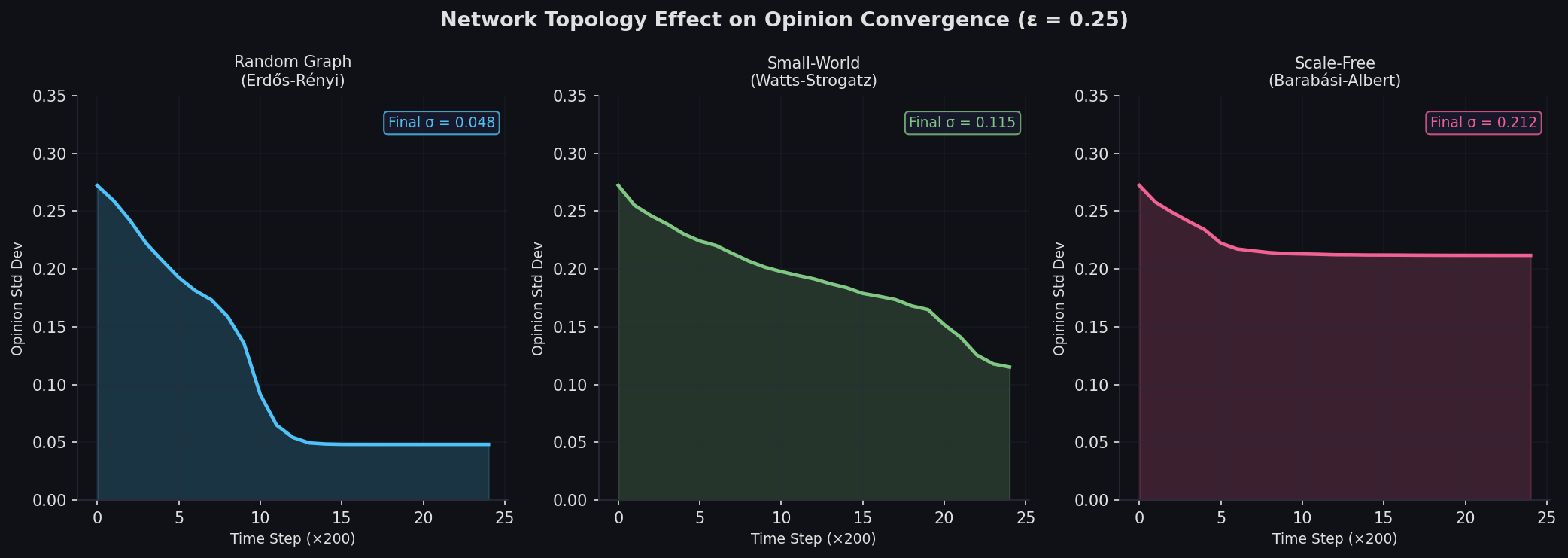
The classical DW model assumes a well-mixed population (any two agents can interact). Real social systems are structured: people interact primarily within their social networks. Extending the model to a network substrate — where agents only interact with graph neighbors — dramatically changes outcomes:
- Scale-free networks (Barabási-Albert): Hub agents act as opinion brokers, accelerating consensus but also enabling persistent minority clusters around low-degree nodes.
- Small-world networks (Watts-Strogatz): Moderate clustering slows convergence compared to random graphs but produces more stable intermediate clusters.
- Homophily-weighted networks: If edge weights reflect initial opinion similarity, polarization is strongly amplified — a finding with direct implications for social media filter bubble research.
To implement network variants in Mesa, replace RandomActivation with a NetworkGrid and restrict partner selection to self.model.grid.get_neighbors(self.pos).
Calibration and Empirical Validation
Calibrating the DW model to real survey data requires careful attention to:
- Opinion operationalization: Map Likert-scale survey responses to $[0,1]$ using min-max normalization or ordinal scaling.
- Threshold estimation: Use approximate Bayesian computation (ABC) to infer $\varepsilon$ from observed cluster counts in longitudinal panel data (e.g., ANES, ESS).
- Convergence time: Real opinion shifts occur over months to years; map model steps to calendar time using interaction rate estimates from communication logs.
A practical benchmark: Hegselmann & Krause (2002) showed that for $N = 200$ agents with uniform initial opinions, $\varepsilon = 0.25$ reliably produces 2–3 clusters after approximately $5N$ interaction steps — a useful sanity check for any implementation.
Extensions and Active Research Directions
The DW model has spawned a rich family of extensions relevant to current policy questions:
- Algorithmic amplification: Introduce a "media agent" that broadcasts a fixed opinion $x_m$ to all agents at each step, modeling social media recommendation systems. Even a weak media agent ($\mu_m = 0.1$) can shift the population mean by 15–20% over 1,000 steps.
- Uncertainty-weighted confidence: Replace the binary threshold with a continuous weight $w_{ij} = \exp(-|x_i - x_j|^2 / \varepsilon^2)$, producing smoother cluster boundaries.
- Radicalization dynamics: Add absorbing boundary states at $x = 0$ and $x = 1$ representing extreme positions, with a small probability $p_r$ of agents drifting toward boundaries — modeling radicalization pathways.
- Multi-dimensional opinions: Extend to $d$-dimensional opinion vectors; the threshold becomes $|\mathbf{x}_i - \mathbf{x}_j| < \varepsilon$. Dimensionality strongly affects cluster geometry and consensus likelihood.
Practical Applications
The DW model and its variants are actively used in:
- Electoral modeling: Simulating how campaign messaging and debate events shift opinion distributions before elections.
- Public health communication: Modeling vaccine hesitancy dynamics and the effect of targeted interventions on opinion clusters.
- Organizational behavior: Studying how team deliberation processes converge (or fail to converge) on decisions under bounded rationality.
- Disinformation research: Quantifying how false narratives propagate through bounded-confidence networks and identifying optimal counter-messaging strategies.
Further Resources
- Deffuant, G. et al. (2000). Mixing beliefs among interacting agents. Advances in Complex Systems, 3(1–4), 87–98. DOI: 10.1142/S0219525900000078
- Hegselmann, R. & Krause, U. (2002). Opinion dynamics and bounded confidence. JASSS, 5(3). Link
- Mesa documentation: https://mesa.readthedocs.io/
- Lorenz, J. (2007). Continuous opinion dynamics under bounded confidence. International Journal of Modern Physics C. DOI: 10.1142/S0129183107011789
- NetLogo Opinion Dynamics model library: https://ccl.northwestern.edu/netlogo/models/