

SimScale Launches Engineering AI Agents and Open Workflows Platform for Autonomous Simulation Orchestration
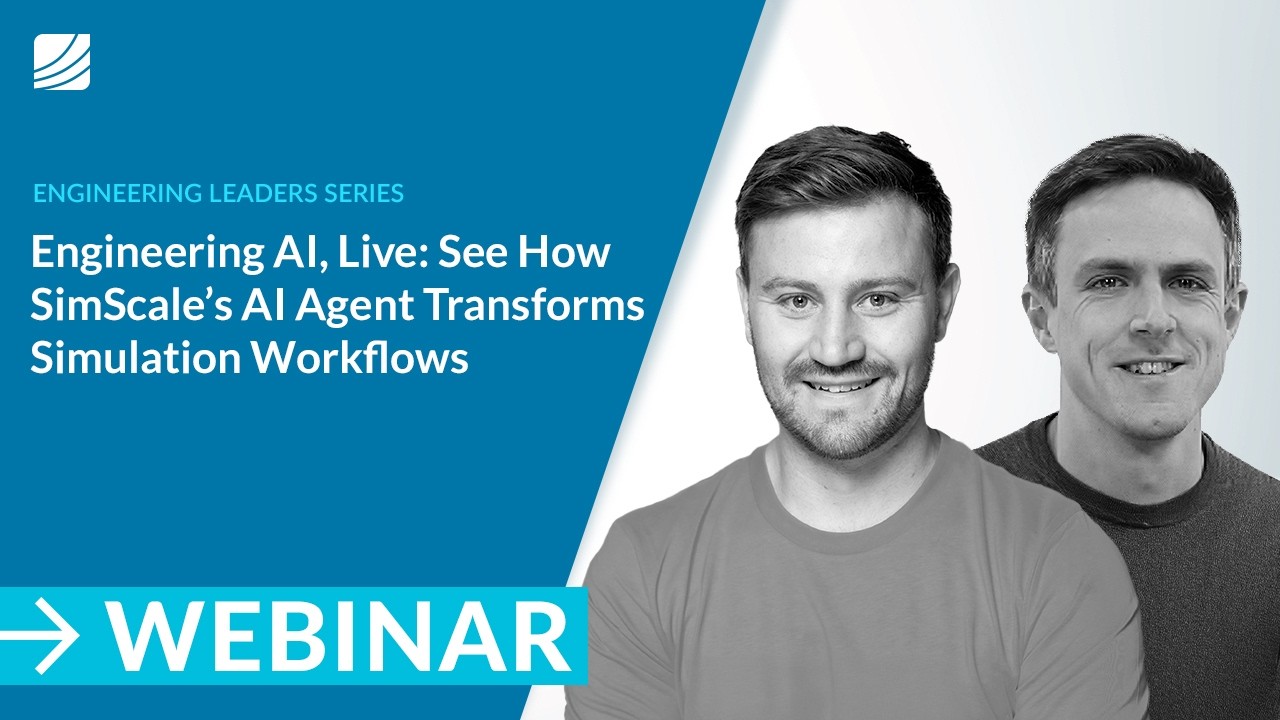
SimScale Opens Engineering AI Agents to All Enterprise Teams
SimScale, the cloud-native engineering simulation platform, has made a significant leap forward in autonomous simulation technology with two major announcements in May 2026: the general availability of its Engineering AI agents for enterprise teams, and the launch of SimScale Workflows — an open platform architecture that allows any solver, tool, or custom method to be integrated natively into the simulation environment.
Together, these releases represent a fundamental shift in how engineering simulation is orchestrated, moving from human-driven, step-by-step workflows to AI-managed, end-to-end automation pipelines.
Engineering AI Agents: From Specialist Bottleneck to Autonomous Execution
The core challenge SimScale addresses is what the company calls the "specialist bottleneck" — the reality that the most time-intensive parts of any simulation project require the judgment of senior engineers who are always in short supply. As design cycles compress and the number of design decisions to validate grows exponentially, organizations face a compounding constraint that traditional tooling has not resolved.

SimScale's Engineering AI agents tackle this directly. Built on a foundation of over one million real-world simulation projects, these agents encode an organization's specific domain standards, solver preferences, and compliance rules, then operate near-autonomously across the full simulation pipeline:
- Intent extraction — Agents parse engineering specifications, RFQs, and project documentation to determine simulation requirements
- Automated setup — CAD preparation, meshing, and solver configuration are handled without manual intervention
- Parallel cloud execution — Simulations run on SimScale's elastic cloud HPC infrastructure
- Auditable reporting — Proposal-ready validation reports are generated automatically
Early adopters have reported dramatic productivity gains. At Silent-Aire, Lead Mechanical Design Engineer Shane McConn noted that tasks previously requiring months of work can now be completed in a single evening. At Convion (an HD Hyundai company), Engineering AI underpins a generative design workflow that produces optimized hydrogen fuel cell designs in under one hour — a cycle that previously took months.
According to SimScale's 2026 State of Engineering AI Report, which surveyed 350 engineering leaders across the US, UK, and Germany, organizations using AI-enabled workflows generate nearly 4× more design variants per program and service simulation requests 2.8× faster on average.
SimScale Workflows: Opening the Platform
Alongside the AI agents announcement, SimScale introduced SimScale Workflows — a new open platform architecture that removes a long-standing constraint in simulation software: the limitation that only the tools built by the platform vendor can be used within it.
With Workflows, any method — a proprietary solver, a custom post-processing script, a Physics AI surrogate model, or a third-party tool — can be registered natively in SimScale and executed within the same infrastructure as the platform's built-in analysis types. Methods run in isolated, containerized environments with full versioning, data lineage, and elastic compute provisioning.
The practical implications are significant:
- Custom solver integration — Engineering teams can register proprietary or open-source solvers, making them first-class citizens on the platform with access to SimScale's HPC, pre-processing, and post-processing tooling
- Partner solver distribution — Solver developers can integrate once into SimScale's method registry and immediately reach the platform's 800,000+ user base
- Multi-step automation — Workflows enables chaining of analysis types, including Design of Experiments loops, microclimate analyses, and multi-physics verification sequences that previously required manual handoffs
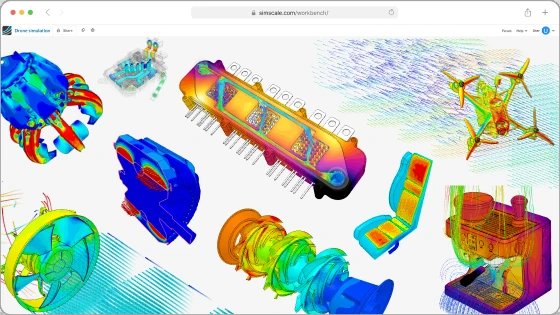
The first major third-party integration through Workflows is PAMICS®, the meshless Smoothed Particle Hydrodynamics (SPH) solver from AI Engineering GmbH, which delivers 10–20× faster fluid dynamics simulation for moving assemblies and free-surface flows directly inside SimScale.
What This Means for Agentic Engineering
The combination of Engineering AI agents and Workflows creates a genuinely new capability: an AI agent that can call any registered method — not just the ones SimScale ships natively — to build and execute complex, multi-step engineering processes without human management of the handoffs between tools.
This architecture enables workflows where an agent can import a CAD file, select the appropriate solver from an organization's registered methods, run the analysis, leverage a Physics AI surrogate model for rapid iteration, validate performance with a physics solver, generate a report, and trigger the next step in the pipeline — all autonomously.
For engineering teams evaluating simulation platforms, SimScale's May 2026 releases mark a meaningful inflection point: the transition from AI-assisted simulation (where AI helps engineers set up and interpret runs) to agentic engineering (where AI manages entire engineering processes at a scale and speed no human team can match).
Getting Started
SimScale has opened a guided pilot waitlist for enterprise organizations with active simulation workflows and defined AI objectives. Accepted teams receive a serviced pilot program in which SimScale engineers deploy Engineering AI directly on live projects.
For technical documentation on integrating custom methods via the Workflow SDK, visit SimScale Docs. For more information on Engineering AI agents, visit simscale.com.