
CESM Ocean Component: Advanced Global Ocean Circulation Modeling for Climate Research
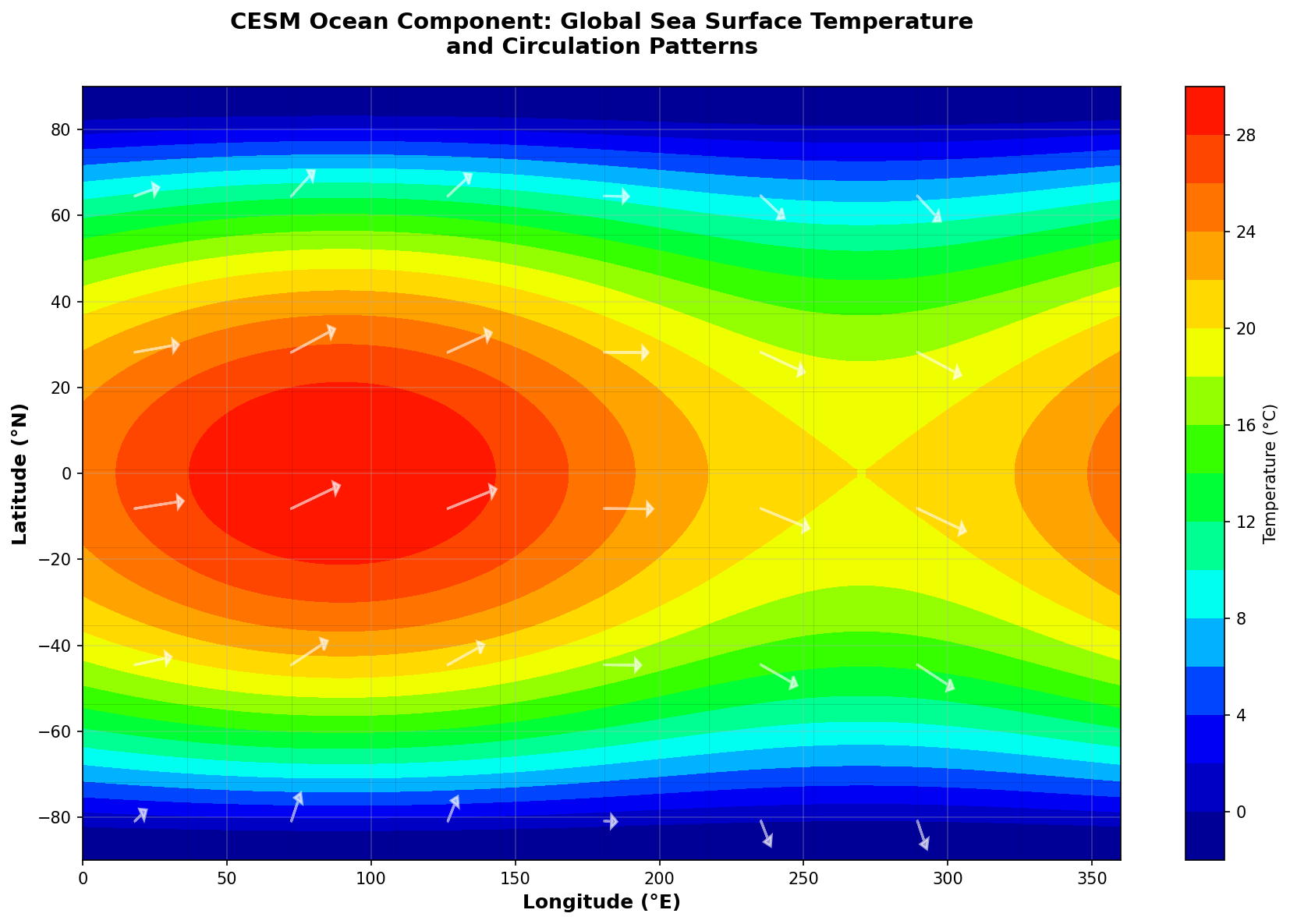
The Community Earth System Model (CESM) represents one of the most sophisticated fully-coupled climate modeling frameworks available to the scientific community. While CESM encompasses multiple Earth system components, its ocean modeling capability—implemented through the Parallel Ocean Program version 2 (POP2)—stands as a critical tool for understanding ocean dynamics, heat transport, and their role in global climate variability.
Architecture and Computational Framework
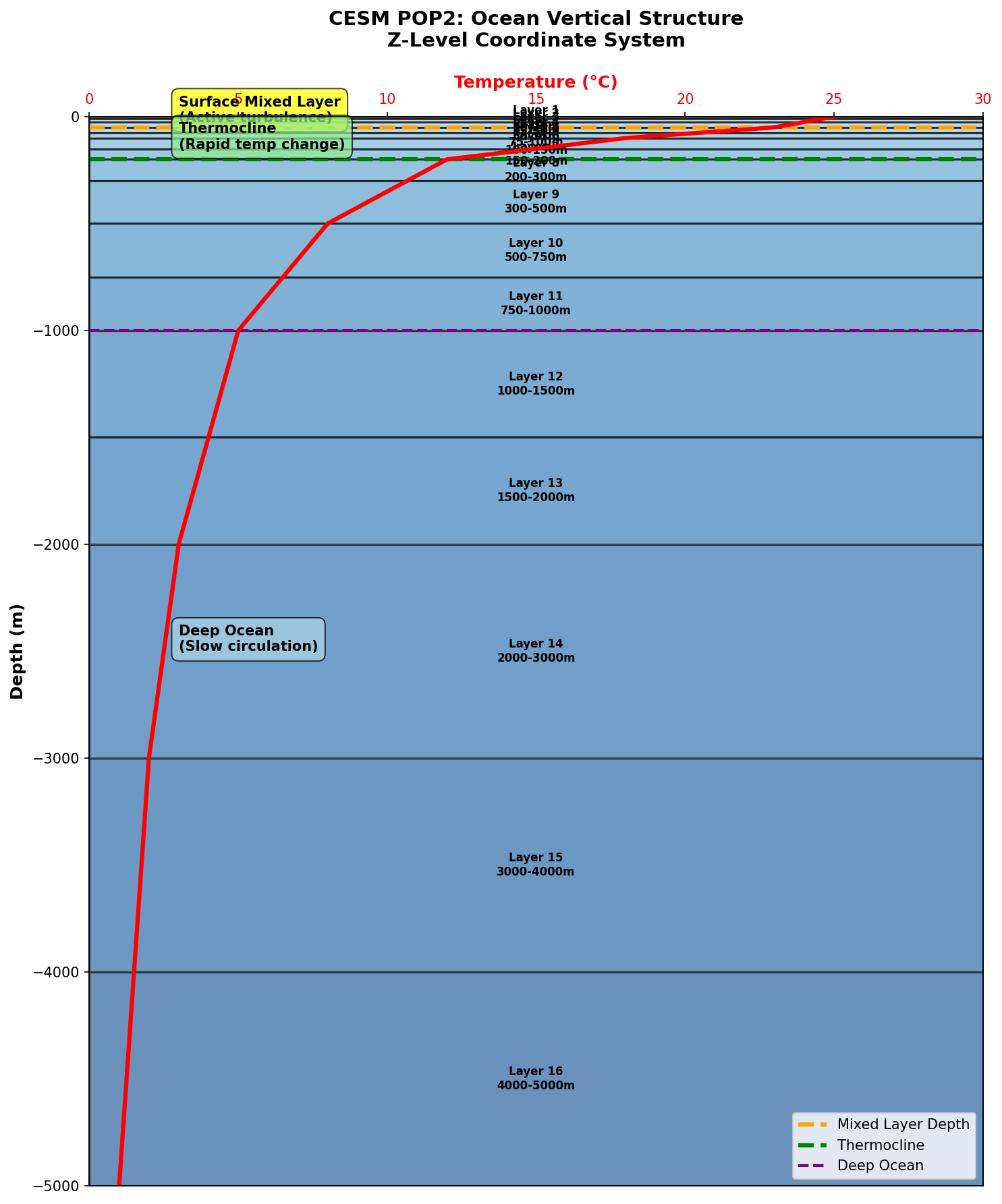
POP2 within CESM employs a z-level vertical coordinate system with sophisticated numerical schemes for solving the primitive equations of ocean motion. The model operates on a displaced pole grid configuration, typically at 1-degree horizontal resolution for standard simulations, with high-resolution configurations extending to 0.1-degree resolution for eddy-resolving studies. This grid structure eliminates the singularity problem at the North Pole by displacing grid poles onto land masses, enabling efficient parallel computation across thousands of processors.
The ocean component integrates seamlessly with CESM's atmospheric (CAM), land (CLM), and sea ice (CICE) models through the flux coupler (CPL7), exchanging momentum, heat, and freshwater fluxes at each coupling timestep. This tight coupling enables realistic representation of ocean-atmosphere feedbacks critical for phenomena like El Niño-Southern Oscillation (ENSO) and Atlantic Meridional Overturning Circulation (AMOC) variability.

Advanced Physical Parameterizations
POP2 incorporates state-of-the-art parameterizations for sub-grid scale processes that cannot be explicitly resolved. The K-Profile Parameterization (KPP) scheme handles vertical mixing in the ocean boundary layer, capturing the effects of wind-driven turbulence, convective instability, and shear-driven mixing. For mesoscale eddy effects, the Gent-McWilliams parameterization represents the impact of baroclinic instabilities on tracer transport, crucial for accurate simulation of ocean heat uptake and carbon sequestration.
The model's biogeochemistry module (MARBL - Marine Biogeochemistry Library) extends beyond physical ocean simulation to include nutrient cycling, phytoplankton dynamics, and carbon chemistry. This capability enables researchers to investigate ocean acidification, marine ecosystem responses to warming, and the ocean's role in the global carbon cycle under various emission scenarios.
Climate Research Applications
CESM's ocean component has proven instrumental in advancing our understanding of climate sensitivity and ocean heat content changes. Recent studies using CESM have quantified the ocean's absorption of approximately 90% of excess heat from anthropogenic greenhouse gas emissions, with POP2 simulations revealing preferential heat uptake in the Southern Ocean and North Atlantic regions.
The model excels at simulating decadal-to-centennial timescale ocean variability. Researchers have used CESM to investigate the Atlantic Multidecadal Oscillation (AMO), demonstrating how ocean circulation changes influence hurricane activity, Sahel rainfall, and Arctic sea ice extent. The high-resolution configurations enable explicit simulation of mesoscale eddies, improving representation of western boundary currents like the Gulf Stream and Kuroshio, which play outsized roles in meridional heat transport.
Practical Implementation Considerations
Running CESM ocean simulations requires substantial computational resources. A typical 100-year fully-coupled simulation at 1-degree resolution consumes approximately 500,000 core-hours on modern HPC systems. Researchers must carefully balance resolution, simulation length, and ensemble size against available computing allocations. The model's modular design allows for component-specific testing—ocean-only simulations forced with prescribed atmospheric conditions can be executed at a fraction of the cost of fully-coupled runs, enabling efficient parameter tuning and sensitivity studies.
Data management presents another practical challenge. A century-long CESM simulation generates multiple terabytes of output data. The model's flexible output streams allow users to specify temporal averaging (daily, monthly, annual) and variable selection to manage storage requirements. Post-processing tools within the CESM framework facilitate computation of derived quantities like mixed layer depth, meridional overturning streamfunction, and heat transport diagnostics.
Integration with Observational Data
CESM ocean simulations are routinely validated against observational datasets including Argo float profiles, satellite altimetry, and historical hydrographic surveys. The model's data assimilation capabilities, implemented through ensemble Kalman filter techniques, enable creation of ocean reanalysis products that blend model physics with observational constraints. These reanalyses provide dynamically consistent estimates of ocean state variables in regions and time periods with sparse observations.
The model's ability to ingest realistic initial conditions from observational products enables decadal prediction experiments. By initializing CESM with current ocean heat content and circulation patterns, researchers can generate probabilistic forecasts of near-term climate variability, informing adaptation planning for sectors sensitive to climate fluctuations.
Future Developments and Community Support
The CESM development team continues to enhance the ocean component's capabilities. Upcoming releases will feature improved sea ice-ocean coupling, refined parameterizations for small-scale mixing processes, and expanded biogeochemical tracers. The transition to the Model for Prediction Across Scales (MPAS) ocean core offers variable-resolution capabilities, allowing researchers to refine grid spacing in regions of interest while maintaining computational efficiency elsewhere.
CESM benefits from robust community support through the National Center for Atmospheric Research (NCAR). Comprehensive documentation, tutorial materials, and user forums facilitate adoption by research groups worldwide. Annual workshops provide training opportunities and foster collaboration among the global CESM user community.
For researchers investigating ocean's role in climate variability, carbon cycling, or ecosystem dynamics, CESM's ocean component provides a powerful, well-validated tool backed by decades of development and extensive scientific literature. More information and model access can be found at the CESM website and through NCAR's Climate Data Gateway.