

CMAQ Air Quality Modeling: Advanced Photochemical Grid Simulation for Pollution Analysis
The Community Multiscale Air Quality (CMAQ) modeling system represents a state-of-the-art computational framework for simulating the formation, transport, and fate of atmospheric pollutants across multiple spatial scales. Developed by the U.S. Environmental Protection Agency (EPA), CMAQ has become an essential tool for air quality forecasting, regulatory impact assessment, and climate-chemistry interaction studies.
Core Capabilities and Architecture
CMAQ employs a one-atmosphere approach that integrates multiple atmospheric processes into a unified modeling framework. The system simultaneously simulates gas-phase chemistry, aerosol dynamics, cloud processes, and deposition mechanisms within a three-dimensional Eulerian grid structure. This comprehensive treatment enables researchers to capture complex interactions between emissions, meteorology, and chemical transformations that determine ambient air quality.
The model's chemical mechanism options include Carbon Bond (CB6r3), SAPRC-07, and RACM2, each offering different levels of detail for representing volatile organic compound (VOC) oxidation pathways and secondary pollutant formation. The aerosol module (AERO7) tracks particle size distributions across multiple modes, accounting for nucleation, coagulation, condensation, and heterogeneous chemistry on particle surfaces.

Advanced Features for Environmental Analysis
One of CMAQ's distinguishing capabilities is its integrated process analysis (IPA) tool, which quantifies the individual contributions of emissions, transport, chemistry, and deposition to pollutant concentrations at specific locations and times. This diagnostic feature proves invaluable for source attribution studies and understanding the relative importance of different atmospheric processes in determining air quality outcomes.
The model's two-way coupled WRF-CMAQ configuration enables direct feedback between atmospheric chemistry and meteorology. Aerosol particles influence radiation transfer and cloud microphysics, while meteorological fields drive chemical reaction rates and pollutant dispersion. This coupling is particularly important for studying climate-air quality interactions and assessing the co-benefits of emission reduction strategies.
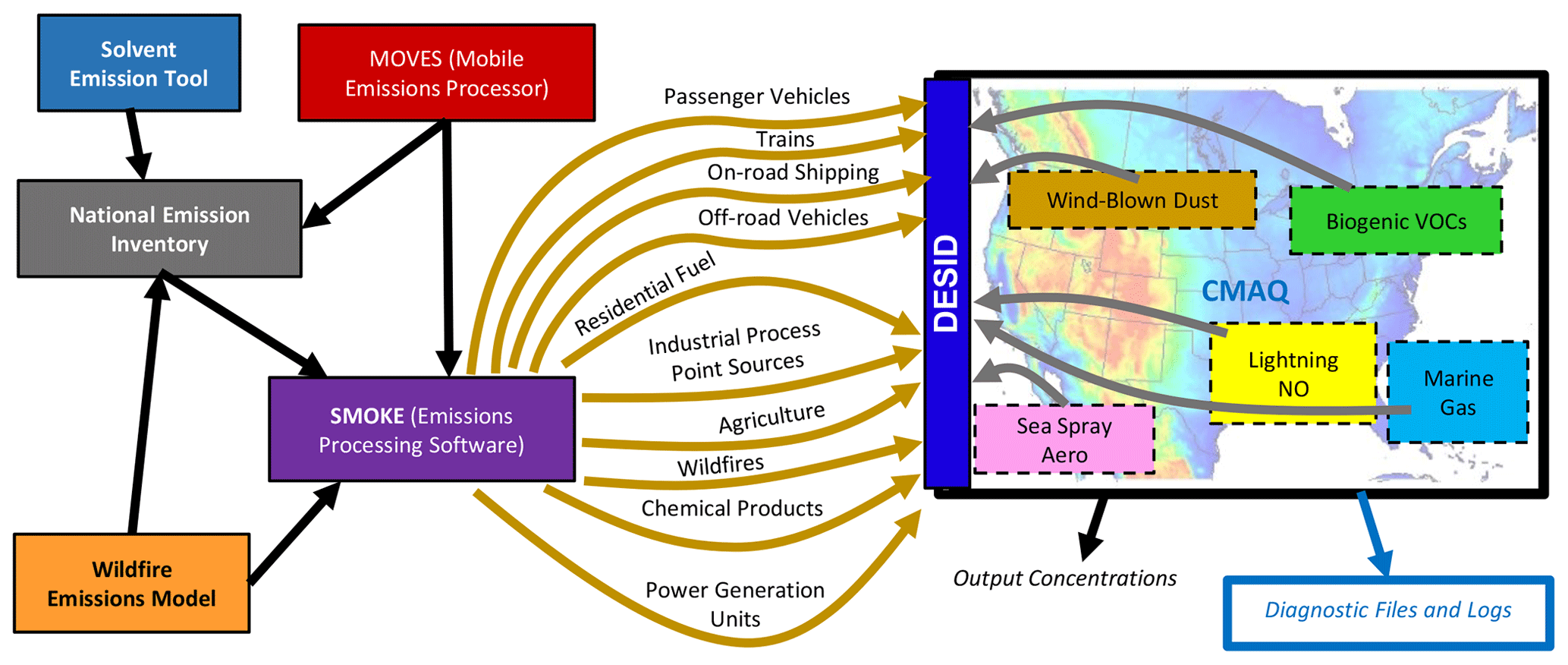
CMAQ's Detailed Emissions Scaling, Isolation and Diagnostic (DESID) system provides unprecedented flexibility in emission processing. Users can apply spatial and temporal scaling factors, isolate specific emission sectors, and track tagged species through the modeling domain. This functionality supports sophisticated sensitivity analyses and policy scenario evaluations.
Practical Implementation Considerations
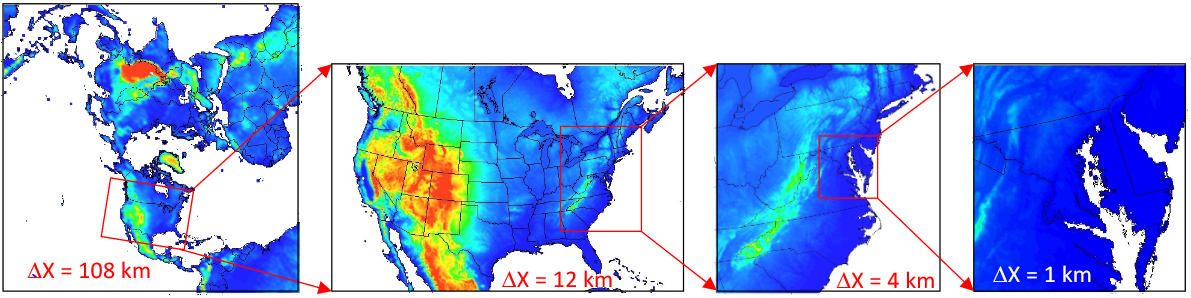
Successful CMAQ applications require careful attention to several technical factors. Grid resolution selection involves balancing computational cost against the need to resolve emission gradients and topographic features. Urban air quality studies typically employ nested grids with horizontal resolutions ranging from 36 km for regional context down to 1-4 km for city-scale detail.
Meteorological inputs from the Weather Research and Forecasting (WRF) model must be processed through the Meteorology-Chemistry Interface Processor (MCIP) to generate CMAQ-compatible fields. Proper configuration of WRF physics options—particularly planetary boundary layer schemes and land surface models—significantly impacts CMAQ's ability to reproduce observed pollutant concentrations.
Emission inventory preparation through the Sparse Matrix Operator Kernel Emissions (SMOKE) system transforms annual emission totals into hourly, gridded, speciated inputs. The temporal allocation of emissions from mobile sources, power plants, and biogenic processes requires sector-specific activity profiles that capture diurnal, weekly, and seasonal patterns.
Performance Optimization and Validation
Modern CMAQ versions leverage parallel computing architectures through MPI and OpenMP implementations, enabling efficient execution on high-performance computing clusters. Domain decomposition strategies should consider load balancing across processors while minimizing inter-processor communication overhead. Typical production runs for annual simulations at 12 km resolution require 500-1000 core-hours per simulated month.
Model performance evaluation follows established protocols comparing simulated concentrations against observations from regulatory monitoring networks. Statistical metrics including mean bias, root mean square error, and correlation coefficients assess model skill for criteria pollutants (O₃, PM₂.₅, NO₂, SO₂). Operational bias correction techniques can improve forecast accuracy for near-term air quality predictions.
Applications in Policy and Research
CMAQ supports regulatory applications including State Implementation Plan (SIP) development, National Ambient Air Quality Standards (NAAQS) attainment demonstrations, and environmental impact assessments. The model's ability to simulate future-year scenarios with projected emissions and meteorology enables evaluation of control strategy effectiveness before implementation.
Research applications span climate change impacts on air quality, long-range pollutant transport, ecosystem exposure to nitrogen and sulfur deposition, and health effects assessment through exposure modeling. The system's modular design facilitates incorporation of new scientific understanding as atmospheric chemistry research advances.
Resources and Community Support
The CMAQ source code, documentation, and test cases are freely available through the EPA's GitHub repository (https://github.com/USEPA/CMAQ). The CMAS Center (https://www.cmascenter.org) provides training materials, user forums, and annual conferences that foster knowledge exchange among the international CMAQ user community. Pre-compiled benchmark datasets enable new users to verify proper installation and establish baseline performance expectations.
For organizations requiring operational air quality forecasting capabilities, CMAQ forms the core of several national and regional prediction systems, including NOAA's National Air Quality Forecasting Capability. The model's proven track record in both research and operational contexts makes it an indispensable tool for understanding and managing atmospheric pollution in a changing climate.