

Jadex BDI: Engineering Rational Agents for Multi-Agent Social Simulation
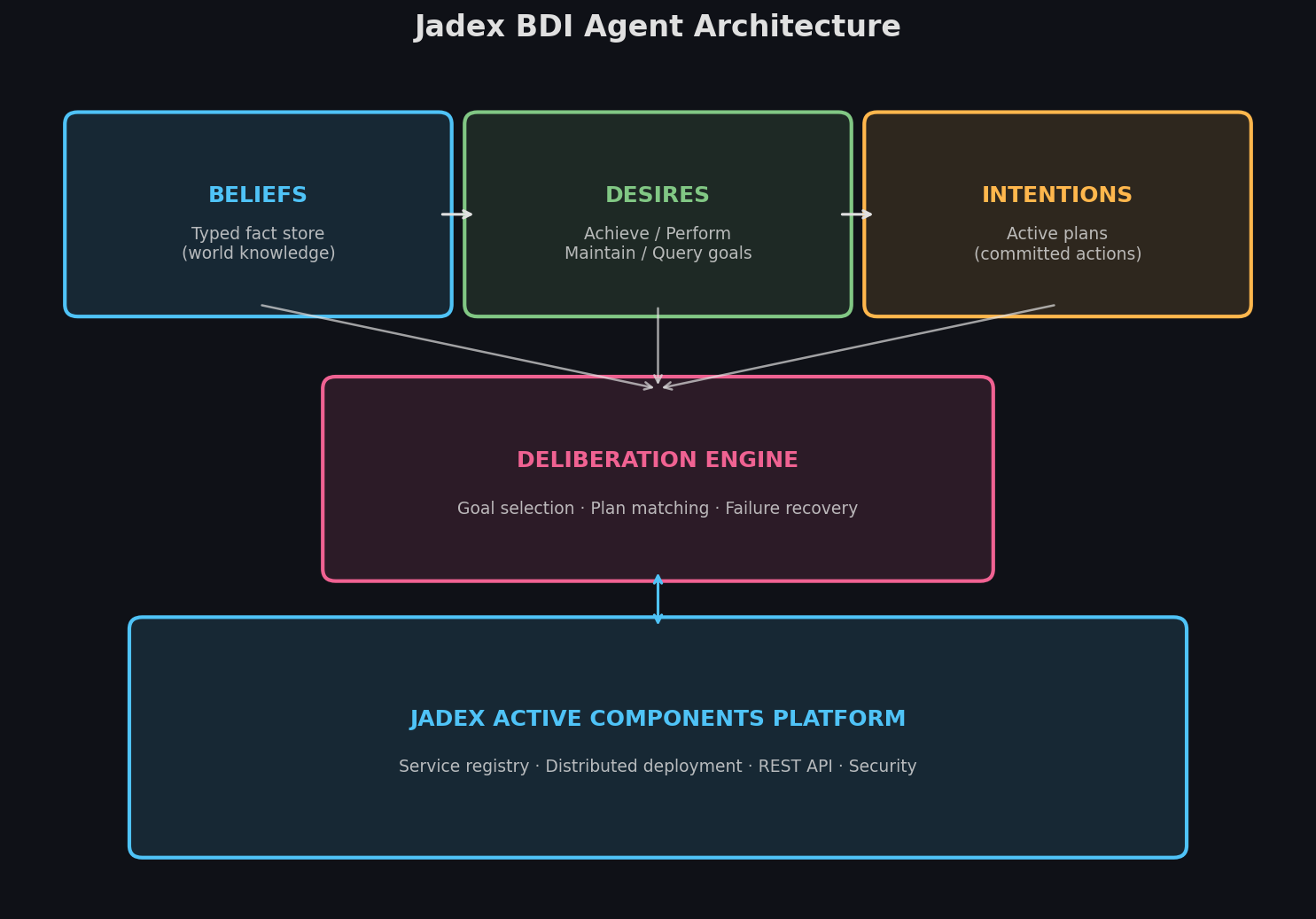
Jadex is a mature, Java-based framework for building Belief-Desire-Intention (BDI) agents that reason, plan, and interact within multi-agent systems. Originally developed at the Distributed Systems and Information Systems (VSIS) group at the University of Hamburg, Jadex has evolved into a full-featured active components platform that supports both classical BDI reasoning and modern service-oriented agent architectures. For researchers and practitioners modeling social systems — from organizational decision-making to norm-governed communities — Jadex provides a principled, scalable foundation that goes well beyond scripted agent behavior.
The BDI Architecture in Jadex
The BDI model formalizes rational agency: agents maintain beliefs (a knowledge base about the world), desires (goals they wish to achieve), and intentions (committed plans currently being executed). Jadex implements this triad through a structured XML/Java or annotation-based agent definition:
- Beliefs are typed fact stores, optionally backed by a query language. Belief changes automatically trigger goal re-evaluation.
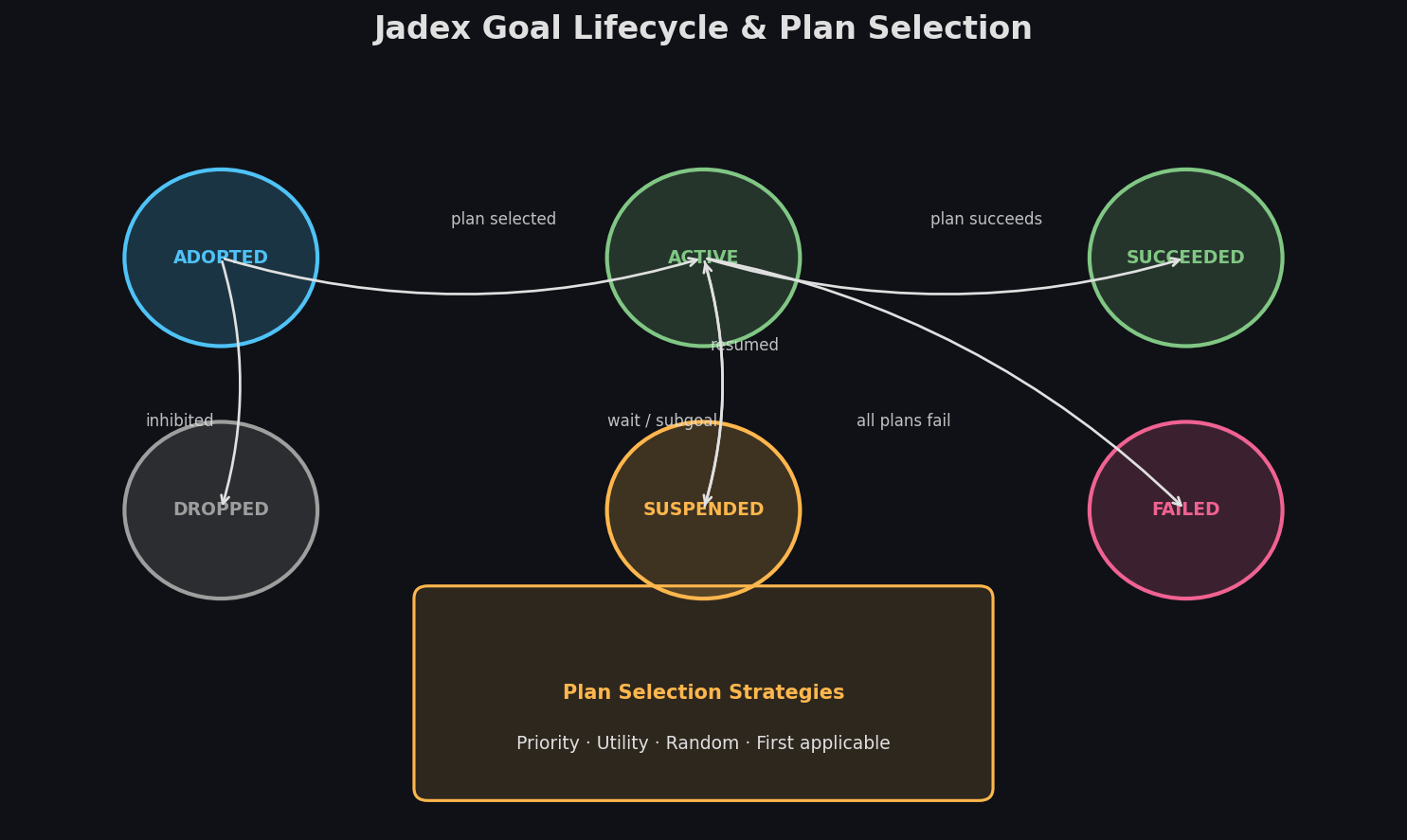
- Goals are declarative targets — achieve goals (reach a state), perform goals (execute a process), maintain goals (keep an invariant), and query goals (retrieve information).
- Plans are procedural Java methods that fire when their preconditions match active goals. The plan selection mechanism supports priority-based and utility-based selection, enabling nuanced deliberation.
This separation of what an agent wants from how it achieves it makes Jadex models far more interpretable than purely reactive or scripted agents, which is critical when validating social simulation results against theoretical predictions.

Setting Up a Jadex BDI Agent
A minimal Jadex BDI agent is defined with annotations in Java:
@Agent
@Description("A negotiating agent in a resource allocation scenario")
public class NegotiatorAgent {

    @Belief
    private double reservationPrice = 50.0;

    @Belief
    private List<Offer> receivedOffers = new ArrayList<>();

    @Goal
    public class AchieveAgreement {
        @GoalResult
        private Offer acceptedOffer;
    }

    @Plan(trigger = @Trigger(goals = AchieveAgreement.class))
    private void negotiatePlan(IPlan plan) {
        // Send counter-offer, evaluate incoming bids
        Offer best = receivedOffers.stream()
            .filter(o -> o.getPrice() >= reservationPrice)
            .findFirst().orElse(null);
        if (best != null) {
            plan.getGoal(AchieveAgreement.class).setAcceptedOffer(best);
        } else {
            // Adjust reservation price and retry
            reservationPrice *= 0.95;
            plan.waitFor(500); // ms
        }
    }
}
The framework's runtime handles plan instantiation, failure recovery, and goal lifecycle management automatically. When a plan fails, Jadex selects an alternative plan if one is available — a built-in resilience mechanism that mirrors real-world adaptive behavior.
Active Components and Service-Oriented Architecture
Beyond classical BDI, Jadex introduces the concept of Active Components — agents that expose typed services via a component model inspired by service-oriented architecture (SOA). Each agent can publish and consume services through a platform-level registry, enabling:
- Dynamic service discovery: agents locate peers at runtime without hard-coded references.
- Distributed deployment: components run across JVMs, nodes, or cloud instances with transparent remote calls.
- Hybrid architectures: mix BDI agents with simpler reactive components or external REST services in the same simulation.
This is particularly valuable for modeling organizational social systems where agents represent departments, firms, or institutions that interact through well-defined interfaces — procurement, reporting, negotiation — rather than direct peer-to-peer messaging.
Modeling Norm-Governed Social Systems
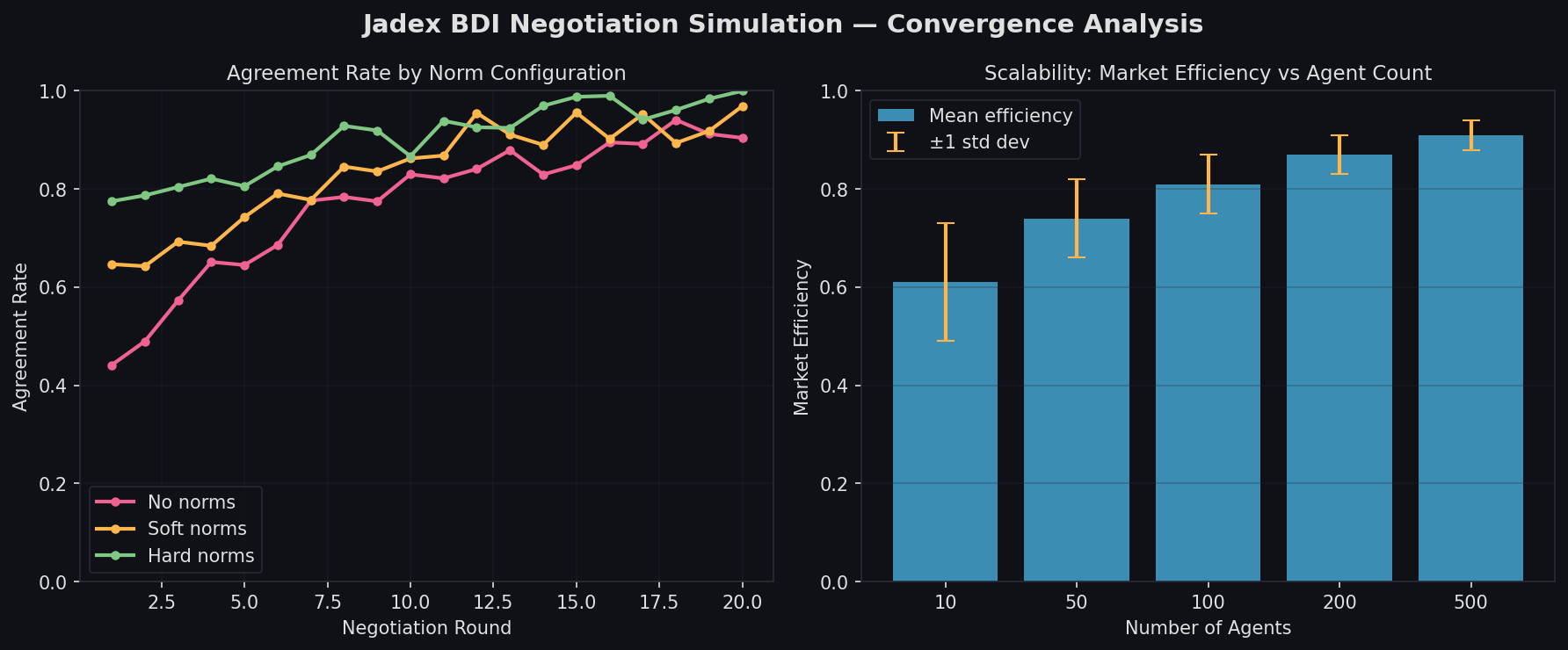
One of Jadex's strengths is its support for normative multi-agent systems. Norms — obligations, permissions, prohibitions — can be encoded as maintenance goals or as external monitors that inject belief updates when violations are detected. A compliance-checking agent can observe all interactions and penalize norm-violating agents by modifying their belief state or triggering sanctioning plans.
This architecture maps naturally to:
- Labor market models: firms (agents) follow hiring norms; regulators enforce compliance.
- Common-pool resource governance: users extract resources subject to Ostrom-style institutional rules.
- Organizational behavior: hierarchical authority structures where subordinate agents defer to managerial goals.
Scalability and the Jadex Platform
The Jadex platform supports thousands of concurrent agents on a single JVM, with horizontal scaling via the Jadex Distributed Platform. Agents migrate transparently between nodes, and the platform provides built-in support for:
- Awareness mechanisms: agents discover peers via multicast, relay servers, or custom registries.
- Security: message signing and encryption for sensitive social simulation scenarios.
- Monitoring: a graphical introspection tool (Jadex Control Center) lets researchers inspect belief states, active goals, and plan execution traces in real time.
For large-scale parameter sweeps, Jadex integrates with OpenMole and custom batch runners via its REST API, enabling systematic exploration of agent population sizes, norm configurations, and interaction topologies.
Comparison with Peer BDI Frameworks
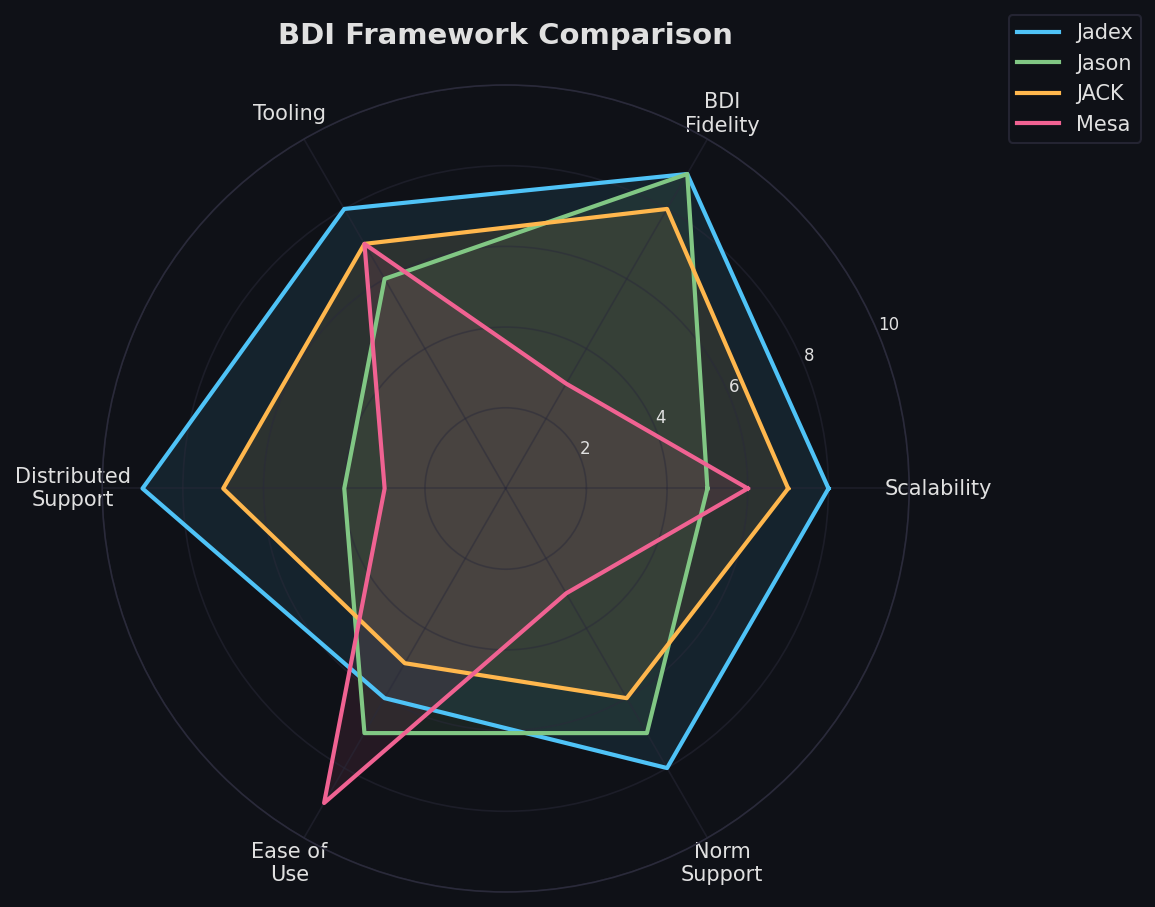
| Feature | Jadex | Jason | JACK |
|---|---|---|---|
| Language | Java + annotations | AgentSpeak (Prolog-like) | Java (proprietary) |
| Service model | SOA / Active Components | Basic messaging | Basic messaging |
| Distributed | Yes (built-in) | Limited | Yes (commercial) |
| GUI tooling | Jadex Control Center | MAS Console | JACK IDE |
| License | LGPL / commercial | LGPL | Commercial |
| Active development | Yes | Yes | Limited |
Jadex's Java-native approach lowers the barrier for teams already working in the JVM ecosystem, while its active components model provides architectural flexibility that pure AgentSpeak interpreters like Jason lack.
Practical Workflow for Social Simulation Research
- Define the social scenario as a set of agent roles, interaction protocols, and environmental dynamics.
- Implement agent types as annotated Java classes with beliefs, goals, and plans.
- Configure the platform (number of agents, network topology, norm set) via XML or programmatic bootstrapping.
- Run experiments using the Jadex REST API or embedded mode for batch execution.
- Analyze results by logging belief state snapshots and goal achievement rates to CSV or a database.
- Validate against analytical models or empirical data using standard statistical tools (R, Python).
Getting Started
Jadex is available under the LGPL license for academic use. The quickstart requires Java 11+ and Maven:
<dependency>
    <groupId>org.activecomponents.jadex</groupId>
    <artifactId>jadex-platform-standalone-launch</artifactId>
    <version>4.0.267</version>
</dependency>
Full documentation, tutorials, and example models — including a negotiation scenario, a supply chain simulation, and a norm-governed resource allocation model — are available at https://www.activecomponents.org. The Jadex GitHub repository at https://github.com/actoron/jadex hosts the source and an active issue tracker.
For researchers transitioning from NetLogo or Mesa, Jadex's explicit goal-plan structure and service-oriented communication model offer a significant step up in modeling fidelity for institutional and organizational social systems — at the cost of a steeper Java learning curve that pays dividends in simulation transparency and scalability.