
Realis Simulation 2025.2: 50% Faster Combustion CFD, Dual-Fuel H₂/NH₃ Support, and Tighter CFD-FEA Coupling
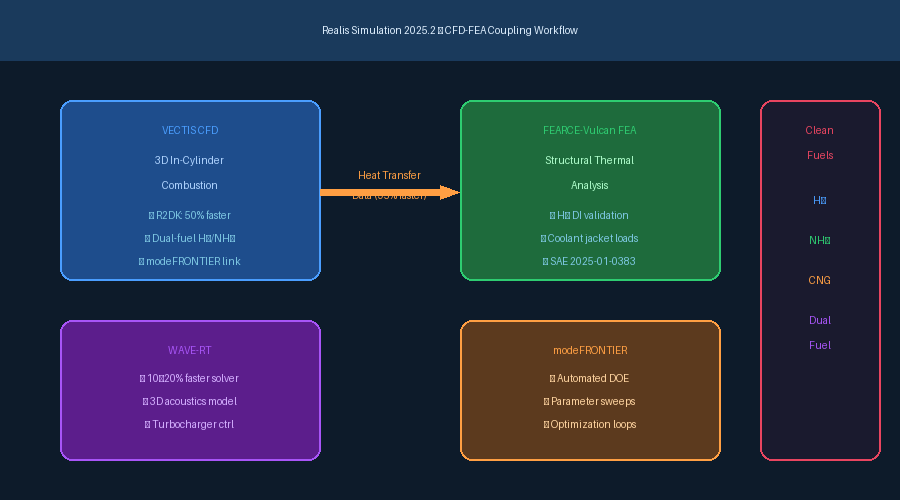
Realis Simulation 2025.2: Advancing Powertrain CFD-FEA Integration for Clean Fuel Engines
Realis Simulation has released version 2025.2 of its powertrain simulation suite, delivering significant performance improvements and expanded clean-fuel modeling capabilities across its WAVE, VECTIS, and FEARCE-Vulcan toolchain. Building on the foundational CFD-FEA coupling introduced in 2025.1, this release targets engineers developing next-generation internal combustion engines running on hydrogen, ammonia, and dual-fuel blends.
VECTIS CFD: 50% Faster Combustion Modeling and Dual-Fuel Support
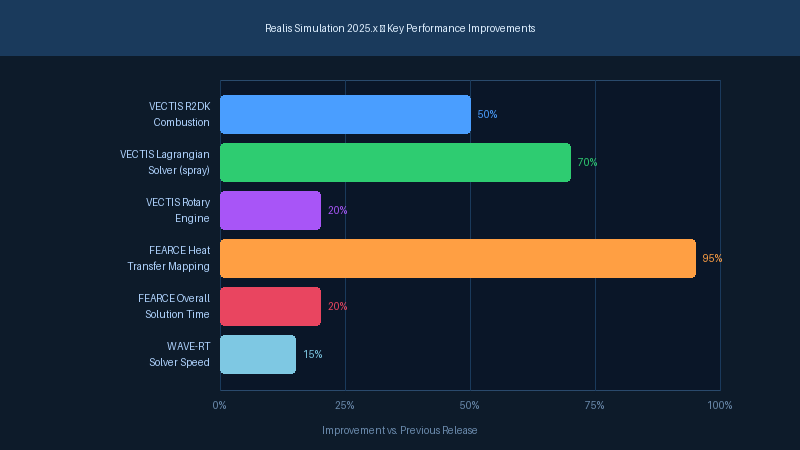
The headline update in VECTIS 2025.2 is a 50% reduction in R2DK combustion modeling run times without any loss in accuracy. This improvement directly benefits engineers running high-fidelity in-cylinder simulations, where combustion chemistry is typically the dominant computational cost.
New dual-fuel auto-ignition capabilities extend VECTIS to heavy-duty and large-engine sectors, supporting diesel-piloted ignition of CNG, ammonia, and hydrogen fuel blends. Updated dual-fuel laminar flame speed models improve combustion predictions for spark-ignited engines operating on hydrogen-ammonia or hydrogen-CNG mixtures — fuels increasingly relevant to decarbonization roadmaps in the marine, off-highway, and power generation sectors.

VECTIS 2025.2 also adds direct coupling with modeFRONTIER, enabling automated simulation optimization, parameter sweeps, and Design of Experiments (DOE) workflows without manual data handoffs between tools.
WAVE-RT: 10–20% Solver Speed Gains and Enhanced Acoustics
The real-time capable WAVE-RT solver receives a 10–20% speed improvement in 2025.2, alongside enhanced 3D acoustics modeling and a new physics-based turbocharger controller for transient simulations. These additions are particularly relevant for hardware-in-the-loop (HiL) and software-in-the-loop (SiL) validation environments where solver throughput directly impacts test cycle times.
FEARCE-Vulcan: Hydrogen Direct Injection Thermal Validation
On the structural side, FEARCE-Vulcan 2025.2 introduces an enhanced in-cylinder combustion model specifically designed to improve cylinder head flame-face temperature predictions for hydrogen direct-injection engines. The model has been validated against Euro VI diesel engine data and documented in SAE paper 2025-01-0383, providing engineers with a peer-reviewed reference for hydrogen DI thermal analysis.
Performance Improvements at a Glance
Foundation: CFD-FEA Coupling from 2025.1
The 2025.2 release builds on the tightly coupled CFD-FEA workflow introduced in 2025.1, which automated the link between VECTIS 3D CFD and FEARCE-Vulcan for coolant jacket thermal load prediction. That release reduced heat transfer data mapping times by up to 95% and cut overall solution time for CFD-based exhaust port thermal models by 20% — eliminating the manual data exchange that previously made coupled analyses time-consuming and error-prone.
Practical Implications for Simulation Engineers
For teams working on clean-fuel engine development, the 2025.2 release addresses two persistent challenges: the computational cost of high-fidelity combustion CFD and the complexity of validating thermal loads in hydrogen-fueled architectures. The modeFRONTIER integration further streamlines the path from simulation to design optimization, reducing the manual overhead of DOE studies.
Engineers can access the full release notes and update documentation at the Realis Simulation support portal.