

COMSOL Multiphysics 6.4 Delivers 5x GPU Speedup, New Granular Flow Module, and LLM-Assisted Simulation
COMSOL Multiphysics 6.4: GPU-Accelerated Simulation with New Granular Flow Module and LLM Integration
Released on November 18, 2025, COMSOL Multiphysics® version 6.4 represents one of the most significant updates to the platform in recent years. The release delivers expanded NVIDIA GPU support, a brand-new Granular Flow Module based on the discrete element method (DEM), a framework for time-explicit structural dynamic analysis, and optional large language model (LLM)-assisted simulation — all in a single update that substantially raises the bar for multiphysics simulation performance and accessibility.
Expanded NVIDIA GPU Acceleration
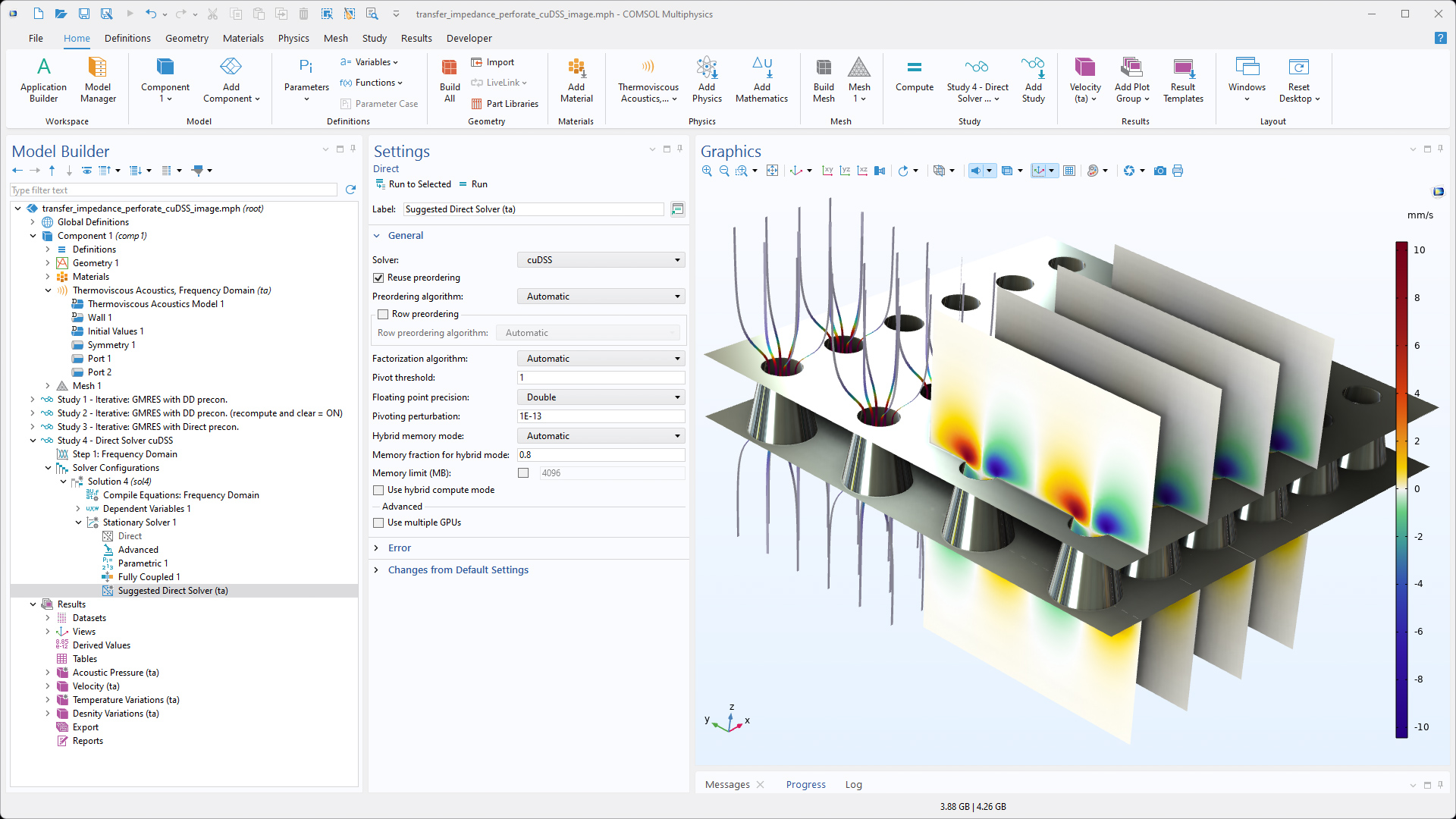
The headline feature of version 6.4 is the integration of NVIDIA's CUDA Direct Sparse Solver (cuDSS), a GPU-accelerated sparse direct solver optimized for hybrid CPU–GPU computation. In benchmark tests, the cuDSS integration delivers 5× or greater speedups compared to CPU-based direct solvers for multiphysics simulations, particularly those requiring high solver robustness.
Complementing cuDSS, version 6.4 extends multi-GPU support for transient pressure acoustics simulations via the NVIDIA CUDA-X cuBLAS library. Engineers can now distribute large acoustic models — such as full car cabin simulations — across multiple GPUs on a single workstation or even across a GPU cluster, dramatically reducing computation time for large-scale acoustic analyses.

Tim Costa, General Manager of Industrial Engineering at NVIDIA, noted that the cuDSS integration is "a critical step for accelerated computing in engineering simulation, allowing engineers to explore larger design spaces with greater fidelity."
New Granular Flow Module (DEM)
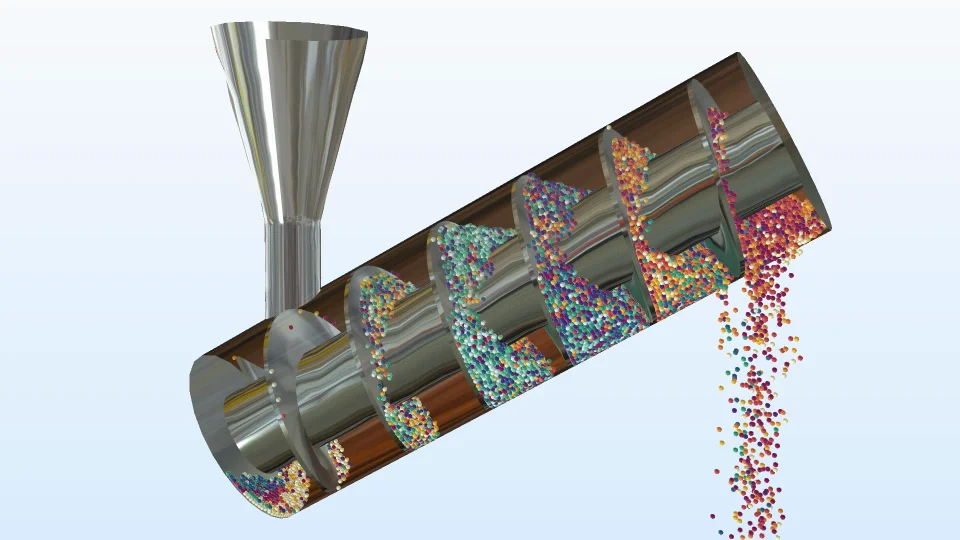
Version 6.4 introduces the Granular Flow Module, a new add-on product based on the discrete element method (DEM). This module enables detailed simulation of granular processes including:
- Hopper discharge and silo storage
- Chute transport and powder spreading
- Industrial mixing and blending
The module captures particle-scale effects such as collisions, adhesion, rotational resistance, and heat transfer, while providing macroscale insights into flow uniformity, packing density, mixing efficiency, and wall stresses. Engineers can identify potential blockages or uneven flow patterns before physical prototyping.
Target industries include pharmaceuticals, chemical processing, agriculture, mining, and additive manufacturing — sectors where granular material behavior is critical to process design and product quality.
Time-Explicit Dynamic Analysis Framework
A new framework for time-explicit structural dynamic analysis enables efficient simulation of fast, transient, and highly nonlinear events such as:
- Impact and drop tests (e.g., consumer electronics)
- Crushing and metal forming
- Elastic wave propagation
- Dynamic fracture
The explicit formulation supports a wide range of nonlinear structural materials — hyperelastic, plastic, viscoplastic, and creep models — and can be combined with dynamic fracture simulations. A new automatic contact detection feature simplifies model setup for complex mechanical assemblies by automatically defining contact conditions between interacting parts.
LLM-Assisted Simulation
COMSOL 6.4 introduces an optional Chatbot window that connects to leading large language models including GPT-5™, DeepSeek™, Google Gemini™, Anthropic Claude™, and other OpenAI API-compatible models. The chatbot provides interactive, model-aware assistance by combining COMSOL's documentation with information from the active simulation model — helping engineers with setup guidance, troubleshooting, and exploring simulation options without leaving the interface.
Additional Enhancements
Beyond the headline features, version 6.4 delivers improvements across the platform:
- Geometry and meshing: Higher-quality quad-dominant and swept meshing, automatic surrounding domain creation, and a new "Mesh-Based Geometry" option for editing imported meshes
- Visualization: Spatially varying transparency, customizable environment maps, and array-based plot layouts
- CFD data import: Support for CGNS format
- Surrogate models: Export of deep neural network (DNN) surrogate model parameters and GPU-based training support
- Uncertainty quantification: New frequency- and time-dependent UQ capabilities
- Model Manager: Batch and cluster studies using models stored directly in the database
Availability
COMSOL Multiphysics 6.4 is available now for Windows, Linux, and macOS platforms. Existing license holders can update through their COMSOL account. For more information, visit the COMSOL 6.4 release page or read the official press release.