
SIMULIA Abaqus R2026x: GPU-Accelerated Explicit Solver, Butler-Volmer Battery Modeling, and Next-Gen Meshing
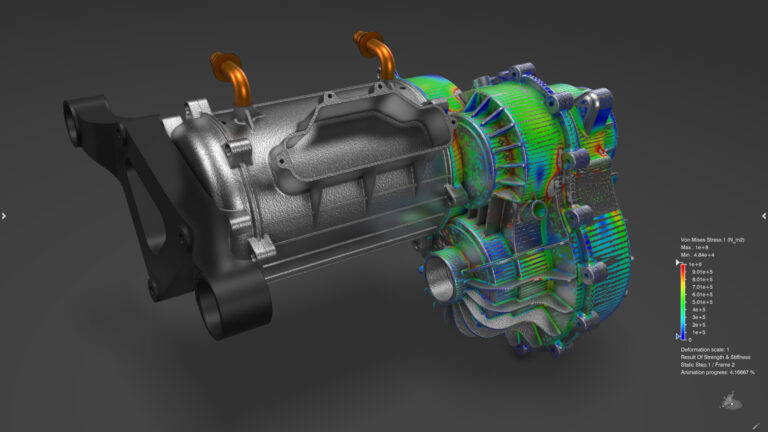
Dassault Systèmes has released the R2026x update for its SIMULIA Abaqus finite element analysis platform, delivering what the company describes as a landmark milestone: native GPU acceleration for the Abaqus/Explicit solver. Combined with new electrochemical battery modeling capabilities, advanced meshing algorithms, and composite manufacturing simulation, R2026x represents one of the most technically significant Abaqus releases in recent years.
GPU Acceleration Comes to Abaqus/Explicit
The headline feature of R2026x FD01 is GPU acceleration for Abaqus/Explicit, making Abaqus one of the first commercial explicit FEA codes to leverage GPU compute natively. The implementation targets NVIDIA GPUs on Linux systems and supports both dynamic impact and quasi-static analyses.
This is distinct from the GPU support previously available in Abaqus/Standard. The Explicit solver handles highly nonlinear, short-duration events — crash, drop test, metal forming, and blast simulation — where time-step constraints make GPU parallelism particularly effective. SIMULIA describes this as the result of a major R&D investment and the beginning of a broader GPU compute strategy across the simulation portfolio.

Engineers running large explicit models on HPC clusters can expect meaningful wall-clock reductions, though SIMULIA notes that specific speedup factors depend on model size, element type, and GPU hardware configuration.
Butler-Volmer Kinetics for Battery Cell Simulation
R2026x adds direct GUI support for Butler-Volmer kinetics in coupled thermal-electrochemical workflows, a critical capability for lithium-ion battery cell modeling. Previously, engineers had to configure these properties through manual keyword editor workarounds; the new release exposes them through the standard interface.
Butler-Volmer kinetics govern the charge-transfer reaction rate at electrode-electrolyte interfaces — the core mechanism determining how current flows through a battery cell under load. Combined with Abaqus's existing porous electrode theory (Newman's model) and lithium diffusion capabilities, R2026x now provides a more complete electrochemical simulation stack for battery engineers working on cell-level thermal runaway, capacity fade, and fast-charging analysis.
Next-Generation Meshing Capabilities
The R2026x meshing engine receives several targeted improvements:
- Quad-dominant meshing: A new algorithmic approach reduces mesh irregularities and improves element flow across complex surfaces, producing cleaner meshes with fewer manual interventions.
- Partition hex meshing: Extended to support generalized polyhedral volumes, enabling hex-dominant meshes on geometries that previously required all-tet approaches.
- Persistent local mesh refinement: Manual mesh density edits are now preserved when the underlying geometry is updated, eliminating a common source of rework in iterative design workflows.
- Interactive edge seeding: Mesh density adjustments can be made interactively without waiting for slow interface refresh cycles.
Composite and Contact Modeling Advances
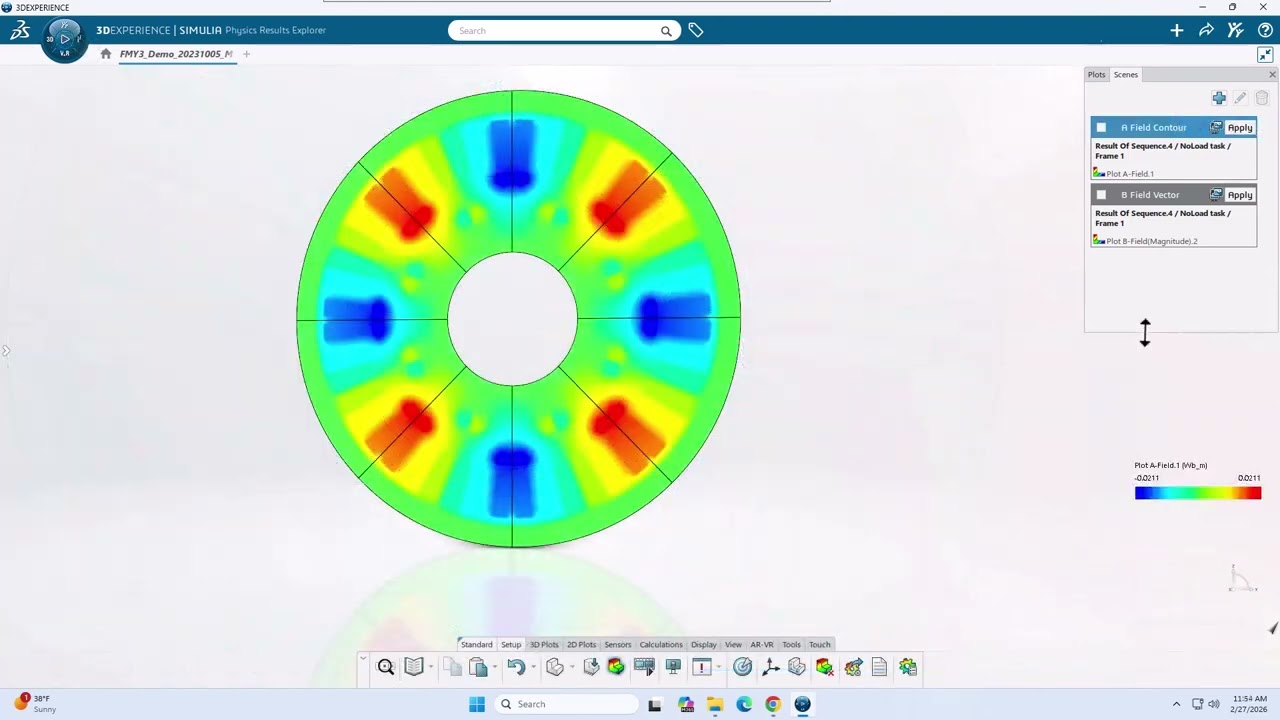
For composite structures, R2026x introduces braided composite part simulation, allowing analysts to account for manufacturing-induced fiber angle variations when braiding processes are performed on the 3DEXPERIENCE platform. This closes a gap for aerospace and automotive teams working with braided carbon fiber components where as-manufactured fiber orientations differ from nominal design intent.
Contact modeling also receives a significant workflow improvement: model-based contact definitions can now be configured once at the model level and reused across multiple simulations. This eliminates the need to re-specify contact properties for each analysis scenario — a common source of setup time and inconsistency in large assembly models.
Platform and Workflow Improvements
The R2026x release introduces the Simulation Process Experience Engineer (PXS) role, designed to democratize simulation access through guided, template-based methodologies. This allows less experienced users to run validated simulation processes without requiring deep Abaqus expertise, while senior analysts retain full control over the underlying solver settings.
Additional platform improvements include:
- Live results monitoring: Analysts can query and visualize simulation results interactively while the solver is still running, enabling earlier detection of convergence issues.
- Encrypted material files: Protected material definitions can now be shared securely across teams and with suppliers without exposing proprietary material data.
- Simulation resume: Stopped multistep analyses can be restarted from any saved increment, reducing the cost of interrupted long-running jobs.
Availability
The R2026x release is available through the 3DEXPERIENCE platform. GPU acceleration for Abaqus/Explicit (introduced in FD01) requires NVIDIA GPU hardware on Linux. Full release notes and technical documentation are available through the SIMULIA R2026x release page and the SIMULIA structures simulation blog.