

Simcenter STAR-CCM+ 2606: Broad GPU Physics Expansion, New FE Electromagnetic Solver, and AR Visualization
Siemens released Simcenter STAR-CCM+ 2606 on July 1, 2026, marking one of the most significant GPU-acceleration milestones in the software's history. The update extends GPU-native physics support to eight additional solver models, introduces a purpose-built Finite Element (FE) Magnetic Field solver for electric machine simulation, and adds mixed-reality visualization and energy monitoring capabilities to the platform.
Broad GPU-Native Physics Expansion
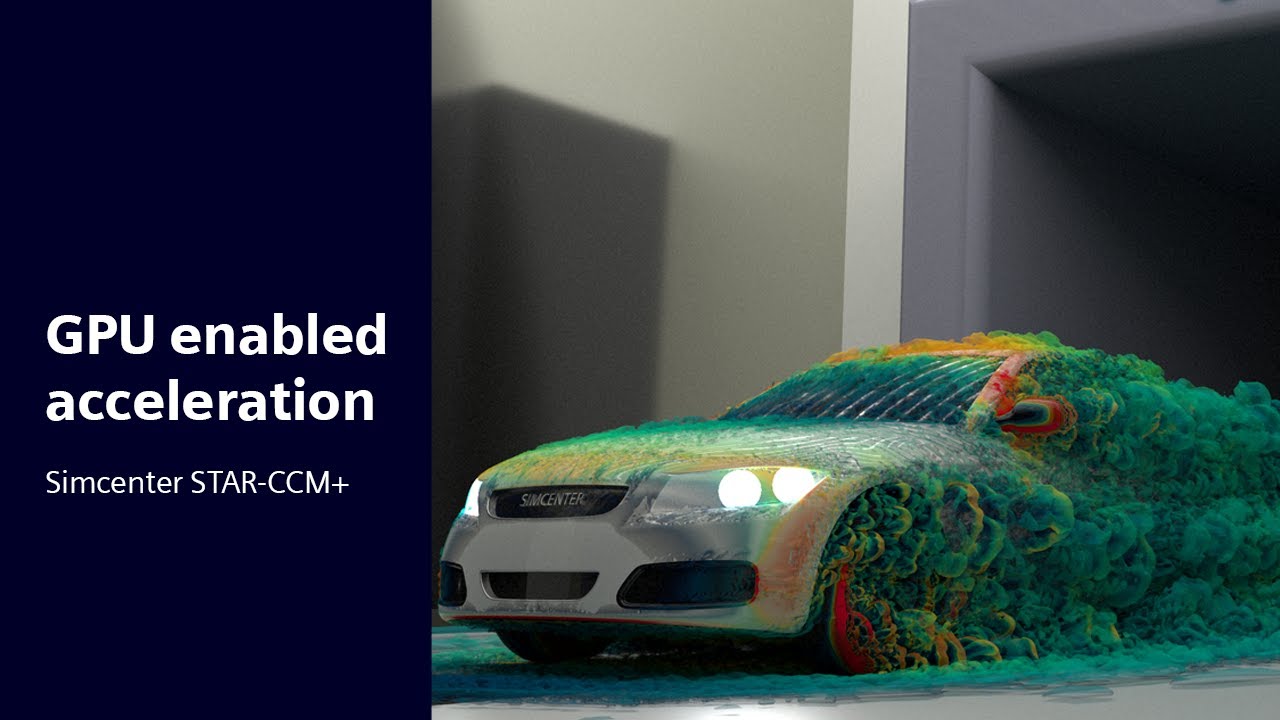
The headline story of the 2606 release is the dramatic expansion of GPU-native solver coverage. For the first time, the following physics models run natively on GPU hardware:
- Eulerian Multiphase (EMP): Particle-based and fluid simulations now leverage GPU compute, with a single GPU delivering the equivalent of hundreds of CPU cores for relevant cases.
- Lagrangian Multiphase (LMP): Benchmarks show up to 17x speedup for steady combustor cases compared to CPU clusters.
- Complex Chemistry: Detailed combustion chemistry calculations achieve a 1.5x speedup for industrial combustor configurations.
- Fluid Film and Dispersed Multiphase (DMP): GPU-native support covers impingement, stripping, boiling, and evaporation interactions.
- Mesh-based Discrete Element Method (DEM): Fluidized bed simulations run 3.3x faster on GPU.
- Eddy Break Up (EBU): Simplified industrial combustors see a 5x speedup.
- Phasic Porous Media: Heat exchanger and catalytic converter models achieve a 3.5x speedup.
- Virtual Body Simulations: DFBI applications for marine and aerospace scenarios now run on GPU, with one GPU node equivalent to 150–200 CPU cores.
The PhysicsAI module also gains multi-GPU support in 2606, enabling near-linear scaling and approximately 3x faster training for both field and 0D-KPI surrogate models. New hardware support is added for the NVIDIA RTX PRO 6000 Blackwell and AMD Radeon AI PRO R9700 workstation GPUs.

New FE Magnetic Field Solver for E-Machine Design
A major new capability in 2606 is the Finite Element Magnetic Field solver, designed specifically for full 3D electromagnetic simulation of electric motors and transformers. The solver is reported to be 10x faster than existing approaches for e-motor and transformer simulations, enabling motor engineers to perform native electromagnetic-thermal (CHT) co-simulations within a single STAR-CCM+ environment. This eliminates the need to transfer data between separate electromagnetic and thermal tools, reducing design cycle time and improving confidence in thermal hotspot predictions—a critical concern for EV powertrain development.
SPH, Acoustics, and Comparative Analysis
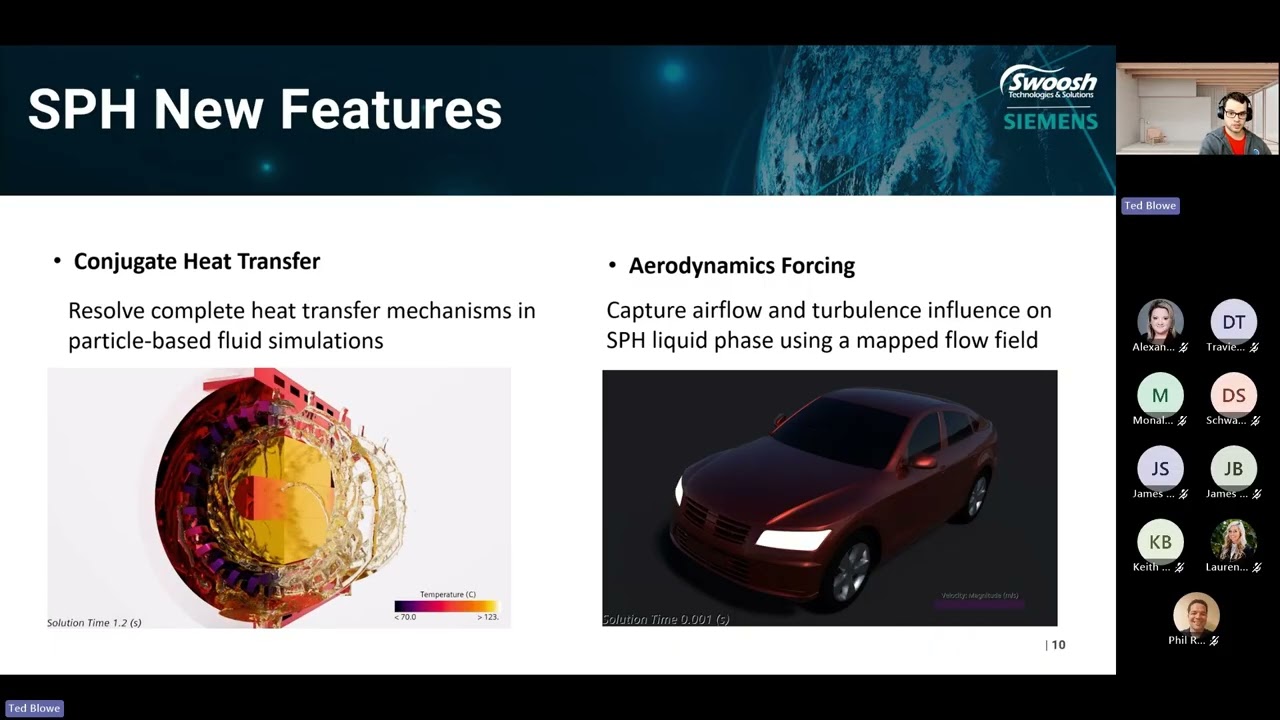
The Smoothed-Particle Hydrodynamics (SPH) solver gains Conjugate Heat Transfer (CHT) support in 2606, enabling integrated thermal and fluid analysis for particle-based simulations. Enhanced airflow coupling for SPH spray simulations allows engineers to capture air influence on liquid droplets more accurately.
A new native frequency-domain acoustics solver is introduced, broadening STAR-CCM+'s capabilities for acoustic phenomena without requiring external tools.
The release also adds a solution field subtraction workflow, allowing engineers to directly compare scalar and vector quantities across design iterations—a practical tool for quantifying the impact of geometry or parameter changes.
Mixed Reality Visualization and Energy Monitoring
The Simcenter Web Viewer now supports mixed reality with controller-free hand tracking via MetaQuest 3, enabling engineers to overlay CFD results—flow features, thermal patterns, pressure distributions—directly onto physical prototypes. This capability bridges the gap between simulation and physical hardware review.
A new built-in energy monitoring tool tracks power consumption throughout simulation runs, helping organizations optimize compute resource allocation and meet sustainability reporting requirements.
Meshing Performance
Surface remeshing in 2606 is now MPI-parallelized, scaling across up to 16 CPU cores and reducing mesh generation time for complex geometries by approximately 50% (up to 2.1x faster). The unified server/client runtime, introduced as an option in the 2602 release, becomes the default in 2606, simplifying deployment and improving overall performance.
Summary
Simcenter STAR-CCM+ 2606 represents a substantial step forward in GPU-native CFD capability, bringing the majority of the physics suite onto GPU hardware and delivering speedups ranging from 1.5x to 17x depending on the application. The new FE Magnetic Field solver addresses a growing need for integrated electromagnetic-thermal simulation in electrified powertrain design. Engineers working on combustion, multiphase flow, DEM, and e-machine applications will find the most immediate performance gains in this release.
For full release notes and benchmark details, visit the Siemens Simcenter blog and the Resolved Analytics STAR-CCM+ 2606 overview.