
CONVERGE 6: AI-Driven Automation, Expanded GPU Solver, and ARROW Combustion Workflow Mark a Major Leap for Reacting Flow CFD
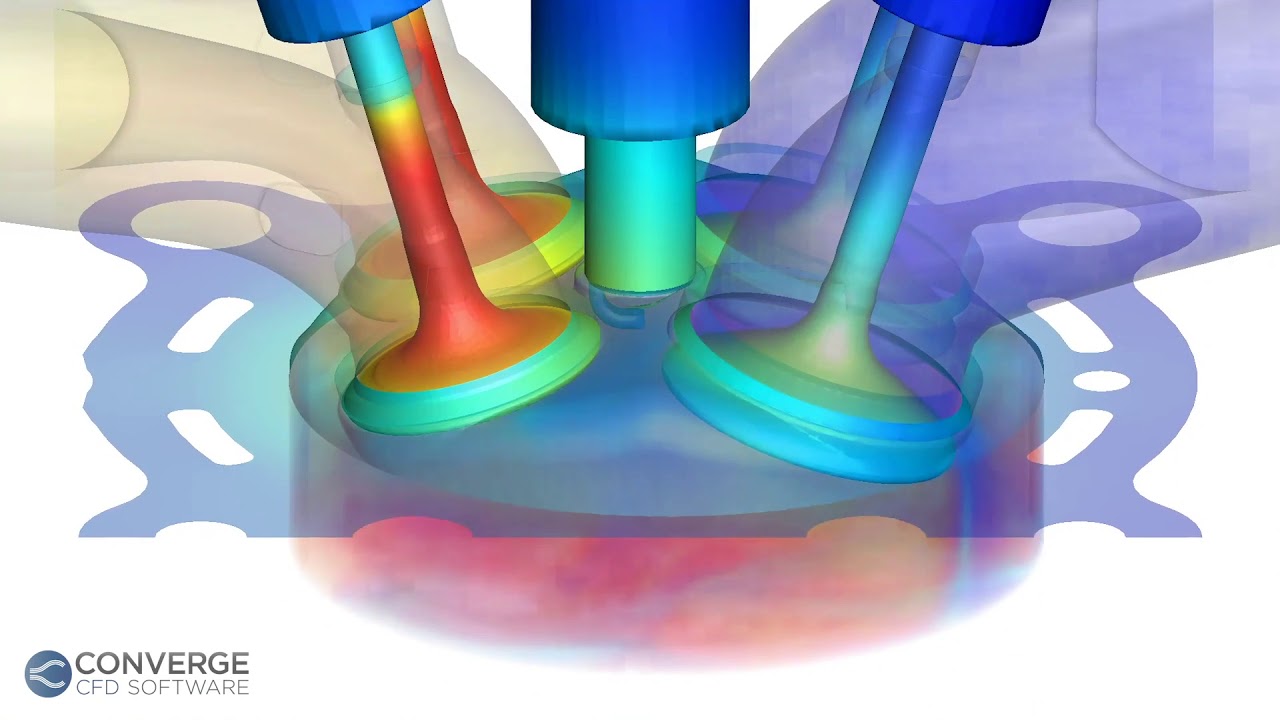
Convergent Science released CONVERGE 6 on July 2, 2026, marking the most significant version milestone in the software's history. Known for its autonomous meshing technology that eliminates manual grid generation, CONVERGE has long been a go-to platform for internal combustion engine simulation, gas turbine analysis, and reacting flow CFD. Version 6 extends this foundation with AI-agent integration, a substantially expanded GPU solver, and a new automated chemistry workflow that together reduce the time from geometry to converged result.
AI Agents in the Simulation Loop
One of the headline additions in CONVERGE 6 is the ability to connect external AI models directly to CONVERGE Studio, the software's graphical pre- and post-processing environment. Using a downloadable instruction set, engineers can configure AI agents to automate repetitive setup tasks—opening and modifying example cases, activating physics models, and plotting output variables—without writing custom scripts. This positions CONVERGE 6 alongside a growing cohort of simulation tools embedding agentic AI into their core workflows, reducing the cognitive overhead of simulation setup for both novice and experienced users.
GPU Solver: Broader Physics Coverage
The GPU solver in CONVERGE 6 has been significantly expanded to cover a wider range of real-world flow regimes. The updated solver now supports:

- Compressible and incompressible flows on a unified GPU code path
- RANS and LES turbulence modeling, enabling both steady-state industrial simulations and high-fidelity transient analyses
- Detailed chemistry for combustion, allowing full chemical kinetics to run on GPU hardware rather than requiring CPU fallback
This expansion is particularly significant for combustion applications, where detailed chemistry has historically been the primary bottleneck preventing full GPU acceleration. By offloading chemistry integration to the GPU, CONVERGE 6 enables faster turnaround on in-cylinder engine simulations, gas turbine combustor studies, and aftertreatment system modeling.
ARROW: Automated Reaction Mechanism Reduction
A persistent challenge in combustion CFD is the gap between detailed chemical mechanisms—which may contain hundreds of species and thousands of reactions—and the reduced mechanisms needed for practical 3D simulations. CONVERGE 6 addresses this with the Automatic Reaction Reduction and Optimization Workflow (ARROW) tool.
ARROW automates mechanism reduction using Directed Relation Graph (DRG) methods, including DRGEP and DRGEPSA, to identify and remove unimportant species while preserving accuracy. Once a skeletal mechanism is generated, ARROW's tuning module adjusts Arrhenius pre-exponential factors to match target ignition delay and laminar flame speed data, using either the built-in CONGO genetic algorithm optimizer or the NLOPT nonlinear optimization library.
CONVERGE Studio 6 ships with the C3MechV4.0.1 detailed reaction mechanism from the Computational Chemistry Consortium, allowing users to extract fuel-specific chemistry, reduce it with ARROW, and feed the result directly into a 3D CFD case—all within a single environment.
Steady-State and 1D Solver Improvements
The Under-Relaxation Steady (URS) solver has been upgraded for faster convergence and is now compatible with a broader set of combustion models, making it more practical for steady-state industrial burner, flare, and gas turbine simulations. The 1D flow solver has been extended to model junctions, compressors, and turbines, and now supports a coupled 1D-3D approach that can substantially reduce total simulation runtimes compared to fully 3D models for systems where some flow paths can be adequately represented in one dimension.
Application Scope and Availability
CONVERGE 6 targets automotive (in-cylinder combustion, fuel injection, exhaust aftertreatment), aerospace and energy (gas turbine combustor optimization, alternative fuel studies), and biomedical (cardiovascular flow) applications. A new tabulated detailed soot model accelerates soot predictions, and a condensation model for wall films supports alternative fuels such as ethanol and methanol. CONVERGE 6 is available now from Convergent Science; further details are at convergecfd.com.