

OpenFOAM v2606: GPU Offloading, GEKO Turbulence Model, and Python Bindings Advance Open-Source CFD
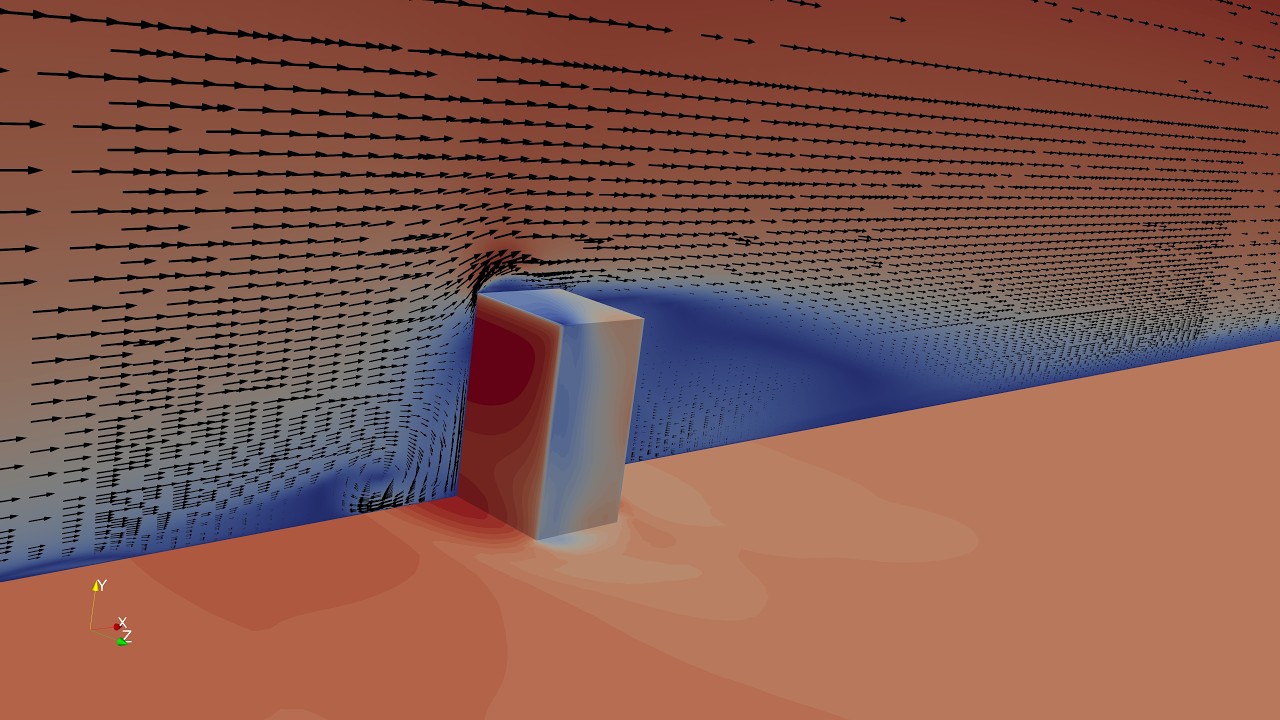
OpenCFD released OpenFOAM v2606 in June 2026, marking one of the most technically ambitious updates to the open-source CFD platform in recent years. The release introduces GPU offloading infrastructure, a new generalised turbulence model, native Python bindings, and VTK-HDF output support — advances that collectively push open-source CFD closer to the performance and flexibility of commercial solvers.
GPU Offloading: A New Compute Frontier
The headline feature of v2606 is experimental GPU offloading, developed in collaboration between OpenCFD/Keysight, the UK Science and Technology Facility Council (STFC), Exeter University, and hardware partners AMD and NVIDIA. The implementation targets performance-critical code paths — field algebra, linear solvers, and boundary evaluation — using C++17/20 policies to dispatch parallel loops to GPU devices.
Key design decisions include cell-based (rather than face-based) loop structures to avoid race conditions, and Umpire memory pool management for efficient CPU-GPU data transfers. Expression templating avoids intermediate field allocations, maximising throughput. For large cases using GAMG with smoothers, meaningful speedups are already demonstrated. The GPU-enabled code ships as a development branch to gather community feedback ahead of full integration in the forthcoming v2612 release.

GEKO: One Turbulence Model to Rule Them All
OpenFOAM v2606 introduces the Generalised k-omega (GEKO) two-equation RANS model, designed to consolidate multiple turbulence frameworks into a single, tunable formulation. GEKO exposes four independent free coefficients:
- CSEP — controls flow separation behaviour
- CNW — governs near-wall treatment
- CMIX — adjusts free-shear layer spreading
- CJET — tunes round-jet spreading rates
Engineers can calibrate these coefficients against experimental data for their specific flow regime without switching models entirely. GEKO also supports machine-learning augmentation via and source terms, a Kato-Launder stagnation correction, and a realizability limiter on turbulent viscosity — making it well-suited for complex industrial flows involving separation, jets, and mixed boundary conditions.
Python Bindings and Modern I/O
Two new community-contributed plugins dramatically improve interoperability with the Python scientific ecosystem:
- pybFoam provides Python bindings for core OpenFOAM classes (, , ) using . It exposes finite-volume operators (, ) and enables direct NumPy access to field data, making it straightforward to integrate OpenFOAM solvers with machine-learning pipelines and physics-informed neural networks (PINNs).
- pyOFTools builds on pybFoam to offer a high-level Python interface for pre- and post-processing, supporting custom pipelines and embedded post-processing during solver execution.
On the I/O side, the new function object and utility export results to the VTK-HDF format (HDF5-based), reducing parsing overhead and data duplication compared to legacy XML-based VTK formats — a significant benefit for large-scale parallel runs.
Additional Solver and Infrastructure Improvements
Beyond the headline features, v2606 delivers targeted refinements across the solver stack:
- BaiGosman spray impingement model for Lagrangian particle tracking, enabling adhesion, rebound, and splash outcomes without requiring a surface film model
- Parallel convolution in the boundary condition, yielding 15–35% speedups for turbulent inflow cases
- GAMG agglomeration improvements with communication-aware multiple masters for better parallel scaling
- Heat flux consistency fix for conjugate heat transfer at material interfaces, enforcing harmonic interpolation for isotropic thermal conductivity
Availability
OpenFOAM v2606 is available now from openfoam.com under the GPL licence. The GPU offloading branch is hosted separately on the development repository. Users are encouraged to test GPU capabilities and provide feedback to the OpenCFD team ahead of the v2612 integration milestone.