

Simcenter FLOEFD 2606: Smart Die Modeling, FEM-Based PCB Thermal Analysis, and Headless EDA Automation
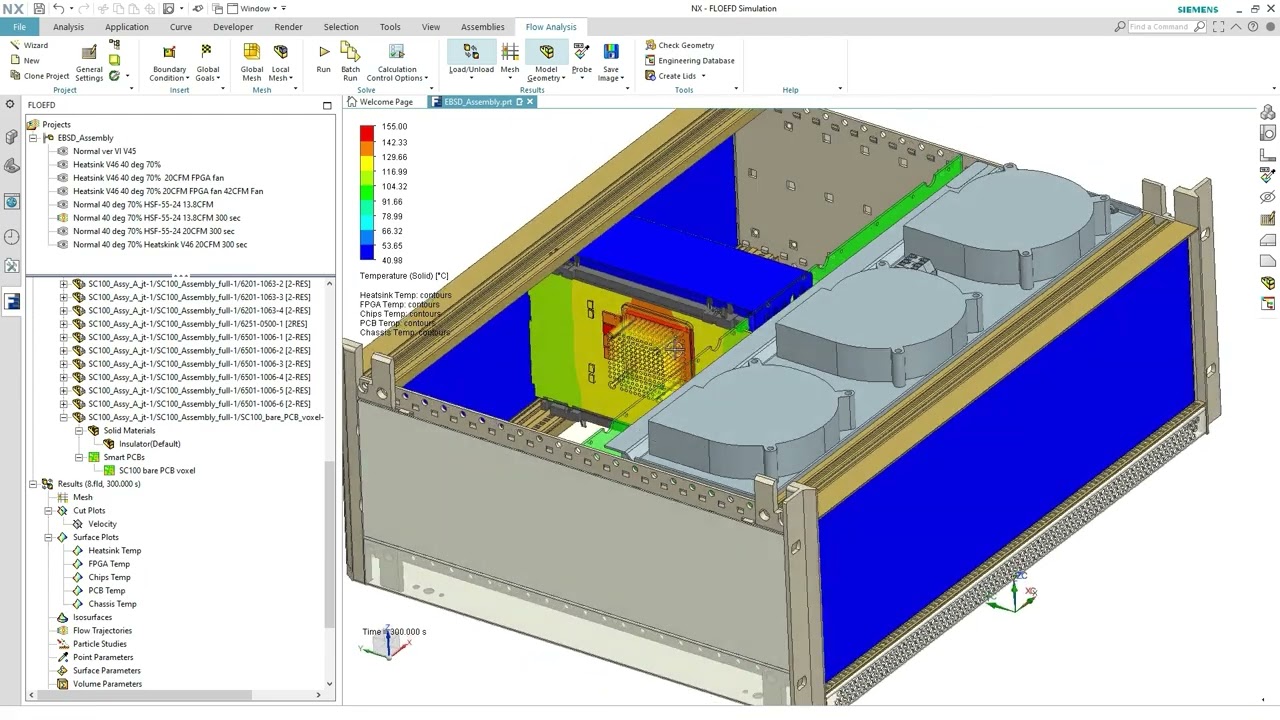
Siemens has released Simcenter FLOEFD 2606, the latest update to its CAD-embedded computational fluid dynamics (CFD) platform for electronics thermal analysis. Available across all major CAD environments—NX, Solid Edge, CATIA V5, Creo, and Simcenter 3D—the 2606 release focuses on three core areas: higher-fidelity IC package modeling, faster PCB thermal simulation, and end-to-end workflow automation.
Smart Die: Modeling Thousands of Power Sources on a Semiconductor Die
The headline feature of FLOEFD 2606 is Smart Die, a new capability for modeling the complex power distribution across a packaged semiconductor die within a full system-level thermal model. Traditional approaches assign a single uniform power value to a die, which can miss localized hotspots driven by leakage currents or non-uniform switching activity.
Smart Die addresses this by subdividing the die into hundreds or thousands of distinct polygons, each with its own dynamic power, leakage model, and thermal dependency. Power floorplan data is imported via CSV files in multiple supported formats, including Simcenter Flotherm discrete sources and total coverage source grids. A voxelized mesh resolves the die geometry, enabling overlapping polygon definitions and transient power variations to be captured accurately.

This capability is particularly valuable for system-in-package (SiP) and advanced IC packaging workflows, where die-level thermal gradients directly influence reliability and performance margins.
Smart PCB: FEM Prism Mesh for Faster, Lower-Memory Board Analysis
The Smart PCB feature—already a popular tool for computationally efficient multi-layer board thermal modeling—receives a significant upgrade in 2606 with the introduction of FEM prism mesh-based thermal analysis. The new approach replaces the previous mesh strategy with a structured prism mesh that better conforms to the layered geometry of high-density PCBs with complex copper routing.
The result is reduced memory consumption and improved solver speed for large, multi-layer boards. Post-processing has also been enhanced: engineers can now visualize internal temperature gradients layer-by-layer and generate heat flux plots that clearly identify thermal bottlenecks within the board stack-up.
For assemblies with hundreds of two-resistor (2R) components in contact with a Smart PCB, Siemens reports performance gains of nearly 2x compared to the previous release, achieved through optimized non-conformal mesh contact handling.
Headless EDA Bridge: Full Automation of PCB Data Import
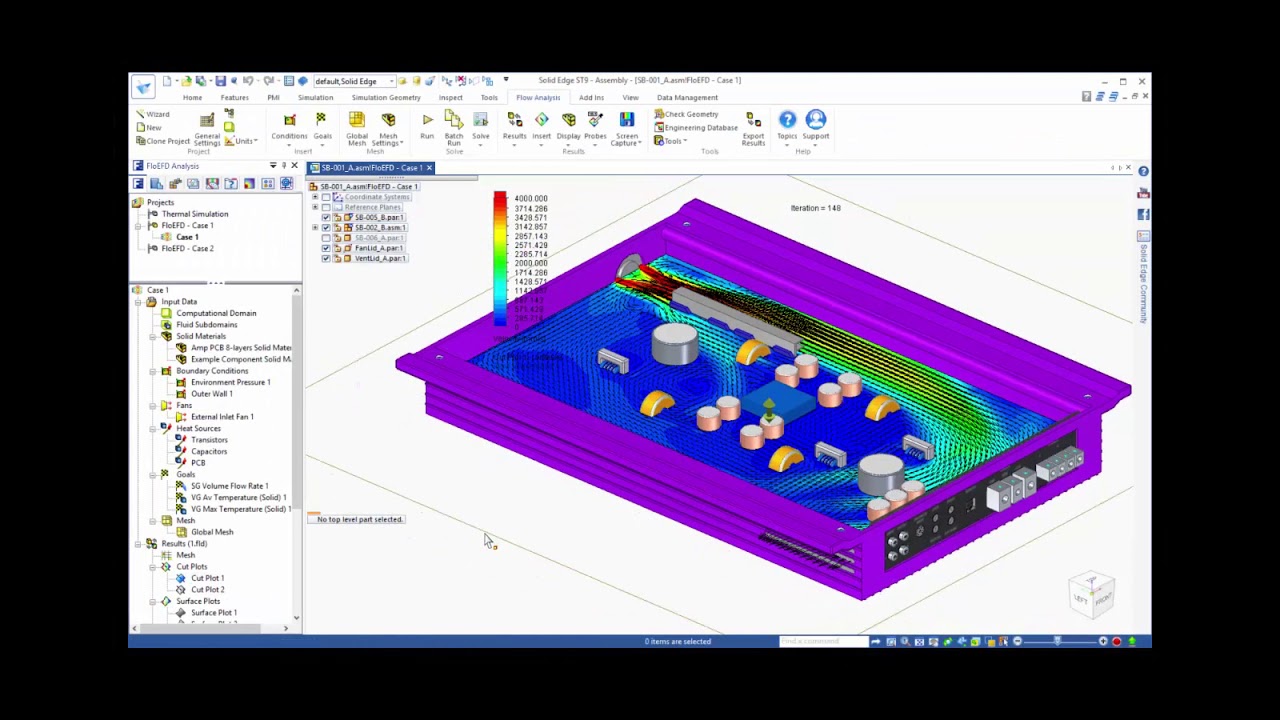
A significant workflow advancement in 2606 is the introduction of headless operation for the EDA Bridge. Previously, importing PCB design data from ECAD tools required interactive steps within the FLOEFD GUI. The new headless mode, combined with expanded EFDAPI scripting capabilities, enables fully automated import and processing of EDA data without any manual intervention.
This unlocks advanced cross-domain thermal optimization workflows where simulation is tightly coupled to the ECAD-MCAD design flow. Engineering teams can now trigger thermal analyses automatically as part of a continuous integration pipeline, with results feeding back into the design process without human-in-the-loop bottlenecks.
Additional API enhancements include easier coordinate system selection, enable/disable controls for absorption in default solids, and improved radiation surface configuration.
Library Ecosystem and Component Reuse
FLOEFD 2606 introduces a new library ecosystem that allows teams to create, share, and reuse validated component models across projects. Libraries can contain custom thermal models, mesh settings, and material definitions, ensuring consistency across engineering groups.
Key library improvements include:
- Sub-component parameter editing directly from the top-level assembly, with independent modification of each component instance
- Absolute cell size mesh refinement in library components, decoupled from the project-level mesh settings
- XTXML export now supports contact resistance and radiative surfaces, streamlining IC package thermal model creation and library integration
The Component Explorer has also been updated with new columns for per-component power values, minimum temperatures, and direct editing of material priority values.
Availability
Simcenter FLOEFD 2606 is available now for NX, Solid Edge, CATIA V5, Creo, and Simcenter 3D environments. The release coincides with Siemens' broader Simcenter June 2026 portfolio update, which integrates capabilities from the recently acquired Altair engineering simulation portfolio.
For full release notes and download access, visit the Siemens Simcenter FLOEFD product page.