
Ansys 2025 R2 Introduces AI Engineering Copilot for Intelligent Simulation Workflows
AI-Driven Virtual Assistant Transforms Simulation Workflows
Ansys has released its 2025 R2 software update, marking a significant milestone in the integration of artificial intelligence into engineering simulation. The centerpiece of this release is the Ansys Engineering Copilot, a virtual assistant that provides AI-driven support directly within Ansys products, fundamentally changing how engineers interact with simulation tools.
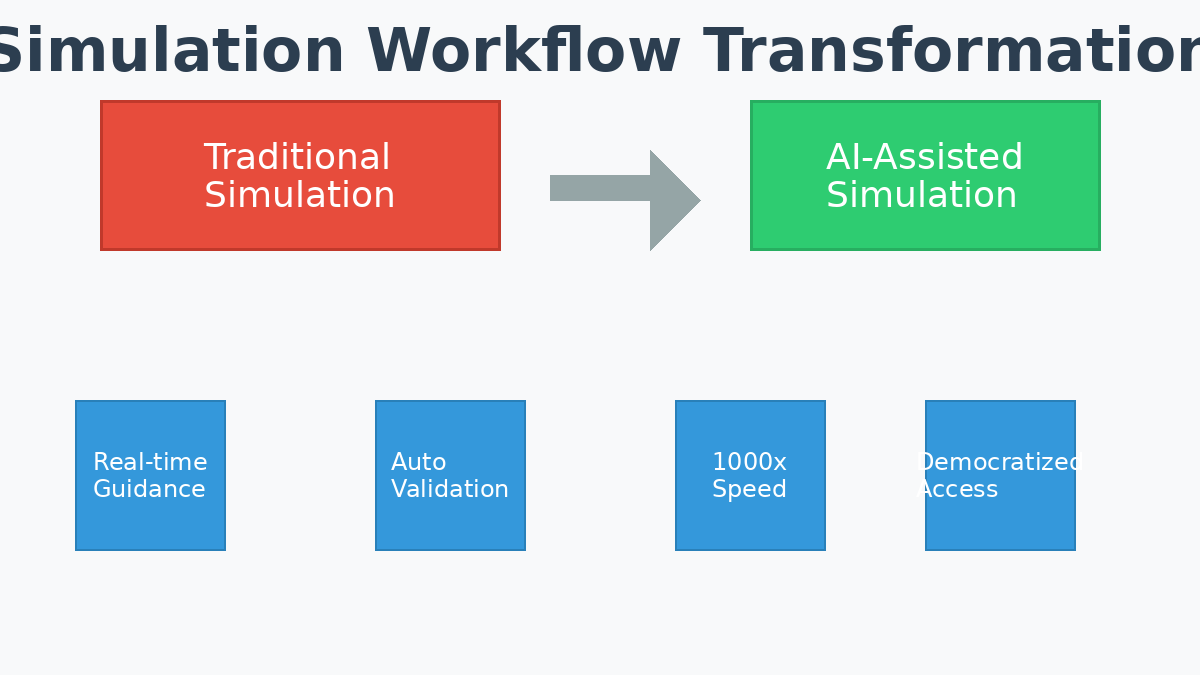
The Engineering Copilot represents a shift from traditional simulation workflows to conversational, AI-assisted processes. Engineers can now receive real-time guidance on simulation setup, access technical expertise through natural language queries, and troubleshoot boundary conditions without leaving their workspace. This capability addresses one of the industry's longstanding challenges: the steep learning curve associated with advanced simulation tools.
Embedded AI Capabilities Across the Portfolio
The 2025 R2 release extends AI integration across Ansys's entire product line, including Ansys Mechanical, Ansys Discovery, Ansys Fluent, and Ansys HFSS. These embedded AI capabilities enable automatic creation, validation, and optimization of high-fidelity simulations, significantly reducing the manual effort required for complex analyses.

Perhaps most impressive is the performance improvement: physics-based AI models in this release can deliver results up to 1,000 times faster than traditional solver simulations. This acceleration is achieved through the integration of OptiSLang and the Ansys SimAI platform, which work together to accelerate dataset creation and AI model training.
Democratizing Simulation Through Intelligent Automation
The implications of these AI enhancements extend beyond speed improvements. By automating routine tasks and providing intelligent guidance, Ansys 2025 R2 makes sophisticated simulation capabilities accessible to a broader range of engineers, including those who may not be simulation specialists. The Engineering Copilot can answer physics questions, suggest optimal solver settings, and even detect potential setup errors before simulations run.
This democratization of simulation aligns with broader industry trends toward "shift-left" engineering, where validation and optimization occur earlier in the design process. With AI assistance reducing the expertise barrier, more team members can participate in simulation-driven design decisions, potentially accelerating product development cycles across industries.
Industry Impact and Future Directions
The automotive, aerospace, and electronics sectors stand to benefit significantly from these advancements. In automotive applications, faster simulation cycles enable more extensive virtual testing of electric vehicle components and autonomous driving systems. Aerospace engineers can explore larger design spaces for lightweight structures, while electronics designers can optimize thermal management in increasingly dense chip packages.
The integration of AI into simulation tools like Ansys 2025 R2 represents more than incremental improvement—it signals a fundamental transformation in how engineering teams approach product development. As these AI capabilities mature, the line between CAD design and simulation validation will continue to blur, enabling truly concurrent engineering workflows.
For more information about Ansys 2025 R2 and the Engineering Copilot, visit the Ansys website.