

TSIS-CORSIM: FHWA's Microscopic Traffic Simulation Platform for Arterial and Freeway Analysis
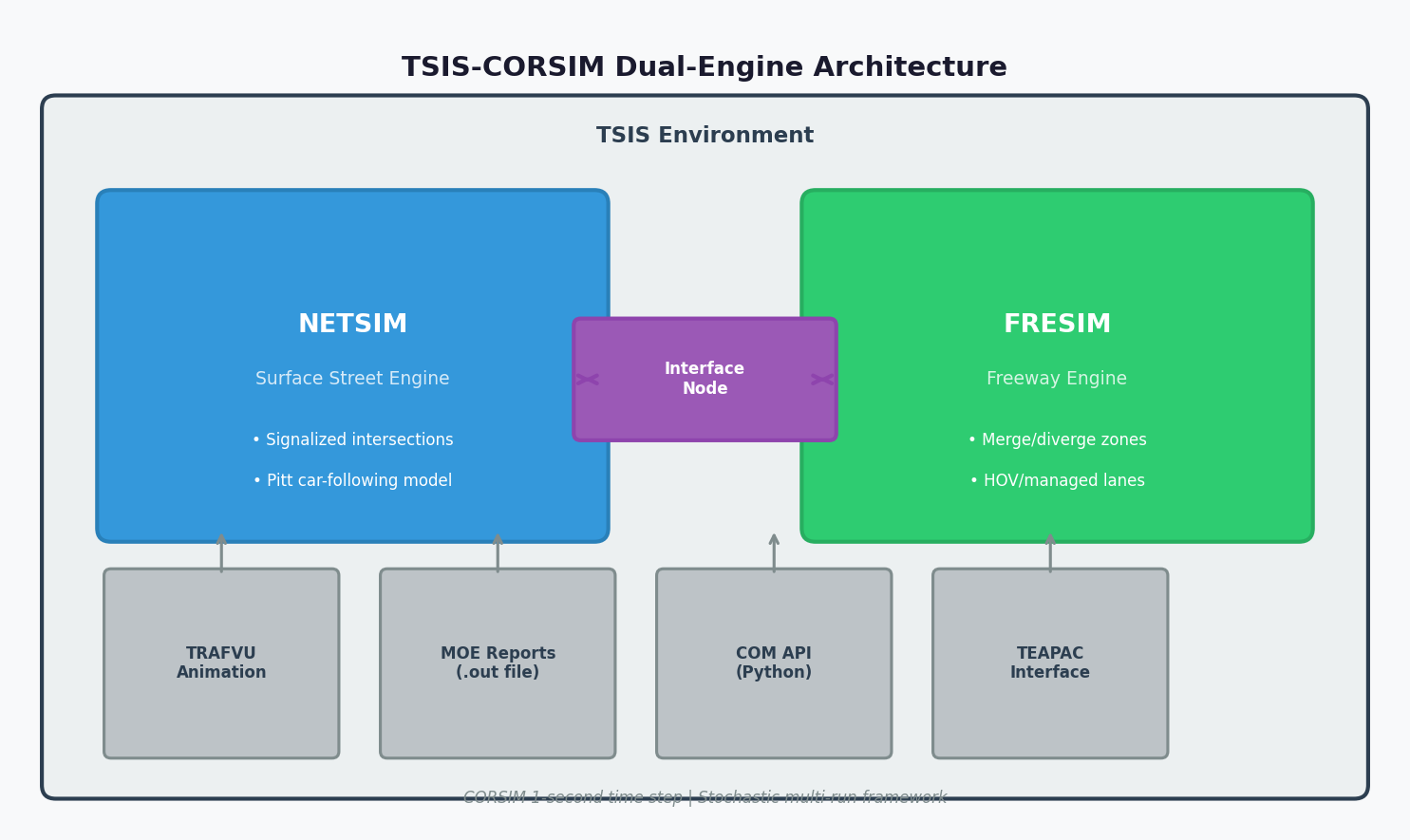
TSIS-CORSIM (Traffic Software Integrated System – CORridor SIMulation) is the Federal Highway Administration's (FHWA) flagship microscopic traffic simulation package, combining two tightly integrated sub-models—NETSIM for surface streets and FRESIM for freeways—into a single corridor-level analysis environment. Originally developed in the 1970s and continuously refined through FHWA sponsorship, CORSIM remains a standard tool in state DOT project workflows, particularly for NEPA-level traffic impact studies, interchange justification reports (IJRs), and signal timing optimization on federally funded corridors.
Architecture: NETSIM and FRESIM Engines
CORSIM's dual-engine architecture reflects the fundamentally different car-following and lane-change dynamics on surface streets versus limited-access facilities.
NETSIM (Network Simulation) models signalized and unsignalized intersections, roundabouts, and arterial segments using a modified Pitt car-following model. Vehicles are represented as discrete entities with individual acceleration/deceleration profiles, gap-acceptance behavior, and turning movement logic. Signal control is handled through TRAFVU-compatible phase/timing plans or via the TSIS API for actuated and adaptive control emulation.

FRESIM (Freeway Simulation) applies a separate car-following algorithm calibrated for high-speed, uninterrupted flow. It explicitly models on-ramp/off-ramp merge and diverge zones, weaving sections, and HOV/managed lane operations. Lane-change decisions use a gap-acceptance model that accounts for relative speed, desired lane, and mandatory versus discretionary maneuvers.
The two engines exchange vehicles at interface nodes—points where a freeway ramp connects to a surface street—allowing seamless simulation of interchange areas where both flow regimes interact simultaneously.
Input Data and Network Coding
A CORSIM network is coded in the TSIS graphical interface (or via the TRF file format for scripted workflows). Key inputs include:
- Geometry: link lengths, number of lanes, lane widths, grade, and speed limits
- Demand: turning movement counts (TMCs) or O-D matrices converted to entry volumes by movement
- Signal timing: pre-timed or actuated phase plans, including pedestrian intervals and overlap phases
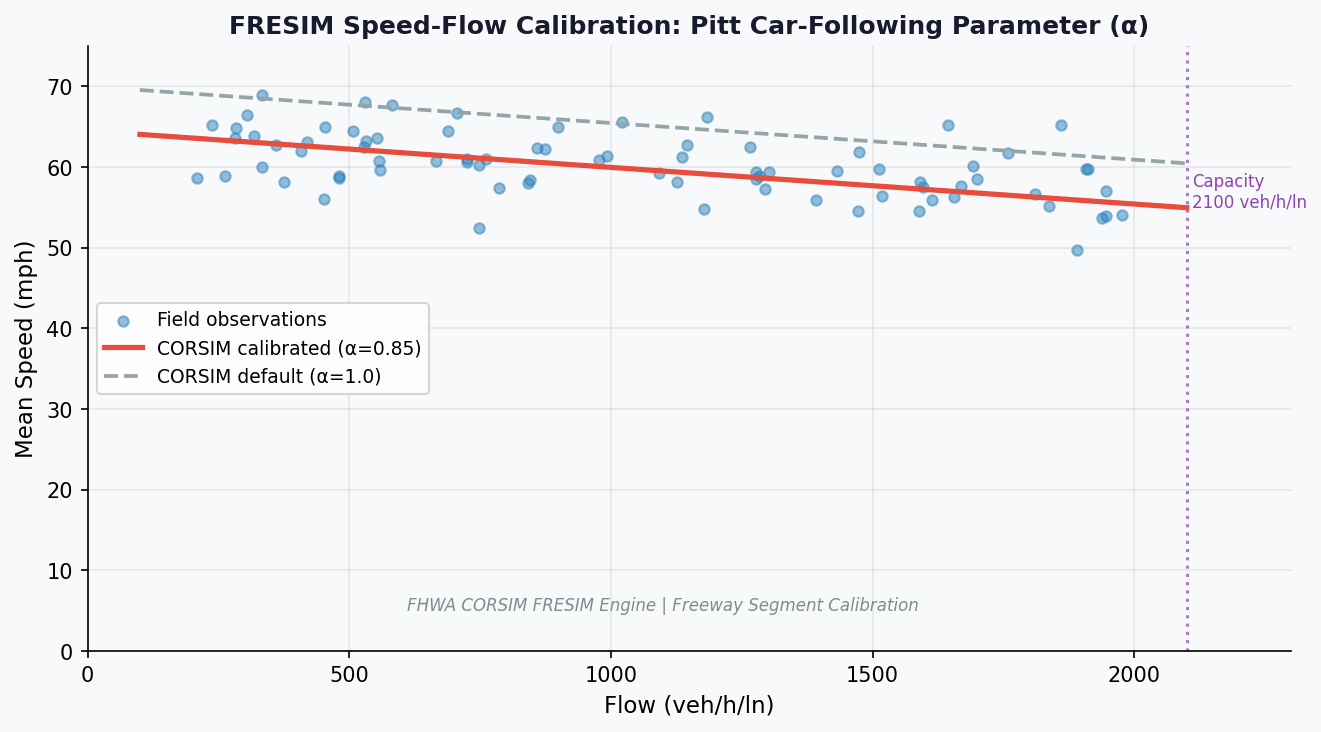
- Driver behavior parameters: mean start-up lost time, saturation headway, free-flow speed, and the Pitt car-following sensitivity factor (α)
CORSIM uses a 1-second simulation time step, which provides high temporal resolution for queue propagation and signal-gap studies without excessive runtime on typical corridor networks (10–50 nodes).
Calibration Workflow
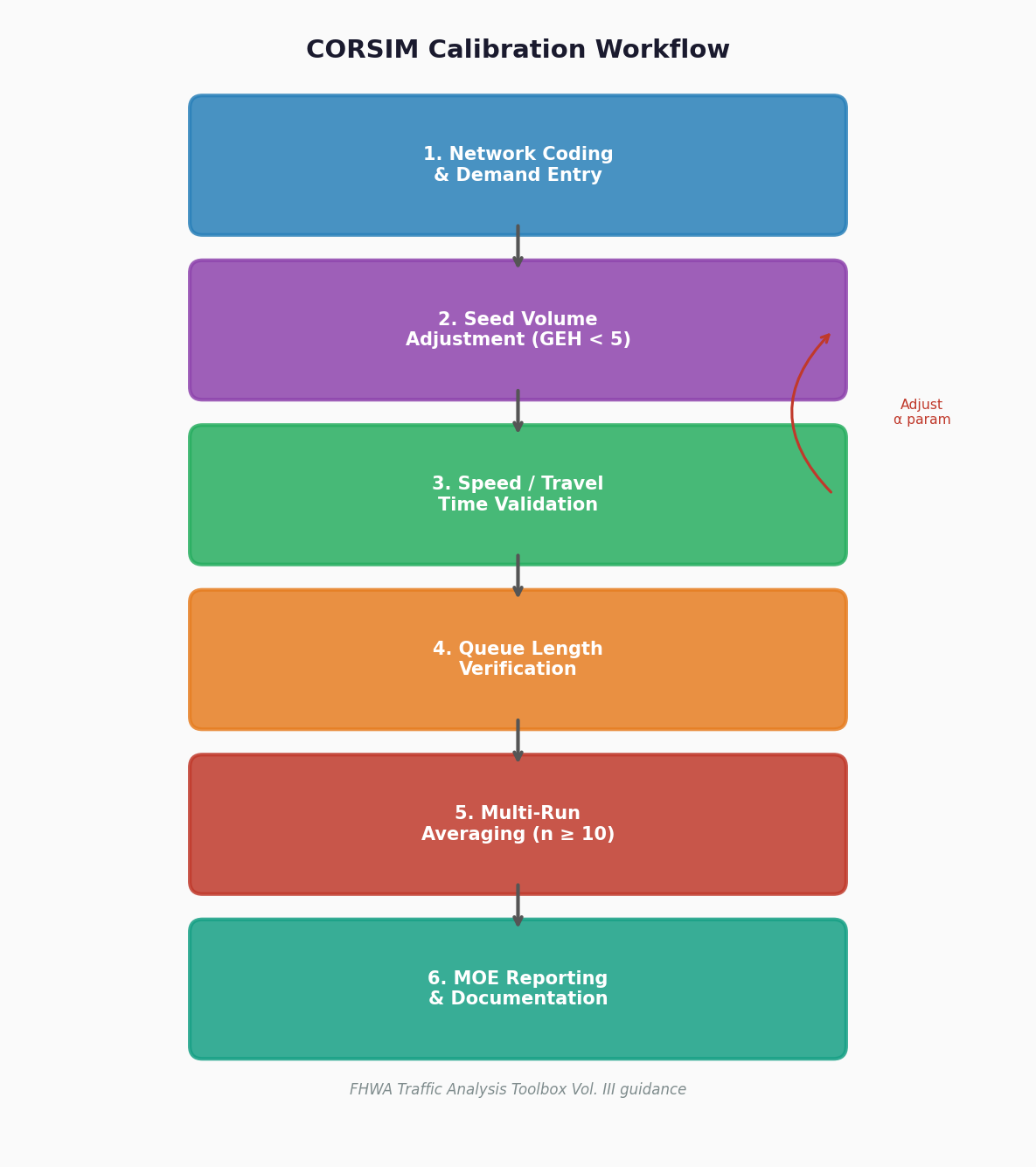
Calibration in CORSIM follows a structured, iterative process aligned with FHWA's Traffic Analysis Toolbox Volume III guidance:
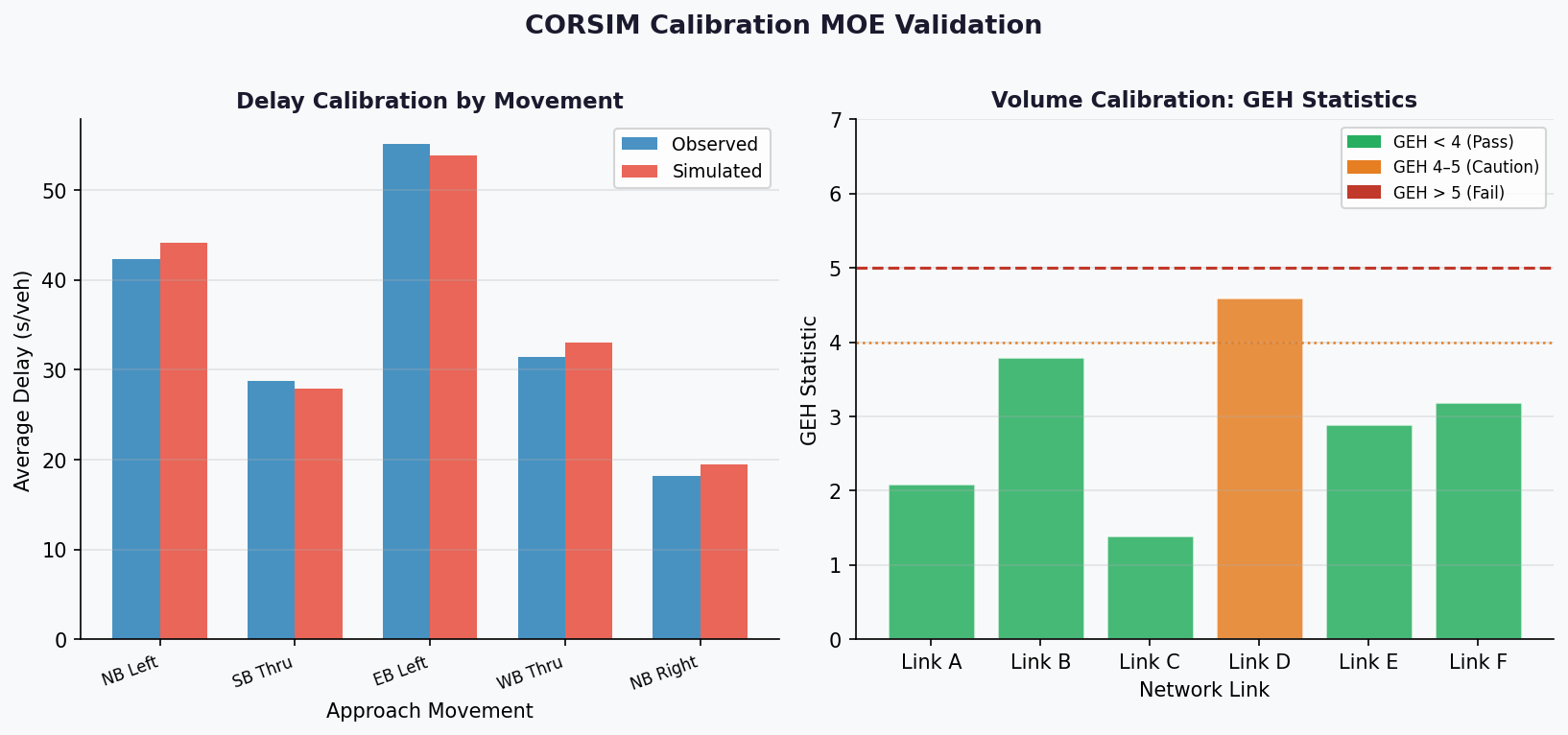
- Seed volume adjustment: Scale entry volumes to match observed link counts using the built-in volume-balancing utility. A GEH statistic < 5.0 for ≥ 85% of count locations is the standard acceptance criterion.
- Speed/travel time validation: Compare simulated mean speeds on key links against field-measured probe or floating-car data. Adjust free-flow speed and the Pitt α parameter to match observed speed-flow relationships.
- Queue length verification: Use TRAFVU's animated queue display to confirm that simulated back-of-queue extents match field observations during peak periods, particularly at critical bottleneck intersections.
- Multiple-run averaging: Because CORSIM uses stochastic random seeds, a minimum of 10 simulation runs with different seeds is recommended. Report mean MOEs with 95% confidence intervals to distinguish real performance differences from random variation.
The TSIS scripting interface (COM-based) allows automated calibration loops—iterating over α values or saturation headway assumptions and logging MOEs to a CSV for post-processing in Python or R.
Key Measures of Effectiveness (MOEs)
CORSIM generates a rich set of MOEs in its standard output report (.out file) and the optional TRAFVU animation:
| MOE | Scope | Typical Use |
|---|---|---|
| Average delay (s/veh) | Link, movement, network | LOS determination per HCM |
| Volume-to-capacity ratio | Link | Bottleneck identification |
| Mean speed (mph) | Link | Travel time reliability |
| Queue length (ft) | Approach | Storage bay adequacy |
| Fuel consumption (gal) | Network | Environmental impact assessment |
| Stops per vehicle | Network | Signal coordination quality |
These outputs feed directly into NEPA air quality conformity analyses when combined with EPA's MOVES model, making CORSIM a natural fit for federally funded project documentation.
Integration with TSIS and Third-Party Tools
The TSIS environment bundles CORSIM with several companion utilities:
- TRAFVU: 2D/3D animated playback of simulation runs for stakeholder presentations and bottleneck visualization
- TEAPAC: signal timing pre-processor that converts HCM-based timing plans into CORSIM-compatible input
- CORSIM API (COM): programmatic control of simulation runs, enabling Python-driven parameter sweeps and automated report extraction
For agencies using TransCAD or Cube for regional demand modeling, scripted workflows can extract peak-hour turning movement volumes from the regional model and inject them directly into CORSIM TRF files, creating a consistent demand-modeling chain from regional to corridor scale.
Practical Considerations and Limitations
CORSIM excels in federally funded corridor studies where FHWA acceptance and established calibration guidance are priorities. However, practitioners should be aware of several constraints:
- Network size: CORSIM is optimized for corridor-scale networks (up to ~200 nodes). City-wide or regional microscopic simulation is better handled by VISSIM or AIMSUN with their more scalable architectures.
- Adaptive signal control: Native support for adaptive systems (e.g., InSync, SynchroGreen) requires custom API scripting; VISSIM's VAP or SCATS/SCOOT interfaces are more mature for this use case.
- Pedestrian and bicycle modeling: CORSIM's pedestrian module is limited to crosswalk gap-acceptance effects on vehicle flow; dedicated pedestrian simulation (e.g., Legion, VISSIM's pedestrian module) is needed for multimodal LOS analysis.
Despite these limitations, TSIS-CORSIM's long validation history, FHWA pedigree, and no-cost availability to public agencies make it an enduring standard for arterial and interchange analysis in the United States.