

Legion by Arup: Pedestrian Simulation and Crowd Dynamics for Transport Infrastructure Design
Pedestrian movement through transport hubs — stations, airports, ferry terminals, and stadium concourses — presents one of the most complex challenges in infrastructure design. Unlike vehicle traffic, pedestrian flow is bidirectional, highly variable in speed and density, and sensitive to spatial geometry at the sub-meter scale. Legion by Arup (now part of the Bentley Systems ecosystem) is the industry-leading pedestrian simulation platform purpose-built for these environments, enabling engineers to model crowd dynamics, evaluate evacuation scenarios, and optimize spatial layouts before a single structural element is built.
What Is Legion?
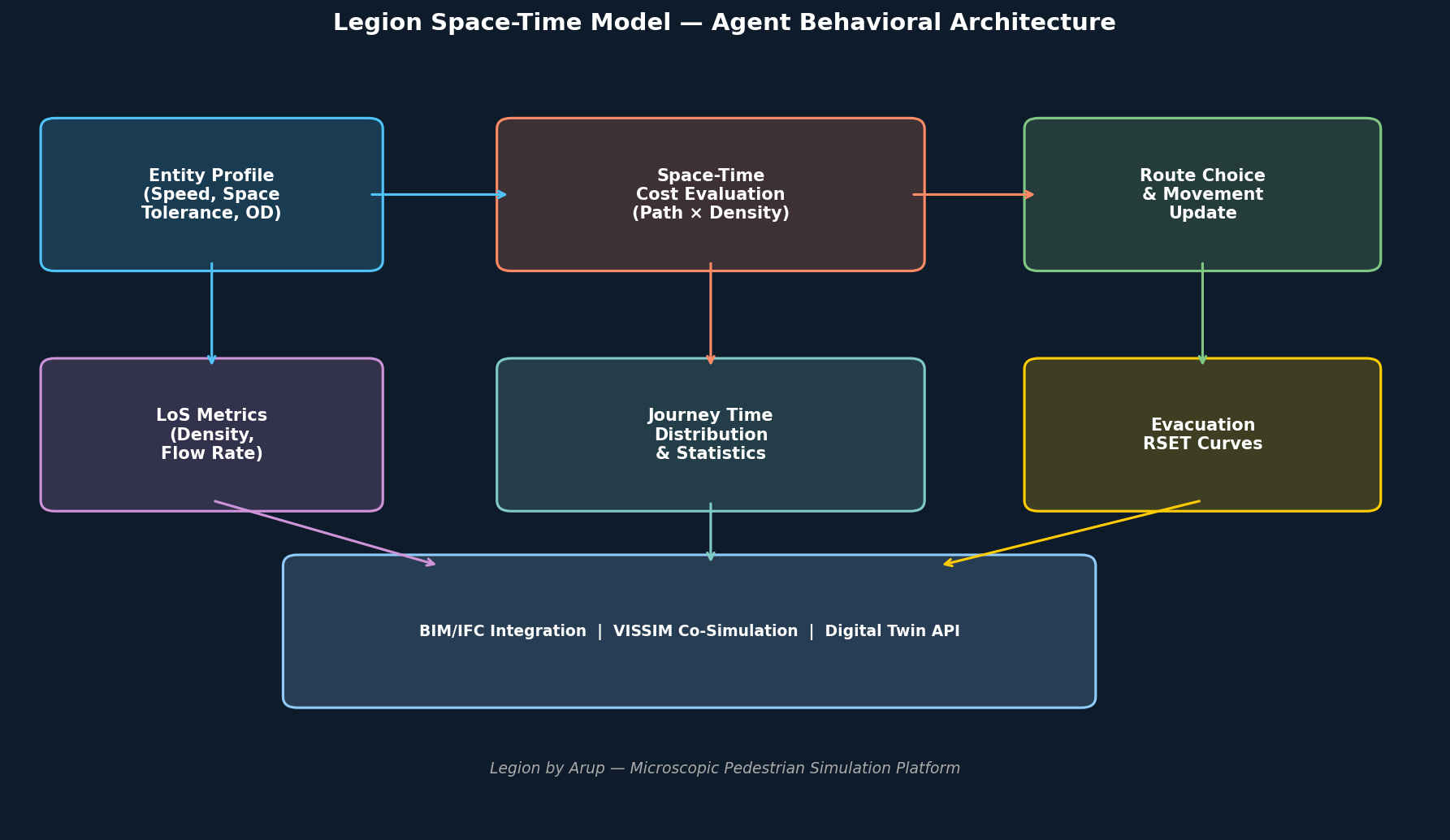
Legion is a microscopic, agent-based pedestrian simulation tool developed by Arup's specialist simulation group. Each simulated pedestrian — called an "entity" — is governed by the Space-Time model, a proprietary behavioral algorithm that replicates how individuals navigate space by continuously evaluating the cost of available paths in terms of time, distance, and discomfort from crowding. Unlike simple flow-based models, Legion captures emergent phenomena such as lane formation in bidirectional flows, bottleneck queuing, and the "faster-is-slower" effect observed in high-density evacuation scenarios.
Legion integrates directly with Bentley OpenRail Designer and MicroStation for geometry import, and outputs can be linked to VISSIM for combined pedestrian-vehicle analysis at interchange nodes.

Core Modeling Capabilities
Entity Behavioral Modeling
Legion's Space-Time algorithm assigns each entity a unique profile drawn from statistical distributions covering:
- Walking speed (mean ~1.34 m/s, with age/luggage adjustments)
- Personal space tolerance (comfort radius affecting route choice)
- Destination assignment (origin-destination matrices or timed schedules)
- Boarding/alighting behavior at platform edges and vehicle doors
This granularity allows engineers to model heterogeneous crowds — commuters, tourists, mobility-impaired passengers — within a single simulation run.
Level of Service Analysis
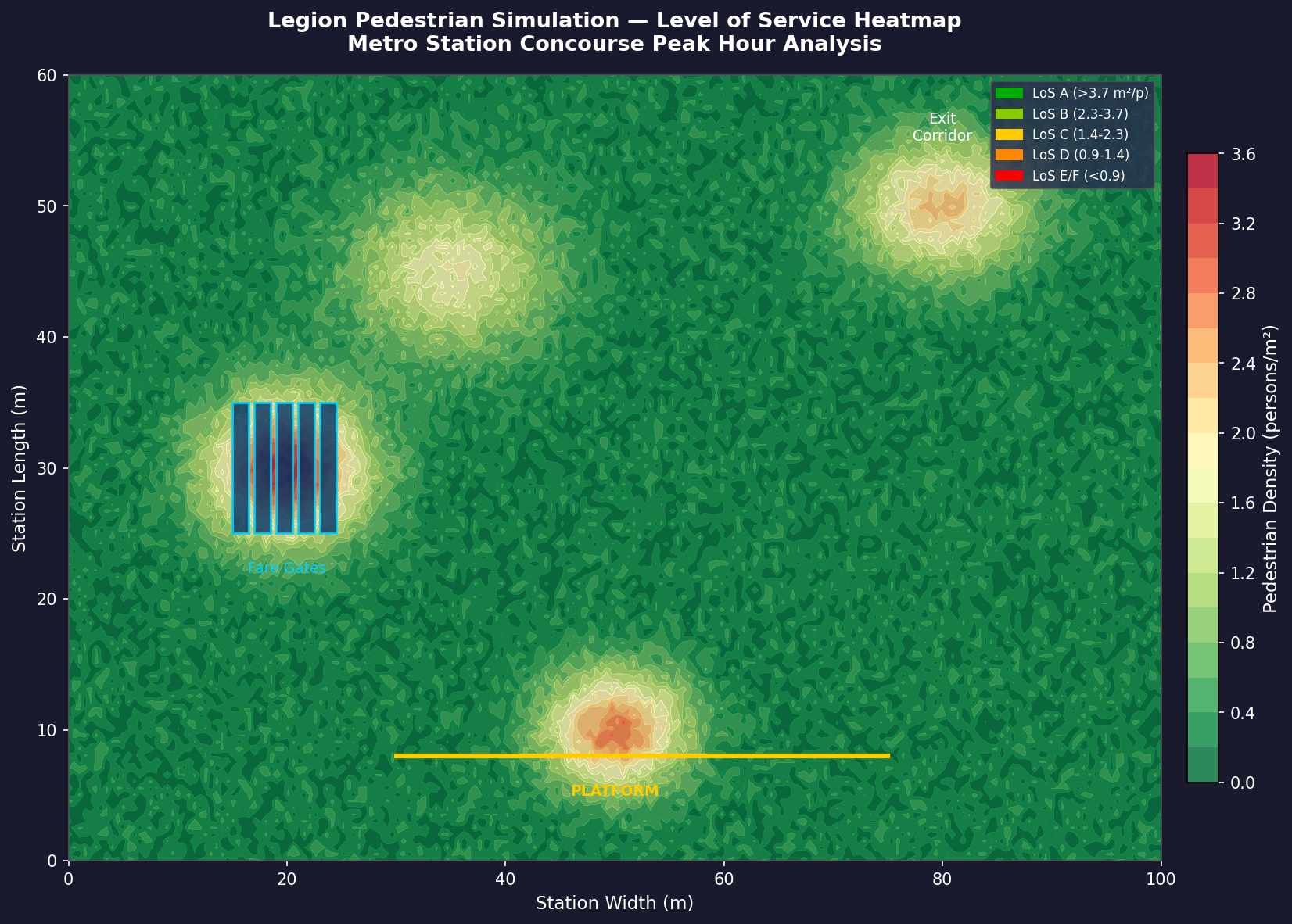
Legion calculates real-time Level of Service (LoS) metrics based on the Fruin pedestrian planning standards, mapping spatial density (persons/m²) and flow rates (persons/min/m) across the entire modeled environment. Heat maps generated from simulation runs identify:
- Chronic bottlenecks at fare gates, escalators, and stairwells
- Temporal peaks during train arrivals and departures
- Conflict zones where opposing flows intersect
These outputs directly inform decisions on gate placement, corridor widths, and the number of escalator units required to maintain LoS C or better during peak hour.
Evacuation and Emergency Egress
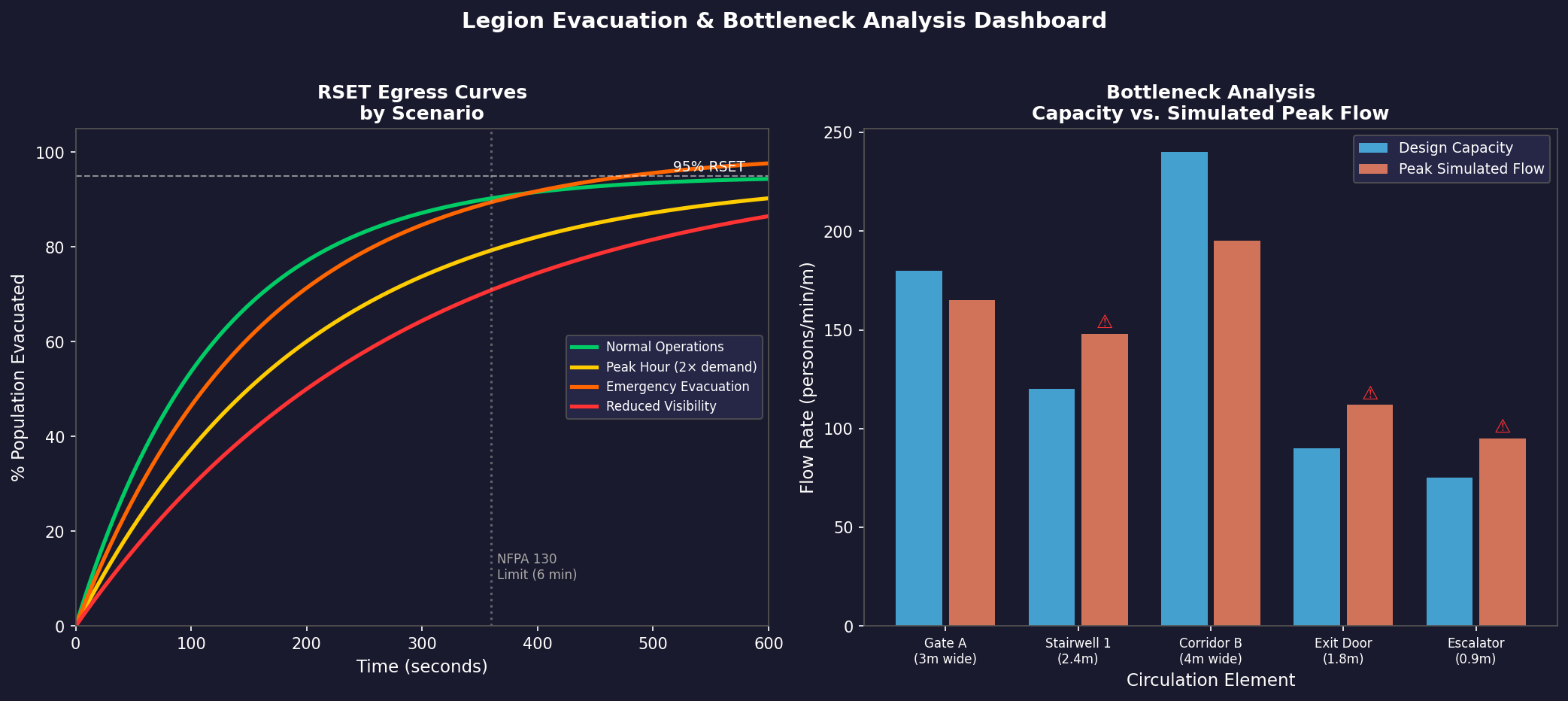
One of Legion's most critical applications is emergency egress analysis in compliance with NFPA 130, BS 9999, and IMO MSC.1/Circ.1533 (for marine vessels). The tool models:
- Simultaneous evacuation from multiple platforms
- Wayfinding under reduced visibility (smoke conditions modeled via reduced speed and increased hesitation parameters)
- Counterflow conflicts between evacuating passengers and arriving emergency responders
- Stairwell capacity constraints under panic-induced density increases
Evacuation simulations produce RSET (Required Safe Egress Time) curves that structural fire engineers use to validate passive fire protection strategies.
Practical Workflow: Station Concourse Optimization
A typical Legion workflow for a new metro station concourse proceeds as follows:
- Geometry Import: CAD or BIM geometry is imported via DXF/DWG or IFC. Walkable surfaces, barriers, and vertical circulation elements are tagged.
- Demand Calibration: Passenger demand is derived from travel demand models (e.g., CUBE Voyager or EMME outputs) and converted to entity generation rates per entry portal.
- Simulation Run: Multiple stochastic runs (typically 10–30) are executed to capture demand variability. Run times for a 500m² concourse over a 60-minute peak period are typically under 5 minutes on modern hardware.
- LoS Post-Processing: Legion's built-in analytics module generates time-series density maps, flow-rate histograms, and entity journey-time distributions.
- Design Iteration: Geometry modifications — widening a corridor, repositioning a kiosk, adding a fare gate — are tested in subsequent runs to quantify improvement.
Integration with BIM and Digital Twin Workflows
Legion supports IFC 2x3 and IFC 4 import, enabling direct integration with Revit and OpenBIM workflows. For digital twin applications, Legion's API layer allows real-time entity injection from passenger counting systems (infrared or LiDAR-based), enabling live crowd state estimation for operational control centers. Several major hub operators — including Network Rail in the UK and MTR Corporation in Hong Kong — have deployed Legion-based digital twins for real-time crowd management.
Limitations and Complementary Tools
Legion is optimized for indoor and semi-enclosed pedestrian environments. For large-scale outdoor pedestrian networks (city-scale evacuation, festival grounds), MATSim's pedestrian extension or VISSIM's pedestrian module may be more appropriate. Legion also does not natively model vehicle-pedestrian interactions at grade crossings; these scenarios require co-simulation with VISSIM via the COM API interface.
Licensing is commercial and project-based, which can be a barrier for academic research. The open-source JuPedSim framework offers a comparable Space-Time-inspired model for research contexts.
Key Takeaways
Legion by Arup remains the benchmark tool for pedestrian simulation in high-stakes transport infrastructure projects. Its agent-based Space-Time model, compliance-ready egress analysis, and BIM integration make it indispensable for station designers, airport planners, and safety engineers. For professionals working at the intersection of structural design and operational performance, mastering Legion's calibration workflow and LoS interpretation is a high-value competency.