

PTV VISUM: Macroscopic Traffic Assignment and Strategic Transport Planning for Urban Networks
PTV VISUM is the industry-standard platform for macroscopic traffic modeling and strategic transport planning, used by transportation agencies, consultancies, and metropolitan planning organizations (MPOs) worldwide. Unlike microscopic simulators that track individual vehicles second-by-second, VISUM operates at the network level—modeling aggregate traffic flows, mode choice, and route assignment across entire regions with hundreds of thousands of links and zones. This article examines VISUM's core assignment algorithms, demand modeling workflow, and practical integration capabilities that make it indispensable for long-range transportation planning.
The Four-Step Demand Model in VISUM
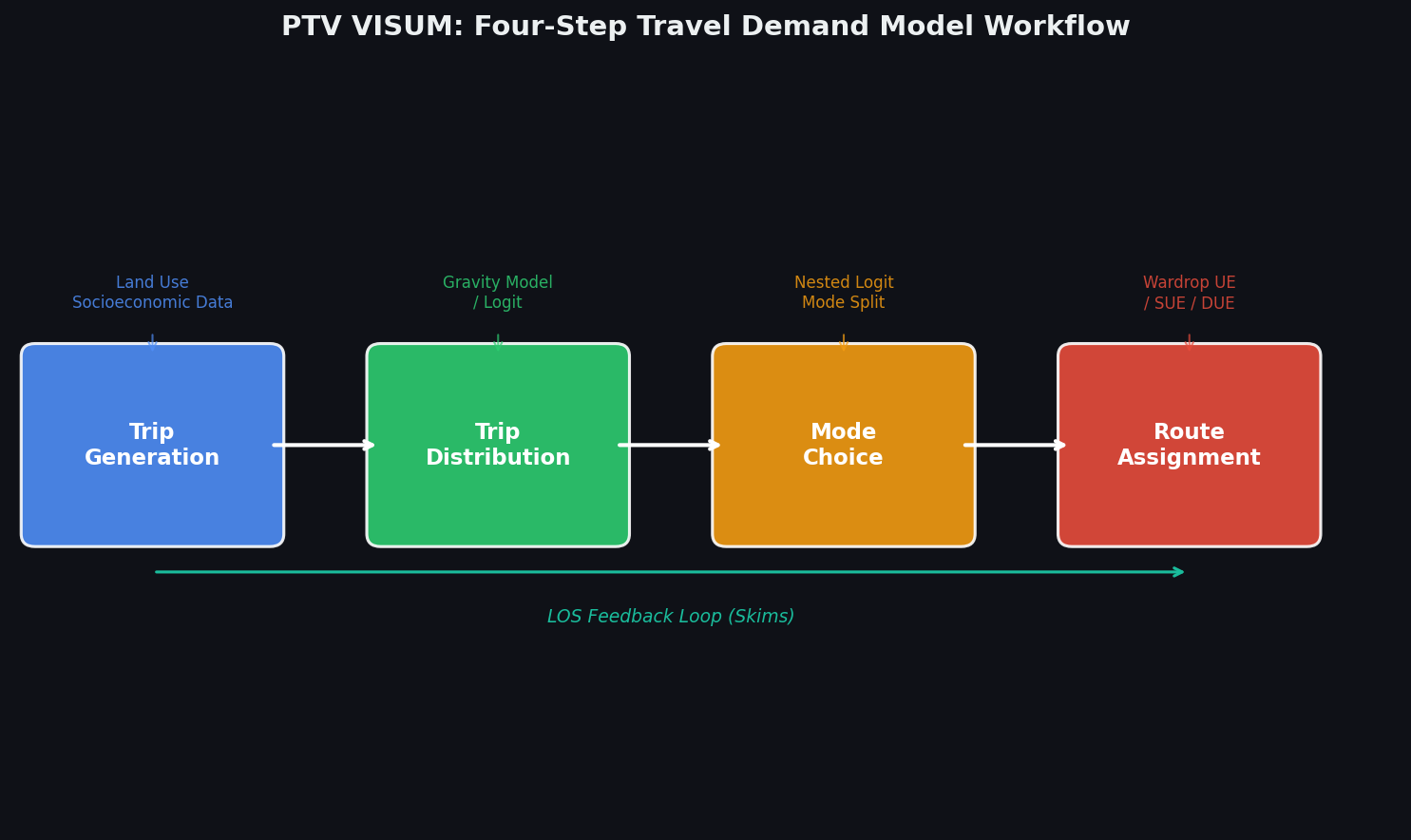
VISUM implements the classical four-step travel demand model as a tightly integrated workflow:
-
Trip Generation — Zone-level regression or cross-classification models estimate productions and attractions based on land-use data (population, employment, floor area). VISUM's matrix editor supports direct import from socioeconomic databases and GIS layers.

-
Trip Distribution — Gravity models or destination-choice logit models distribute trips between origin-destination (OD) pairs. The doubly-constrained gravity model with iterative proportional fitting (IPF) is the standard approach for balancing productions and attractions.
-
Mode Choice — Nested logit or multinomial logit models split demand across auto, transit, walk, and bike modes. VISUM's mode-choice module reads level-of-service (LOS) skims—travel time, cost, and reliability—from the assignment step, enabling feedback loops.
-
Route Assignment — The final step loads OD demand onto the network. VISUM supports multiple equilibrium algorithms suited to different planning contexts.
Traffic Assignment Algorithms
VISUM's assignment engine is its analytical core. Key algorithms include:
Wardrop User Equilibrium (UE)
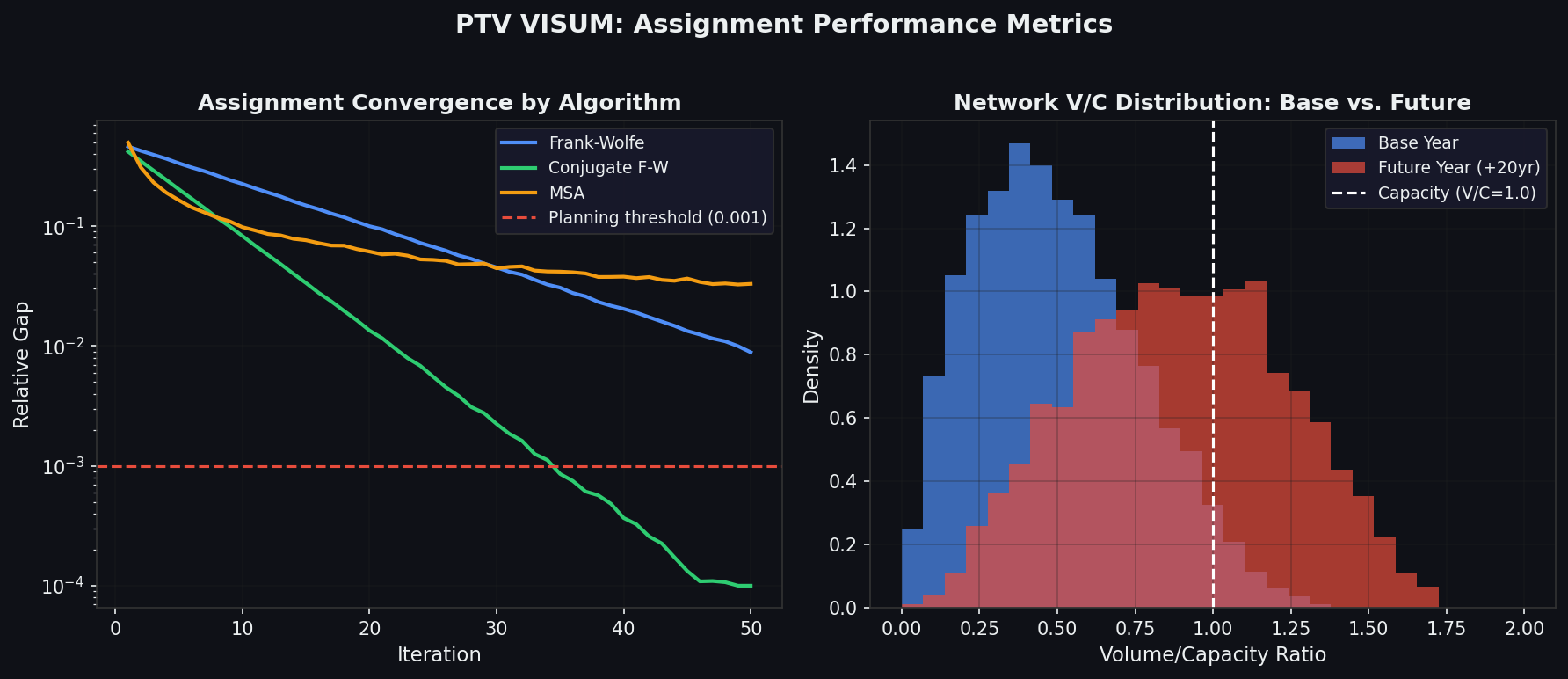
The Frank-Wolfe method iteratively assigns demand to minimize total travel time, converging to the Wardrop equilibrium where no traveler can reduce their travel time by unilaterally switching routes. VISUM's implementation uses the Method of Successive Averages (MSA) or conjugate Frank-Wolfe for faster convergence on large networks. Convergence is monitored via the Relative Gap (RG) statistic—values below 0.001 are typically required for planning-grade results.
Stochastic User Equilibrium (SUE)
For networks where route perception varies among travelers, SUE with probit or logit route choice models captures the dispersion of route choices. VISUM's C-logit and path-size logit formulations correct for route overlap, a critical issue in dense urban networks with many parallel paths.
Dynamic User Equilibrium (DUE)
VISUM's dynamic assignment module (formerly VISUM-Online) models time-of-day variation in demand and congestion. Departure time choice and within-day re-routing are captured through iterative day-to-day learning models, enabling peak-spreading analysis for congestion pricing studies.
Public Transport Assignment
VISUM's headway-based and timetable-based transit assignment algorithms model passenger route choice across complex multimodal networks. The Optimal Strategies algorithm (Spiess & Florian) finds the minimum expected travel time strategy across all feasible transit paths, correctly handling frequency-based services. For timetable-based assignment, VISUM uses a connection-scan algorithm that respects scheduled departure times and transfer constraints.
Demand Matrix Estimation and Calibration
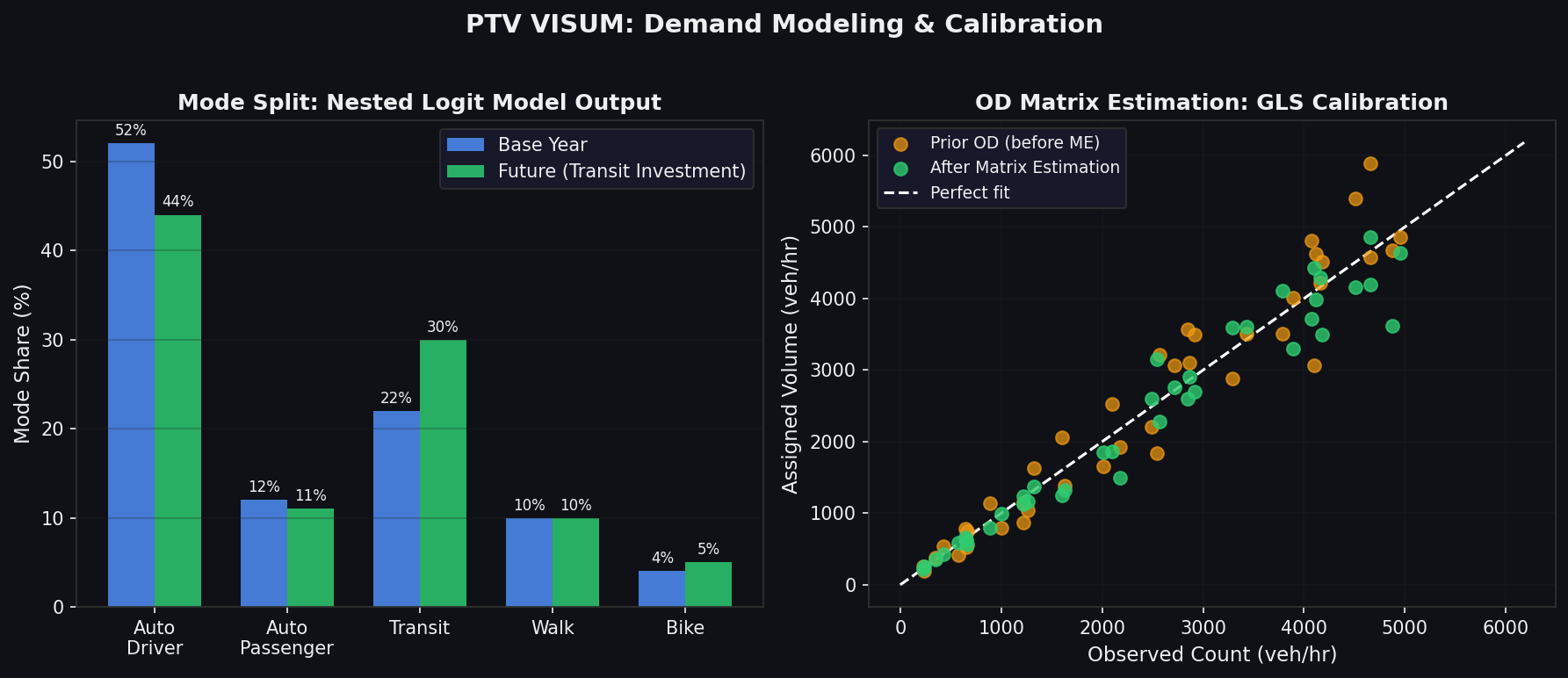
A critical practical challenge in macroscopic modeling is calibrating OD matrices to observed traffic counts. VISUM's Matrix Estimation (ME) module implements the Generalized Least Squares (GLS) method, adjusting the prior OD matrix to minimize the weighted sum of:
- Squared deviations between assigned and counted volumes
- Squared deviations from the prior OD matrix (Tikhonov regularization)
The regularization weight controls the trade-off between count fit and matrix plausibility. VISUM supports both link-count and turn-count constraints, and the ME procedure can be run iteratively within the assignment loop for simultaneous OD estimation and equilibrium assignment (ODME).
For transit networks, Automated Passenger Count (APC) data and AFC (fare card) data can be imported to calibrate boarding/alighting matrices directly.
Scenario Management and Strategic Analysis
VISUM's Scenario Manager is designed for systematic evaluation of planning alternatives:
- Base network with versioned modifications (link additions, signal changes, land-use updates)
- Demand scenarios (population growth, mode shift targets, autonomous vehicle penetration)
- Comparison matrices that compute differences in LOS metrics, VMT, VHT, and emissions across scenarios
The Procedure Sequence editor chains operations—matrix aggregation, assignment, skimming, and reporting—into reproducible workflows that can be executed in batch mode via VISUM's COM interface or command-line runner (visum.exe /run).
Python and COM Integration
VISUM exposes a full COM automation interface accessible from Python via the win32com library:
import win32com.client

visum = win32com.client.Dispatch("VISUM.Visum.240")
visum.LoadVersion(r"C:\Projects\CityModel\base.ver")

# Run assignment
visum.Procedures.Execute()

# Extract link volumes
net = visum.Net
links = net.Links
for link in links:
    vol = link.AttValue("Vol(AP)")
    v_c = link.AttValue("VCRatio(AP)")
The PTV Developer API (Python-native, available in VISUM 2024+) eliminates the COM dependency and supports direct NumPy array access for large matrix operations—critical for models with 2,000+ zones where COM iteration becomes a bottleneck.
VISUM also integrates with R via the VISUMPy package and exports to standard formats: EMME matrix format, TransCAD binary matrices, GTFS for transit networks, and Shapefile/GeoPackage for GIS workflows.
Emissions and Environmental Analysis
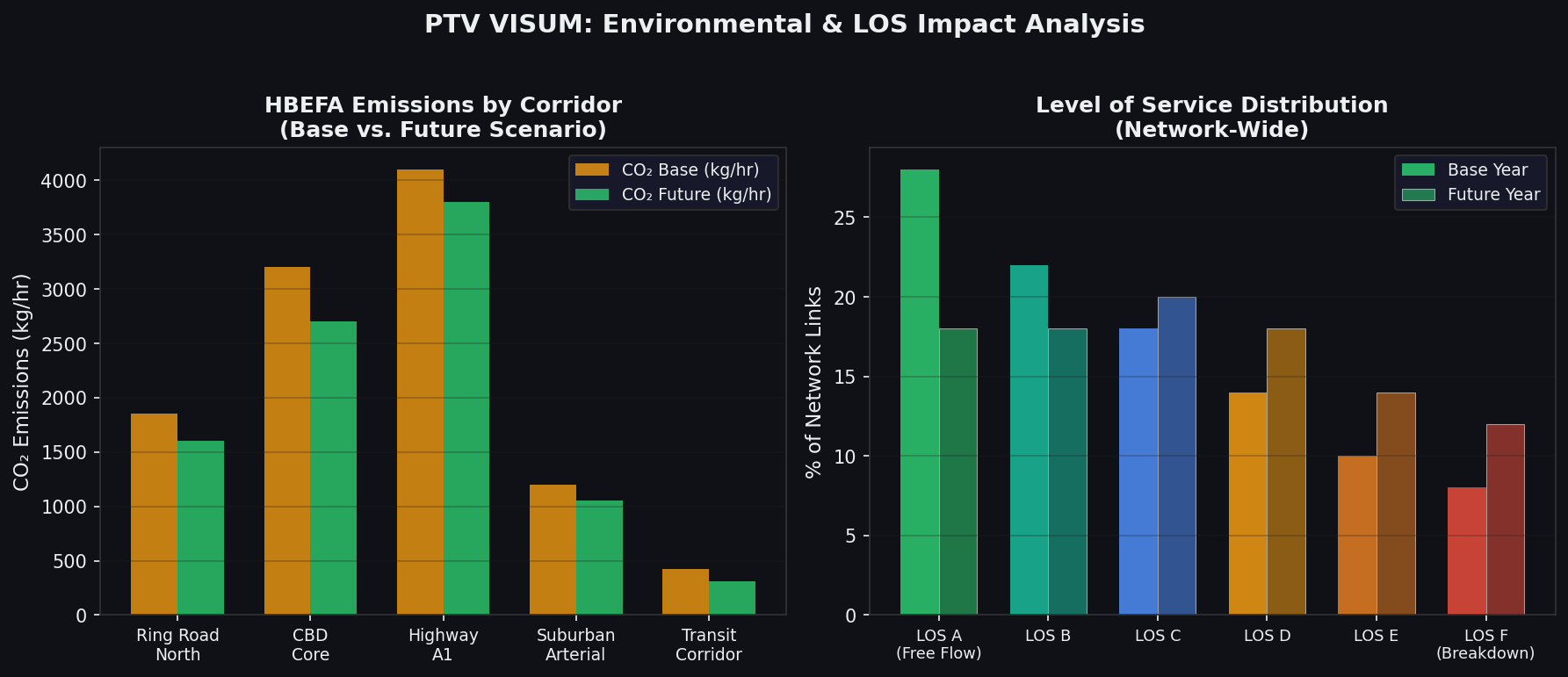
VISUM's HBEFA (Handbook Emission Factors for Road Transport) integration computes link-level emissions (CO₂, NOₓ, PM₂.₅) from assigned volumes and speed profiles. The workflow:
- Assign traffic and compute speed-flow curves per link
- Map link types to HBEFA traffic situations
- Apply fleet composition (vehicle mix by Euro standard)
- Aggregate emissions by zone, corridor, or network-wide
This output feeds directly into air quality dispersion models (AERMOD, CALINE) and supports conformity analysis required for federally funded projects in the US.
Practical Workflow Recommendations
Network coding discipline: Use VISUM's turn penalties and connector design carefully—poorly coded connectors (zone centroid connections) are the most common source of unrealistic assignment results. Limit connector speeds to 25–40 km/h and use multiple connectors per zone for large zones.
Convergence monitoring: Always plot the relative gap by iteration. If the gap plateaus above 0.01, check for network coding errors (disconnected links, missing turn permissions) before increasing iteration counts.
Feedback loop implementation: Run at least 3–5 feedback iterations between mode choice and assignment to achieve stable LOS skims. Use MSA averaging on skims (not just volumes) to prevent oscillation.
Validation targets: Follow FHWA's model validation guidelines—screenline volumes within ±10%, district-level VMT within ±5%, and transit boardings within ±10% at the route level.
Conclusion
PTV VISUM remains the benchmark tool for strategic transport planning at the regional and metropolitan scale. Its combination of rigorous equilibrium assignment algorithms, integrated four-step demand modeling, and robust scenario management capabilities makes it the platform of choice for long-range transportation plans (LRTPs), environmental impact assessments, and congestion pricing studies. Practitioners who invest in understanding VISUM's convergence behavior, matrix estimation capabilities, and Python automation interface will find it a highly productive environment for evidence-based transport policy analysis.
Further Reading: