

SIDRA Intersection: Roundabout and Signalized Intersection Capacity Analysis Using the HCM Gap-Acceptance Model
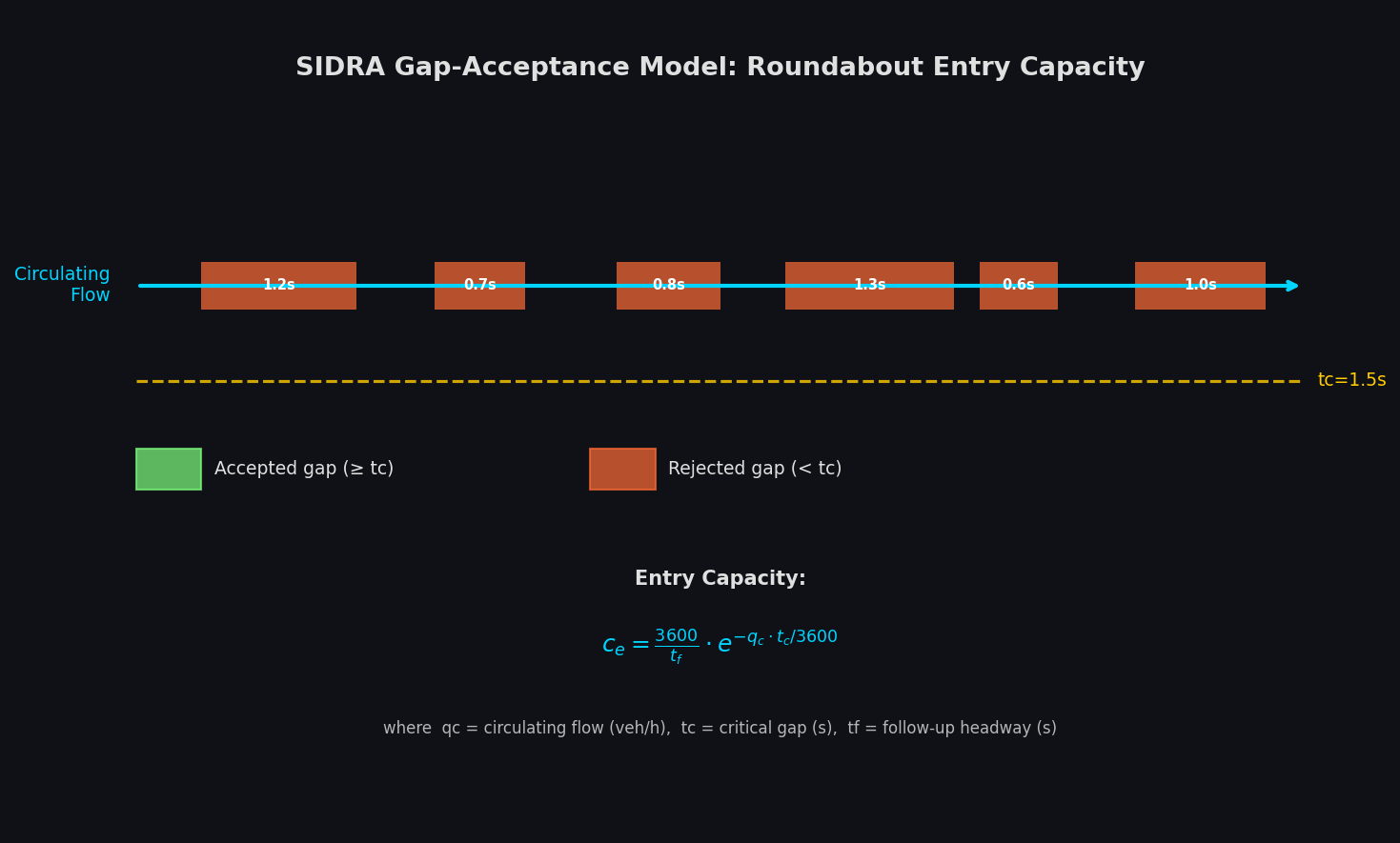
SIDRA Intersection (Signalised and unsignalised Diagram for Road Assessment) is the industry-standard software for intersection and roundabout capacity analysis, delay estimation, and level-of-service (LOS) determination. Developed by Akcelik & Associates in Australia and widely adopted across North America, Europe, and Asia-Pacific, SIDRA implements the Highway Capacity Manual (HCM) gap-acceptance methodology alongside its own calibrated analytical models to deliver rapid, accurate performance assessments without the overhead of full microscopic simulation.
Core Analytical Framework
SIDRA's engine is built around a steady-state queuing model that combines gap-acceptance theory with empirical capacity functions. For each movement at an intersection, the tool computes:
- Critical gap (tc) and follow-up headway (tf) — calibrated per facility type (roundabout, TWSC, AWSC, signalized)
- Capacity (c) — derived from conflicting flow rates and the gap-acceptance parameters
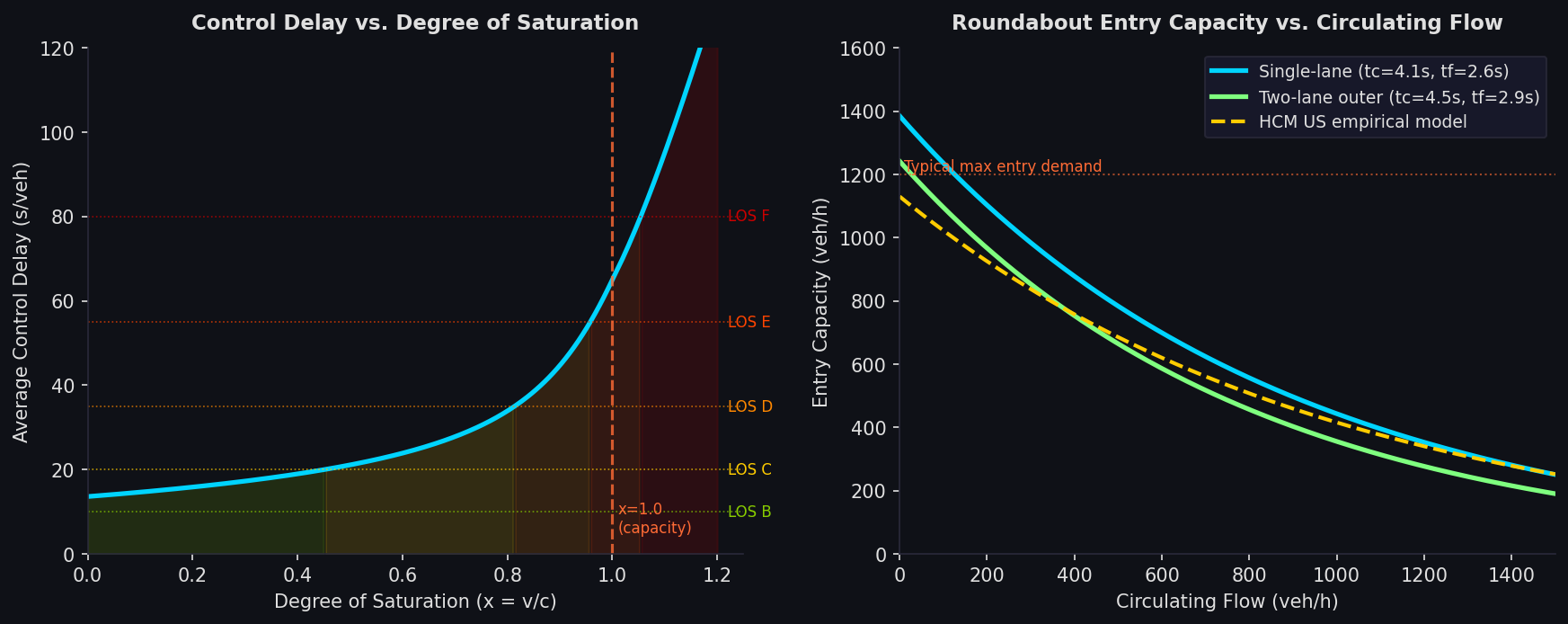
- Degree of saturation (x = v/c) — the primary stability indicator
- Average control delay (d) — combining uniform delay, incremental delay, and initial queue delay per HCM 7th Edition methodology
For signalized intersections, SIDRA solves the Webster-based cycle optimization problem, iterating over phase splits and cycle lengths to minimize total intersection delay. The SIDRA signal optimization module can handle pre-timed, actuated, and coordinated signal plans, outputting optimal green times, cycle lengths, and phase sequences.

Roundabout Modeling: Beyond the HCM Worksheet
Roundabout analysis is where SIDRA differentiates itself most clearly from spreadsheet-based HCM worksheets. The software implements the Akcelik roundabout capacity model, which extends the basic HCM exponential gap-acceptance formula with:
- Entry capacity adjustment for circulating and exiting flow interactions — critical for multi-lane roundabouts where lane-change behavior affects effective circulating headways
- Pedestrian and bicycle conflict modeling — crosswalk delay and capacity reduction factors applied per approach
- Metering effects — upstream signal coordination that creates platoon arrivals, altering the effective gap distribution at the roundabout entry
A key practical feature is the lane-by-lane analysis for multi-lane roundabouts. Rather than treating each approach as a single entity, SIDRA distributes demand across lanes using a utility-based model, then computes capacity and delay per lane. This reveals unbalanced lane utilization — a common design flaw where the outer lane of a two-lane entry operates near capacity while the inner lane remains underutilized.
Calibration Parameters and Local Conditions
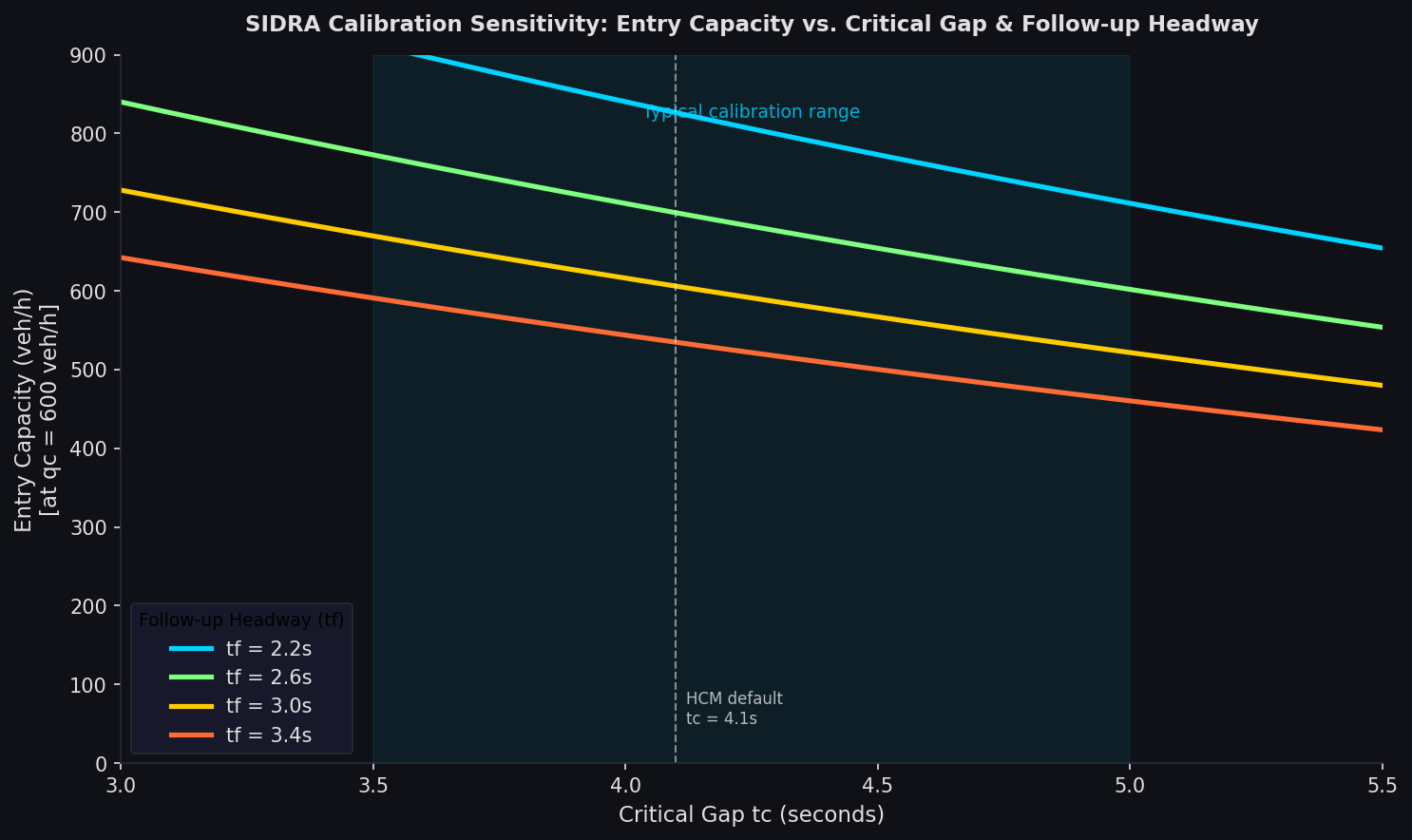
Out-of-the-box HCM parameters are calibrated to U.S. average conditions. SIDRA exposes the underlying calibration parameters so practitioners can match local driver behavior:
| Parameter | Default (HCM) | Typical Adjustment Range |
|---|---|---|
| Critical gap tc (roundabout, single-lane) | 4.1 s | 3.5 – 5.0 s |
| Follow-up headway tf | 2.6 s | 2.2 – 3.2 s |
| Saturation flow rate (signalized) | 1,900 pc/h/ln | 1,600 – 2,000 pc/h/ln |
| Peak hour factor (PHF) | 0.92 | Field-measured |
| Heavy vehicle factor | 2.0 PCE | 1.5 – 3.0 PCE |
Calibration is typically performed using turning movement counts (TMC) collected during peak periods. SIDRA's back-calculation mode accepts observed queue lengths or delays and inversely solves for the critical gap and follow-up headway that best reproduce field conditions — a significant time-saver compared to manual iterative calibration.
Network Analysis and SIDRA TRIP Integration
Individual intersection files can be linked into a SIDRA TRIP network model, enabling corridor-level analysis. SIDRA TRIP propagates arrival flow profiles between intersections using a platoon dispersion model (Robertson's TRANSYT-based formula), so downstream intersections receive realistic bunched arrivals rather than uniform random flow. This is essential for:
- Arterial progression analysis — identifying green wave opportunities and bandwidth optimization
- Roundabout series — quantifying the metering benefit of upstream roundabouts on downstream capacity
- Mixed-control corridors — combining signalized, TWSC, and roundabout nodes in a single model
Output metrics at the network level include total vehicle hours of delay (VHD), total stops, fuel consumption, and CO₂ emissions — inputs directly usable in benefit-cost analyses for project justification.
Practical Workflow: From Count Data to LOS Report
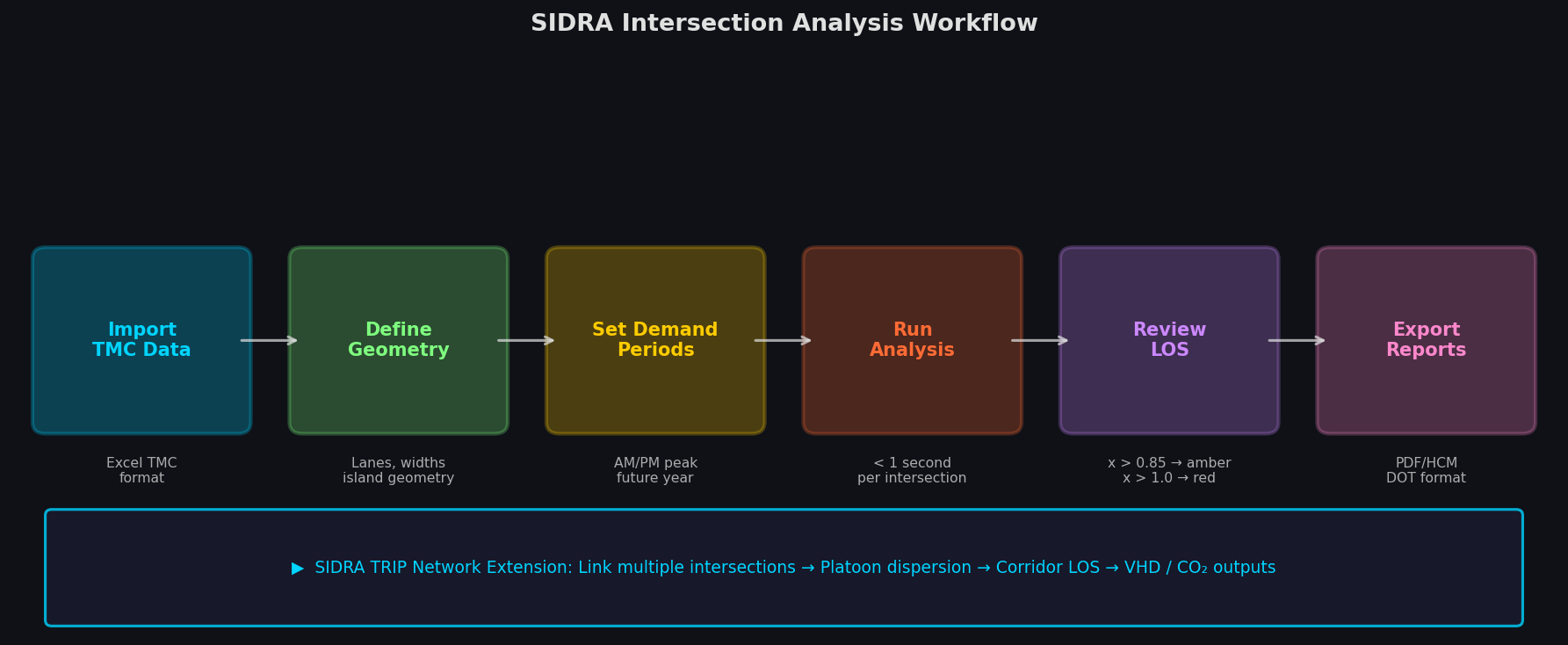
A typical SIDRA project follows this sequence:
- Import TMC data — SIDRA accepts Excel-formatted count files; the import wizard maps turning movements to approach lanes automatically
- Define geometry — lane widths, number of lanes, storage lengths, and island geometry for roundabouts
- Set demand periods — AM peak, PM peak, and future-year scenarios can be stored in a single file
- Run analysis — computation takes under one second per intersection
- Review LOS summary — the dashboard flags movements exceeding x > 0.85 (approaching capacity) in amber and x > 1.0 (over capacity) in red
- Export reports — SIDRA generates formatted PDF reports compliant with state DOT submission requirements, including HCM-style LOS tables and movement-level delay summaries
Limitations and Complementary Tools
SIDRA is an analytical (deterministic) model, not a stochastic microsimulator. It does not capture:
- Spillback interactions between adjacent intersections (use VISSIM or AIMSUN for tight spacing < 200 m)
- Driver behavior heterogeneity — all drivers follow the same gap-acceptance distribution
- Dynamic demand variation within a peak period — demand is treated as constant over the analysis interval
For preliminary design, signal warrant studies, and roundabout feasibility assessments, SIDRA's speed and HCM compliance make it the preferred tool. For final design of complex interchanges or congested urban networks, SIDRA results are typically used to initialize and validate a microscopic simulation model.
Further Resources
- SIDRA Solutions official documentation and tutorials
- HCM 7th Edition, Chapters 17–22 — foundational methodology
- FHWA Roundabout Guide — design standards referenced by SIDRA's geometry defaults
- ITE Traffic Engineering Handbook — intersection analysis context