

Ansys Lumerical 2026 R1: VCSEL Design Tool, PyLumerical Automation, and Synopsys Photonic Integration
Ansys has released Lumerical 2026 R1, a significant update to its photonic simulation platform that introduces a dedicated VCSEL Design Tool, the new PyLumerical Python automation framework, and substantially deeper integration with Synopsys OptoCompiler. The release targets photonic integrated circuit (PIC) designers, laser engineers, and optoelectronics researchers who require tightly coupled multiphysics simulation across optical, electrical, and thermal domains.
VCSEL Design Tool: Coupled Multiphysics for Laser Cavities
The headline addition in 2026 R1 is the VCSEL Design Tool, integrated directly into Lumerical Multiphysics (currently in beta for Enterprise license holders). Vertical-Cavity Surface-Emitting Lasers are notoriously difficult to simulate accurately because their performance depends on the simultaneous interaction of optical cavity modes, carrier dynamics, and thermal gradients.
The new tool addresses this by enabling fully coupled optical, electrical, and thermal simulations within a single environment. Engineers can:

- Import epitaxial layer stacks from
.csvspreadsheets, including doping profiles and alloy grading, to automatically construct complex DBR and active region geometries. - Simulate cavity modes and LIV curves, accounting for gain, group velocity, photon lifetime, and spontaneous emission.
- Visualize standing waves and refractive index profiles to verify quantum well and oxide aperture alignment before committing to fabrication.
- Model III-V semiconductor optical materials with graded alloy compositions via a dedicated scripting interface.
This integrated approach eliminates the manual data transfer between separate optical, electrical, and thermal solvers that has historically made VCSEL design iteration slow and error-prone.
PyLumerical: Python-Native Automation Across the Lumerical Suite
The 2026 R1 release also debuts PyLumerical, a Python-based automation framework that replaces legacy scripting approaches with a modern, PyAnsys-compatible API. PyLumerical provides programmatic access to Lumerical's core solvers—FDTD, MODE, Multiphysics, and INTERCONNECT—and integrates with the broader Ansys Python ecosystem, including OptiSLang for design optimization and Speos for system-level optical analysis.
Key capabilities include:
- Automated simulation setup and parameter sweeps without relying on the GUI, enabling large-scale design space exploration.
- Integration with open-source Python libraries (NumPy, SciPy, Matplotlib) for custom post-processing and data analysis pipelines.
- Compatibility with Ansys OptiSLang for sensitivity analysis and surrogate model-based optimization of photonic components.
For teams building automated design-to-verification pipelines, PyLumerical significantly lowers the barrier to scripted, reproducible simulation workflows.
Synopsys OptoCompiler Integration: Closing the PIC Design Loop
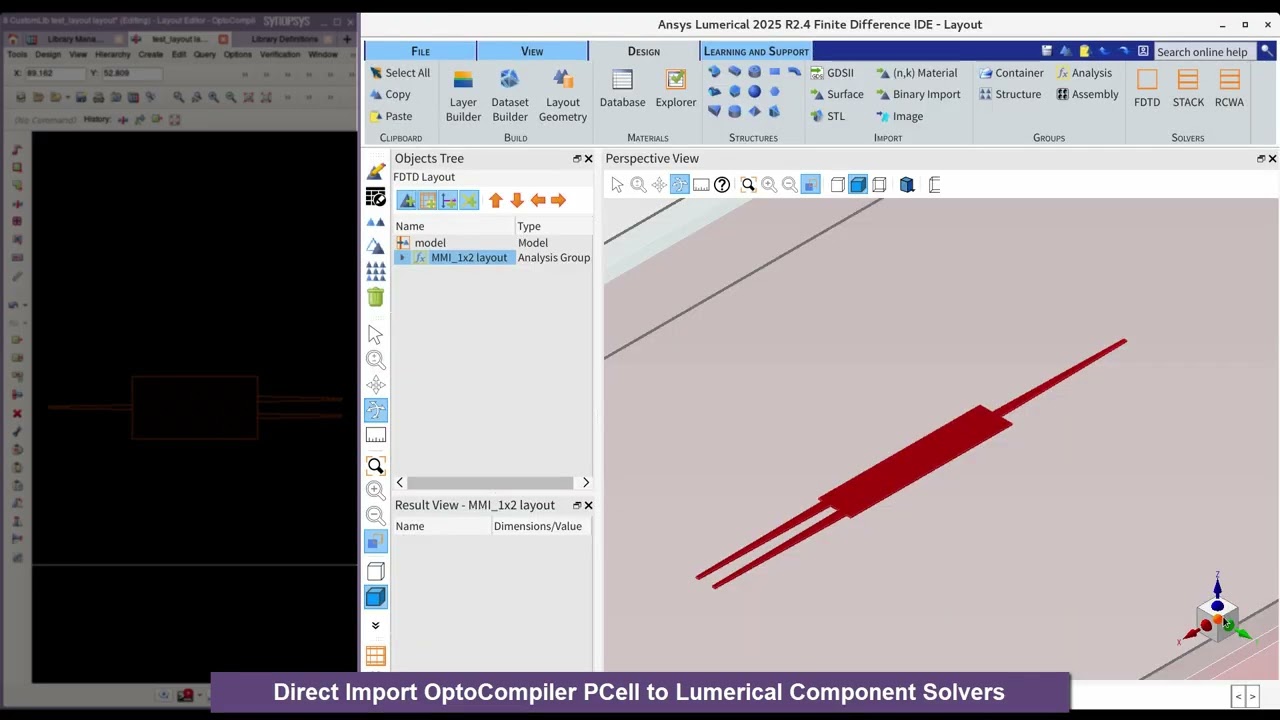
Following the Synopsys-Ansys union, 2026 R1 delivers the first substantive co-design integration between Lumerical and Synopsys OptoCompiler. A new Direct Bridge allows component engineers to import parametric cell layouts from OptoCompiler directly into Lumerical FDTD or MODE using a Layout Geometry Wizard, enabling component-level electromagnetic simulation without manual geometry reconstruction.
At the circuit level, PIC designers can now run Lumerical INTERCONNECT directly within the OptoCompiler environment via PrimeWave, performing transient photonic circuit simulations and analyzing results in WaveView—all without leaving the OptoCompiler workflow. The CML Compiler can additionally generate photonic Verilog-A compact models compatible with Synopsys PrimeSim HSPICE and PrimeSim SPICE, enabling electro-optical co-simulation for high-speed SerDes and datacom applications.
A new CMOS Image Sensor (CIS) workflow bridges Synopsys Sentaurus TCAD and Lumerical FDTD, allowing geometry and material data to be exchanged via TDR files. Optical generation rate results from FDTD can be exported back to Sentaurus S-Device for electro-thermal analysis, closing the loop between fabrication process simulation and optical performance prediction.
GPU-Accelerated FDTD and INTERCONNECT Improvements
On the solver performance side, the FDTD solver gains a Direct Meshing to GPU feature that reduces host memory requirements and shortens total wall time for large 3D geometries with curved surfaces—a common bottleneck in nanophotonic device simulation. GPU acceleration has also been extended to volumetric current sources and broadband sources, which are critical for inverse design workflows using LumOpt.
INTERCONNECT receives memory performance improvements to support longer simulation times, addressing a practical limitation for complex tasks such as TDECQ calculations and bit error rate (BER) estimation in high-speed optical links. A beta IBIS-AMI model is also available for simulating optical SerDes links using machine learning to capture non-linear device behavior.
Availability and Further Information
Ansys Lumerical 2026 R1 is available now for existing license holders. Full release notes and documentation are available at the Ansys Optics support portal. The VCSEL Design Tool requires an Enterprise license and activation through Ansys support.