

AnyLogic Pedestrian Library: Simulating Crowd Behavior and Evacuation Dynamics
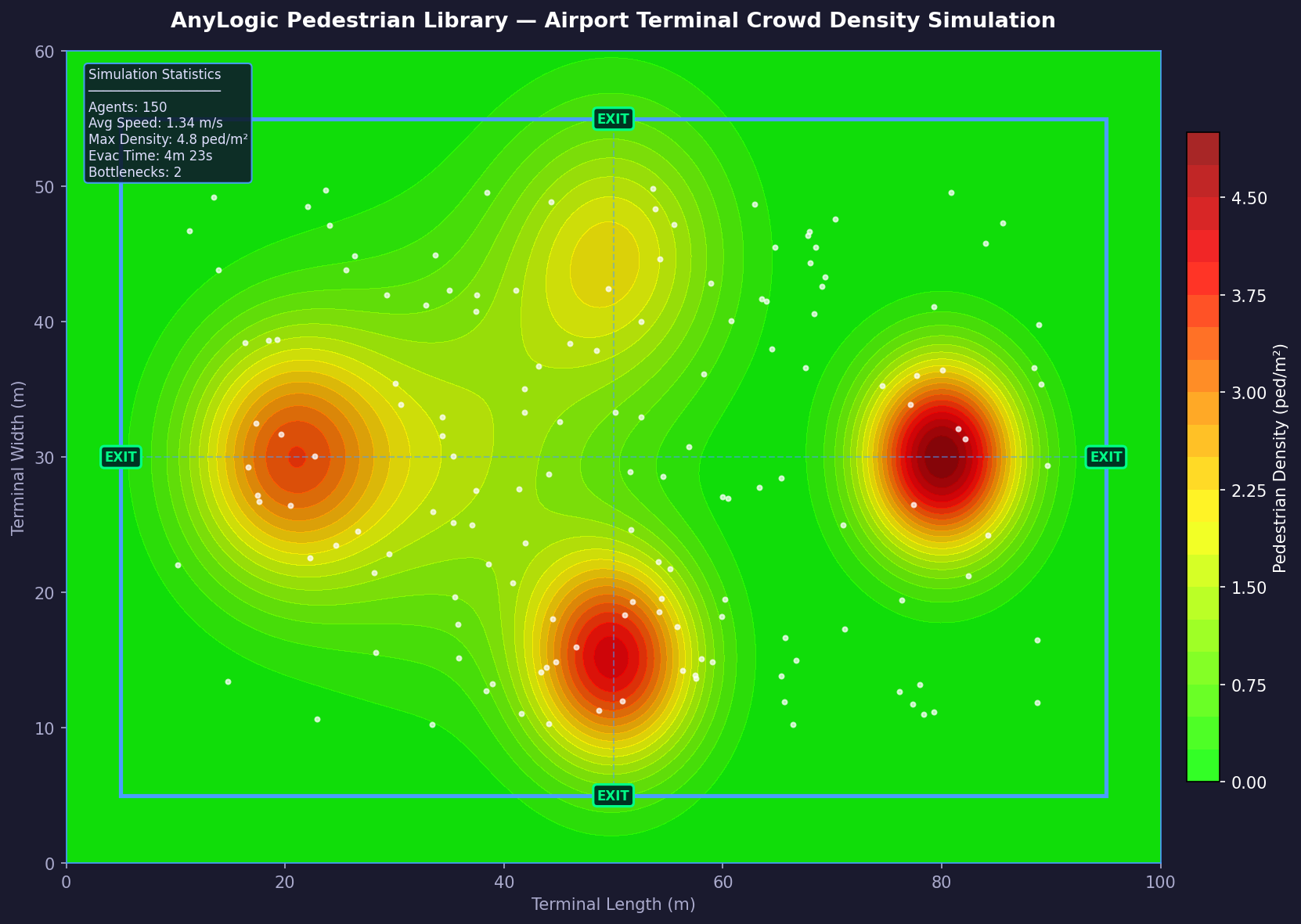
Crowd behavior simulation is one of the most demanding applications in agent-based modeling. Whether you are designing a stadium evacuation plan, optimizing airport terminal throughput, or analyzing pedestrian flow in a transit hub, the accuracy of your model depends on how faithfully individual agents respond to their environment and to each other. AnyLogic's Pedestrian Library is a purpose-built toolkit within the AnyLogic platform that addresses exactly this challenge — combining continuous-space movement, social force physics, and rich behavioral logic in a single, commercially supported environment.
What Is the AnyLogic Pedestrian Library?
AnyLogic is a multi-method simulation platform that supports agent-based, discrete-event, and system dynamics modeling within a single Java-based IDE. The Pedestrian Library is one of its domain-specific extension libraries, alongside the Road Traffic Library and the Rail Library. It provides a set of pre-built blocks — PedSource, PedSink, PedGoTo, PedWait, PedService, and others — that can be assembled visually on a floor-plan canvas to define pedestrian flows without writing low-level physics code.
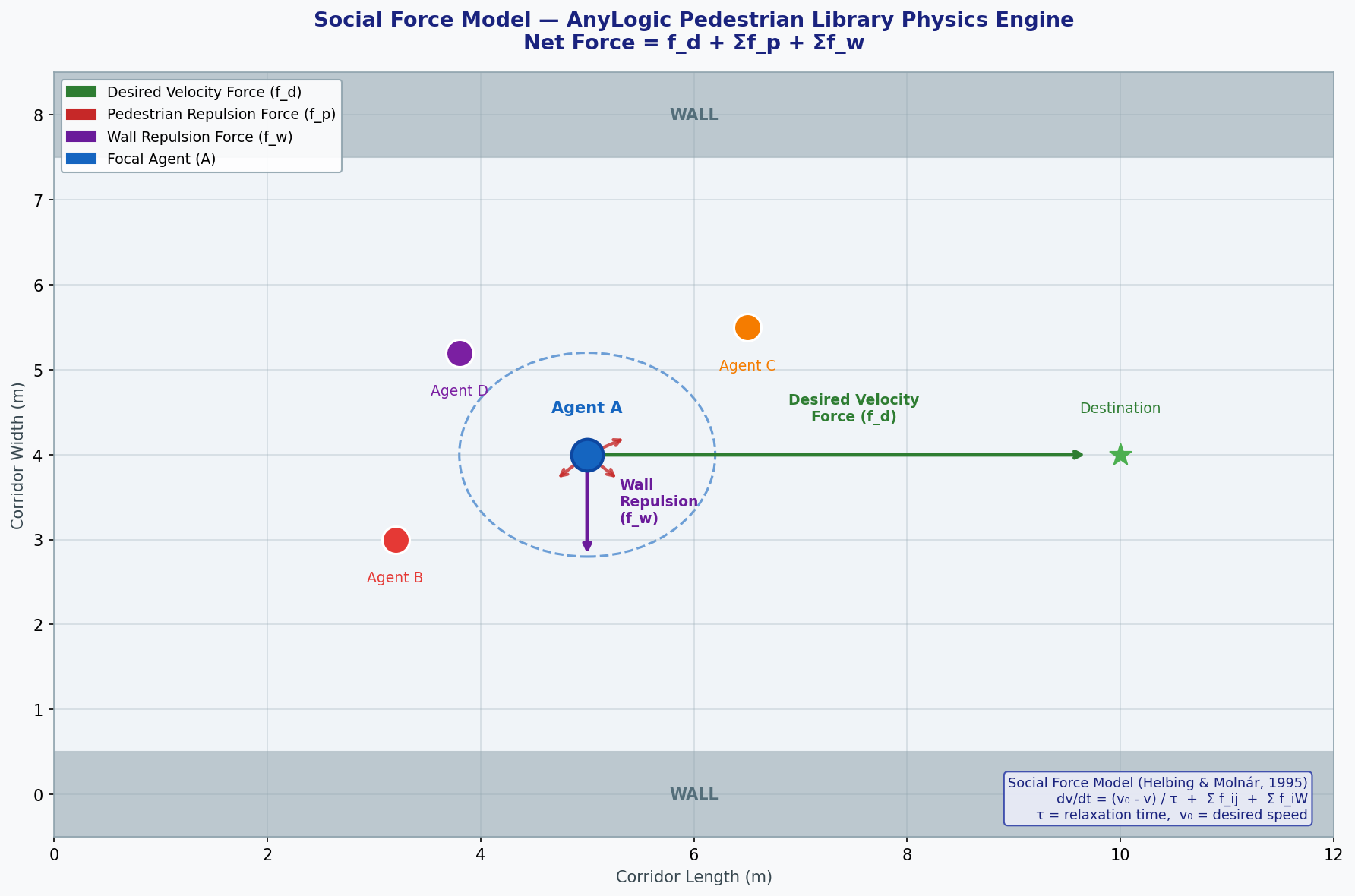
Internally, each pedestrian agent is governed by the Social Force Model (Helbing & Molnár, 1995), which treats crowd movement as the result of three competing forces:

- Desired velocity force — the agent's drive toward its current target.
- Repulsive forces from other pedestrians — personal-space maintenance that produces realistic lane formation and bottleneck queuing.
- Repulsive forces from walls and obstacles — boundary avoidance that keeps agents on navigable paths.
This physics layer runs in continuous 2-D space, meaning agents are not constrained to a grid. The result is smooth, emergent crowd behavior — including counter-flow lane formation, arching at bottlenecks, and density-dependent speed reduction — without hand-coding any of these phenomena.
Setting Up a Floor-Plan Model
The typical workflow begins by importing a CAD or image floor plan directly into the AnyLogic canvas. The library's Pedestrian Space element defines the walkable area, and Wall and Target Line elements mark boundaries and destinations respectively.
A minimal evacuation model requires only a few blocks:
PedSource— generates pedestrians at a specified rate or from a schedule; supports statistical distributions for arrival inter-arrival times.PedGoTo— directs agents to a target line or area; the library's path-planning engine automatically computes collision-free routes using a navigation mesh.PedSink— removes agents who have reached an exit, recording transit time and density statistics.
For service scenarios (security checkpoints, ticket gates), PedService adds a queue-and-server pattern with configurable service-time distributions, directly analogous to discrete-event queuing but rendered in continuous space.
Behavioral Layers Beyond Physics
The Social Force Model handles low-level movement, but real crowds exhibit higher-level behaviors: route choice under uncertainty, response to signage, herding under panic, and compliance with staff instructions. AnyLogic addresses these through statechart-driven agent logic layered on top of the physics engine.
Each pedestrian agent can carry a statechart that transitions between behavioral states — Normal, Evacuating, Panicking — based on environmental triggers such as alarm signals, smoke density fields, or proximity to other panicking agents. This two-layer architecture (physics + statechart) is what distinguishes AnyLogic's approach from pure social-force simulators: you can model why agents change direction, not just how they move.
Additionally, the library supports pedestrian groups (families, tour groups) that maintain cohesion forces, and density maps that visualize real-time crowd concentration as a heat map overlaid on the floor plan.
Calibration and Validation
A common pitfall in pedestrian simulation is over-reliance on default parameters. The Social Force Model's key parameters — desired speed distribution, relaxation time, repulsion strength, and interaction range — must be calibrated against empirical data for the specific population and environment being modeled.
AnyLogic supports calibration through its Optimization Experiment, which uses OptQuest or a built-in evolutionary algorithm to minimize the difference between simulated and observed metrics (e.g., evacuation time, flow rate at a bottleneck). Observed data can come from video tracking studies, sensor counts, or published pedestrian flow datasets such as those from the Pedestrian Dynamics Data Archive.
For validation, the library's built-in statistics collection records per-agent trajectory data, density time-series, and service-level metrics that can be exported to CSV for comparison against field measurements or against benchmark scenarios from the literature (e.g., the NIST World Trade Center evacuation study).
Performance Considerations
AnyLogic's Pedestrian Library runs on the JVM and is single-threaded by default. For models with tens of thousands of agents, performance can become a constraint. Practical strategies include:
- Spatial partitioning: The library uses a cell-based spatial index internally; keeping floor-plan resolution appropriate to the scenario avoids unnecessary neighbor searches.
- Agent pooling: Reusing pedestrian objects rather than creating and destroying them reduces garbage-collection pressure in long-run simulations.
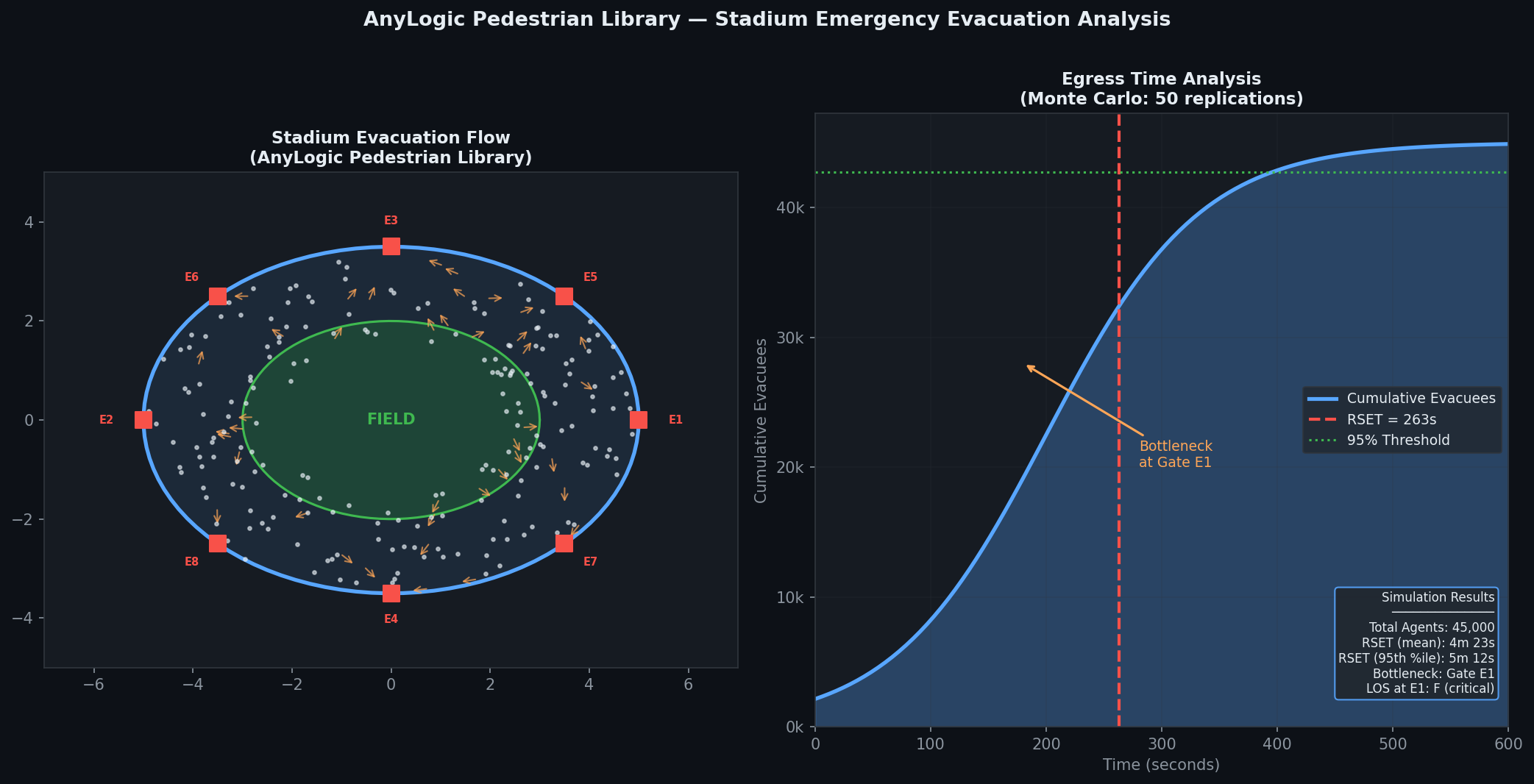
- Distributed experiments: AnyLogic Cloud or AnyLogic Professional's multi-run experiment framework distributes parameter sweeps across CPU cores or cloud nodes, enabling Monte Carlo studies with hundreds of replications.
For very large venues (100,000+ agents), practitioners sometimes couple AnyLogic with a mesoscopic flow model for distant zones, switching to the full social-force model only in critical areas — a hybrid approach AnyLogic's multi-method architecture supports natively.
Practical Applications
The Pedestrian Library has been applied across a wide range of real-world projects:
- Stadium and arena design: Evaluating egress times under normal and emergency conditions to meet NFPA 101 life-safety code requirements.
- Airport terminal optimization: Modeling security checkpoint staffing levels and gate assignment strategies to minimize passenger dwell time.
- Rail station planning: Assessing platform capacity and stairway widths for new transit infrastructure.
- Event management: Simulating festival crowd dynamics to identify crush-risk zones before an event takes place.
Getting Started
AnyLogic offers a free Personal Learning Edition (PLE) that includes the Pedestrian Library with a model-size limit suitable for learning and prototyping. The AnyLogic Help documentation provides a comprehensive API reference, and the AnyLogic Cloud model repository hosts several open pedestrian models — including airport, stadium, and subway station examples — that serve as practical starting points.
For teams requiring production deployments, AnyLogic Professional and University licenses remove model-size restrictions and add the Optimization Experiment and AnyLogic Cloud integration needed for large-scale calibration studies.
Conclusion
AnyLogic's Pedestrian Library occupies a productive middle ground between academic social-force simulators and full-featured crowd-safety engineering tools. Its visual floor-plan workflow lowers the barrier to entry, while the statechart behavioral layer and optimization experiment support the rigor required for professional safety analysis. For simulation practitioners working on built-environment design, event planning, or emergency management, it represents one of the most complete and immediately deployable pedestrian modeling toolkits available today.
Further Reading: