
Mesa: Python-Native Agent-Based Modeling for Social System Simulation
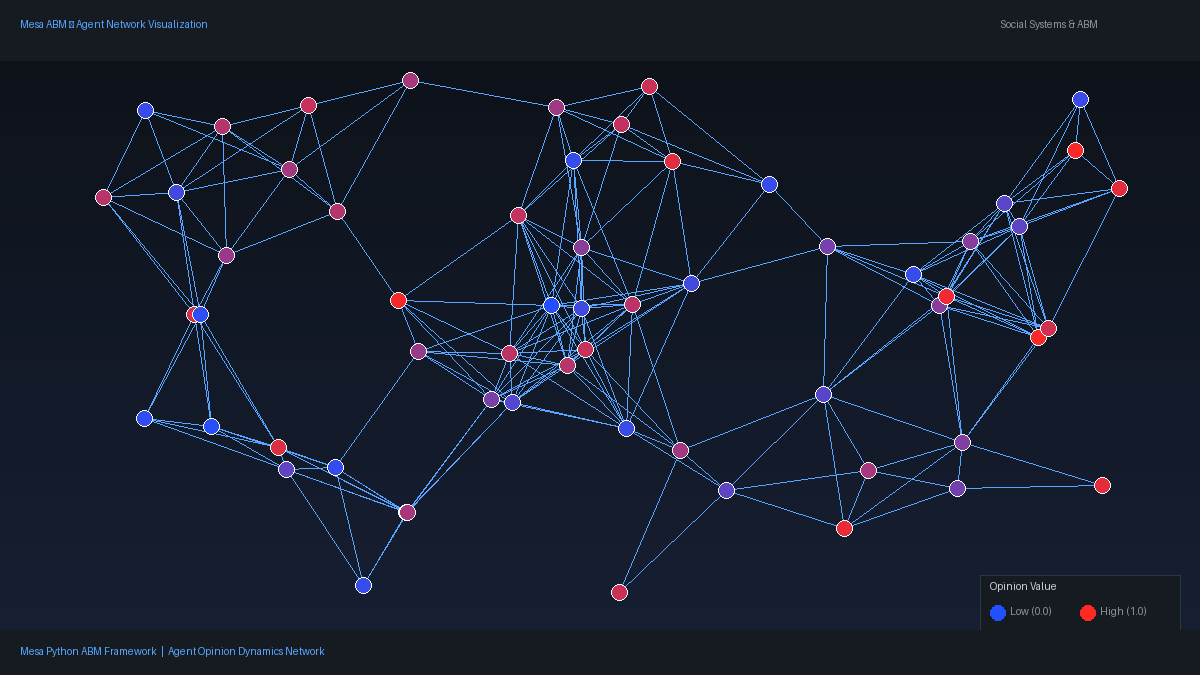
Agent-based modeling (ABM) has long been dominated by Java-based platforms and domain-specific languages. Mesa, an open-source Python framework developed at George Mason University and maintained by the broader Python scientific community, changes that equation. By bringing ABM directly into the Python ecosystem, Mesa enables social scientists, economists, and systems researchers to build, analyze, and visualize complex agent-based models using the same tools they already rely on—NumPy, pandas, Matplotlib, and Jupyter notebooks.
This article examines Mesa's architecture, its key modeling primitives, and best practices for building rigorous social-system simulations.
Why Mesa for Social Systems?
Traditional ABM platforms like NetLogo and MASON require researchers to learn proprietary languages or navigate heavyweight Java environments. Mesa's Python-first design offers several concrete advantages:

- Zero context switching: Model logic, statistical analysis, and visualization all live in the same Python environment.
- Reproducible research: Models run inside Jupyter notebooks can be shared as self-contained
.ipynbfiles, complete with results and charts. - Rich ecosystem integration: Leverage
scipyfor statistical distributions,networkxfor social network topologies, andscikit-learnfor behavioral classification—without any bridging code. - Active maintenance: Mesa 2.x (released 2023) introduced a modernized API with improved batch-run support and a cleaner agent scheduler interface.
Core Architecture
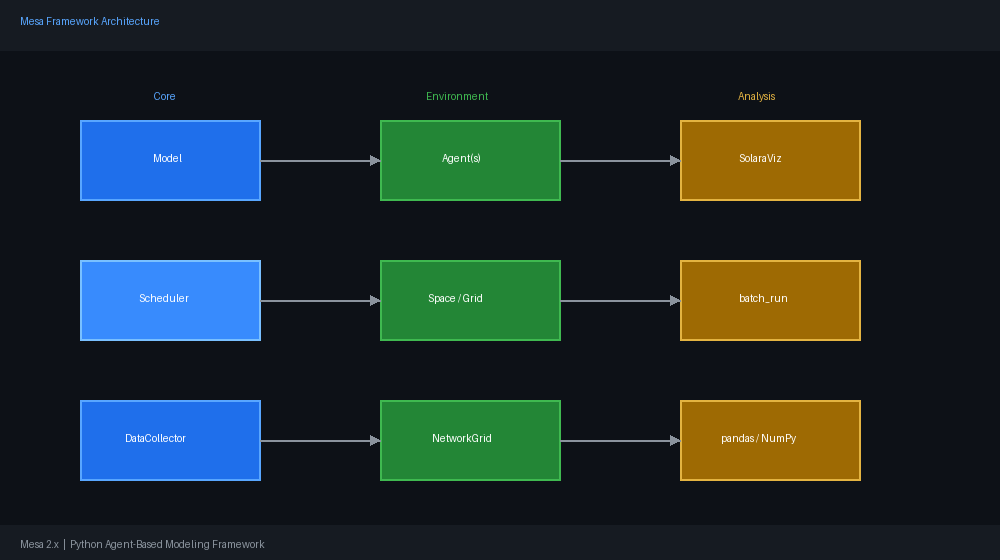
Mesa organizes every simulation around three primary abstractions:
1. Agent
The Agent base class represents an individual actor in the simulation. Each agent holds its own state variables and implements a step() method that encodes its decision logic. For social-system models, this is where you define behavioral rules—opinion updating, resource consumption, network link formation, or migration decisions.
from mesa import Agent

class CitizenAgent(Agent):
    def __init__(self, unique_id, model, opinion=0.5):
        super().__init__(unique_id, model)
        self.opinion = opinion

    def step(self):
        neighbors = self.model.grid.get_neighbors(self.pos, moore=True, include_center=False)
        if neighbors:
            avg_opinion = sum(n.opinion for n in neighbors) / len(neighbors)
            # Bounded confidence update (Deffuant model)
            if abs(self.opinion - avg_opinion) < 0.3:
                self.opinion += 0.5 * (avg_opinion - self.opinion)
2. Model
The Model class is the simulation container. It initializes agents, configures the environment, and advances the simulation clock. Mesa's RandomActivation and SimultaneousActivation schedulers give you fine-grained control over the order in which agents execute their step() methods—a critical choice in social dynamics models where update order can significantly affect emergent outcomes.
3. Spaces
Mesa provides two spatial paradigms:
- Grid spaces (
SingleGrid,MultiGrid): Discrete lattice environments suitable for neighborhood-effect models (opinion diffusion, disease spread, residential segregation). - Network spaces (
NetworkGrid): Agents placed on nodes of anetworkxgraph, ideal for social network influence models, information cascades, and organizational hierarchy simulations.
Best Practice: Batch Runs
and Parameter Sweeps
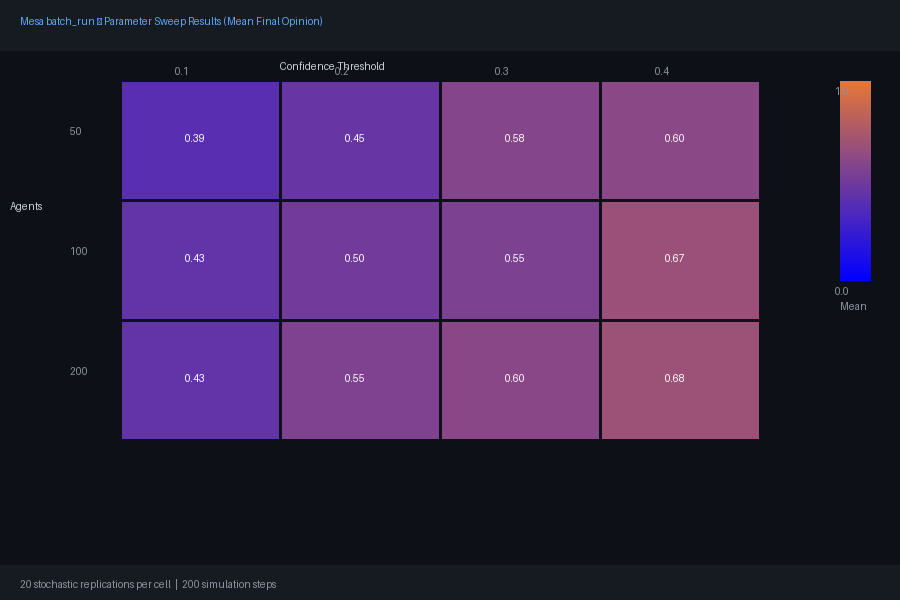
One of Mesa's most powerful features for rigorous research is its batch_run utility, introduced in Mesa 2.x. Rather than running a single simulation, batch_run executes the model across a full parameter grid and returns results as a pandas DataFrame—ready for statistical analysis.
from mesa.batchrunner import batch_run
import pandas as pd

params = {
    "num_agents": [50, 100, 200],
    "confidence_threshold": [0.1, 0.2, 0.3, 0.4],
}

results = batch_run(
    OpinionDynamicsModel,
    parameters=params,
    iterations=20,          # 20 stochastic replications per parameter set
    max_steps=200,
    data_collection_period=10,
)

df = pd.DataFrame(results)
This pattern is essential for social-system research: stochastic models require multiple replications to distinguish signal from noise, and parameter sensitivity analysis is often the primary scientific contribution. With batch_run, a full sweep that would take hours of manual scripting runs in a few lines.
Data Collection with DataCollector
Mesa's DataCollector class captures model-level and agent-level metrics at each time step without cluttering model logic:
from mesa import DataCollector

self.datacollector = DataCollector(
    model_reporters={"Mean Opinion": lambda m: sum(a.opinion for a in m.schedule.agents) / m.num_agents},
    agent_reporters={"Opinion": "opinion", "Position": "pos"},
)
After the run, model.datacollector.get_model_vars_dataframe() returns a time-indexed DataFrame that integrates directly with Matplotlib or Plotly for publication-quality charts.
Visualization: SolaraViz
Mesa 2.x ships with SolaraViz, a browser-based interactive visualization layer built on the Solara reactive UI framework. SolaraViz renders agent grids and network topologies in real time, with sliders for live parameter adjustment—enabling exploratory analysis without restarting the simulation.
For headless batch runs on HPC clusters, visualization can be disabled entirely, keeping computational overhead minimal.
Practical Limitations and Mitigations
| Limitation | Mitigation |
|---|---|
| Single-threaded Python GIL limits parallelism | Use batch_run with multiprocessing or distribute across HPC nodes |
| No built-in GIS support | Integrate geopandas + shapely for geospatial agent placement |
| Large models (>100k agents) slow in pure Python | Profile with cProfile; vectorize agent state with NumPy arrays |
| No native 3D visualization | Export to matplotlib 3D or plotly for post-hoc rendering |
Getting Started
Install Mesa and its visualization dependencies:
pip install mesa[viz]The official Mesa documentation includes a step-by-step tutorial building a Schelling segregation model—an ideal starting point for social-system researchers. The Mesa Examples repository on GitHub provides over 20 reference models spanning opinion dynamics, epidemiology, economic markets, and organizational behavior.
For deeper theoretical grounding on agent-based social simulation, the Journal of Artificial Societies and Social Simulation (JASSS) publishes peer-reviewed Mesa-based studies across sociology, economics, and political science.
Conclusion
Mesa's Python-native design makes it the most accessible entry point for researchers who want to build rigorous, reproducible agent-based social simulations without leaving the scientific Python ecosystem. Its batch_run infrastructure, flexible spatial abstractions, and tight integration with pandas and Matplotlib make it equally suitable for exploratory prototyping and publication-grade parameter studies. For teams already working in Python, Mesa eliminates the toolchain friction that has historically been a barrier to adopting agent-based methods in social science research.