
AnyLogic's Process Modeling Library: Advanced Assembly Line Balancing Techniques
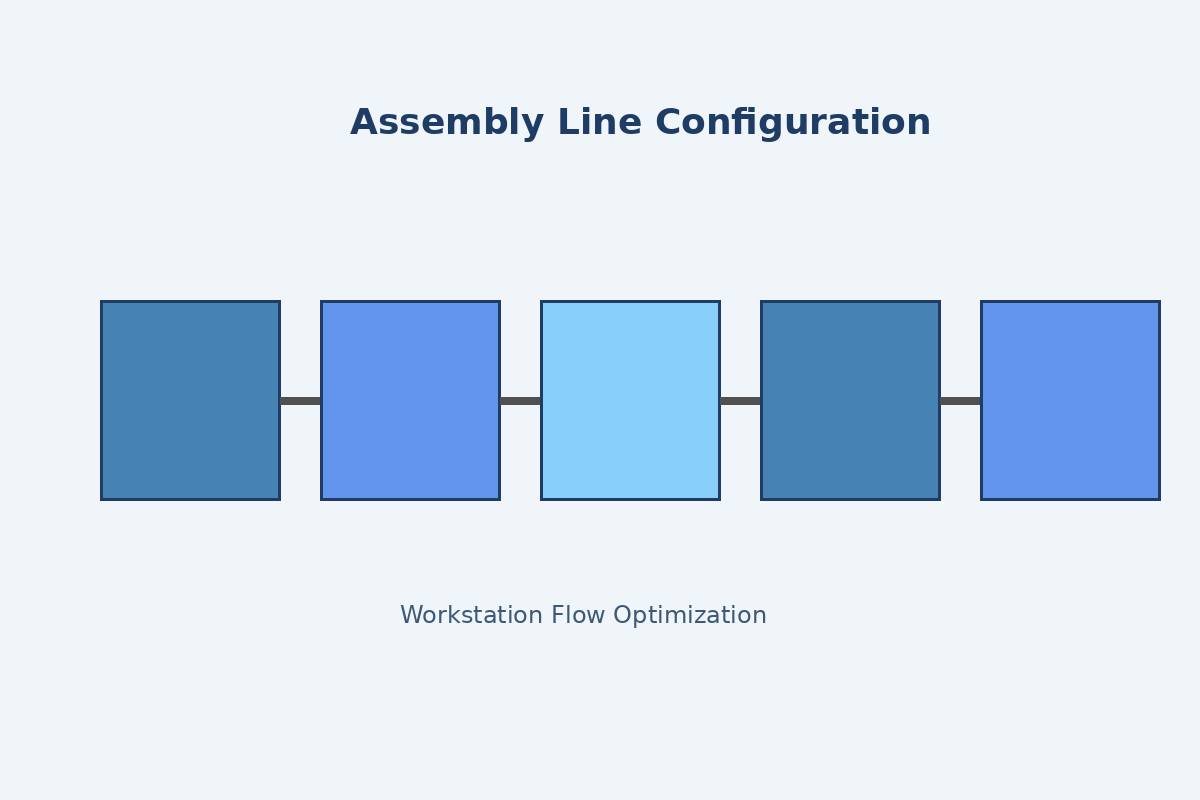
Assembly line balancing remains one of the most critical challenges in modern manufacturing, directly impacting throughput, labor utilization, and production costs. AnyLogic's Process Modeling Library (PML) provides a sophisticated framework for modeling and optimizing assembly line configurations, enabling engineers to achieve optimal workstation allocation and minimize cycle time variability.
Understanding the Process Modeling Library Architecture
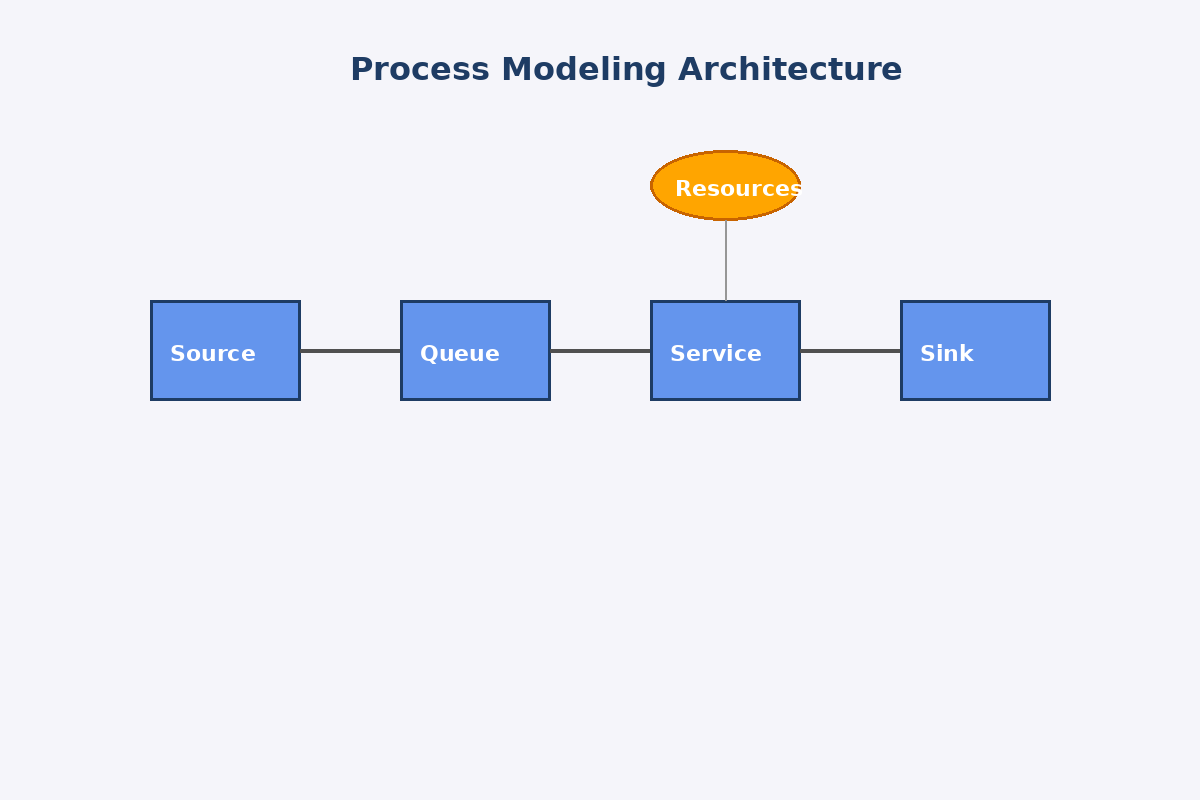
The Process Modeling Library in AnyLogic employs a discrete-event simulation paradigm specifically designed for manufacturing workflows. Unlike generic modeling approaches, PML offers pre-built blocks that represent real-world manufacturing entities: ResourcePool for workers and equipment, Queue for buffer zones, Seize-Delay-Release patterns for workstation operations, and Service blocks for processing tasks with statistical distributions.
This architecture allows engineers to construct assembly line models that accurately capture the stochastic nature of manufacturing operations—variable task times, equipment failures, worker efficiency variations, and material arrival patterns. The library's strength lies in its ability to model these complexities without requiring extensive custom coding.

Implementing Line Balancing Analysis
Assembly line balancing in AnyLogic begins with defining workstation capacities and task precedence relationships. The Service block becomes the fundamental building unit, where each block represents a discrete assembly operation. Engineers configure processing time distributions (normal, triangular, or empirical) based on time-study data, creating realistic task duration models.
The critical innovation in AnyLogic's approach is the integration of resource constraints with process flow. By connecting ResourcePool blocks to Service operations, the model automatically handles resource contention, queue formation, and blocking/starving conditions. This enables engineers to identify bottleneck workstations through built-in statistics collectors that track utilization rates, queue lengths, and throughput metrics.
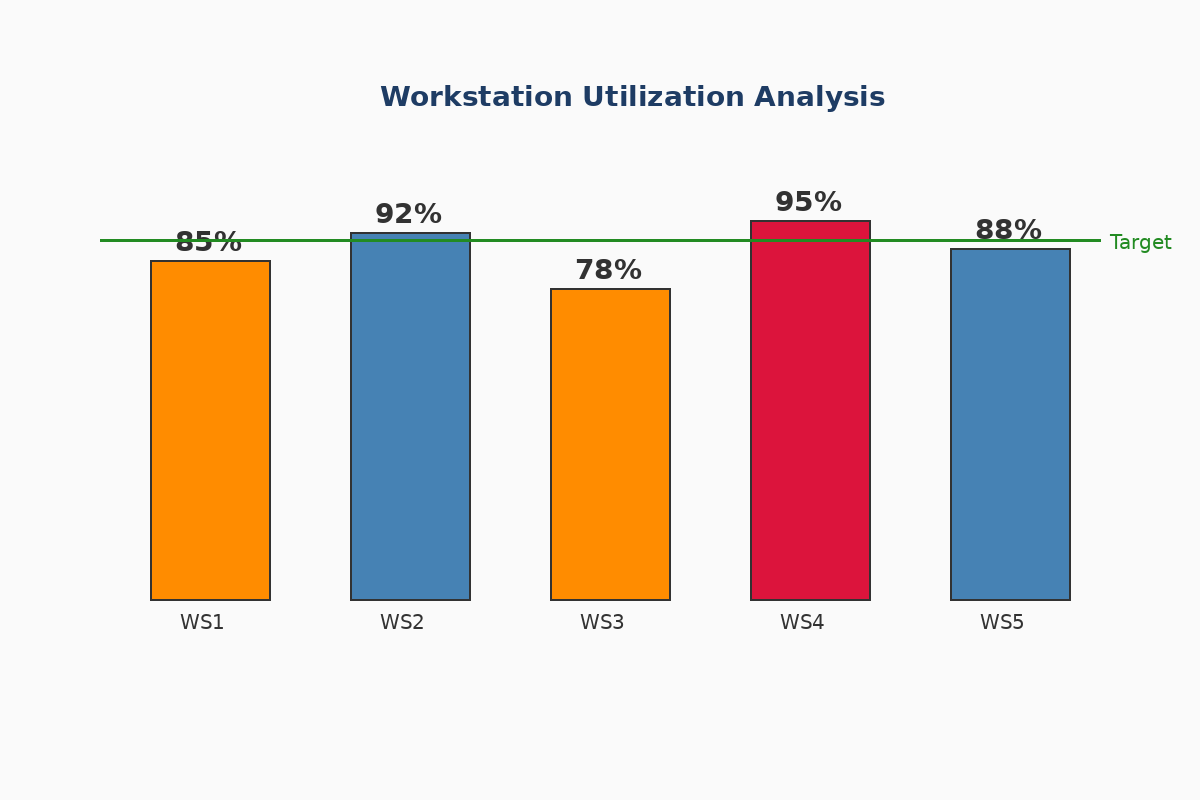
For complex assembly lines with parallel workstations and flexible routing, AnyLogic's SelectOutput block provides intelligent load-balancing logic. Engineers can implement various dispatching rules—shortest queue, least utilized resource, or custom priority algorithms—to optimize work distribution across parallel stations.
Optimization Experiments and What-If Analysis
AnyLogic's Optimization Experiment framework transforms line balancing from a trial-and-error process into a systematic optimization problem. Engineers define decision variables (number of workers per station, buffer sizes, task assignments) and objective functions (minimize cycle time, maximize throughput, minimize labor cost). The built-in OptQuest engine then explores the solution space using metaheuristic algorithms.
A typical optimization scenario might involve determining the optimal number of workers for each of five workstations, subject to constraints on total labor budget and minimum throughput requirements. The experiment automatically runs thousands of simulation replications, evaluating different configurations and converging on Pareto-optimal solutions that balance competing objectives.
The Parameter Variation experiment complements optimization by enabling sensitivity analysis. Engineers can systematically vary task times, arrival rates, or resource counts to understand how system performance degrades under different scenarios—essential for robust line design that performs well under uncertainty.
Advanced Features for Modern Manufacturing
AnyLogic's PML extends beyond basic line balancing to address contemporary manufacturing challenges. The library supports mixed-model assembly lines where different product variants share the same line, requiring dynamic task sequencing and flexible resource allocation. The Batch block enables modeling of lot-based production, while the Combine and Split blocks handle assembly and disassembly operations.
For Industry 4.0 applications, AnyLogic models can integrate with real-time data sources through database connections and REST APIs. This enables digital twin implementations where the simulation model continuously synchronizes with actual production data, providing real-time performance monitoring and predictive analytics.
The 3D animation capabilities in AnyLogic provide powerful visualization for stakeholder communication. Engineers can create photorealistic representations of assembly lines, with animated workers, moving conveyors, and accumulating inventory—making simulation results accessible to non-technical decision-makers.
Practical Implementation Considerations
Successful assembly line balancing with AnyLogic requires careful attention to model validation. Engineers should calibrate processing time distributions using actual production data, validate queue behavior against observed patterns, and verify that simulated throughput matches historical performance. AnyLogic's built-in statistical analysis tools, including confidence intervals and warm-up period detection, support rigorous validation protocols.
Model complexity must be balanced against computational efficiency. While AnyLogic can handle extremely detailed models with thousands of entities, practical line balancing studies often benefit from appropriate abstraction—modeling workstation clusters rather than individual operations, or using aggregate resource pools rather than individual workers.
Documentation and model organization become critical for long-term model maintenance. AnyLogic's hierarchical modeling capabilities allow engineers to encapsulate workstation logic into reusable agent types, creating modular models that can be easily modified as production requirements evolve.
Conclusion
AnyLogic's Process Modeling Library provides manufacturing engineers with a comprehensive toolkit for assembly line balancing and optimization. By combining intuitive visual modeling with powerful optimization algorithms and real-time integration capabilities, AnyLogic enables organizations to design efficient, flexible assembly systems that adapt to changing production demands. The investment in simulation-based line balancing typically yields significant returns through reduced cycle times, improved resource utilization, and more robust production systems.
For engineers seeking to implement these techniques, AnyLogic offers extensive documentation, tutorial models, and an active user community. The AnyLogic Cloud platform also enables web-based model deployment, allowing stakeholders to interact with optimization tools without requiring desktop software installation.