
Drake: Model-Based Design and Trajectory Optimization for Robotic Manipulation
Drake is an open-source C++ and Python toolbox developed by the Toyota Research Institute (TRI) and MIT, purpose-built for model-based design, analysis, and control of robotic systems. Unlike physics simulators that prioritize visual fidelity, Drake centers on mathematical rigor: it provides a unified framework for multibody dynamics, trajectory optimization, and feedback control synthesis—making it the tool of choice for researchers and engineers tackling complex manipulation tasks.
Core Architecture: Systems Framework
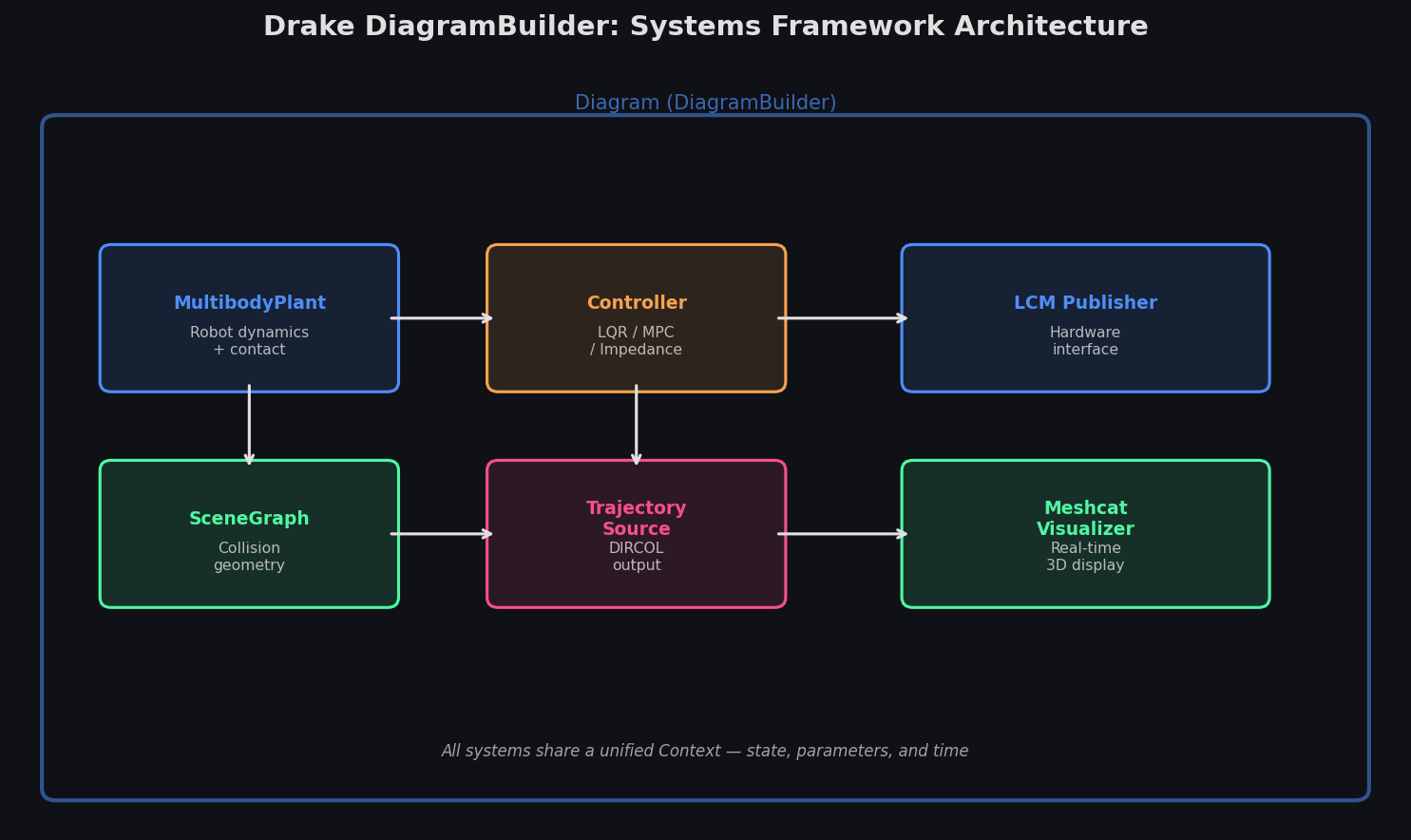
Drake's architecture revolves around a block-diagram systems framework called DiagramBuilder. Every component—a robot plant, a controller, a sensor model, a visualizer—is a System with declared input/output ports. You wire systems together into a Diagram, which Drake then simulates as a unified dynamical system.
from pydrake.all import DiagramBuilder, AddMultibodyPlantSceneGraph, Parser

builder = DiagramBuilder()
plant, scene_graph = AddMultibodyPlantSceneGraph(builder, time_step=1e-3)
parser = Parser(plant)
parser.AddModelsFromUrl("package://drake_models/iiwa_description/urdf/iiwa14_no_collision.urdf")
plant.Finalize()
diagram = builder.Build()
This composability means you can swap a simulated plant for a hardware interface without changing the controller code—a critical property for sim-to-real transfer.

Multibody Dynamics with Contact
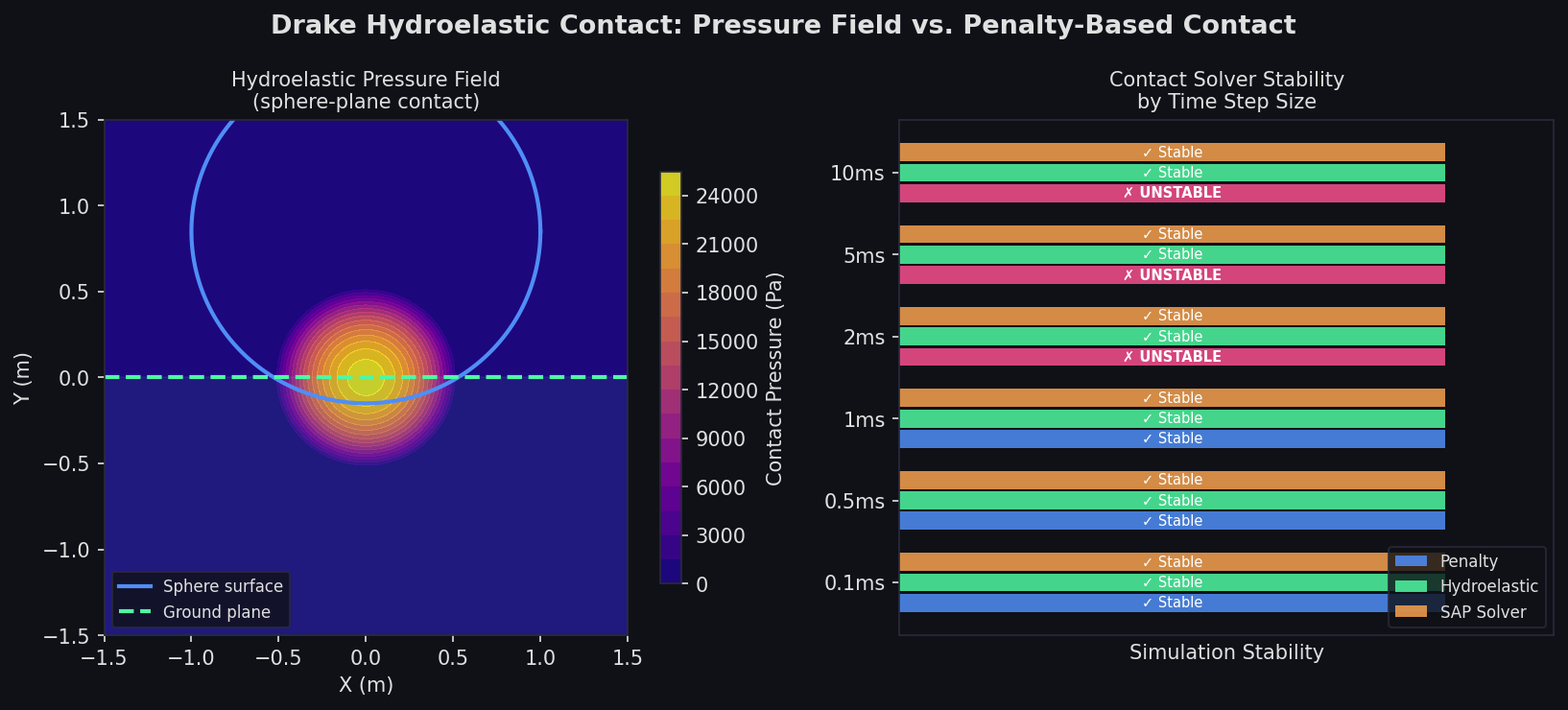
Drake's MultibodyPlant implements rigid body dynamics with compliant contact using the Hydroelastic contact model. Unlike penalty-based methods that require tiny time steps, Hydroelastic contact computes volumetric pressure fields between geometries, enabling stable simulation at millisecond time steps even for objects with complex surface geometry.
Key capabilities include:
- Articulated body inertia (ABI) algorithm for O(n) forward dynamics
- Continuous and discrete-time integration (Runge-Kutta 3, implicit Euler, SAP solver)
- Actuator models with gear ratios, rotor inertia, and joint limits
- Deformable body simulation (FEM-based, for soft manipulation)
The SAP (Semi-Analytic Primal) contact solver handles stiff contact scenarios—grasping, in-hand manipulation, assembly—without the numerical instability that plagues penalty-based simulators.
Trajectory Optimization
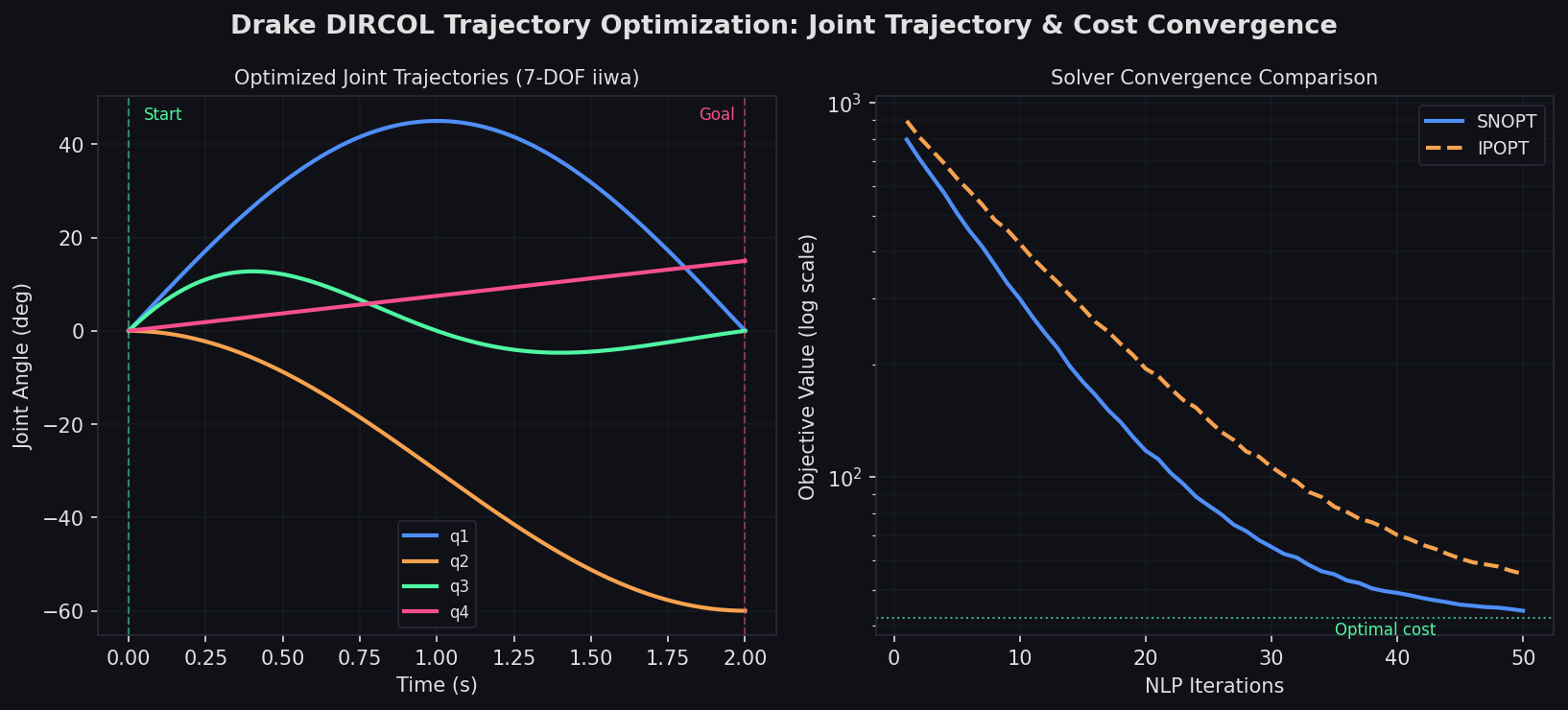
Drake's most distinctive capability is its mathematical programming interface for trajectory optimization. The MathematicalProgram class provides a unified API over multiple solvers (SNOPT, IPOPT, OSQP, Gurobi, Mosek), and higher-level wrappers make trajectory optimization accessible:
Direct Collocation (DIRCOL)
from pydrake.all import DirectCollocation, PiecewisePolynomial

dircol = DirectCollocation(plant, context, num_time_samples=21,
                           minimum_time_step=0.05, maximum_time_step=0.2)
dircol.AddEqualTimeIntervalsConstraints()

# Joint limit constraints
prog = dircol.prog()
dircol.AddConstraintToAllKnotPoints(
    prog.AddLinearConstraint(dircol.state()[:7] <= q_max))

# Running cost: minimize control effort
dircol.AddRunningCost(dircol.input().dot(dircol.input()))
result = Solve(prog)
DIRCOL transcribes the continuous optimal control problem into a nonlinear program, finding globally smooth trajectories that satisfy dynamics, joint limits, and collision avoidance simultaneously.
Kinematic Trajectory Optimization (Toppra / Kinematic IK)
For manipulation tasks where Cartesian paths are pre-specified, Drake's KinematicTrajectoryOptimization generates time-optimal joint trajectories respecting velocity, acceleration, and jerk limits—essential for industrial arms where cycle time matters.
Inverse Kinematics and Grasp Planning
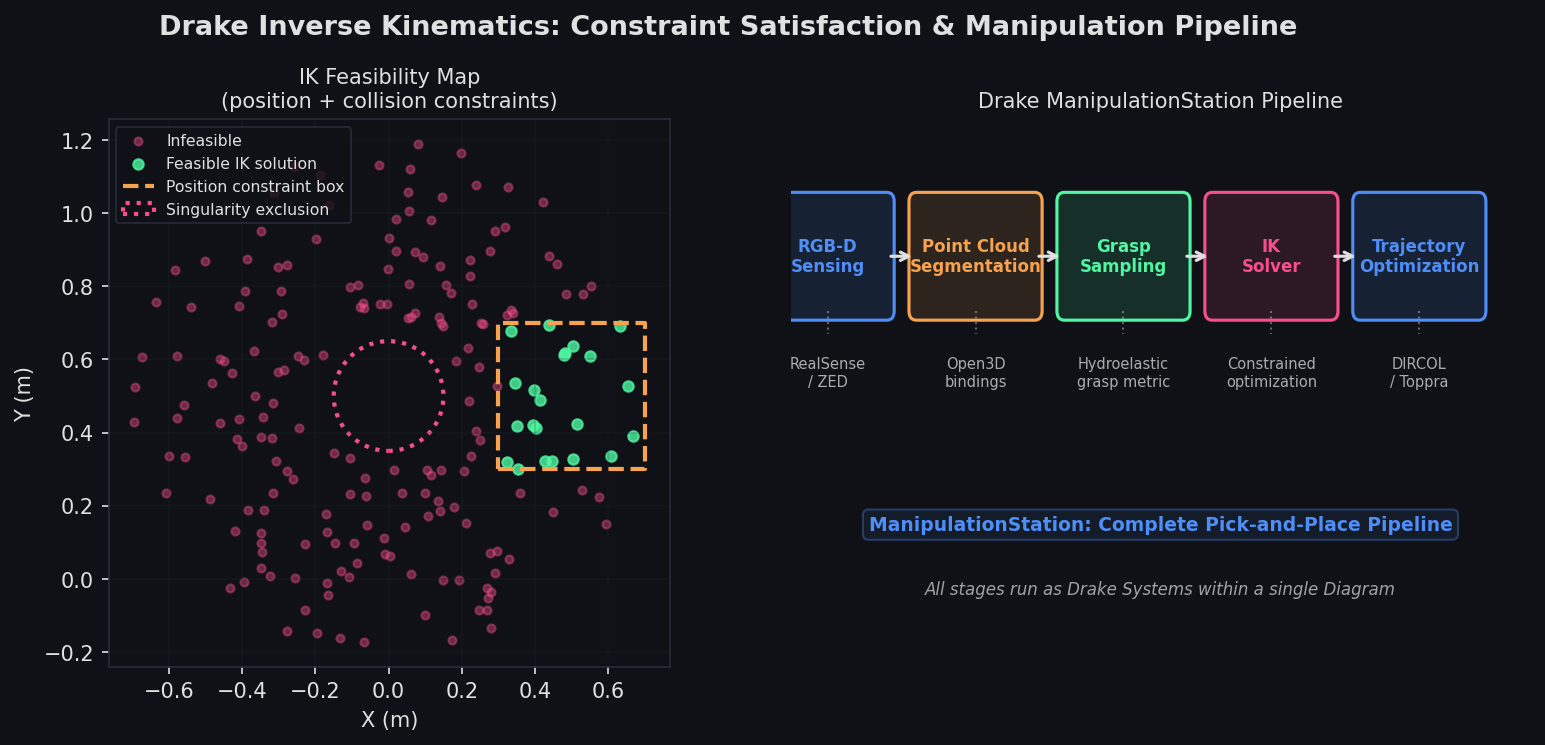
Drake's InverseKinematics solver formulates IK as a constrained optimization problem rather than a closed-form lookup. This enables:
- Orientation constraints (e.g., keep end-effector upright within ±10°)
- Gaze constraints (point camera at target)
- Minimum distance constraints (collision avoidance during IK)
- Multi-body IK (coordinated dual-arm solutions)
from pydrake.all import InverseKinematics
ik = InverseKinematics(plant)
ik.AddPositionConstraint(
    frameB=plant.GetFrameByName("iiwa_link_7"),
    p_BQ=[0, 0, 0], frameA=plant.world_frame(),
    p_AQ_lower=[0.4, -0.1, 0.3], p_AQ_upper=[0.6, 0.1, 0.5])
ik.AddMinimumDistanceLowerBoundConstraint(0.01)
result = Solve(ik.prog())
Perception and Manipulation Pipeline Integration
Drake integrates with point cloud processing and pose estimation through its PointCloud class and bindings to Open3D. The ManipulationStation reference implementation demonstrates a complete pick-and-place pipeline: RGB-D sensing → point cloud segmentation → antipodal grasp sampling → IK → trajectory execution—all within a single Drake Diagram.
The Hydroelastic grasp metric evaluates grasp quality by simulating contact pressure distributions, providing a physics-grounded alternative to geometric grasp quality measures.
LCM-Based Hardware Interface
Drake uses LCM (Lightweight Communications and Marshalling) for real-time inter-process communication. The same LcmSubscriberSystem / LcmPublisherSystem blocks used in simulation connect directly to hardware drivers (KUKA iiwa, Franka Panda, Schunk WSG gripper), enabling zero-code-change hardware deployment.
Practical Workflow
- Model the robot in URDF/SDF or Drake's SDFormat with Hydroelastic geometry tags
- Design the controller as a Drake
System(LQR, impedance, MPC) - Optimize trajectories offline with DIRCOL or online with MPC
- Validate in simulation using Drake's built-in Meshcat visualizer
- Deploy to hardware by swapping the simulated plant for LCM hardware blocks
When to Choose Drake
Drake excels when:
- Contact-rich manipulation is involved (assembly, in-hand re-grasping, deformable objects)
- Trajectory optimization is needed (not just motion planning)
- Mathematical guarantees matter (stability certificates, constraint satisfaction)
- Sim-to-real fidelity is critical (Hydroelastic contact reduces the reality gap)
It is less suited for large-scale environment simulation (use Gazebo/Isaac Sim) or reinforcement learning at scale (use MuJoCo/Isaac Lab), though Drake integrates with both via its Python bindings.
Further Resources
- Drake Documentation — official API reference and tutorials
- Underactuated Robotics (Tedrake) — the textbook behind Drake's design philosophy
- Drake GitHub Repository — source, examples, and model files
- Drake Manipulation Station — complete pick-and-place reference implementation
- TRI Research Papers — publications using Drake for manipulation research