

DSSAT: Comprehensive Agricultural Simulation for Crop Modeling and Food Security
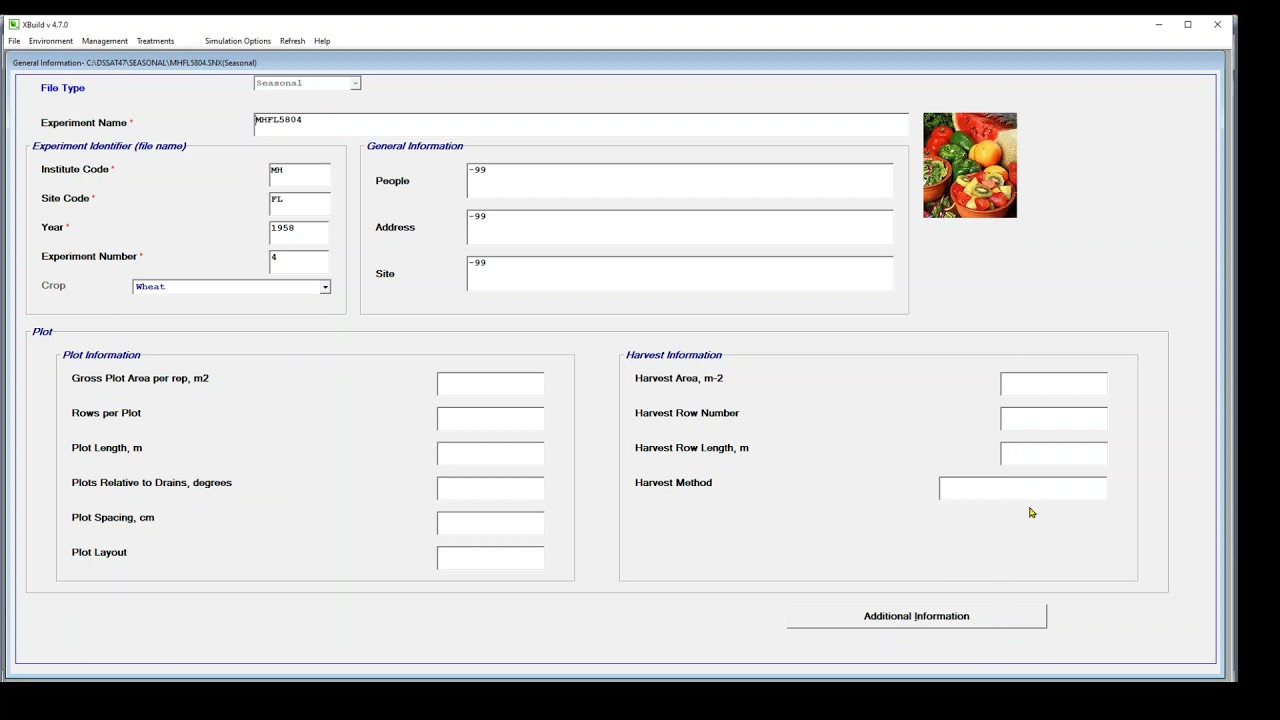
The Decision Support System for Agrotechnology Transfer (DSSAT) stands as one of the most comprehensive and widely adopted crop modeling systems globally, serving as an invaluable tool for agricultural scientists, policymakers, and practitioners. It is a sophisticated software application program that integrates a suite of crop simulation models with various utilities and data management tools, enabling the simulation of agricultural crop growth, development, and yield under diverse environmental conditions and management practices.
Overview and Development History
Developed through a remarkable international scientific collaboration spanning over three decades, DSSAT has evolved significantly since its inception in the 1980s as part of the International Benchmark Sites Network for Agrotechnology Transfer (IBSNAT) project. Contributions from institutions like the University of Florida, USDA Agricultural Research Service, University of Georgia, and numerous international research centers have fostered its continuous improvement, incorporating enhanced models, additional crops, and improved interfaces based on user feedback and scientific advancements.
The system's longevity and continuous development underscore its scientific rigor and practical utility across diverse agricultural settings, with a community of thousands of users in over 100 countries. This global adoption demonstrates DSSAT's critical role in addressing food security challenges, climate change adaptation, and sustainable agricultural development worldwide.

Core Architecture and Components
At its core, DSSAT is a collection of crop simulation models unified under a single software platform, designed to simulate the intricate interactions within the soil-plant-atmosphere continuum. The system's architecture is built around a process-based approach, tracking the daily changes in energy, water, carbon, and nitrogen balance, rather than merely projecting historical trends.
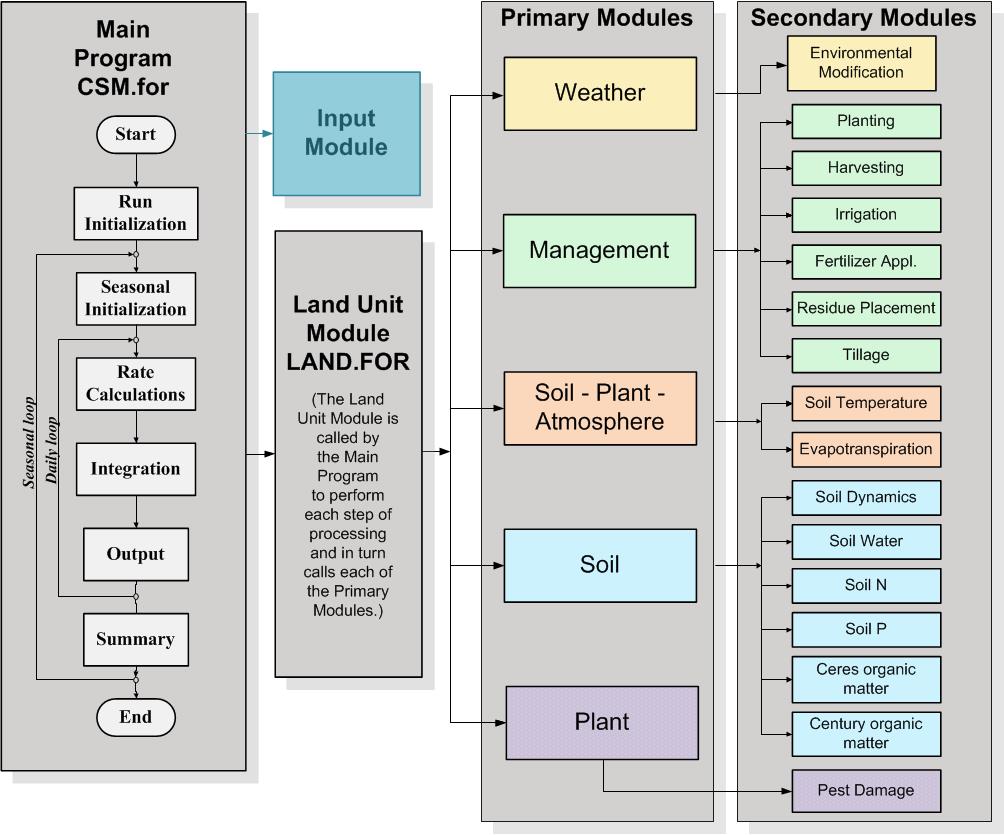
Crop Simulation Models (CSM)
The heart of DSSAT comprises dynamic crop growth simulation models for a wide array of crops. As of Version 4.8.5, it includes models for more than 45 crops, with the most well-known being CERES for cereals (e.g. CERES-Maize) and CROPGRO for legumes. These models simulate various aspects of crop life:
Growth and Development: They calculate expected growth and development based on equations describing how a plant community responds to soil and weather conditions. These equations are often a set of differential equations representing rates of growth or development, with numerical integration over time (typically daily or hourly time steps) allowing estimation of growth, development, and water/nutrient levels.
Yield Formation: Predicting the final harvestable yield based on environmental conditions and management practices.
Biomass Accumulation: Tracking the total organic matter produced by the crop throughout the growing season.
Photosynthesis: Simulating the process of converting light energy into chemical energy for plant growth.
Water and Nutrient Dynamics: The models simulate water and nutrient movement within the soil and crop, considering processes like leaching, organic matter decomposition, and runoff. Users can often select among model options to assess how different assumptions affect simulations, given the varying levels of process detail.
Integrated Modules
DSSAT incorporates several interconnected modules that process different types of input data and simulate their interactions with the crop:
Soil Modules: These modules track water movement, nutrient cycling, and organic matter decomposition within different soil layers. They account for soil physical and chemical properties that affect water retention, nutrient availability, and root growth.
Weather Modules: They process daily weather data, which is essential for driving crop growth calculations. Weather data includes solar radiation, temperature, precipitation, and other meteorological variables that directly influence crop development.
Management Modules: These modules incorporate human decisions and agricultural practices, such as planting dates, irrigation scheduling, fertilizer applications, tillage operations, and harvest timing. They allow users to test different management scenarios and their impacts on crop performance.
Supporting Utilities and Data Management
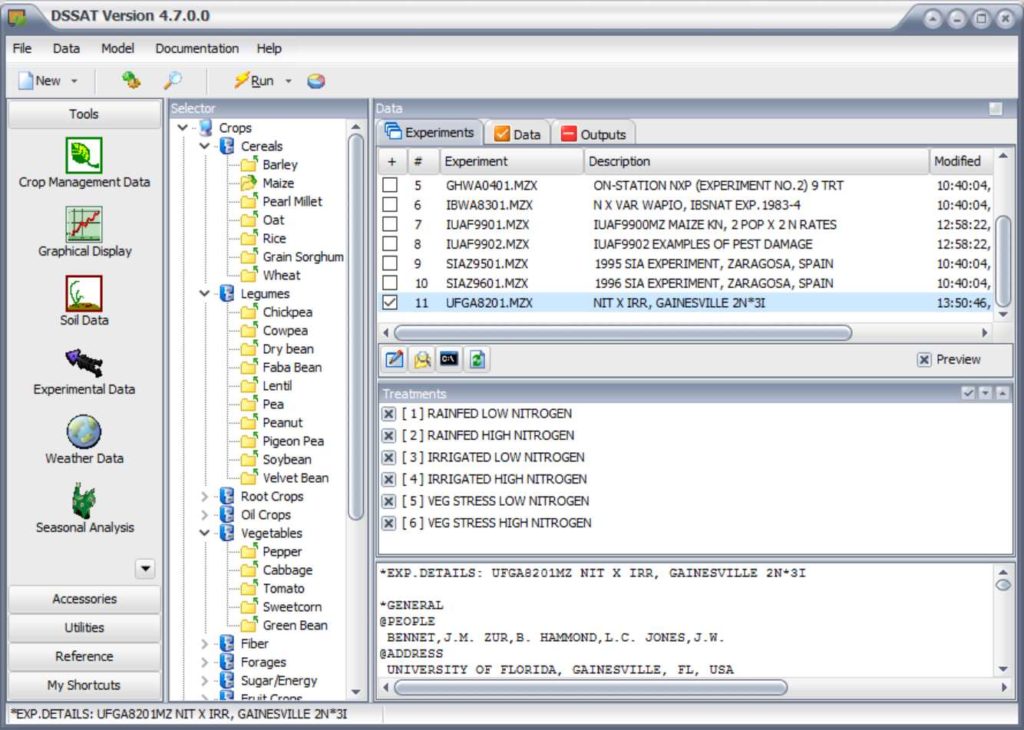
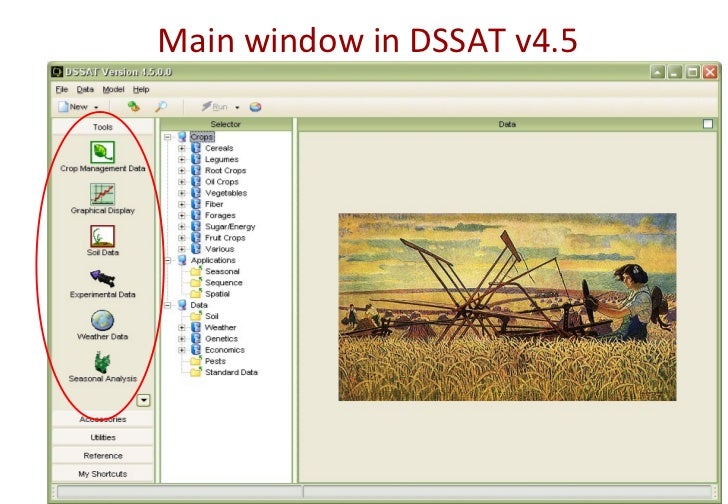
For DSSAT to be fully functional and effective, it is supported by a range of utilities and database management programs. These tools assist modelers in organizing the vast amounts of input data required for simulations:
Weather Data Management: Programs for handling and formatting weather data from various sources, including weather stations, satellite data, and climate models.
Soil Data Management: Tools for managing soil characteristics, including physical properties (texture, bulk density), chemical properties (pH, nutrient content), and hydraulic properties.
Crop Management Data Management: Utilities for organizing details of agricultural practices, including planting information, fertilizer applications, irrigation schedules, and harvest operations.
Experimental Data Management: Programs for observational experimental data, crucial for calibration and validation of the models.
Utilities and Application Programs: General utilities that facilitate the effective use of the models, including data conversion tools, statistical analysis programs, and visualization utilities.
Essential Data Requirements
One of the primary challenges and critical aspects of using DSSAT effectively is gathering and preparing the appropriate input data. DSSAT requires a minimum data set to function, which includes detailed information across several categories.
Weather Data Requirements
Daily weather variables are the environmental driving force for crop growth simulations. DSSAT requires:
Solar Radiation: Provides the energy for photosynthesis, typically measured in MJ/m²/day. This is crucial for calculating potential photosynthesis and crop growth rates.
Maximum and Minimum Temperatures: Control development rates and influence multiple physiological processes of the crop, including germination, flowering, and grain filling.
Precipitation: Essential for accurate soil water balance calculations, affecting crop water stress and nutrient uptake.
Optional Variables: Relative humidity, wind speed, and dew point can significantly improve simulation accuracy if available, particularly for modeling evapotranspiration and disease pressure.
When observed weather data is unavailable, DSSAT includes weather generators that can create synthetic weather data based on monthly averages and historical patterns, though observed data is always preferred for accuracy.
Soil Characterization Data
The soil environment profoundly impacts crop growth by influencing water and nutrient availability. Required soil parameters include:
Physical Properties: Texture (percentages of sand, silt, and clay), bulk density, and hydraulic characteristics for each soil layer. These properties determine water infiltration, retention, and movement through the soil profile.
Chemical Properties: Organic carbon content, pH, and nutrient concentrations (nitrogen, phosphorus, potassium). These affect nutrient availability and soil biological activity.
Horizon Information: Depth and thickness of different soil layers, which influence root development and water/nutrient dynamics.
While soil data collection can be resource-intensive, DSSAT offers the flexibility for users to select from pre-defined soil profiles when specific measurements are not available, though site-specific data always improves accuracy.
Crop Management Information
Agricultural management practices are crucial determinants of crop growth and must be accurately represented in the model:
Planting Information: Date, depth, row spacing, and plant population. These factors affect crop establishment and early growth.
Fertilizer Applications: Timing, placement, amount, and type of fertilizers applied. This information is crucial for simulating nutrient availability and crop response.
Irrigation Details: Method, timing, and amounts of water applied. Irrigation management significantly affects crop water stress and yield.
Tillage Operations: Type and timing of soil disturbance, which affects soil structure, water infiltration, and organic matter decomposition.
Crop-Specific Parameters: Variety coefficients that describe the unique genetic characteristics of a particular crop cultivar, including maturity group, photoperiod sensitivity, and yield potential.
Genotype-Specific Parameters (GSPs)
These are a particularly challenging set of inputs used to quantify how one cultivar differs from another. GSPs are most often estimated through calibration to measurements from field trials, and DSSAT provides tools to organize data used for calibration and to estimate these required GSPs.
Calibration and Validation: Ensuring Model Reliability
For DSSAT to produce reliable and accurate predictions, proper calibration and validation are indispensable steps in the modeling process. These procedures ensure that the model adequately represents the crop's behavior under local conditions and can generalize beyond the specific data used for its development.
The Calibration Process
Calibration involves adjusting model parameters until simulated values closely match observed field data. This process typically focuses on:
Genetic Coefficients: Parameters describing variety-specific traits such as photoperiod sensitivity, thermal time requirements, and potential growth rates. These coefficients are adjusted to match observed phenological development and yield data.
Soil Parameters: Adjusting characteristics like water holding capacity and nutrient availability based on local soil conditions and observed crop responses.
Phenological Development: Ensuring the model correctly predicts key growth stages like flowering and maturity dates, which are critical for accurate yield prediction.
Calibration usually requires detailed field observations, including measurements at multiple growth stages. Optimization algorithms are often employed to systematically adjust parameters, minimizing the differences between simulated and observed values.
Validation Approaches
Following calibration, validation is a critical step where the model's performance is tested using independent datasets that were not used during the calibration phase. This ensures the model's ability to generalize. Validation typically involves:
Statistical Evaluation: Calculating metrics such as Root Mean Square Error (RMSE), Normalized RMSE, and model efficiency to quantify the model's accuracy. These statistics provide objective measures of model performance.
Graphical Analysis: Creating scatter plots and time series comparisons of simulated versus observed values to visually assess performance and identify systematic biases.
Sensitivity Analysis: Testing how changes in input variables affect model outputs to understand the model's behavior and robustness. This helps identify which parameters most strongly influence model predictions.
A well-validated model instills greater confidence in its predictions across different environments and seasons, which is crucial for its application in various agricultural contexts, especially climate change research.
Applications of DSSAT
The versatility and robustness of DSSAT have led to its widespread adoption across numerous agricultural research, development, and policy contexts. Its applications range from real-time decision support at the farm level to assessing the potential impact of climate change on global food security.
Precision Agriculture and Farm Management
At the field level, DSSAT assists farmers and agricultural advisors in optimizing management decisions, leading to improved resource use efficiency and potentially higher profits:
Planting Date Optimization: Identifying optimal planting windows based on historical weather patterns and future climate projections. This helps farmers maximize yield potential while minimizing weather-related risks.
Fertilizer Efficiency: Determining optimal fertilizer application rates and timing to maximize yields while minimizing environmental impacts. DSSAT can simulate nitrogen, phosphorus, and potassium dynamics to optimize nutrient management.
Irrigation Scheduling: Optimizing water use by simulating crop water requirements throughout the growing season. This is particularly valuable in water-limited environments where efficient irrigation is crucial.
Variety Selection: Evaluating which crop varieties perform best under specific local conditions, considering factors like maturity, disease resistance, and yield potential.
Climate Change Impact Assessments and Adaptation
One of DSSAT's most valuable applications is in climate change research and planning:
Climate Adaptation Strategies: Evaluating how changes in planting dates, crop varieties, and management practices might mitigate the adverse impacts of climate change. This includes assessing the effectiveness of different adaptation options.
Risk Assessment: Quantifying yield variability under future climate scenarios to inform adaptation planning and build resilience. DSSAT can simulate the probability of crop failure or low yields under different climate conditions.
Food Security Projections: Estimating future production potential across regions under changing climate conditions, aiding in food security analysis. This includes assessing the impacts of temperature increases, changing precipitation patterns, and increased weather variability.
By coupling DSSAT with outputs from climate models, researchers can translate abstract climate projections into concrete agricultural impacts, bridging the gap between climate science and agricultural planning.
Regional Agricultural Planning and Policy Development
At larger scales, DSSAT provides crucial support for policy development and regional planning:
Land Use Planning: Identifying areas suitable for specific crops under current and future conditions. This helps optimize land use and identify areas at risk from climate change.
Technology Targeting: Determining which regions would benefit most from specific agricultural technologies or practices. This helps prioritize research and development investments.
Investment Prioritization: Guiding research and development investments by identifying interventions with the highest potential impact. DSSAT can assess the potential benefits of new varieties, management practices, or technologies.
Food Security Analysis: Assessing production potential across regions to identify vulnerable areas and inform strategic interventions. This includes evaluating the impacts of policy changes on agricultural productivity.
These applications make DSSAT an invaluable tool for organizations involved in agricultural development, food security, and climate adaptation at regional and national levels.
Research and Education
DSSAT is widely used in university classrooms to teach crop modeling principles. It also serves as a heuristic device, helping identify research problems where current knowledge is limited and further research is needed. The ability of crop models to simulate how different weather years or soil conditions affect crop performance makes them especially useful in research involving climatic uncertainty or geospatial variation.
Recent advances in field phenomics and crop genomics are opening opportunities for crop models to support research in fundamental plant science. Furthermore, DSSAT's development aimed to facilitate the application of crop system models like CERES-Maize in agricultural studies by integrating various data, thereby enhancing technology dissemination across different regions.
Advanced Features and Cloud Deployment
Deploying DSSAT on AWS: A Best Practice for Efficiency
A significant advancement in running DSSAT simulations more efficiently involves deploying the software on cloud platforms like Amazon Web Services (AWS). This approach leverages cloud computing resources to handle the computational demands of running numerous crop simulation models.
The AWS guidance demonstrates a robust architecture for using DSSAT, incorporating several AWS services to streamline data collection, processing, simulation, and storage:
Data Ingestion: Farm data is loaded into Amazon Simple Storage Service (Amazon S3) for scalable and secure storage.
Data Transfer to Compute: An AWS Lambda function, invoked by Amazon S3, loads farm data into the DSSAT application directory in Amazon Elastic Compute Cloud (Amazon EC2) for Microsoft Windows Server via a virtual private cloud (VPC) endpoint.
Real-time Weather Data: Field-centric weather data from Internet of Things (IoT) weather stations is sent to AWS IoT Core via Message Queuing Telemetry Transport (MQTT), enabling real-time data integration.
Time-Series Data Storage: An AWS IoT rule inserts weather station data into Amazon Timestream, a fast, scalable, and serverless time-series database optimized for IoT and operational applications.
Scheduled Data Preparation: Amazon EventBridge schedules a Lambda function to query, format, and save Timestream data into Amazon S3 and Amazon EC2 for use in crop simulations.
Simulation Execution and Output Storage: A separate, scheduled Lambda function invokes DSSAT to run crop simulations and moves the output prediction files into Amazon S3 for long-term storage. This function also parses and inserts crop prediction data into Timestream tables.
Application Integration: Amazon API Gateway is used to invoke a Lambda function that returns crop prediction data, which can then be loaded into an application for display and use.
This architecture adheres to the AWS Well-Architected Framework, emphasizing operational excellence, security, reliability, performance efficiency, cost optimization, and sustainability.
Best Practices for DSSAT Implementation
Model Development and Validation
Rigorous Verification and Validation: Implement a clear V&V plan early in development, including documentation of testing procedures, validation criteria, and methods for assessing model accuracy.
Systematic Model Testing: Conduct unit testing of individual model components, integration testing of module interactions, and comprehensive validation against real-world data when available.
Thorough Documentation: Document model assumptions, limitations, and validation results to improve model credibility and reusability.
Iterative Refinement: Start with simple baseline models and systematically add complexity, validating each iteration to ensure improvements in model utility.
Data Management and Quality
Data Quality Assurance: Ensure high-quality input data through careful collection, validation, and quality control procedures. Poor input data quality is one of the most common sources of model errors.
Comprehensive Data Documentation: Maintain detailed documentation of data sources, collection methods, and quality control procedures.
Regular Data Updates: Keep weather, soil, and management data current to ensure model accuracy and relevance.
Backup and Version Control: Implement robust data backup and version control systems to prevent data loss and track changes over time.
Simulation Configuration and Execution
Appropriate Model Selection: Choose the most appropriate crop model for the specific crop and environment being studied. Different models may be better suited for different crops or conditions.
Careful Parameter Setting: Pay close attention to parameter settings, particularly genetic coefficients and soil parameters, as these significantly affect model accuracy.
Sensitivity Analysis: Conduct sensitivity analysis to understand how changes in input parameters affect model outputs and identify the most critical parameters.
Uncertainty Quantification: Account for uncertainty in model parameters and inputs, and propagate this uncertainty through model predictions.
Application-Specific Considerations
Climate Change Studies: When using DSSAT for climate change impact assessment, carefully consider the selection and downscaling of climate model outputs, and account for CO2 fertilization effects.
Precision Agriculture: For farm-level applications, ensure that input data accurately represents local conditions and management practices.
Regional Studies: For large-scale applications, consider spatial variability in soils, weather, and management practices, and use appropriate aggregation methods.
Policy Analysis: When using DSSAT for policy analysis, clearly communicate model limitations and uncertainties, and consider multiple scenarios and sensitivity analyses.
Limitations and Future Directions
Despite its power and versatility, DSSAT faces several challenges:
Data Requirements: The substantial data needs can be prohibitive in data-scarce regions, particularly in developing countries where detailed soil and weather data may not be available.
Complexity: The learning curve for new users can be steep, requiring dedicated training and experience to use the system effectively.
Process Representation: Some complex processes, such as pest damage, disease impacts, and intricate crop rotations, remain challenging to model accurately.
Uncertainty Quantification: Methods for expressing confidence in model predictions are continuously evolving, and better approaches for uncertainty analysis are needed.
Future Development Directions
The DSSAT development team is actively addressing these limitations through ongoing research and development. Promising future directions include:
Integration with Remote Sensing: Combining model simulations with satellite observations to improve spatial predictions and provide real-time insights into crop conditions.
Smartphone Applications: Developing mobile interfaces to make crop modeling more accessible to a broader range of users, including farmers and extension agents.
Machine Learning Integration: Utilizing artificial intelligence techniques to improve parameter estimation, model calibration, and prediction accuracy.
Ecosystem Service Assessment: Expanding beyond traditional yield prediction to evaluate the broader environmental impacts of agricultural practices, such as carbon sequestration, water quality, and biodiversity.
Enhanced User Interfaces: Developing more intuitive and user-friendly interfaces to reduce the learning curve and make DSSAT more accessible to non-experts.
Cloud-Based Deployment: Expanding cloud-based deployment options to improve accessibility and reduce computational barriers for users worldwide.
Global Impact and Community
DSSAT has had a profound impact on agricultural research and development worldwide. Its applications span from individual farm management to global food security assessments, and it has been instrumental in advancing our understanding of crop-environment interactions.
Training and Capacity Building
For those interested in engaging with DSSAT, resources such as training workshops, comprehensive user manuals, active online forums, and sample datasets are available. The DSSAT Foundation also provides educational resources for incorporating crop modeling into agricultural curricula.
Regular training workshops are conducted worldwide, providing hands-on experience with the software and its applications. These workshops cover topics ranging from basic model operation to advanced applications in climate change research and precision agriculture.
Research Collaboration
DSSAT has fostered extensive international collaboration in agricultural research. The system's development has involved researchers from dozens of countries, and its applications have contributed to numerous scientific publications and policy documents.
The DSSAT community continues to grow, with active user groups in many countries and regions. This community contributes to model development, validation, and application, ensuring that DSSAT remains relevant and useful for addressing current and future agricultural challenges.
Conclusion
DSSAT represents a cornerstone achievement in agricultural simulation and crop modeling, offering unparalleled capabilities for understanding and predicting crop performance under diverse conditions. Its comprehensive approach to simulating the soil-plant-atmosphere continuum, combined with its extensive validation and global application, makes it an indispensable tool for agricultural research, policy development, and practical farm management.
The system's continued evolution, driven by advances in computing technology, data availability, and scientific understanding, ensures its continued relevance in addressing the challenges of feeding a growing global population under changing climate conditions. As agriculture faces increasing pressures from climate change, population growth, and resource constraints, tools like DSSAT provide essential capabilities for developing sustainable and resilient food production systems.
The integration of DSSAT with modern technologies such as cloud computing, remote sensing, and machine learning opens new possibilities for precision agriculture, climate adaptation, and food security planning. By continuing to improve and expand DSSAT's capabilities while maintaining its scientific rigor and practical utility, the agricultural research community can better serve the needs of farmers, policymakers, and society as a whole.
DSSAT's success demonstrates the power of international collaboration in developing tools that address global challenges. As we face an uncertain future with respect to climate, population, and resource availability, DSSAT and similar tools will play increasingly important roles in ensuring food security and sustainable agricultural development worldwide.
References
- DSSAT Official Website (https://dssat.net/)
- DSSAT Foundation (https://dssat.net/about/dssat-foundation/)
- DSSAT Training Resources (https://dssat.net/training/)
- DSSAT Publications (https://dssat.net/publications/)
- AWS DSSAT Deployment Guide (https://aws.amazon.com/solutions/guidance/crop-growth-simulation-models-using-dssat-on-aws/)