
FarmDESIGN: Multi-Objective Optimization for Sustainable Whole-Farm System Redesign
Introduction
Designing a farm that simultaneously maximizes economic returns, minimizes environmental impact, and maintains agronomic resilience is inherently a multi-objective problem. Trade-offs are unavoidable: higher yields often require more inputs, reducing nutrient losses may cut productivity, and diversification can improve resilience at the cost of efficiency. FarmDESIGN is an open-source, model-based optimization tool developed at Wageningen University & Research that addresses this challenge head-on, enabling agricultural professionals to explore the full Pareto frontier of farm system configurations before committing to costly real-world changes.
Unlike single-objective crop models or economic planning tools, FarmDESIGN treats the farm as an integrated system — coupling crop rotations, livestock enterprises, soil organic matter dynamics, nutrient flows, labor requirements, and gross margins into a unified simulation framework. Its evolutionary multi-objective optimization engine then searches this high-dimensional design space to identify non-dominated solutions: farm configurations where no objective can be improved without sacrificing another.
Core Architecture and Simulation Logic
FarmDESIGN operates on an annual time-step and models the farm at the field and enterprise level. The key simulation components include:

1. Nutrient Flow Accounting
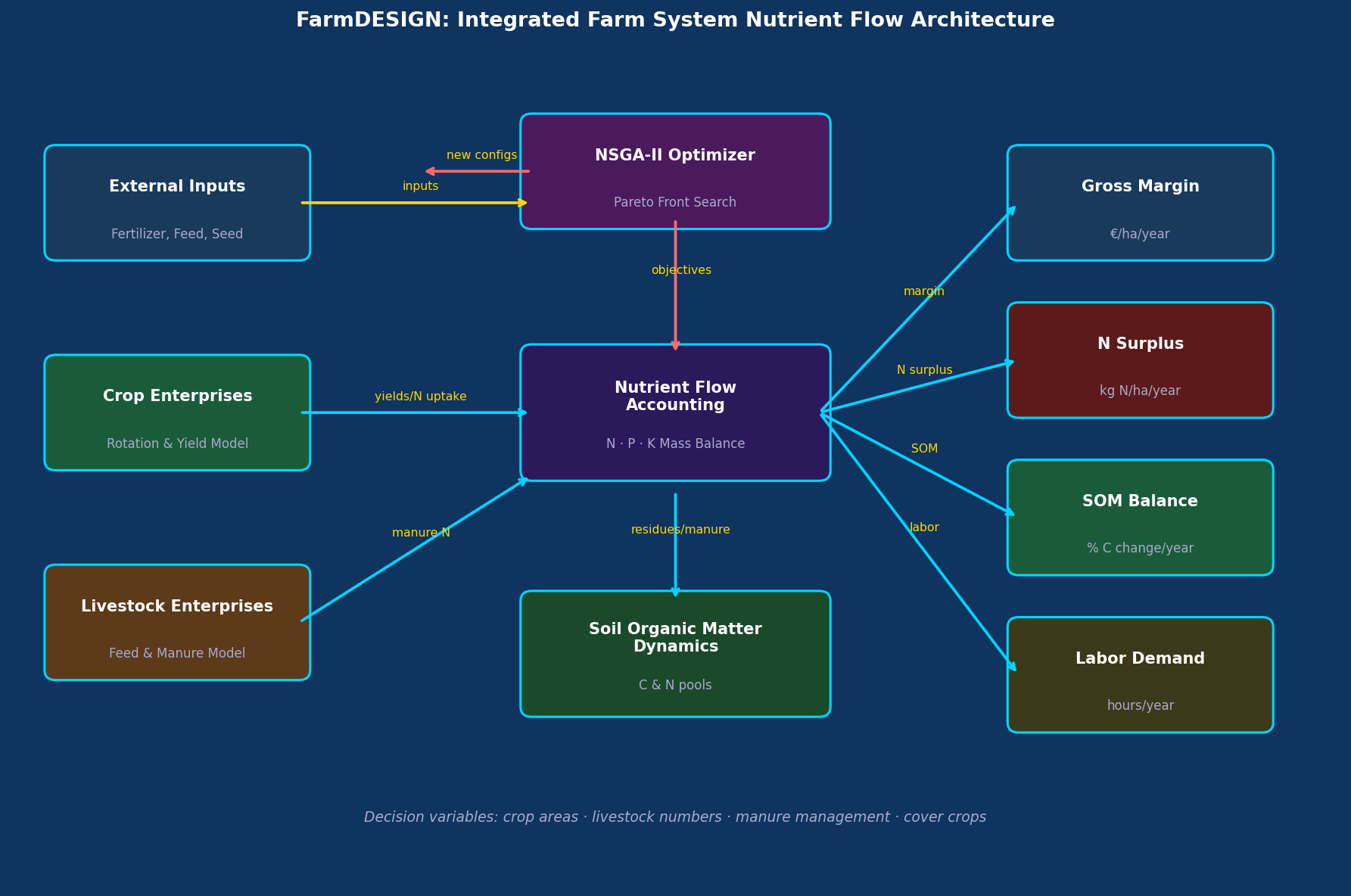
The model tracks nitrogen (N), phosphorus (P), and potassium (K) flows across all farm subsystems — from purchased fertilizers and feed inputs, through crop uptake and livestock excretion, to soil organic matter pools and off-farm losses. This mass-balance approach ensures that nutrient surpluses and deficits are explicitly quantified, making it possible to evaluate compliance with regulatory thresholds (e.g., EU Nitrates Directive limits) as an optimization constraint.
2. Soil Organic Matter Dynamics
FarmDESIGN integrates a simplified SOM model that tracks the effect of crop residue incorporation, manure applications, and cover cropping on soil carbon stocks over time. This is critical for evaluating long-term soil health trajectories alongside short-term economic performance — a capability absent from purely economic farm planning tools.
3. Crop and Livestock Enterprise Modules
Each crop or livestock enterprise is parameterized with yield coefficients, input requirements (seed, fertilizer, pesticides, feed), labor demands, and gross margin data. Users can define custom enterprise libraries reflecting local varieties, prices, and agronomic practices, making FarmDESIGN applicable across diverse farming systems from Dutch dairy operations to smallholder mixed farms in sub-Saharan Africa.
4. Multi-Objective Evolutionary Optimization
The optimization engine uses a genetic algorithm (specifically NSGA-II — Non-dominated Sorting Genetic Algorithm II) to evolve populations of farm configurations across generations. Decision variables include crop areas, livestock numbers, manure management choices, and cover crop inclusion. Objectives typically include:
- Gross margin (maximize)
- Nitrogen surplus (minimize)
- Soil organic matter balance (maximize or constrain)
- Labor requirement (minimize or constrain to available capacity)
- Pesticide use intensity (minimize)
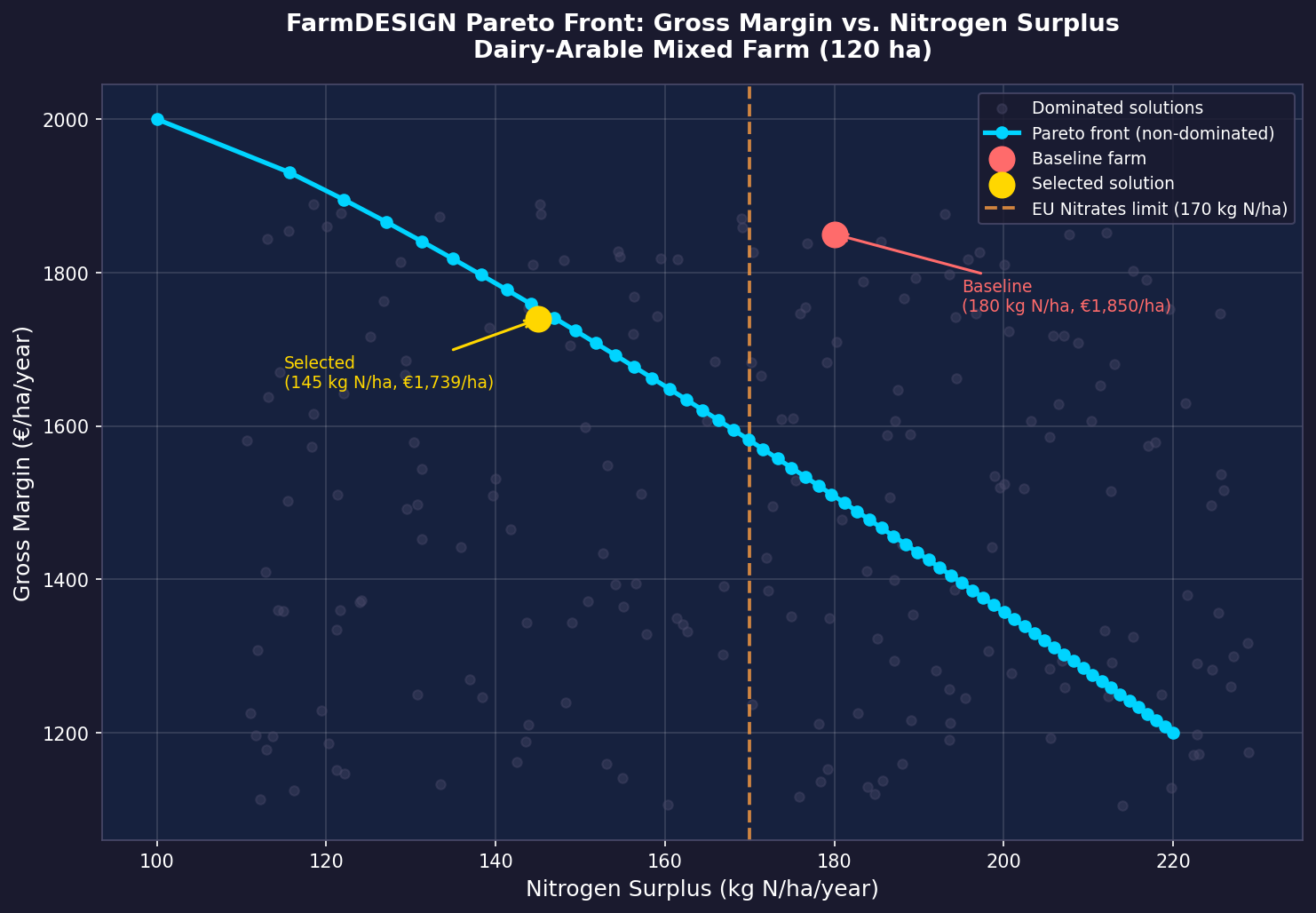
The result is a Pareto front — a set of hundreds of non-dominated farm designs — visualized in interactive scatter plots that allow practitioners to navigate trade-offs interactively.
Practical Workflow: From Farm Inventory to Pareto Front
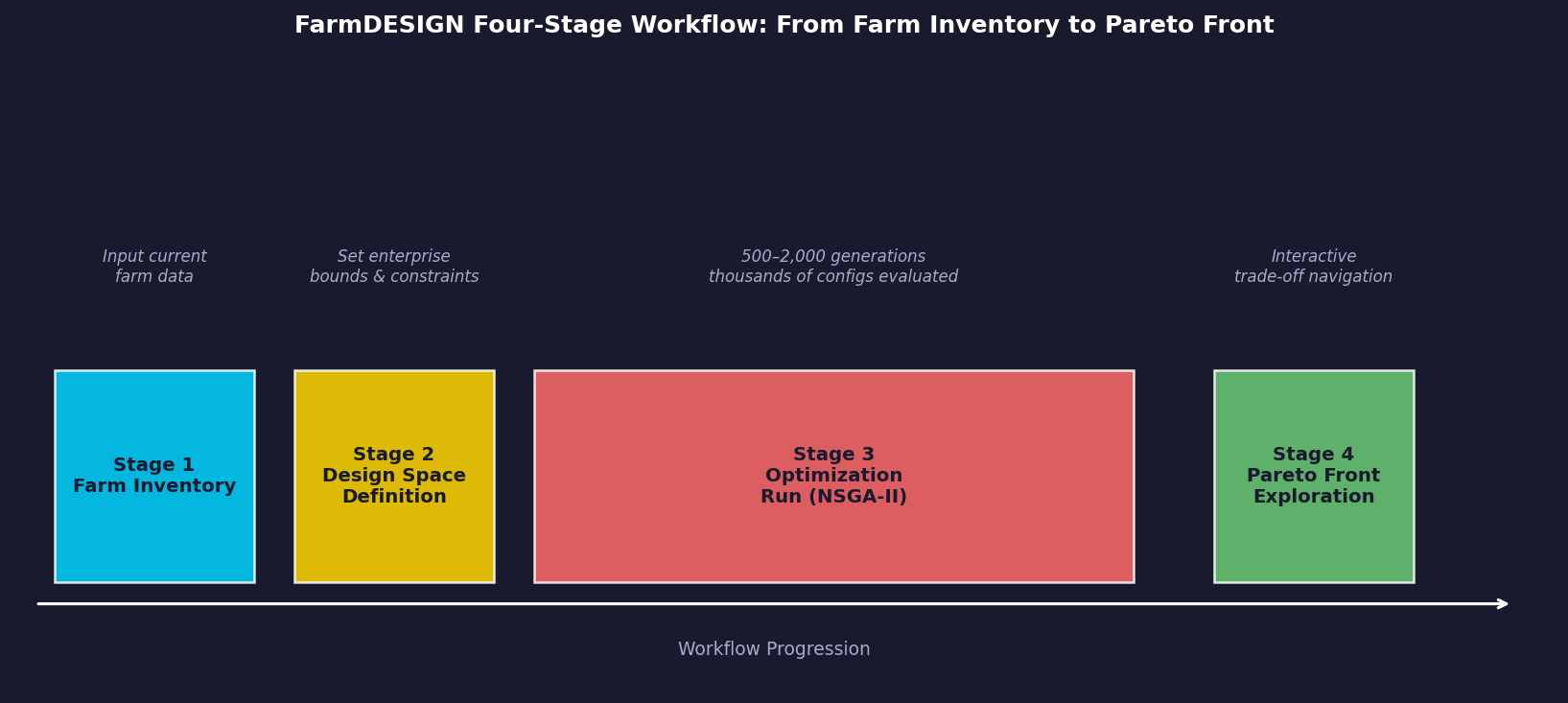
A typical FarmDESIGN analysis follows four stages:
Stage 1 — Farm Inventory: The user inputs the current farm configuration: field areas, current crop rotation, livestock numbers, input purchase records, and output sales data. FarmDESIGN calculates the baseline performance across all objectives, providing a reference point for improvement.
Stage 2 — Design Space Definition: The user defines the bounds of the optimization search — which enterprises can be added or removed, minimum and maximum areas for each crop, livestock capacity limits, and any hard constraints (e.g., organic certification rules prohibiting synthetic fertilizers).
Stage 3 — Optimization Run: The NSGA-II algorithm runs for a user-specified number of generations (typically 500–2,000), evaluating thousands of candidate farm configurations. On modern hardware, a full optimization run completes in minutes to a few hours depending on farm complexity.
Stage 4 — Pareto Front Exploration: Results are visualized as 2D or 3D scatter plots of the Pareto front. Advisors and farmers can filter solutions by constraint satisfaction, select promising configurations, and export detailed farm plans for further agronomic review.
Case Study: Dairy-Arable Mixed Farm Optimization
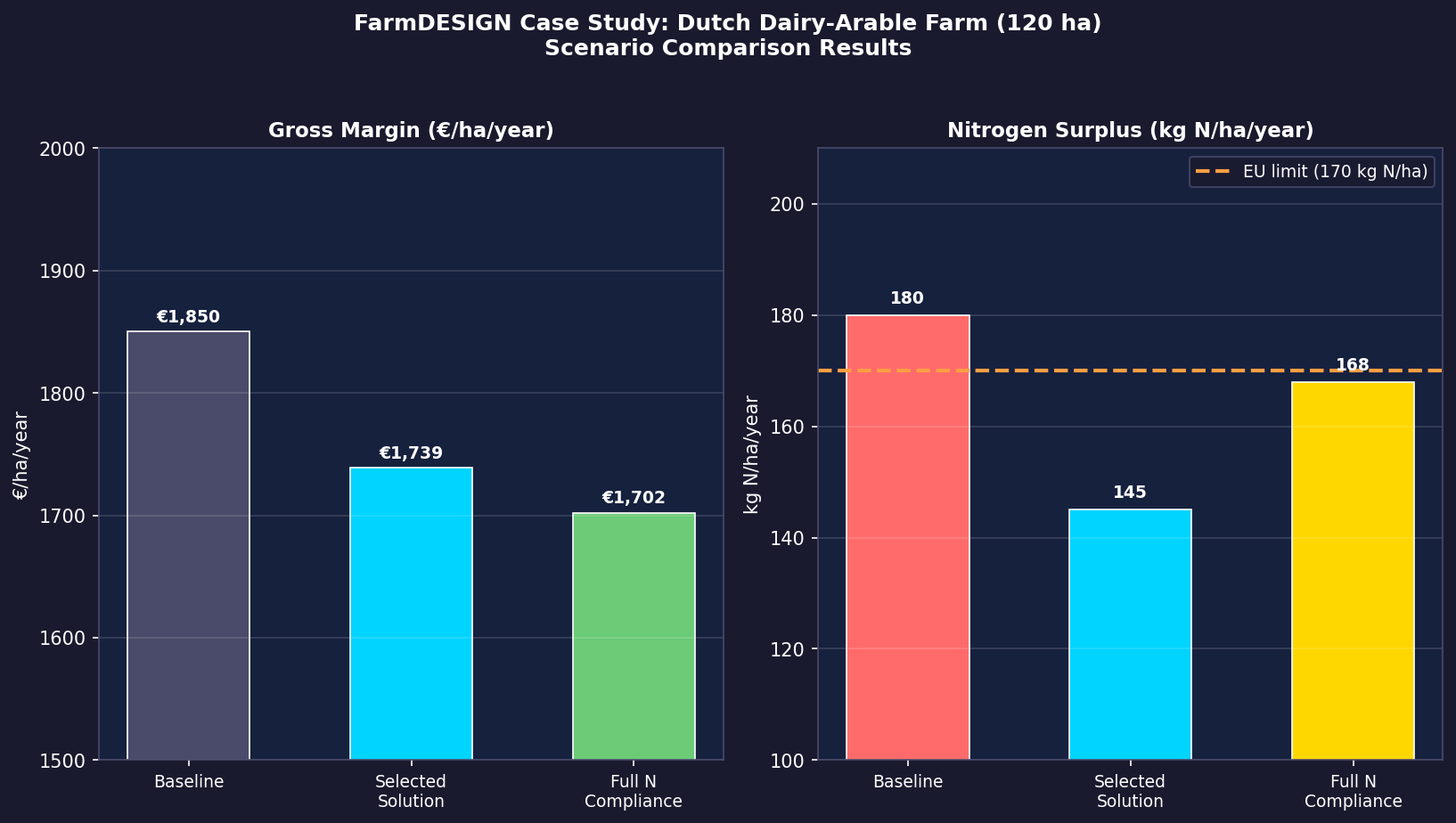
A published application of FarmDESIGN to a 120-hectare Dutch mixed dairy-arable farm illustrates its practical value. The baseline farm showed a nitrogen surplus of 180 kg N/ha/year — well above the 170 kg N/ha regulatory ceiling — with a gross margin of €1,850/ha. The optimization identified a Pareto front of 340 non-dominated solutions. Key findings included:
- Reducing the dairy herd by 15% and replacing silage maize with protein-rich legume-cereal intercrops reduced N surplus to 145 kg N/ha while maintaining 94% of baseline gross margin.
- Introducing a winter cover crop (mustard) on 40% of arable area improved SOM balance by 0.08% C/year with only a 3% labor increase.
- Full compliance with the 170 kg N/ha limit was achievable at a gross margin penalty of just 8% — a finding that shifted the farm advisor's recommendation from a costly manure processing investment to a simpler enterprise restructuring.
Integration with Other Tools
FarmDESIGN is designed to complement, not replace, more detailed process-based models. Common integration patterns include:
- APSIM or DSSAT for high-fidelity crop yield estimation under specific climate scenarios, with outputs feeding FarmDESIGN's enterprise yield coefficients
- SWAT+ for watershed-scale nutrient loss validation of FarmDESIGN's field-level nutrient surplus estimates
- AnyLogic for supply chain and logistics optimization downstream of the farm gate, using FarmDESIGN outputs as production scenario inputs
Getting Started with FarmDESIGN
FarmDESIGN is freely available and runs as a Java-based desktop application. The source code and documentation are maintained on the Wageningen University FarmDESIGN page. A comprehensive user manual and example farm datasets are provided to support onboarding.
For practitioners new to multi-objective optimization, the NSGA-II algorithm paper by Deb et al. (2002) provides essential background on the optimization engine. The peer-reviewed validation study by Groot et al. (2012) in Agricultural Systems demonstrates FarmDESIGN's application across contrasting farming systems in Europe and Africa.
Conclusion
FarmDESIGN fills a critical gap in the agricultural simulation toolkit: it moves beyond single-objective optimization or scenario comparison to reveal the full landscape of trade-offs inherent in farm system redesign. For agricultural advisors, policy analysts, and farm managers facing simultaneous pressure to improve profitability, reduce environmental footprint, and maintain soil health, FarmDESIGN's Pareto-based approach provides a rigorous, transparent, and practically actionable decision support framework. Its open-source availability and flexible enterprise library make it adaptable to farming systems worldwide.