

IFSM: Whole-Farm Systems Modeling for Nutrient Cycling and Economic Analysis
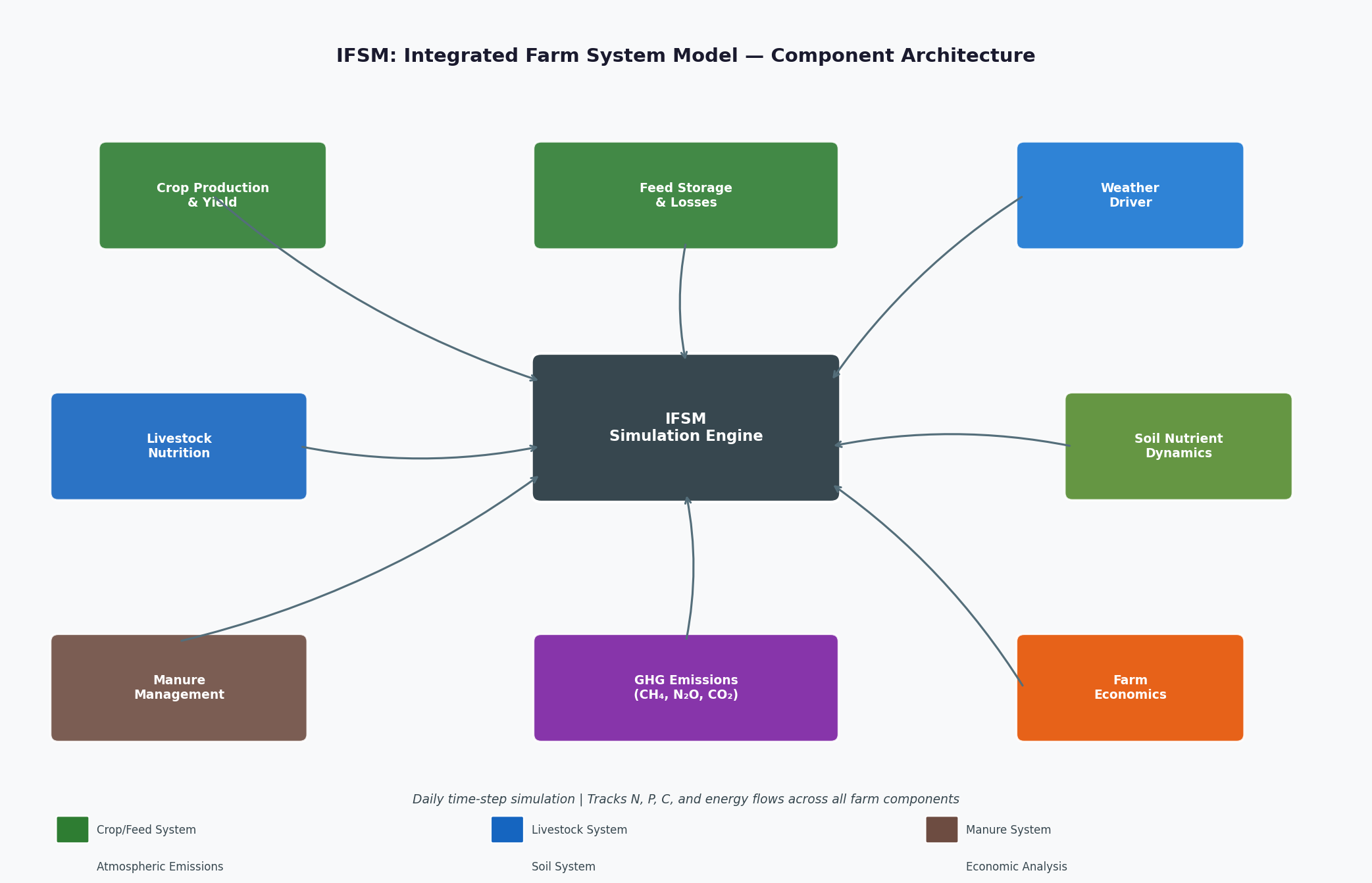
The Integrated Farm System Model (IFSM), developed by the USDA Agricultural Research Service, is a process-based simulation tool that evaluates the environmental and economic performance of entire farming operations as a unified system. Unlike single-component models such as APSIM's nitrogen module or AquaCrop's water-productivity framework, IFSM integrates crop production, feed storage, livestock feeding, manure handling, and farm economics into a single cohesive simulation — making it uniquely suited for whole-farm sustainability assessments and policy analysis.
What IFSM Models
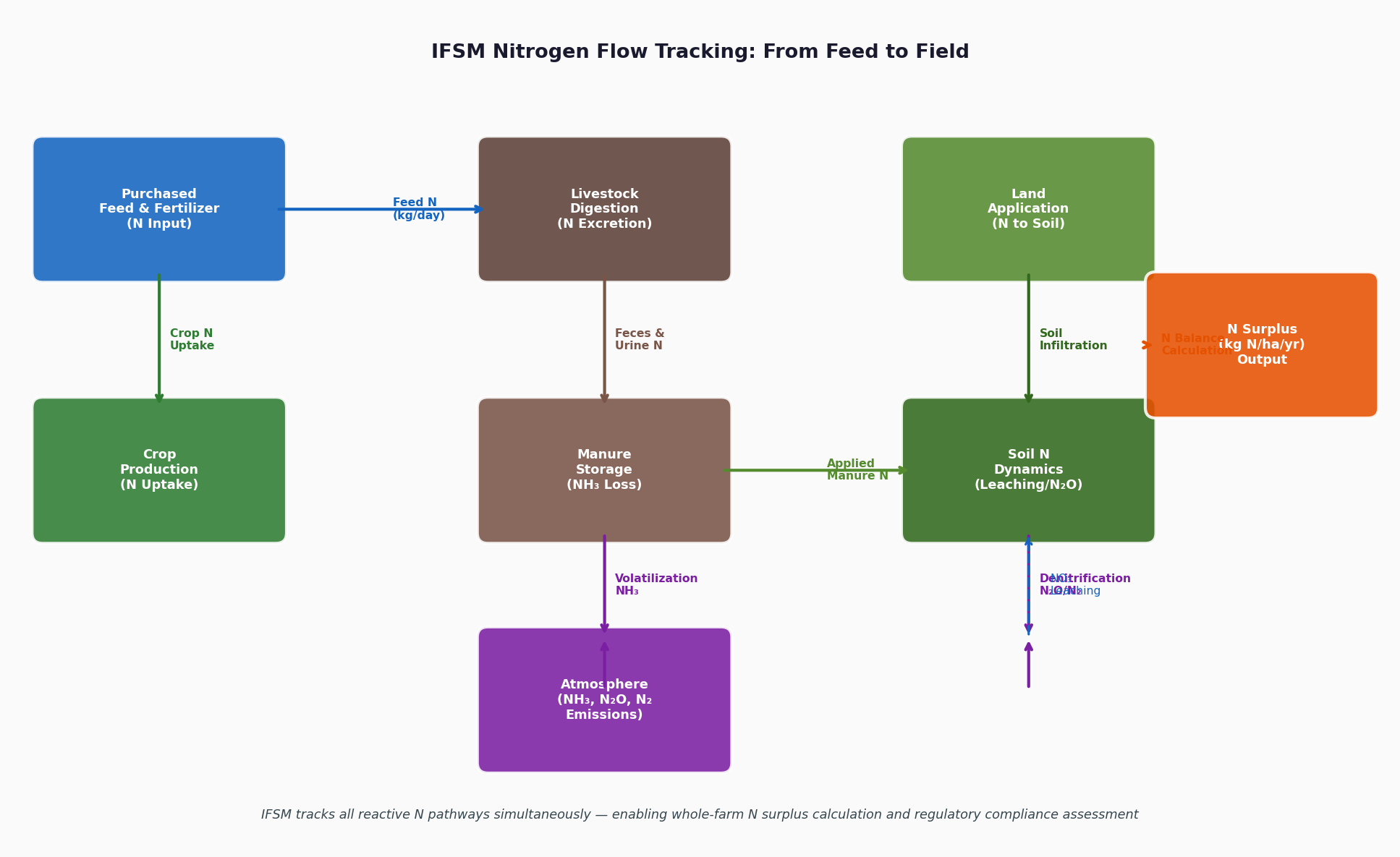
IFSM simulates the complete nutrient and carbon cycle across a farm, tracking flows of nitrogen, phosphorus, carbon, and energy from field to barn to atmosphere. The model operates on a daily time step and accounts for:
- Crop growth and yield — using weather-driven biomass accumulation models calibrated for corn, alfalfa, small grains, and grass forages
- Feed storage losses — silage fermentation, dry matter losses in hay storage, and grain drying energy costs
- Livestock nutrition and manure production — feed intake, milk or meat output, and excretion of N and P based on animal type and diet
- Manure management systems — storage (liquid, solid, slurry), anaerobic digestion, land application timing and method
- Soil nutrient dynamics — N mineralization, nitrification, denitrification, leaching, and P runoff
- Greenhouse gas emissions — CH₄ from enteric fermentation and manure, N₂O from soils and manure, CO₂ from fuel combustion
- Farm economics — detailed cost accounting for machinery, labor, inputs, and revenues
This breadth distinguishes IFSM from watershed-scale tools like SWAT+ (which focuses on hydrology) or disease-spread models like NAADSM. IFSM answers the question: How does a management change in one part of the farm ripple through the entire system?

Key Analytical Capabilities
Scenario Comparison and Sensitivity Analysis
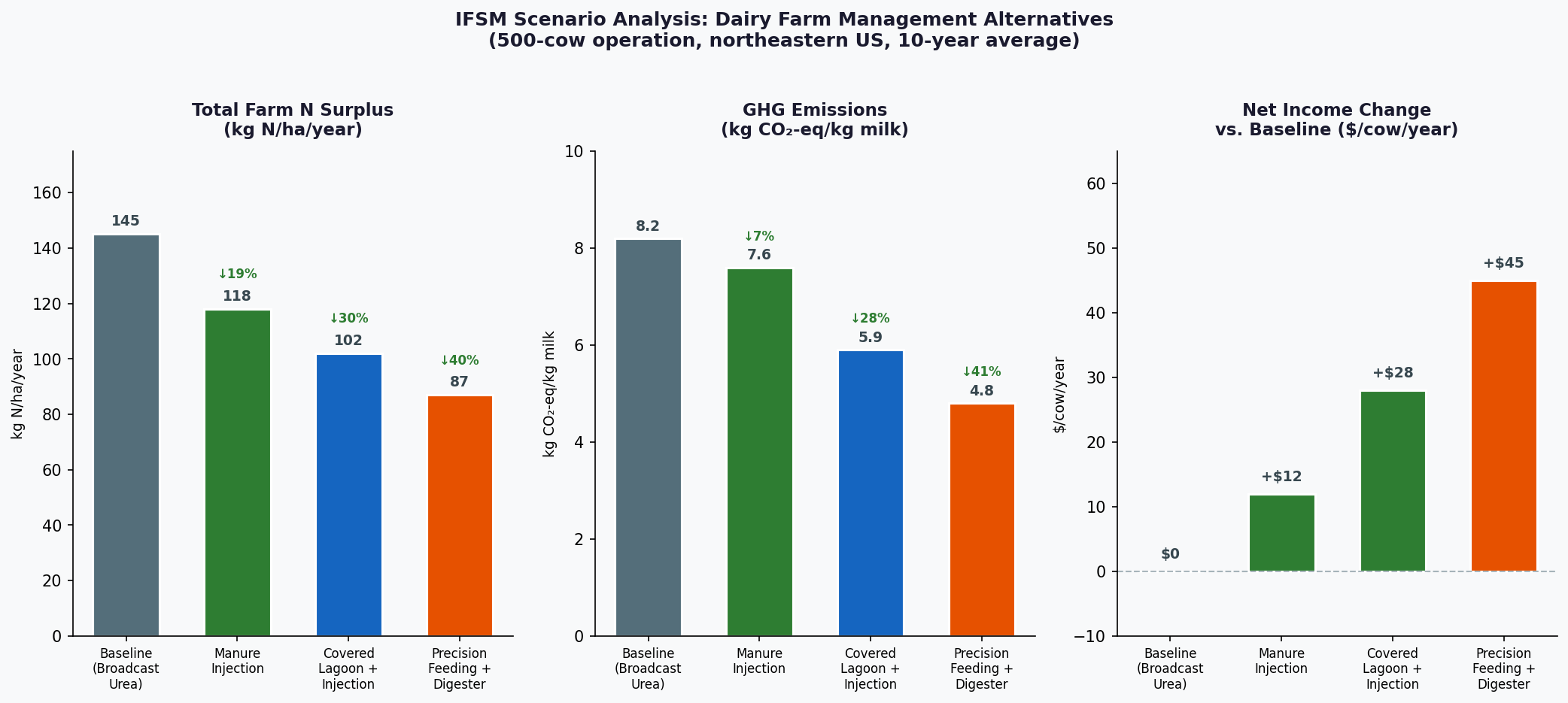
IFSM's primary strength is its scenario comparison engine. Users define a baseline farm configuration and then test alternative management strategies — for example, switching from broadcast urea application to injected digestate, or adding a covered lagoon to capture methane. The model reports changes in:
- Total farm N surplus (kg N/ha/year)
- Reactive N losses (ammonia volatilization, nitrate leaching, N₂O emissions)
- Carbon footprint per unit of milk or meat produced
- Net farm income and return on investment for capital improvements
This makes IFSM particularly valuable for nutrient management planning under regulatory frameworks such as the EU Nitrates Directive or US state nutrient management plans, where farmers must demonstrate that proposed practices will reduce nutrient losses to acceptable levels.
Manure Management System Optimization
One of IFSM's most-used features is its detailed manure management module. Users can configure multi-stage systems — for instance, a gravity separator followed by a covered storage tank and a drag-hose field applicator — and the model tracks N and P retention, ammonia emissions, and pathogen reduction at each stage. Comparative outputs allow consultants and extension agents to identify the combination of practices that achieves the best environmental outcome at the lowest cost.
Anaerobic Digestion Integration
IFSM includes a validated anaerobic digestion sub-model that estimates biogas yield, digestate composition, and net energy production based on manure characteristics and digester operating temperature. This allows farms to evaluate whether on-farm digestion is economically viable given local electricity prices and available manure volumes — a calculation that requires integrating livestock numbers, manure collection efficiency, and energy costs simultaneously.
Getting Started with IFSM
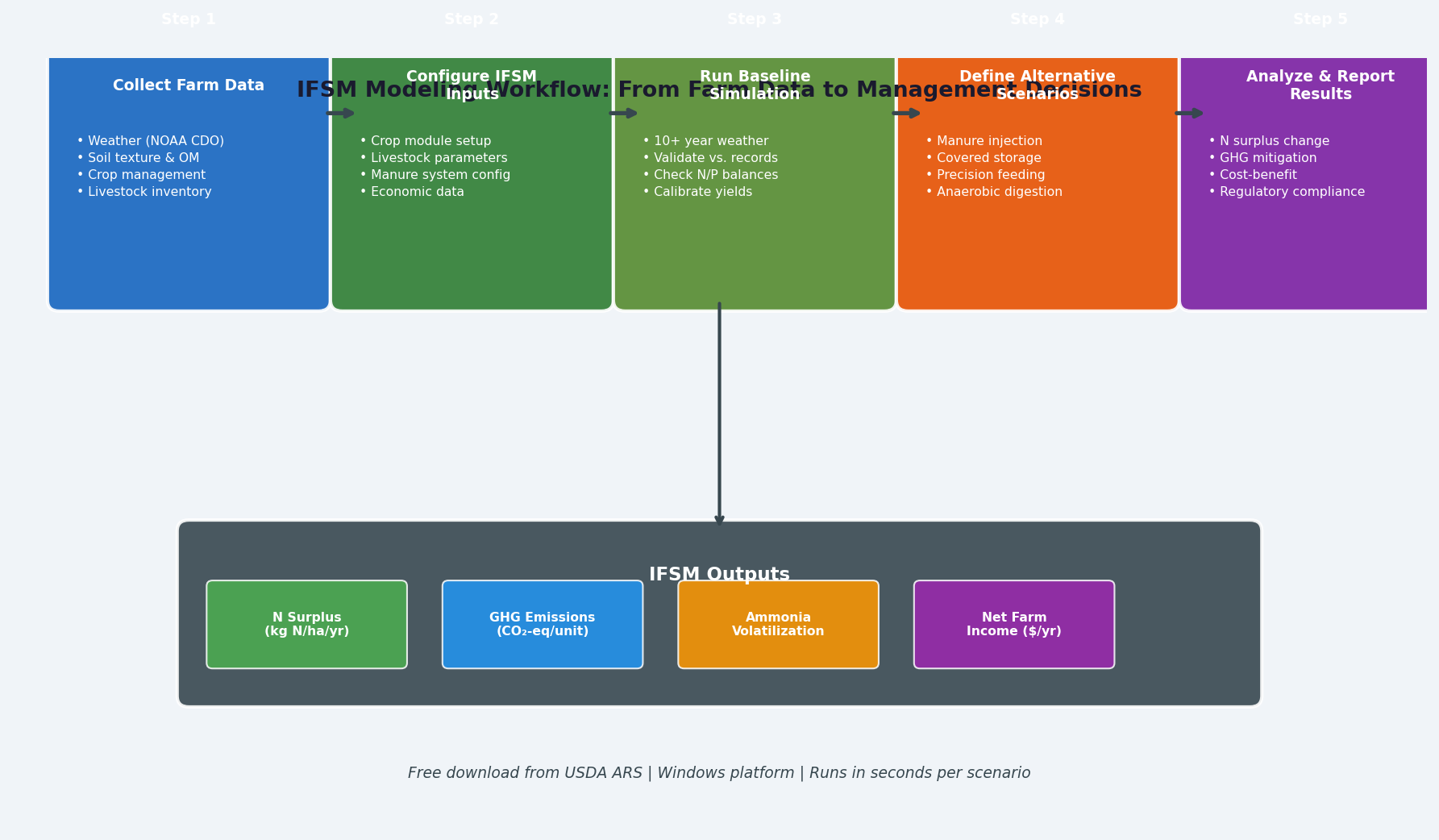
IFSM is freely available from the USDA ARS website and runs on Windows. The input interface uses a structured spreadsheet-style form organized by farm component (crops, livestock, manure, economics). Key inputs include:
- Weather data — daily temperature, precipitation, and solar radiation (NOAA Climate Data Online is a common source)
- Soil properties — texture, organic matter, drainage class, and initial nutrient levels
- Crop management — planting dates, tillage operations, fertilizer applications, and harvest schedules
- Livestock inventory — animal type, number, production level, and housing system
- Manure system configuration — collection method, storage type, and application equipment
A typical dairy farm baseline can be configured in 2–4 hours. The model runs in seconds, enabling rapid iteration across dozens of scenarios.
Calibration and Validation Considerations
IFSM has been validated against measured data from dairy, beef, swine, and poultry operations across the northeastern and midwestern United States. Published validation studies report that the model predicts annual milk production within ±5%, total N excretion within ±10%, and ammonia emissions within ±20% of measured values under typical conditions.
For site-specific applications, practitioners should:
- Calibrate crop yield parameters using 3–5 years of local yield records before running scenario analyses
- Verify manure N content against laboratory analyses rather than relying on default tabular values, which can vary substantially by diet and season
- Use ensemble weather inputs (multiple years of historical weather) rather than a single representative year to capture yield and emission variability
Integration with Other Tools
IFSM outputs can be linked to broader analyses:
- GIS platforms — farm-level N surplus values can be spatially aggregated to watershed or regional scales for policy modeling
- Life cycle assessment (LCA) software — IFSM's detailed emission inventories serve as high-quality foreground data for SimaPro or openLCA dairy product LCAs
- Economic optimization models — IFSM scenario outputs can populate linear programming models to identify cost-minimizing nutrient management strategies across a portfolio of farms
Practical Applications
IFSM has been applied in peer-reviewed research and regulatory contexts to:
- Quantify the GHG mitigation potential of precision feeding strategies on large dairy operations
- Evaluate the cost-effectiveness of manure injection versus surface spreading under different soil and weather conditions
- Support state-level nutrient trading program design by establishing baseline emission factors for different farm types
- Assess the economic feasibility of anaerobic digestion under varying renewable energy incentive structures
Further Resources
- USDA ARS IFSM Download and Documentation: https://www.ars.usda.gov/northeast-area/up-pa/pswmru/docs/integrated-farm-system-model/
- Rotz, C.A. et al. (2021) — "Whole-farm simulation of greenhouse gas emissions and mitigation strategies for dairy farms" — Journal of Dairy Science 104(7): 7993–8010
- USDA NRCS Nutrient Management Practice Standard (590): https://www.nrcs.usda.gov/wps/portal/nrcs/detailfull/national/technical/cp/ncps/?cid=nrcs143_026849
- Penn State Extension — Nutrient Management: https://extension.psu.edu/nutrient-management
IFSM fills a critical niche in the agricultural simulation landscape: it is the only freely available, process-based tool that simultaneously optimizes environmental performance and economic viability across the full farm system. For nutrient management planners, sustainability consultants, and agricultural researchers working at the farm scale, IFSM provides a level of integrated analysis that no single-component model can match.