WOFOST: Process-Based Crop Growth Simulation for Yield Forecasting and Climate Impact Assessment
WOFOST (WOrld FOod STudies) is a mechanistic, process-based crop simulation model developed at Wageningen University & Research and maintained by the Food and Agriculture Organization of the United Nations. Originally released in the late 1980s as part of the World Food Studies project, WOFOST has evolved into one of the most widely deployed crop growth simulators in operational agrometeorological monitoring systems worldwide — including the European Commission's MARS Crop Monitoring system, which covers 40+ countries.
Unlike empirical yield-gap models, WOFOST simulates the physiological processes driving crop growth at daily time steps: photosynthesis, respiration, phenological development, biomass partitioning, and soil water balance. This mechanistic foundation makes it particularly valuable for climate impact assessments, where extrapolation beyond historical observations is required.
Core Simulation Architecture
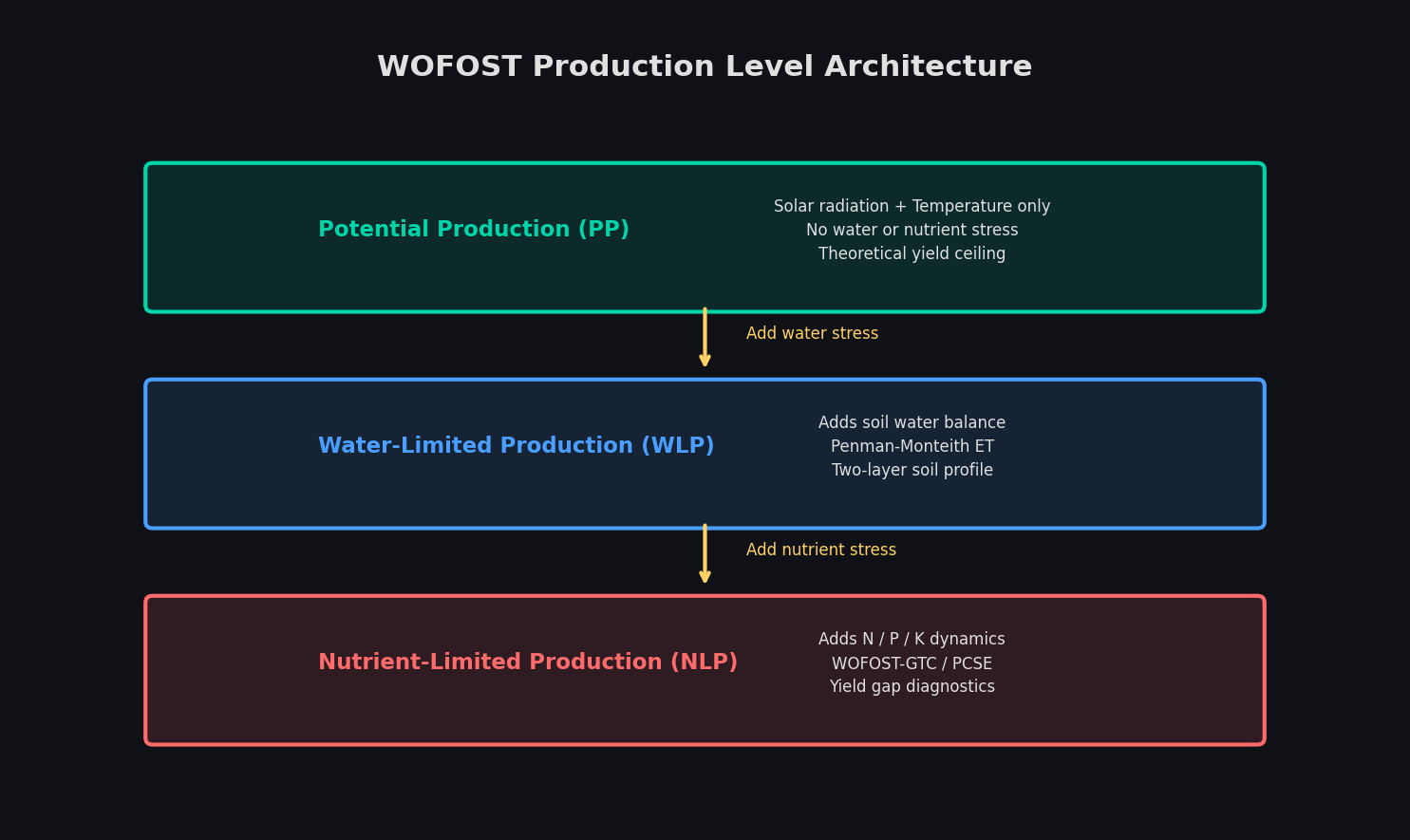
WOFOST operates under three production levels that progressively introduce limiting factors:

- Potential production (PP): Growth is limited only by solar radiation and temperature. No water or nutrient stress. Establishes the theoretical ceiling for a given genotype and location.
- Water-limited production (WLP): Adds a soil water balance module (PENMAN-MONTEITH evapotranspiration, two-layer soil profile). Crop growth is reduced when actual transpiration falls below potential transpiration.
- Nutrient-limited production (NLP): Extends WLP with nitrogen, phosphorus, and potassium dynamics. Available in WOFOST-GTC (Generic Trophic Chain) and the PCSE implementation.
The separation of production levels is a deliberate design choice: it allows practitioners to isolate the contribution of water stress versus nutrient stress to observed yield gaps — a critical diagnostic for precision agriculture interventions.
Phenological Development Engine
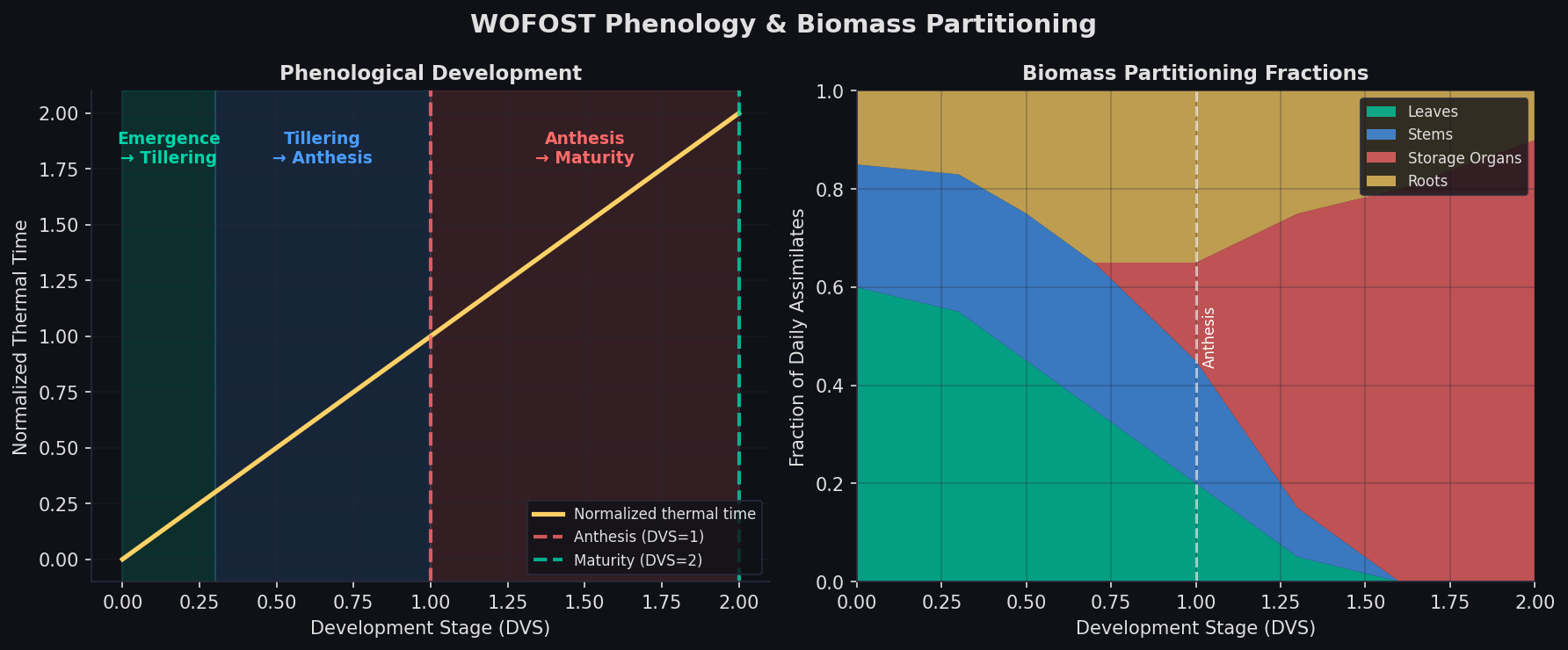
Phenology in WOFOST is driven by thermal time (degree-days above a base temperature) and, for long-day or short-day crops, by photoperiod response. The development stage (DVS) variable runs from 0 (emergence) through 1 (anthesis) to 2 (maturity). Biomass partitioning coefficients — the fraction allocated to leaves, stems, storage organs, and roots — are tabulated as functions of DVS, allowing the model to capture the dramatic shifts in assimilate allocation that occur around flowering.
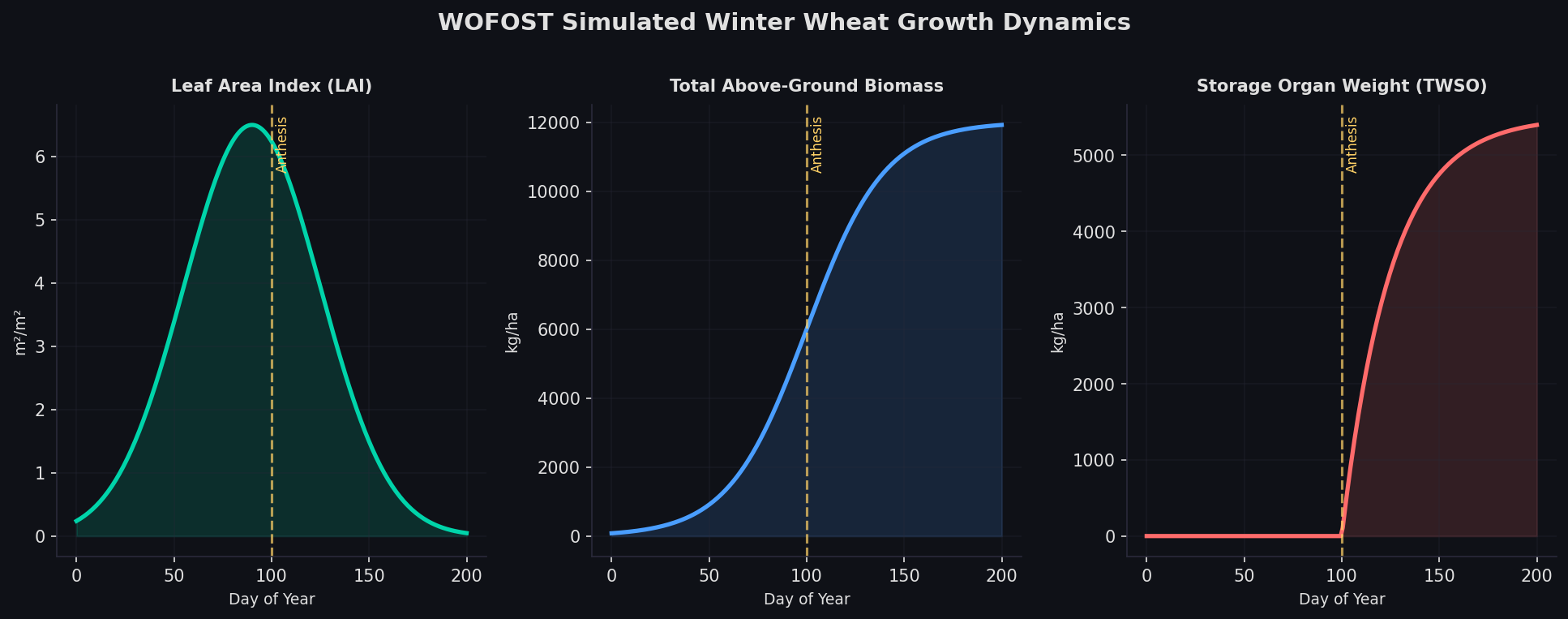
Leaf area index (LAI) dynamics are modeled explicitly: new leaf area is generated from leaf biomass using a specific leaf area (SLA) parameter, while senescence is driven by both age and water stress. The resulting LAI drives the light interception calculation via Beer's law, closing the feedback loop between canopy structure and photosynthesis.
Python Crop Simulation Environment (PCSE)
The modern interface to WOFOST is PCSE (Python Crop Simulation Environment), an open-source Python framework that wraps the WOFOST engine with a clean API:
import pcse
from pcse.models import Wofost72_WLP_FD
from pcse.base import ParameterProvider
from pcse.db import NASAPowerWeatherDataProvider

# Load weather data from NASA POWER (automatic download)
weatherdata = NASAPowerWeatherDataProvider(latitude=52.0, longitude=5.5)

# Load crop, soil, and site parameters
cropdata = pcse.util.load_cropdata("WINTERWHEAT")
soildata = pcse.util.load_soildata("EC3")
sitedata = {"IFUNRN": 0, "SSMAX": 0.0, "WAV": 100, "NOTINF": 0}

parameters = ParameterProvider(cropdata=cropdata, soildata=soildata, sitedata=sitedata)

# Define agromanagement calendar
agromanagement = pcse.util.load_agromanagement("winterwheat_NL.yaml")

# Initialize and run model
wofost = Wofost72_WLP_FD(parameters, weatherdata, agromanagement)
wofost.run_till_terminate()

# Extract output
output = wofost.get_output()
df = pd.DataFrame(output).set_index("day")
print(df[["LAI", "TAGP", "TWSO"]].tail())
PCSE integrates with NASA POWER for automatic weather data retrieval, supports batch ensemble runs across spatial grids, and outputs daily state variables including LAI, total above-ground biomass (TAGP), and weight of storage organs (TWSO — the yield proxy).
Calibration and Parameter Estimation
WOFOST crop parameters are organized into YAML-formatted crop files covering ~50 parameters per crop. The Wageningen team maintains a curated library for major crops (wheat, maize, rice, soybean, potato, sugar beet, sunflower). For new cultivars, calibration typically targets:
- Phenological parameters (TSUM1, TSUM2): thermal sum requirements for emergence-to-anthesis and anthesis-to-maturity. Calibrated against observed heading and maturity dates.
- Maximum leaf CO₂ assimilation rate (AMAX): Calibrated against peak LAI and biomass measurements.
- Light use efficiency (EFF): Initial slope of the light response curve; relatively stable across cultivars.
- Harvest index parameters (FRTB, FLTB, FSTB, FOTB): Partitioning tables; calibrated against biomass component measurements at key growth stages.
Automated calibration is supported via PCSE's CalibrationInterface, which wraps any optimizer (scipy, DEAP genetic algorithms) around the model's objective function.
Operational Use in Crop Monitoring
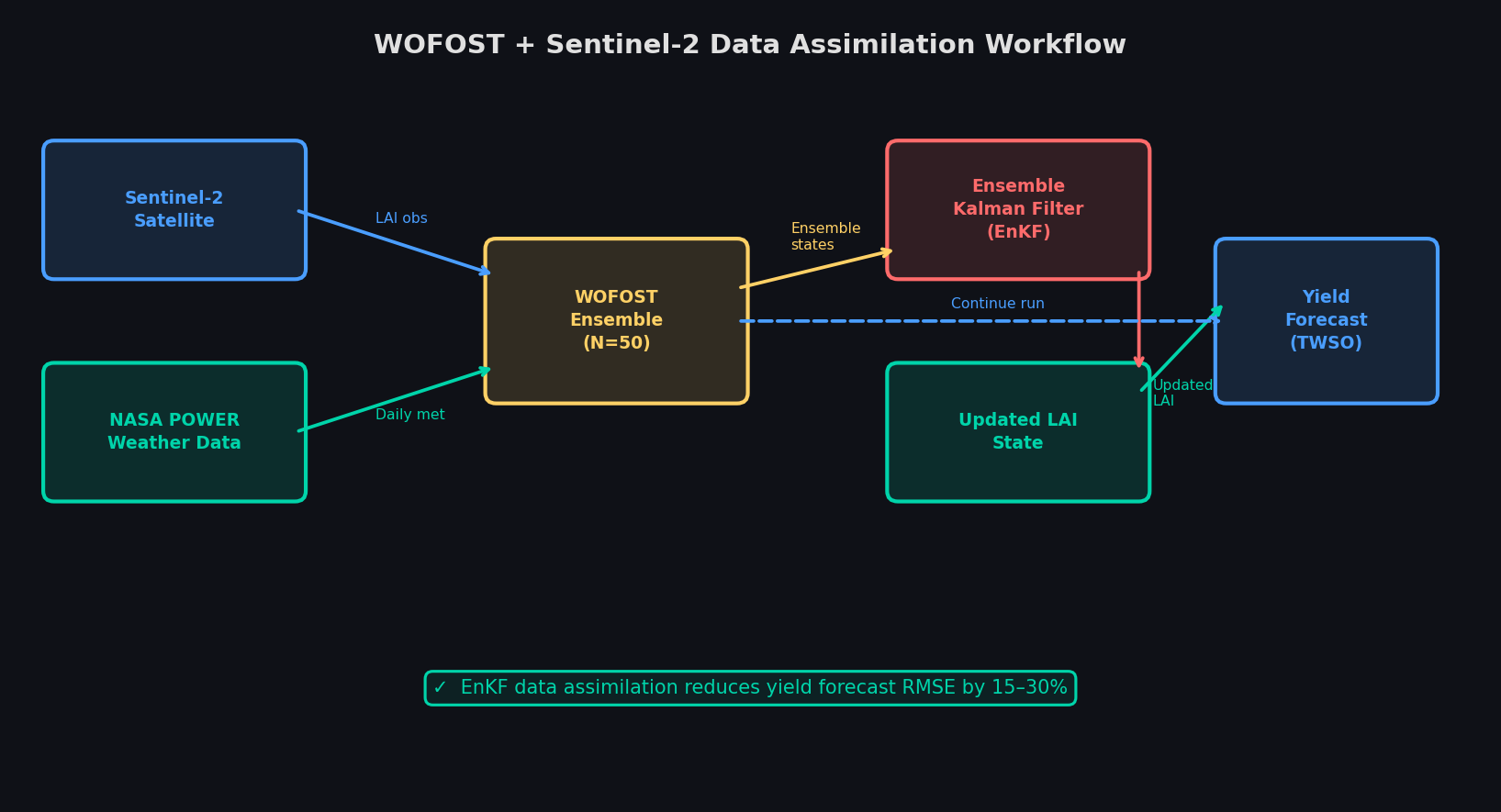
WOFOST is the engine behind the BioMA (Biophysical Models Applications) platform used in the EU MARS Bulletin, which publishes monthly crop condition and yield forecasts for Europe. In this operational context, WOFOST runs are driven by gridded meteorological data (JRC AGRI4CAST dataset, 25 km resolution) and assimilate satellite-derived LAI from Sentinel-2 and MODIS using an Ensemble Kalman Filter (EnKF). The data assimilation step corrects model state variables mid-season, substantially reducing forecast uncertainty in years with anomalous weather.
For national-scale applications, WOFOST has been coupled with GIS frameworks (QGIS, ArcGIS) to produce spatially explicit yield maps. The CGMS (Crop Growth Monitoring System) database schema, developed by JRC, provides a standardized structure for storing gridded WOFOST inputs and outputs.
Climate Change Impact Assessment
WOFOST's process-based structure makes it well-suited for Representative Concentration Pathway (RCP) scenario analysis. Key considerations when running climate projections:
- CO₂ fertilization: WOFOST 7.2 includes a CO₂ response function for AMAX and stomatal conductance. Elevated CO₂ increases potential yield but reduces water use efficiency gains in C3 crops.
- Heat stress: The standard WOFOST formulation does not include explicit heat stress on grain filling. For high-temperature scenarios, coupling with the LINTUL5 heat stress module or using APSIM is recommended.
- Phenological shifts: Warmer temperatures accelerate thermal time accumulation, shortening growing seasons. This effect is captured automatically through the DVS mechanism.
Multi-model ensemble studies (e.g., AgMIP) consistently include WOFOST alongside DSSAT and APSIM, providing cross-model uncertainty estimates for policy-relevant yield projections.
Integration with Remote Sensing Workflows
A growing use case is the integration of WOFOST with Sentinel-2 time series for field-scale yield estimation. The workflow typically involves:
- Extracting LAI time series from Sentinel-2 using the SNAP toolbox or sen2r.
- Running WOFOST in ensemble mode with perturbed initial conditions.
- Applying EnKF or Particle Filter to update LAI state variables at each satellite overpass.
- Extracting final TWSO as the yield estimate.
This approach has demonstrated RMSE reductions of 15–30% compared to open-loop WOFOST runs in wheat and maize trials across Europe and China.
Getting Started
WOFOST via PCSE is available on PyPI:
pip install pcseThe Wageningen WOFOST documentation and crop parameter database are maintained at https://wofost.readthedocs.io. The CGMS/BioMA operational framework documentation is available through the JRC MARS Bulletin portal. For ensemble climate impact studies, the AgMIP protocols provide standardized experimental designs compatible with WOFOST/PCSE.
WOFOST's combination of physiological rigor, open-source accessibility, and operational pedigree makes it a foundational tool for any practitioner working at the intersection of crop modeling, remote sensing, and climate adaptation planning.