

MASON: High-Performance Agent-Based Simulation for Large-Scale Social Systems

Agent-based modeling (ABM) has become an indispensable tool for understanding complex social dynamics, from market behavior to epidemic spread. While platforms like NetLogo excel at educational and exploratory modeling, researchers tackling large-scale simulations with millions of agents require a different approach. MASON (Multi-Agent Simulator Of Neighborhoods) fills this critical niche, offering a Java-based framework optimized for computational performance and scalability.
Architecture and Performance Advantages
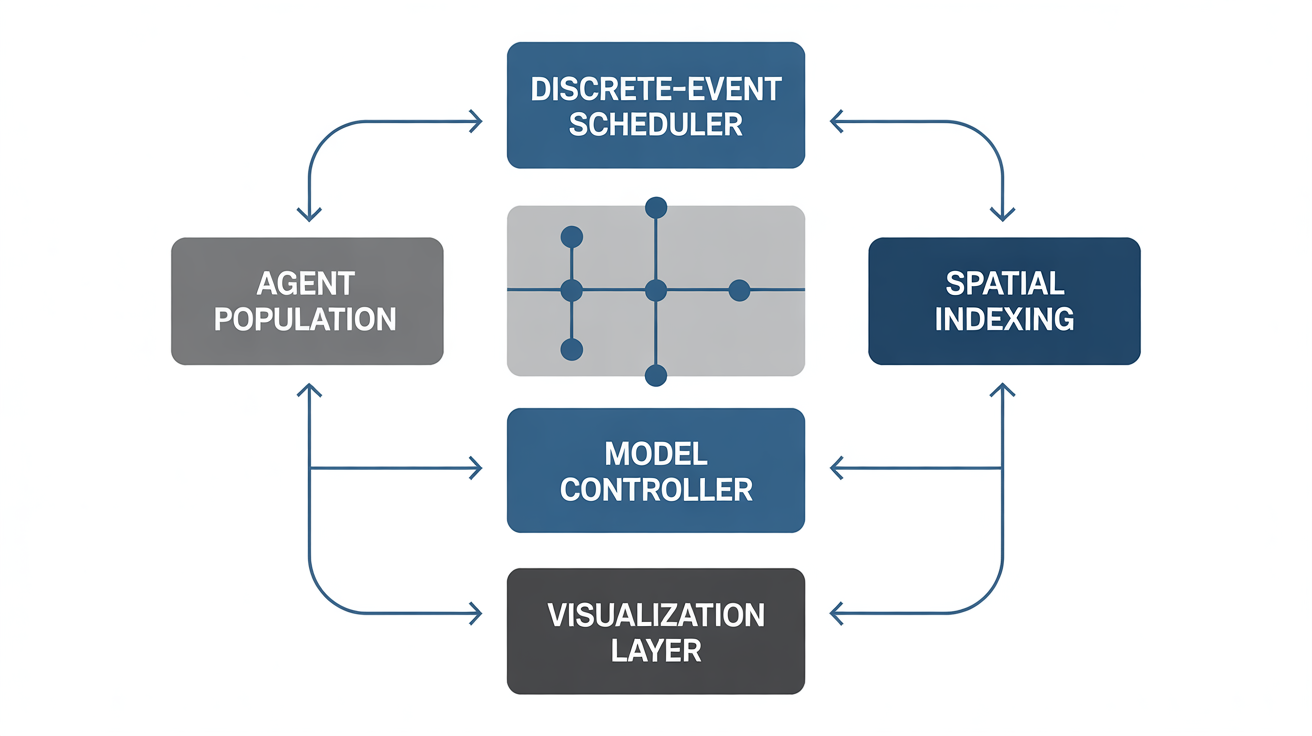
MASON distinguishes itself through a lightweight, library-based architecture that prioritizes execution speed over graphical sophistication. Unlike monolithic simulation environments, MASON operates as a set of Java libraries that developers integrate directly into their applications. This design eliminates the overhead of interpreted scripting languages, enabling simulations to run at speeds approaching pure Java performance.

The framework employs a discrete-event scheduler that efficiently manages agent activation sequences. Agents can be scheduled at specific time steps, at repeating intervals, or dynamically based on simulation state. This flexibility proves essential when modeling heterogeneous populations where different agent types operate on varying temporal scales—for instance, simulating both individual consumer decisions (hourly) and organizational strategic planning (quarterly) within the same model.
MASON's spatial representation system supports multiple paradigms simultaneously. Researchers can implement continuous 2D/3D spaces for physical movement models, discrete grids for cellular automaton-style interactions, or network topologies for social relationship structures. The framework's spatial indexing algorithms ensure that neighborhood queries—critical for agent interaction detection—scale logarithmically rather than linearly with agent population.
Practical Applications in Social Systems Research

One of MASON's most powerful features is its support for distributed computing through its distributed MASON (D-MASON) extension. This capability enables researchers to partition large agent populations across multiple processors or computing nodes, making previously intractable problems computationally feasible. Studies of urban evacuation dynamics, for example, can now simulate entire metropolitan populations with realistic behavioral heterogeneity.
The framework's visualization system, while less polished than NetLogo's interface, provides real-time rendering of simulation state through Java2D or Java3D graphics. Researchers can create custom visualizations that display only relevant metrics, reducing computational overhead during long simulation runs. For publication-quality output, MASON supports headless execution with periodic state snapshots that can be post-processed using external visualization tools.
MASON's integration with standard Java development tools enables sophisticated debugging and profiling workflows. Developers can use IDEs like Eclipse or IntelliJ IDEA to set breakpoints within agent decision logic, inspect simulation state at arbitrary time steps, and identify performance bottlenecks using Java profilers. This level of development support proves invaluable when implementing complex cognitive architectures or validating model behavior against empirical data.
Best Practices for Implementation
When building MASON models, careful attention to object creation patterns significantly impacts performance. The framework provides object pooling mechanisms that reuse agent instances rather than repeatedly allocating and garbage-collecting objects. For simulations with dynamic populations—such as epidemic models where agents recover and become susceptible again—this technique can reduce execution time by 30-40%.
Parameter sweeps and sensitivity analyses benefit from MASON's batch execution capabilities. The framework includes utilities for systematically varying input parameters across specified ranges and collecting output statistics. Combined with parallel execution on multi-core systems, researchers can explore large parameter spaces efficiently. Integration with optimization libraries like ECJ (Evolutionary Computation in Java) further enables automated calibration of model parameters to match observed data.
Documentation and community support remain active through the MASON website and mailing list, with numerous example models demonstrating best practices. The framework's open-source license (Academic Free License) permits both academic and commercial use, fostering a diverse user community across research institutions and industry.
Conclusion
MASON represents a mature, performance-oriented solution for agent-based modeling of social systems at scale. Its library-based architecture, efficient scheduling mechanisms, and distributed computing support make it particularly well-suited for research questions requiring large populations or extensive parameter exploration. While the learning curve is steeper than visual modeling environments, the investment pays dividends for computationally demanding projects where execution speed and scalability are paramount.
For researchers transitioning from exploratory modeling to production-scale simulations, MASON provides the computational foundation necessary to bridge the gap between conceptual models and empirically grounded, large-scale social system analysis.
Further Information:
- Official MASON website: https://cs.gmu.edu/~eclab/projects/mason/
- MASON API documentation: https://cs.gmu.edu/~eclab/projects/mason/docs/
- D-MASON distributed computing extension: https://github.com/isislab-unisa/dmason