
OpenFlows WaterGEMS: Hydraulic Modeling, Criticality Analysis, and Calibration for Water Distribution Networks
OpenFlows WaterGEMS: Advanced Water Distribution Network Modeling and Resilience Analysis
Water utilities face mounting pressure to maintain reliable service while aging infrastructure degrades and climate-driven demand patterns shift unpredictably. OpenFlows WaterGEMS, Bentley Systems' flagship hydraulic modeling platform, provides engineers with a comprehensive environment for steady-state, extended-period, water quality, and fire-flow analysis across networks of any scale. This article examines the platform's core simulation engine, its resilience analysis workflows, and practical calibration strategies that distinguish production-grade models from academic exercises.
The EPANET Engine and WaterGEMS Extensions
WaterGEMS builds on the EPANET 2 hydraulic solver but extends it substantially. Where EPANET operates as a standalone command-line tool, WaterGEMS wraps the solver in a GIS-integrated environment with native connectors to Esri ArcGIS, AutoCAD, and MicroStation, enabling engineers to maintain a single authoritative network model rather than maintaining parallel GIS and hydraulic datasets.
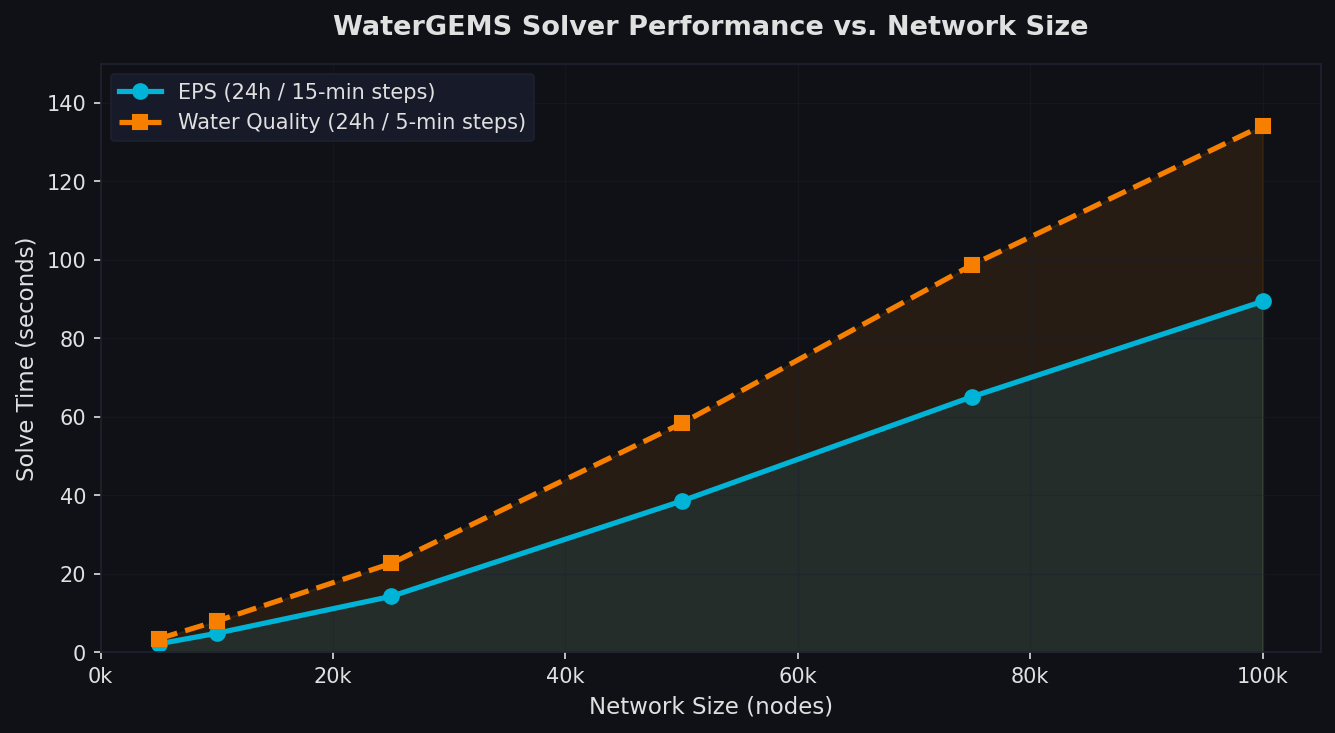
The extended-period simulation (EPS) engine solves the full set of continuity and energy equations at each timestep using a gradient algorithm. For large networks—those exceeding 50,000 pipes—WaterGEMS employs a sparse matrix solver with bandwidth minimization to keep runtimes tractable. A 100,000-node network with a 24-hour EPS at 15-minute intervals typically solves in under 90 seconds on modern hardware, making iterative scenario analysis practical within a planning session.

Water quality modeling uses a Lagrangian time-driven method to track constituent transport, reaction, and decay. Engineers commonly apply this to:
- Chlorine residual management: Calibrating bulk and wall decay coefficients against field measurements to predict disinfectant depletion across the distribution zone.
- Contaminant intrusion scenarios: Simulating backflow events or main breaks to estimate exposure zones and inform flushing protocols.
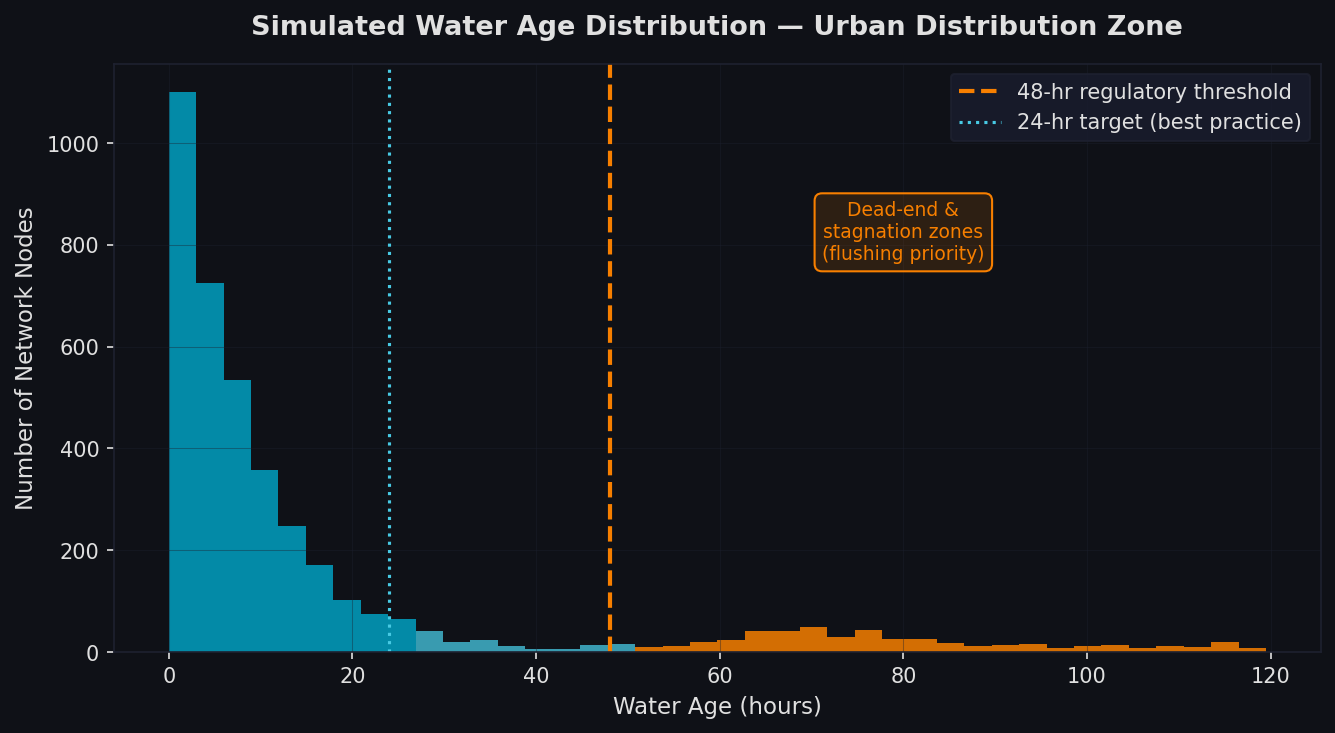
- Age analysis: Identifying stagnation zones where water age exceeds regulatory thresholds, guiding looping or flushing program design.
Resilience Analysis with Criticality and Segment Analysis
Modern utility planning requires quantifying network resilience—the ability to maintain acceptable service levels under component failure. WaterGEMS provides two complementary tools for this.
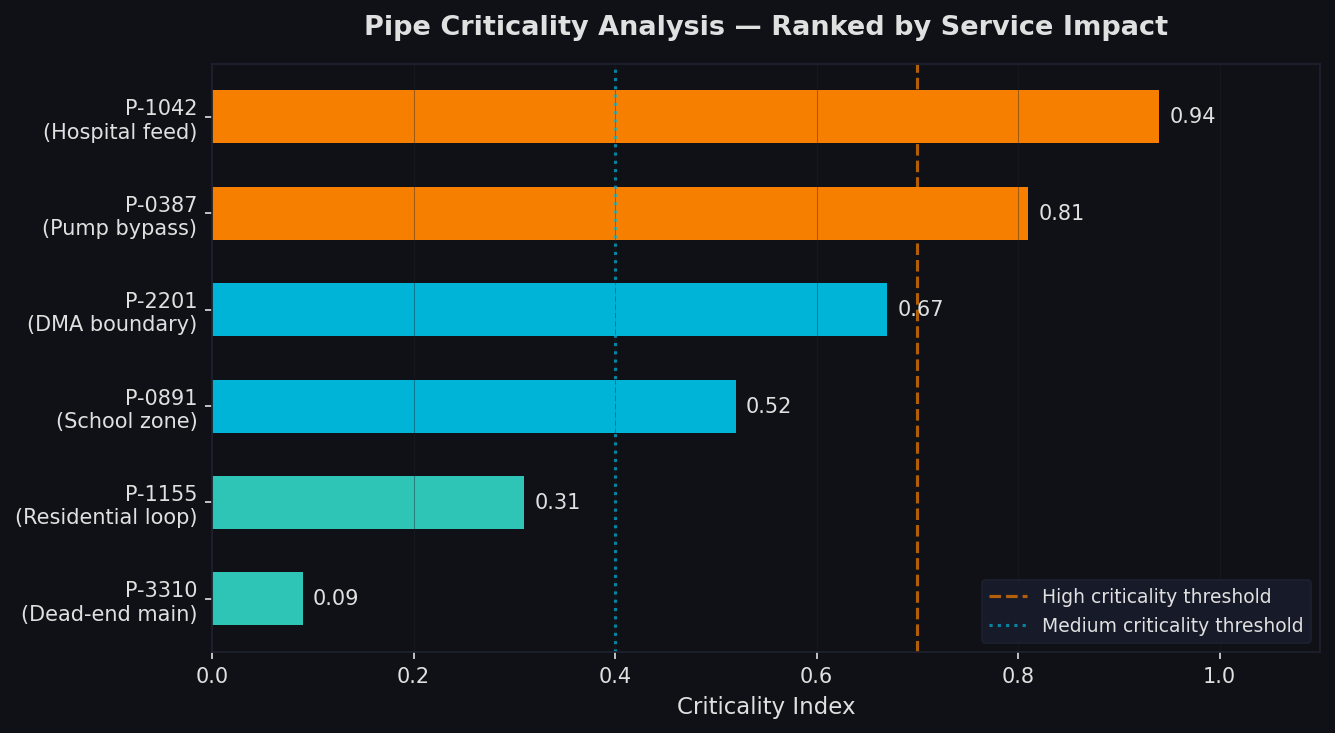
Criticality Analysis systematically isolates each pipe or pump in the model, simulates the resulting network state, and records the pressure deficit and number of customers affected. The output is a ranked criticality index that prioritizes rehabilitation investment. A pipe serving 5,000 connections whose failure drops system pressure below 20 psi across a hospital district scores far higher than a dead-end main serving a handful of residential meters.
Segment Analysis models the realistic isolation boundary created by closing the nearest operable valves around a failed element. Unlike simple pipe removal, segment analysis accounts for the fact that closing a valve isolates not just the target pipe but every element within the valve-bounded segment. This distinction is critical: a single valve failure can inadvertently isolate a segment containing a booster pump station, cascading pressure loss far beyond the immediate break location. WaterGEMS traces the segment graph automatically, identifies all affected customers, and computes the minimum number of valve operations required to restore service to each sub-zone.
Demand Allocation and Calibration Workflow
Model accuracy depends entirely on demand allocation quality. WaterGEMS supports three allocation methods:
- Unit demand loading: Assigns a per-connection demand based on meter count and average consumption—appropriate for planning-level studies.
- Billing record import: Reads monthly or annual consumption from the utility's customer information system (CIS) and distributes it temporally using a diurnal pattern library.
- SCADA-driven allocation: Imports real-time or historical SCADA flow data at district metered area (DMA) boundaries and uses a proportional allocation algorithm to distribute measured flows to individual nodes within each DMA.
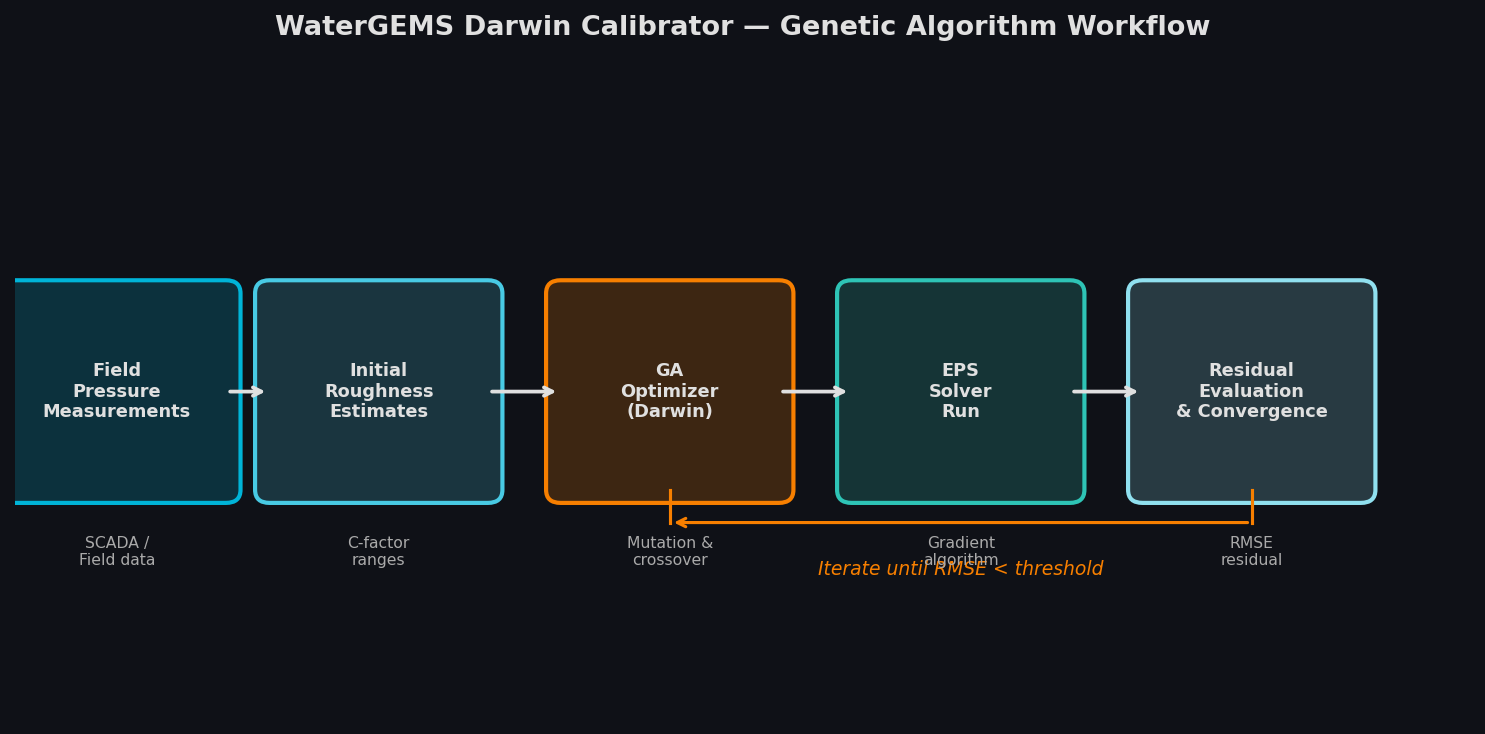
Calibration against field pressure measurements uses WaterGEMS' Darwin Calibrator, a genetic algorithm optimizer that adjusts pipe roughness coefficients (Hazen-Williams C-factors) and demand multipliers to minimize the residual between simulated and observed pressures. Best practice is to run calibration against at least two independent demand states—typically a peak-hour fire-flow test and an overnight minimum-night-flow period—to avoid overfitting roughness to a single operating condition.
A common pitfall is calibrating roughness without first auditing the pipe connectivity model. Phantom loops created by incorrect valve-open/closed status or missing isolation valves produce pressure gradients that no roughness adjustment can correct. A pre-calibration connectivity audit—verifying that simulated flows at DMA meters match SCADA records within ±5%—is a prerequisite for meaningful roughness calibration.
Fire Flow and Regulatory Compliance
Fire flow analysis in WaterGEMS evaluates available fire flow (AFF) at every node simultaneously, using a constrained optimization that holds system pressure at or above the minimum residual (typically 20 psi) while maximizing the flow that can be delivered at the test node. The results feed directly into ISO fire suppression rating schedules and support subdivision approval workflows where minimum AFF requirements must be demonstrated before permits are issued.
For utilities operating under the EPA Lead and Copper Rule Revisions (LCRR), WaterGEMS' water age and stagnation analysis identifies service lines and premise plumbing segments where extended residence time elevates lead leaching risk. Coupling age results with the utility's service line material inventory enables targeted flushing program design and prioritizes service line replacement in high-risk zones.
Integration with Digital Twin Platforms
Bentley's iTwin platform extends WaterGEMS models into continuously updated digital twins. SCADA telemetry feeds update demand patterns and operational states in near-real-time, enabling operators to run what-if scenarios against current network conditions rather than yesterday's snapshot. When a pressure transient alarm fires, operators can load the current model state, simulate the suspected break location, and compare predicted pressure signatures against observed SCADA readings to confirm the failure location before dispatching a crew—reducing mean time to repair and limiting non-revenue water losses.
Practical Recommendations
- Skeletonize judiciously: Removing pipes below 4-inch diameter is standard practice for transmission models, but distribution models supporting fire flow or water quality analysis should retain 2-inch and larger mains to capture local pressure gradients accurately.
- Version-control your model: WaterGEMS' built-in scenario manager tracks alternatives, but exporting the
.wtgfile to a version-controlled repository (Git LFS handles binary files) provides an audit trail essential for regulatory submissions. - Validate before calibrating: Confirm that total system demand, storage levels, and pump operating points match SCADA before adjusting any roughness coefficients.