

OpenKIM: Standardizing Interatomic Potentials for Reliable Molecular Dynamics Simulations
Molecular dynamics (MD) simulations are only as accurate as the interatomic potentials — also called force fields or empirical potentials — that govern atomic interactions. Selecting, validating, and deploying these potentials has historically been a fragmented, error-prone process. OpenKIM (Open Knowledgebase of Interatomic Models) addresses this challenge head-on by providing a curated, open-access repository of interatomic models paired with a rigorous, automated testing framework.
What Is OpenKIM?
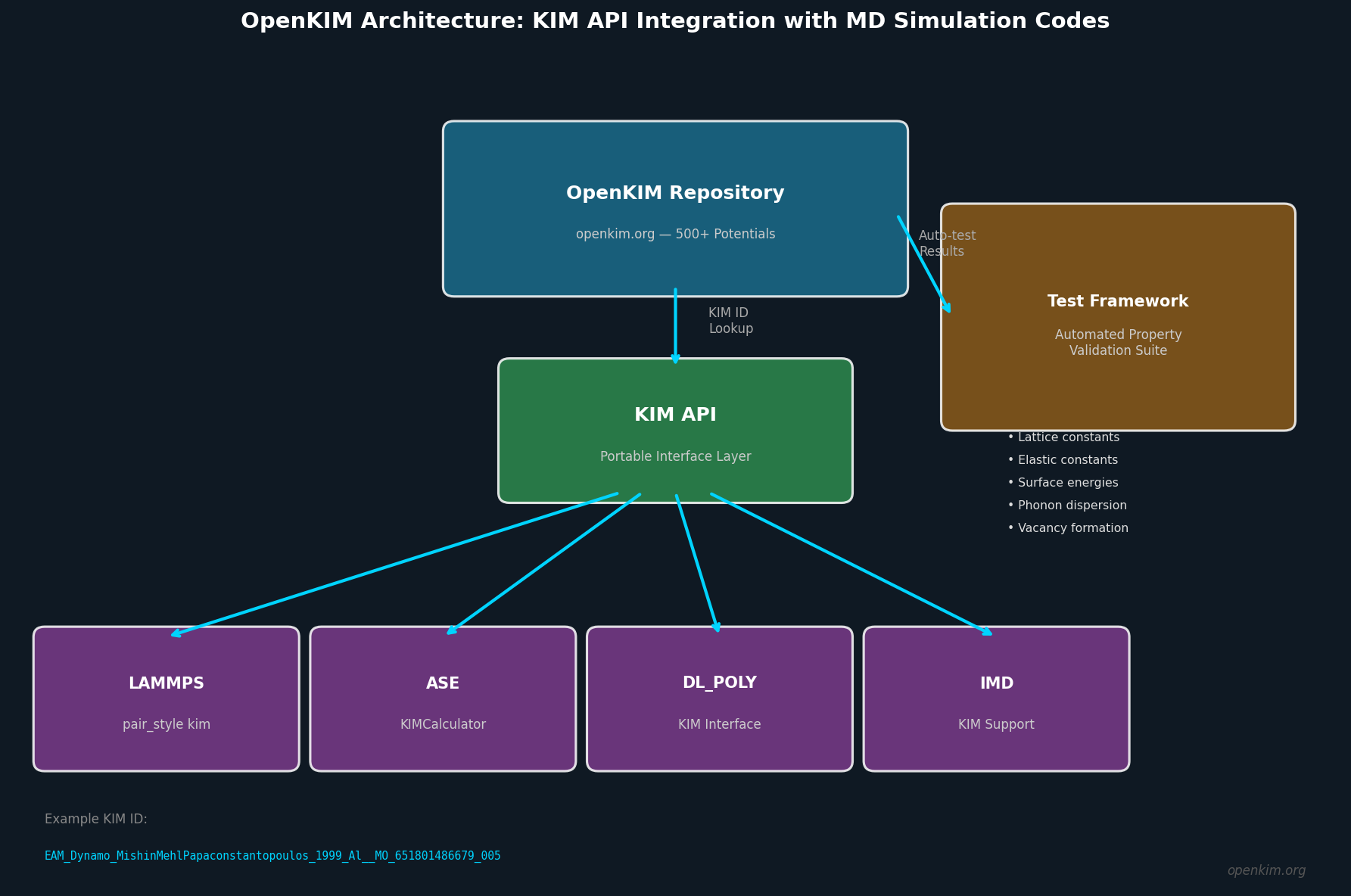
OpenKIM is a community-driven cyberinfrastructure project hosted at openkim.org. It serves two primary functions:
- A repository of interatomic models — hundreds of peer-reviewed potentials covering metals, semiconductors, ceramics, polymers, and more, each assigned a unique identifier (KIM ID) for reproducibility.
- An automated testing pipeline — every model in the repository is subjected to a standardized battery of property tests (lattice constants, elastic constants, surface energies, vacancy formation energies, etc.) so users can objectively compare model performance before committing to a simulation campaign.
The project is funded by the National Science Foundation and developed collaboratively by researchers at the University of Minnesota, Stony Brook University, and partner institutions.

The KIM API: Seamless Integration with MD Codes
At the heart of OpenKIM is the KIM Application Programming Interface (KIM API), a portable, language-agnostic interface layer that decouples simulation engines from potential implementations. Major MD codes — including LAMMPS, ASE (Atomic Simulation Environment), DL_POLY, and IMD — ship with native KIM API support.
In LAMMPS, invoking an OpenKIM potential is as simple as:
pair_style kim EAM_Dynamo_ErcolessiAdams_1994_Al__MO_123629422045_005
pair_coeff * * Al
This single line replaces the traditional workflow of manually downloading a potential file, verifying its format, and hoping the implementation matches the original publication. The KIM ID encodes the model name, authors, year, element set, and version — making simulation inputs fully self-documenting and reproducible.
Property Tests and Verification Reports
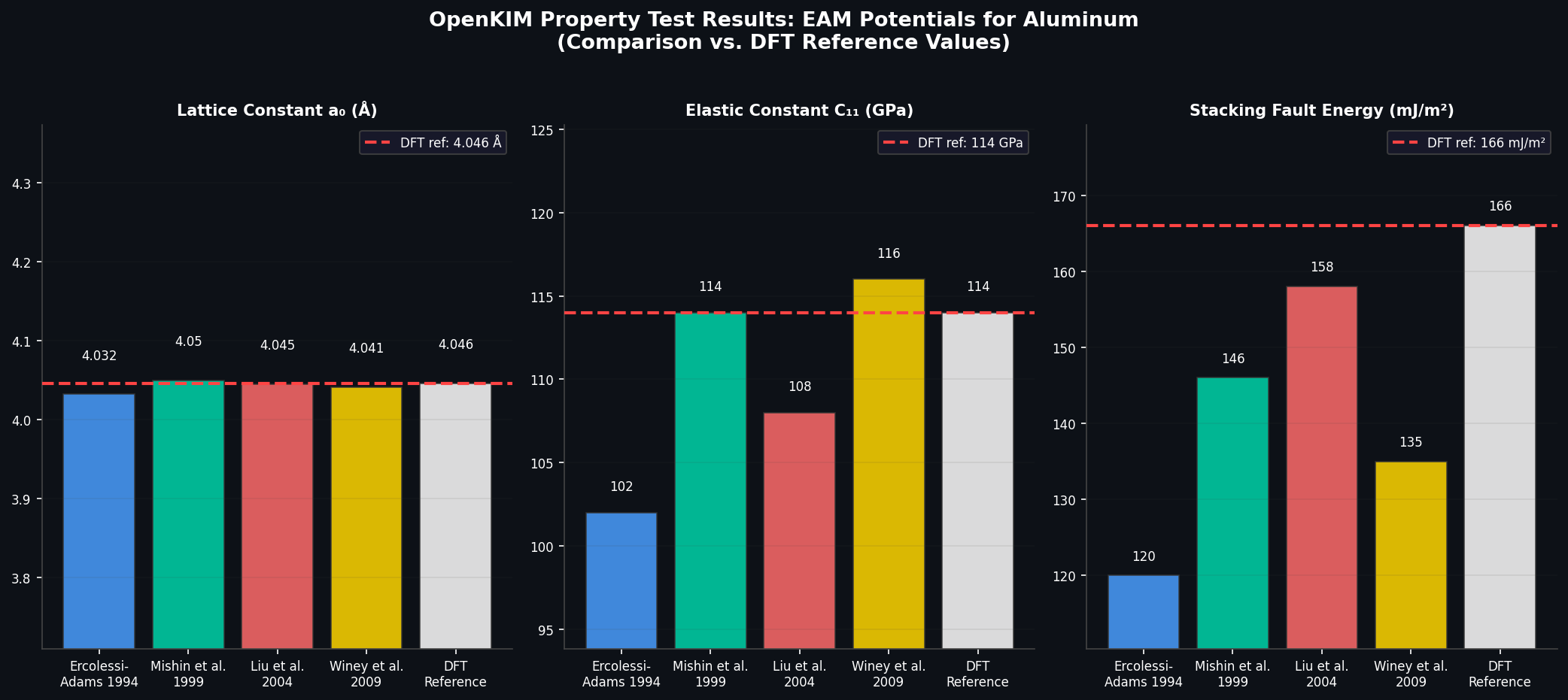
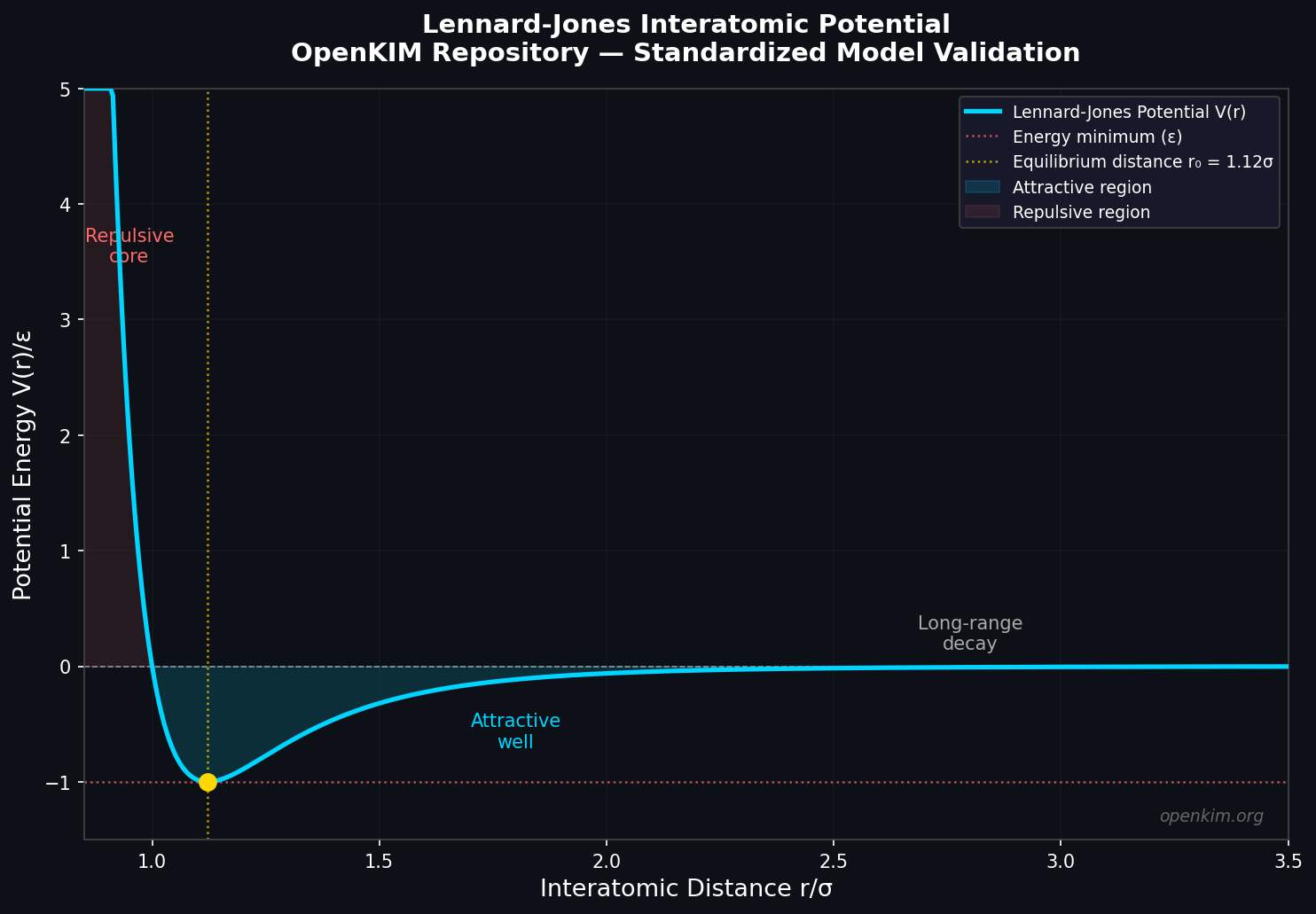
Every model in the OpenKIM repository is automatically evaluated against a growing library of Tests — standardized property calculations written in Python, LAMMPS, or other supported languages. Results are stored as structured JSON data conforming to the KIM Properties Definition schema, enabling machine-readable comparison across models.
Key property categories include:
- Cohesive energy and lattice parameters — fundamental checks that a potential reproduces the correct crystal structure
- Elastic constants (C₁₁, C₁₂, C₄₄) — critical for any simulation involving mechanical deformation
- Phonon dispersion curves — essential for thermal transport and vibrational property studies
- Stacking fault energies — important for dislocation dynamics and plasticity modeling
- Surface and grain boundary energies — relevant to fracture, sintering, and thin-film simulations
Each test result is linked to experimental or DFT reference data where available, giving users a quantitative basis for model selection rather than relying on anecdotal recommendations.
Practical Workflow: Selecting a Potential for Aluminum Deformation Studies
Consider a researcher studying dislocation nucleation in aluminum under shock loading. The OpenKIM web interface allows filtering by element (Al), model type (EAM, MEAM, ADP), and sorting by error metrics on elastic constants or stacking fault energies. Within minutes, the researcher can identify that the Mishin et al. (1999) EAM potential reproduces the intrinsic stacking fault energy of Al (≈ 166 mJ/m²) more accurately than older Ercolessi-Adams parameterizations — a critical distinction for plasticity simulations.
The selected model can then be cited by its permanent KIM ID in publications, allowing other researchers to reproduce results exactly, even years later when potential file formats may have changed.
Model Drivers and Parameterized Families
OpenKIM distinguishes between Model Drivers (the functional form of a potential, e.g., EAM, Tersoff, ReaxFF) and Parameterized Models (a specific set of parameters for a given element system). This separation enables efficient repository management: a single EAM driver can serve hundreds of parameterizations without code duplication.
For users developing new potentials, OpenKIM provides templates and contribution guidelines that ensure new submissions are immediately testable and comparable to existing models — accelerating the peer-review process for computational materials science.
Integration with the Materials Project and NIST
OpenKIM is increasingly interoperable with other materials informatics platforms. Reference data from the Materials Project (DFT-computed properties) and NIST Interatomic Potentials Repository are cross-linked, creating a richer ecosystem for potential validation. The ColabFit Exchange further extends this by connecting ML-based interatomic potentials (e.g., GAP, NNP, SNAP) to the same standardized testing infrastructure.
Best Practices for Production Use
- Always cite the KIM ID in publications and simulation input files — not just the author name — to ensure exact reproducibility.
- Run the full test suite for your element system before production runs; pay particular attention to properties most relevant to your physical phenomenon of interest.
- Check the verification checks (distinct from property tests) — these confirm that a model satisfies basic physical requirements such as energy conservation and correct neighbor-list behavior.
- Use versioned models: OpenKIM assigns version numbers to models; if a bug fix is released, the old version remains available so existing published results are not invalidated.
Conclusion
OpenKIM represents a paradigm shift in how the MD community manages interatomic potentials — from ad hoc file sharing to a rigorous, versioned, automatically tested repository. For any research group running molecular dynamics simulations in materials science, integrating OpenKIM into the workflow is a straightforward step that substantially improves reproducibility, reduces potential-selection errors, and accelerates the path from simulation to publication.
Further Reading:
- OpenKIM Official Documentation
- KIM API Specification
- LAMMPS + OpenKIM Integration Guide
- OpenKIM on GitHub
- Tadmor, E.B. et al. (2011). "The potential of atomistic simulations and the Knowledgebase of Interatomic Models." JOM, 63(7), 17–17.