

Thermo-Calc and the CALPHAD Method: Computational Alloy Design Through Thermodynamic Modeling
Introduction
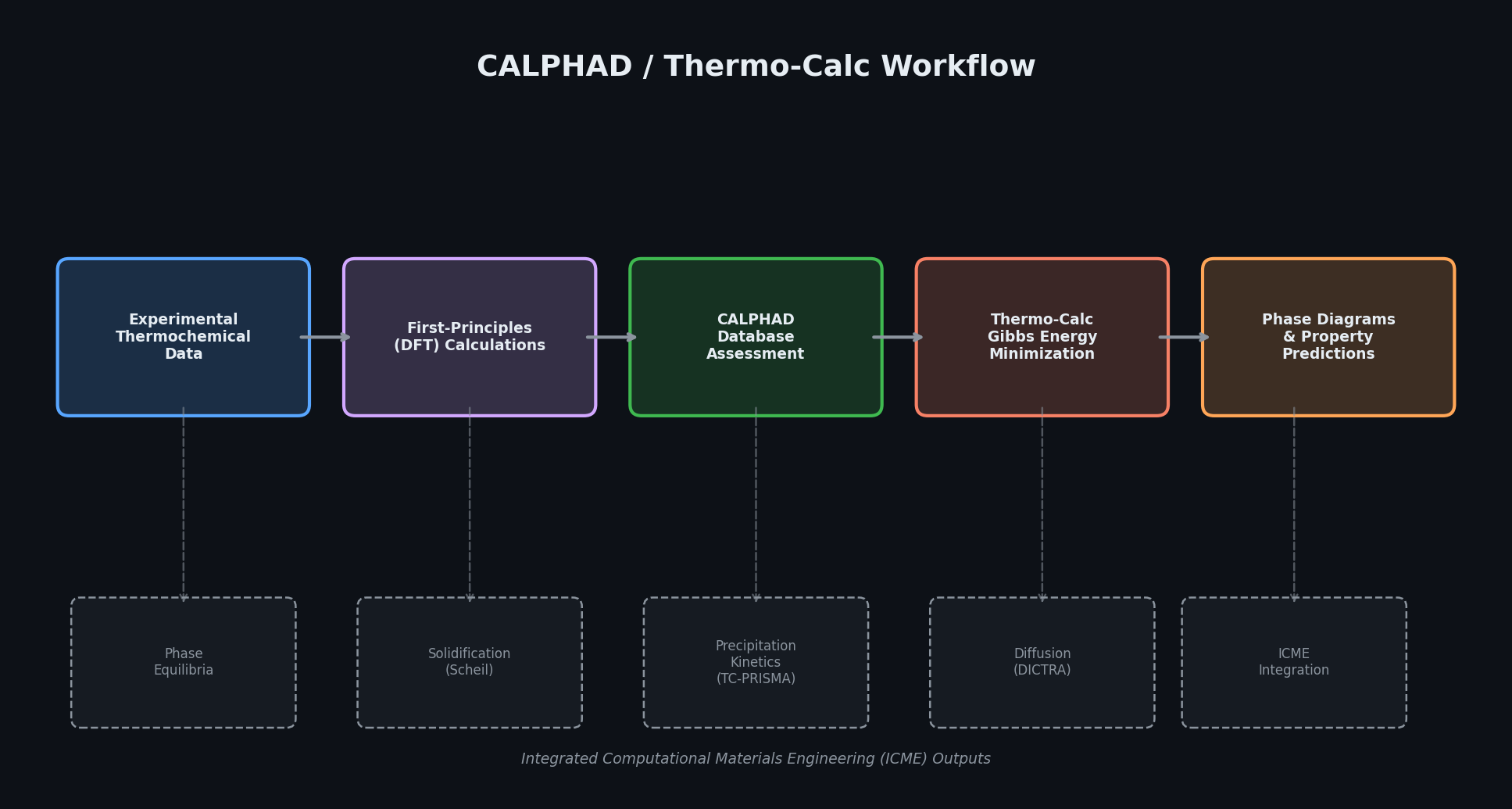
Designing new alloys and predicting their phase behavior has historically required extensive experimental trial-and-error. The CALPHAD (CALculation of PHAse Diagrams) method, implemented in tools such as Thermo-Calc, transforms this process by computing thermodynamic equilibria from first principles of Gibbs energy minimization. For materials engineers working on high-performance alloys, superalloys, steels, or light-metal systems, Thermo-Calc is an indispensable platform that bridges atomic-scale thermodynamics with macroscopic alloy design.
What Is the CALPHAD Method?
CALPHAD is a semi-empirical computational approach that models the Gibbs energy of each phase in a multicomponent system as a function of temperature, pressure, and composition. By minimizing the total Gibbs energy of the system, the method predicts:
- Phase equilibria (which phases are stable at a given temperature and composition)
- Phase fractions and compositions as a function of temperature
- Liquidus and solidus temperatures
- Driving forces for phase transformations
- Thermochemical properties such as heat capacity, enthalpy of mixing, and activity coefficients
The power of CALPHAD lies in its database-driven extensibility: thermodynamic parameters for binary and ternary subsystems are assessed from experimental data and first-principles calculations, then combined to predict behavior in higher-order multicomponent alloys — a feat impossible with purely experimental approaches.

Thermo-Calc: The Industry-Standard CALPHAD Platform
Thermo-Calc Software (developed in Sweden, now widely used in aerospace, automotive, and steel industries) provides a comprehensive GUI and scripting environment built around the CALPHAD engine. Key capabilities include:
1. Phase Diagram Calculation
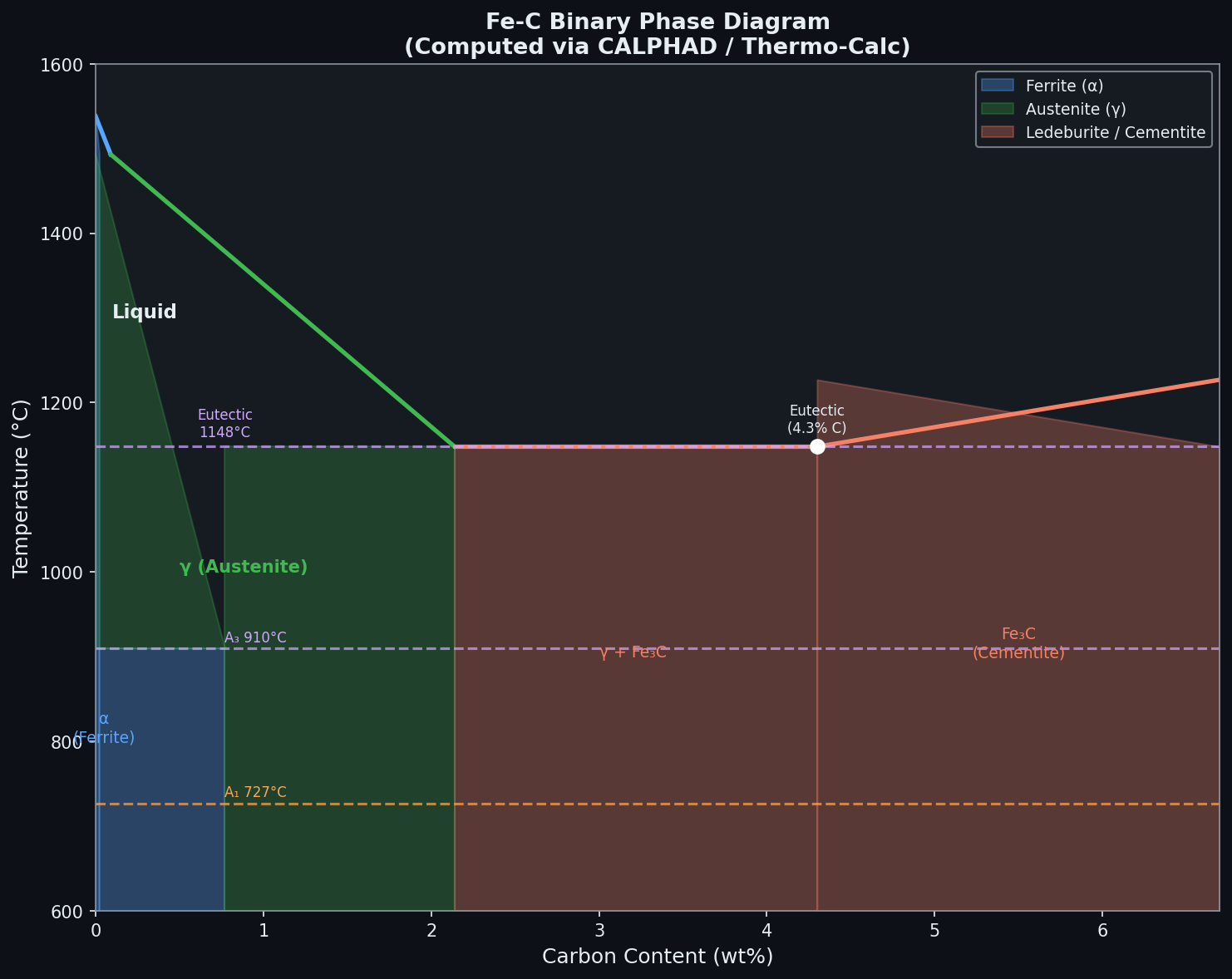
Thermo-Calc can compute binary, ternary, and pseudo-binary phase diagrams for virtually any alloy system covered by its thermodynamic databases. Users define the system components, select the relevant database (e.g., TCFE for steels, TTAL for aluminum alloys, TCNI for nickel superalloys), and specify the calculation type. The software then maps stable phase regions across the full composition-temperature space.
Practical use case: An engineer designing a new precipitation-hardened aluminum alloy can compute the Al-Cu-Mg ternary phase diagram to identify the two-phase (α + θ') window that maximizes precipitate volume fraction at the aging temperature.
2. Equilibrium and Scheil Solidification Calculations
Two solidification modes are available:
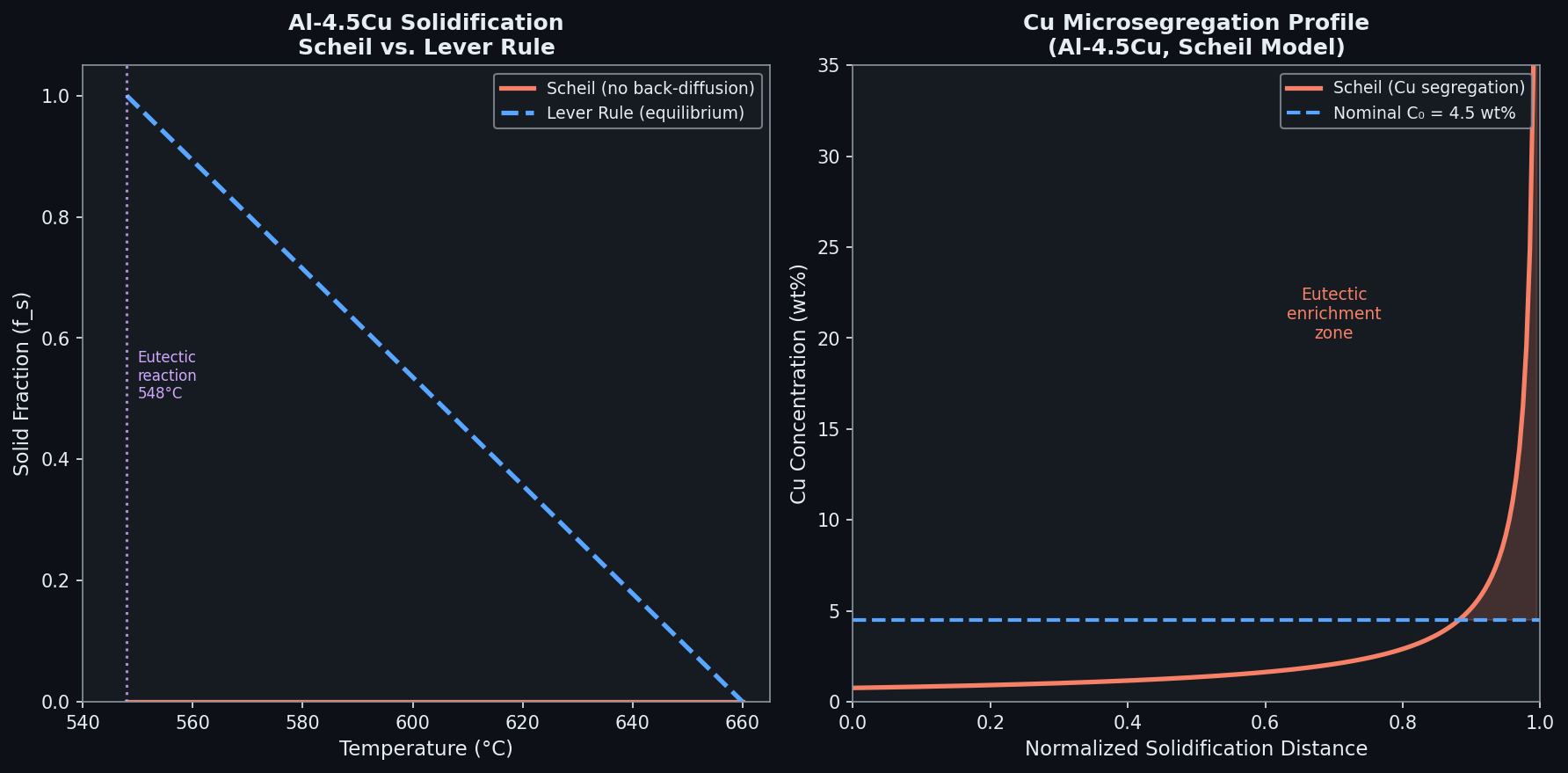
- Lever rule (equilibrium): Assumes complete diffusion in both solid and liquid — appropriate for slow cooling or annealing studies.
- Scheil-Gulliver model: Assumes no back-diffusion in the solid, modeling realistic rapid solidification. This predicts microsegregation, the onset of eutectic reactions, and the final solidification temperature — critical for casting and additive manufacturing process design.
The Scheil module outputs phase fraction vs. temperature curves and composition profiles, directly informing solidification cracking susceptibility assessments.
3. Property Diagrams and Step Calculations
Beyond phase diagrams, Thermo-Calc computes property diagrams — plots of any thermodynamic quantity (phase fraction, molar volume, driving force, liquidus temperature) as a function of a single variable such as temperature or one component's composition. This is invaluable for:
- Identifying the γ' solvus temperature in nickel superalloys
- Predicting the martensite start (Ms) temperature in steels
- Optimizing heat treatment windows for solution annealing
4. DICTRA: Diffusion-Controlled Transformations
Thermo-Calc integrates with DICTRA (DIffusion Controlled TRAnsformations), a module that couples CALPHAD thermodynamics with multicomponent diffusion kinetics. DICTRA simulates:
- Carburization and nitriding of steel surfaces
- Homogenization of cast alloys
- Coarsening of precipitate phases
- Diffusion bonding at interfaces
DICTRA uses the MOBFE (mobility database for steels) or MOBAL (aluminum alloys) to provide composition- and temperature-dependent diffusion coefficients, enabling quantitative predictions of concentration profiles and transformation kinetics.
5. TC-PRISMA: Precipitation Kinetics
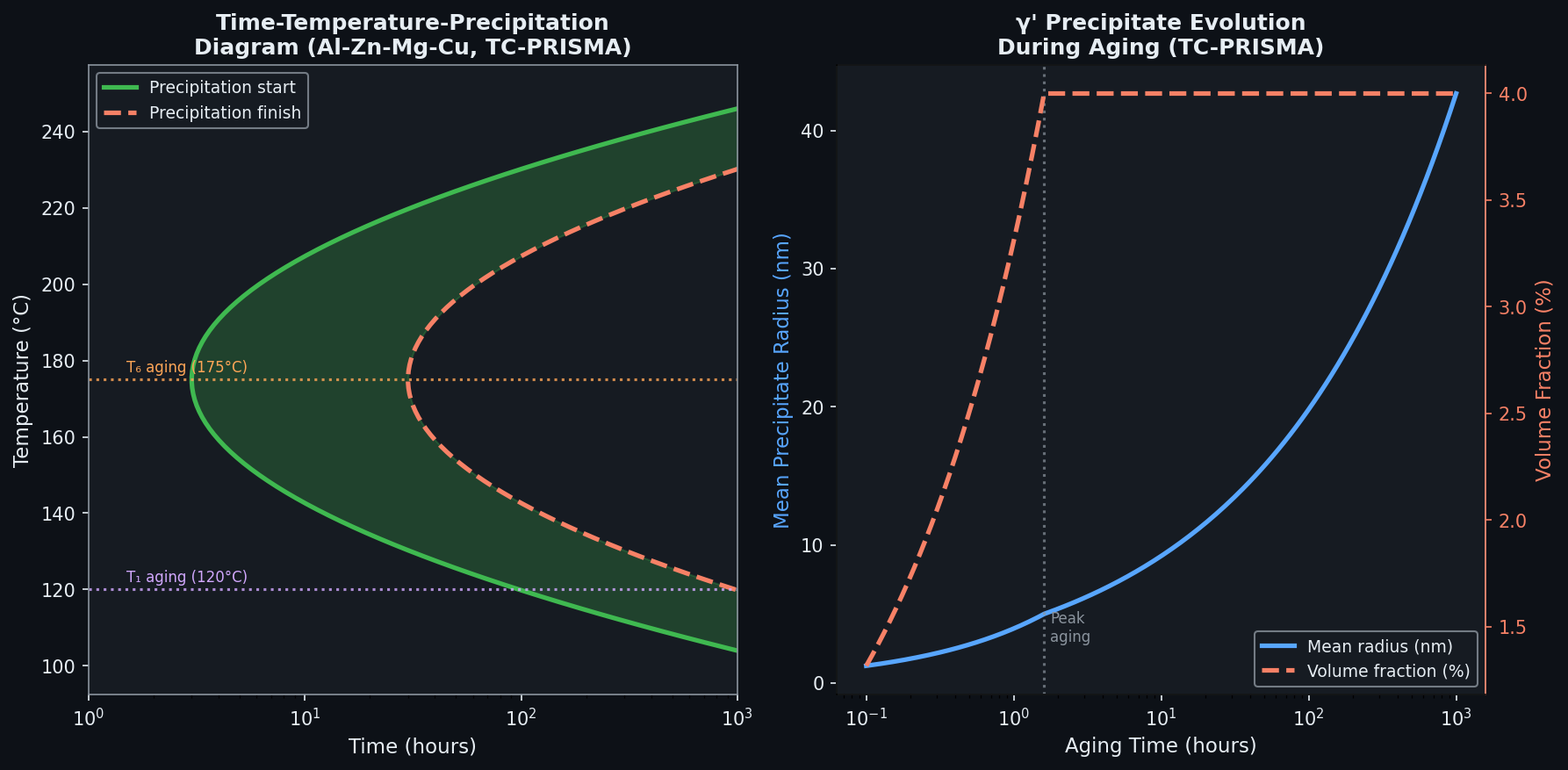
The TC-PRISMA module extends CALPHAD into precipitation modeling using classical nucleation theory coupled with thermodynamic driving forces. It predicts:
- Nucleation rate as a function of undercooling and interfacial energy
- Precipitate size distribution evolution during aging
- Time-Temperature-Precipitation (TTP) diagrams
This is particularly powerful for designing aging treatments in aluminum alloys (6xxx, 7xxx series) and nickel superalloys, where precipitate size and volume fraction directly control yield strength.
Thermodynamic Databases: The Foundation of Accuracy
The accuracy of any CALPHAD calculation depends critically on the quality of the thermodynamic database. Thermo-Calc maintains several peer-reviewed, commercially validated databases:
| Database | System | Key Applications |
|---|---|---|
| TCFE | Fe-based alloys | Steels, cast irons, stainless steels |
| TCNI | Ni-based alloys | Superalloys, turbine blades |
| TTAL | Al-based alloys | Aerospace, automotive Al alloys |
| TCTI | Ti-based alloys | Aerospace Ti alloys, biomedical |
| TCHEA | High-entropy alloys | Multi-principal-element alloys |
The TCHEA database, covering up to 15 elements in high-entropy alloy (HEA) systems, exemplifies how CALPHAD enables exploration of vast compositional spaces that would be experimentally intractable.
Scripting and Automation with the Python API
Thermo-Calc exposes a Python API (tc-python) that enables programmatic access to all calculation types. This is essential for:
- Alloy screening: Iterating over thousands of compositions to identify those meeting multiple thermodynamic criteria simultaneously
- Integration with machine learning: Generating CALPHAD-computed training data for surrogate models
- Coupling with process simulation: Feeding liquidus/solidus temperatures and phase fractions into casting or welding simulation codes
from tc_python import TCPython

with TCPython() as session:
    calc = (session
            .select_database_and_elements("TCFE10", ["Fe", "C", "Mn", "Si", "Cr"])
            .get_system()
            .with_single_equilibrium_calculation()
            .set_condition("T", 1073.15)   # 800°C
            .set_condition("P", 101325)
            .set_condition("X(C)", 0.002)
            .set_condition("X(Mn)", 0.015)
            .set_condition("X(Si)", 0.003)
            .set_condition("X(Cr)", 0.01))
    result = calc.calculate()
    print(result.get_value_of("NP(FCC_A1)"))  # Austenite phase fraction
This scripting capability makes Thermo-Calc a natural component in Integrated Computational Materials Engineering (ICME) workflows, where thermodynamic predictions feed directly into microstructure and performance models.
Best Practices for CALPHAD Calculations
- Validate against binary/ternary data first: Before trusting a multicomponent prediction, verify that the database reproduces known binary phase diagrams for your key element pairs.
- Check database element coverage: Not all elements are assessed in every database. Missing assessments default to ideal solution behavior, which can introduce significant errors.
- Use Scheil for casting, lever rule for wrought: Match the solidification model to the actual process cooling rate.
- Combine with kinetics modules: Equilibrium thermodynamics alone cannot predict metastable phases or time-dependent behavior — always couple with DICTRA or TC-PRISMA when kinetics matter.
- Cross-validate with experimental TTT/TTP diagrams: Use published time-temperature-transformation data to calibrate interfacial energy parameters in precipitation models.
Further Resources
- Thermo-Calc Official Documentation
- CALPHAD Journal — peer-reviewed thermodynamic assessments
- tc-python API Reference
- NIST CALPHAD Resources
- Integrated Computational Materials Engineering (ICME) — TMS
Conclusion
Thermo-Calc and the CALPHAD method represent a paradigm shift in alloy development — replacing years of experimental iteration with hours of computational screening. By accurately predicting phase equilibria, solidification behavior, and precipitation kinetics across complex multicomponent systems, CALPHAD-based tools are now central to ICME workflows in aerospace, automotive, and advanced manufacturing industries. For materials engineers seeking to accelerate alloy design while reducing experimental costs, mastering Thermo-Calc is an essential investment.