

PyIron: Integrated Simulation Framework for Hierarchical Materials Modeling
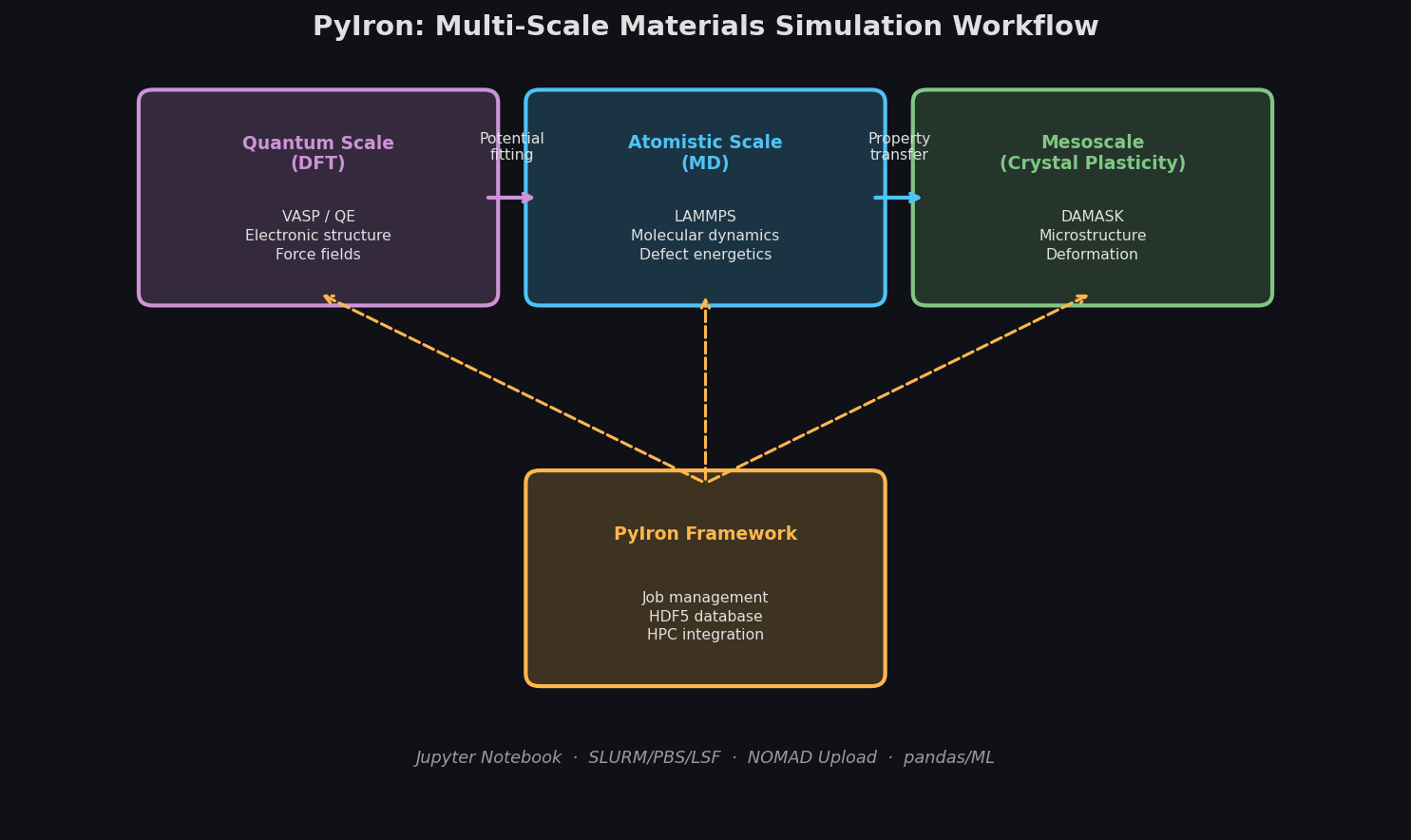
Materials scientists increasingly need to bridge multiple length and time scales — from quantum-mechanical electronic structure to atomistic molecular dynamics to mesoscale microstructure evolution. PyIron is an open-source, Python-based integrated development environment (IDE) for computational materials science that unifies these disparate simulation codes under a single, reproducible workflow framework. Developed at the Max-Planck-Institut für Eisenforschung (MPIE), PyIron has become a cornerstone tool for researchers who need to orchestrate complex, multi-code simulation pipelines without sacrificing reproducibility or scalability.
What PyIron Does
At its core, PyIron provides a unified Python interface to a wide range of established simulation engines, including LAMMPS (molecular dynamics), VASP and Quantum ESPRESSO (DFT), S/PHI/nX (electronic structure), and DAMASK (crystal plasticity). Rather than replacing these codes, PyIron wraps them in a consistent job management layer that handles input generation, job submission to HPC clusters, output parsing, and data storage — all within a Jupyter Notebook environment.
The framework is built around three core concepts:

- Jobs: Each simulation run is encapsulated as a
Jobobject with a defined state machine (initialized → running → finished/aborted). Jobs store all inputs and outputs in a structured HDF5 database, making every calculation fully reproducible. - Projects: A
Projectorganizes related jobs, enabling hierarchical data management and efficient querying across thousands of calculations. - Tables: PyIron's
TableJobaggregates results from many jobs into pandas DataFrames, enabling statistical analysis and machine learning workflows directly in Python.
Setting Up a LAMMPS Workflow in PyIron
A typical PyIron workflow for computing the equation of state (EOS) of a BCC iron structure illustrates the framework's power:
from pyiron_atomistics import Project

pr = Project("iron_eos")
job = pr.create.job.Lammps("bcc_iron_eos")
job.structure = pr.create.structure.bulk("Fe", cubic=True)
job.potential = "2013--Bonny-G--Fe-Ni-Cr--LAMMPS--ipr1"
job.calc_minimize(pressure=0.0)
job.run()
PyIron automatically selects the appropriate LAMMPS potential from the OpenKIM repository, generates the LAMMPS input files, submits the job, and parses the output — all without manual file manipulation. The EOS can then be computed by creating a Murnaghan job that wraps the base LAMMPS job and systematically varies the lattice parameter:
murn = pr.create.job.Murnaghan("bcc_iron_murnaghan")
murn.ref_job = job
murn.run()
murn.plot()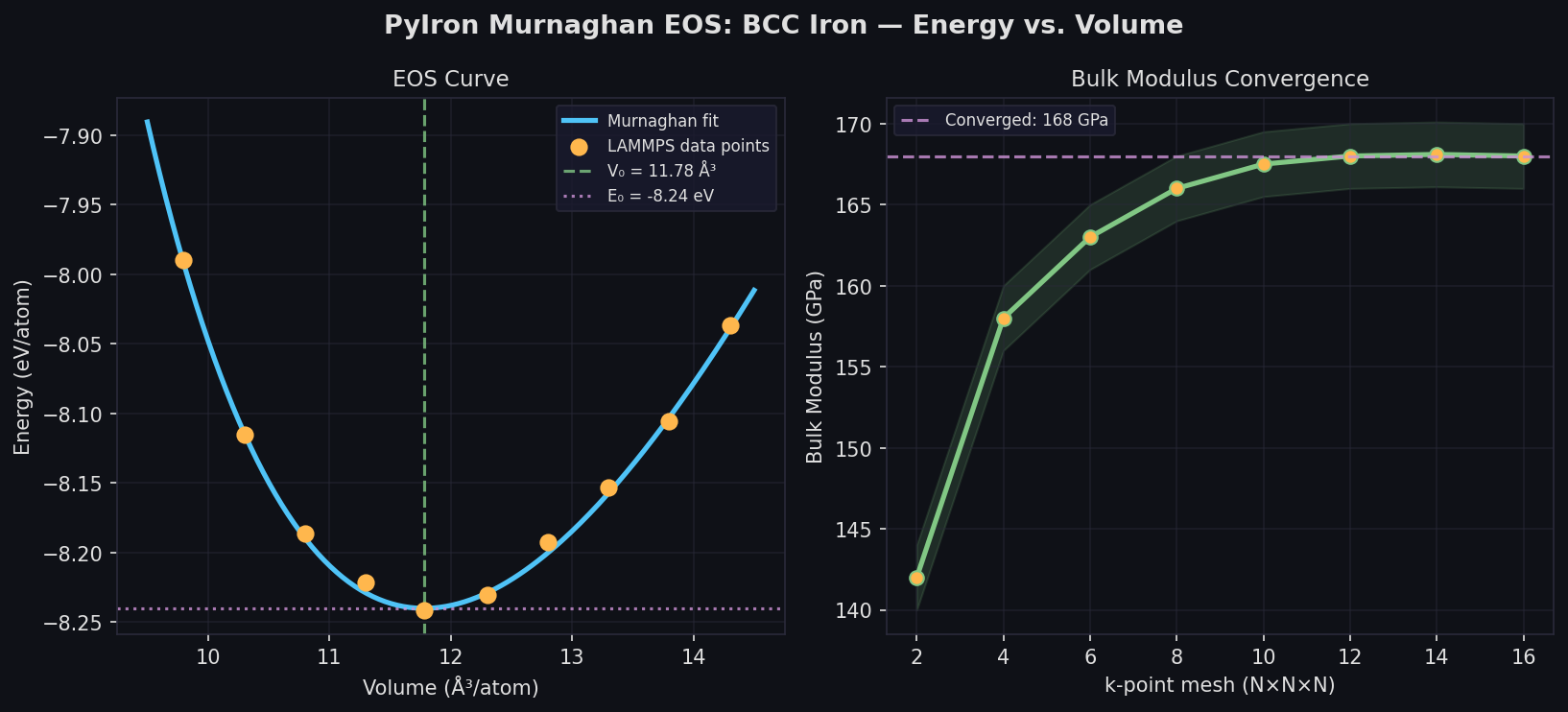
This produces the bulk modulus, equilibrium volume, and cohesive energy in a few lines of code, with all intermediate calculations stored and queryable.
Multi-Scale Workflows: DFT → MD Potential Fitting
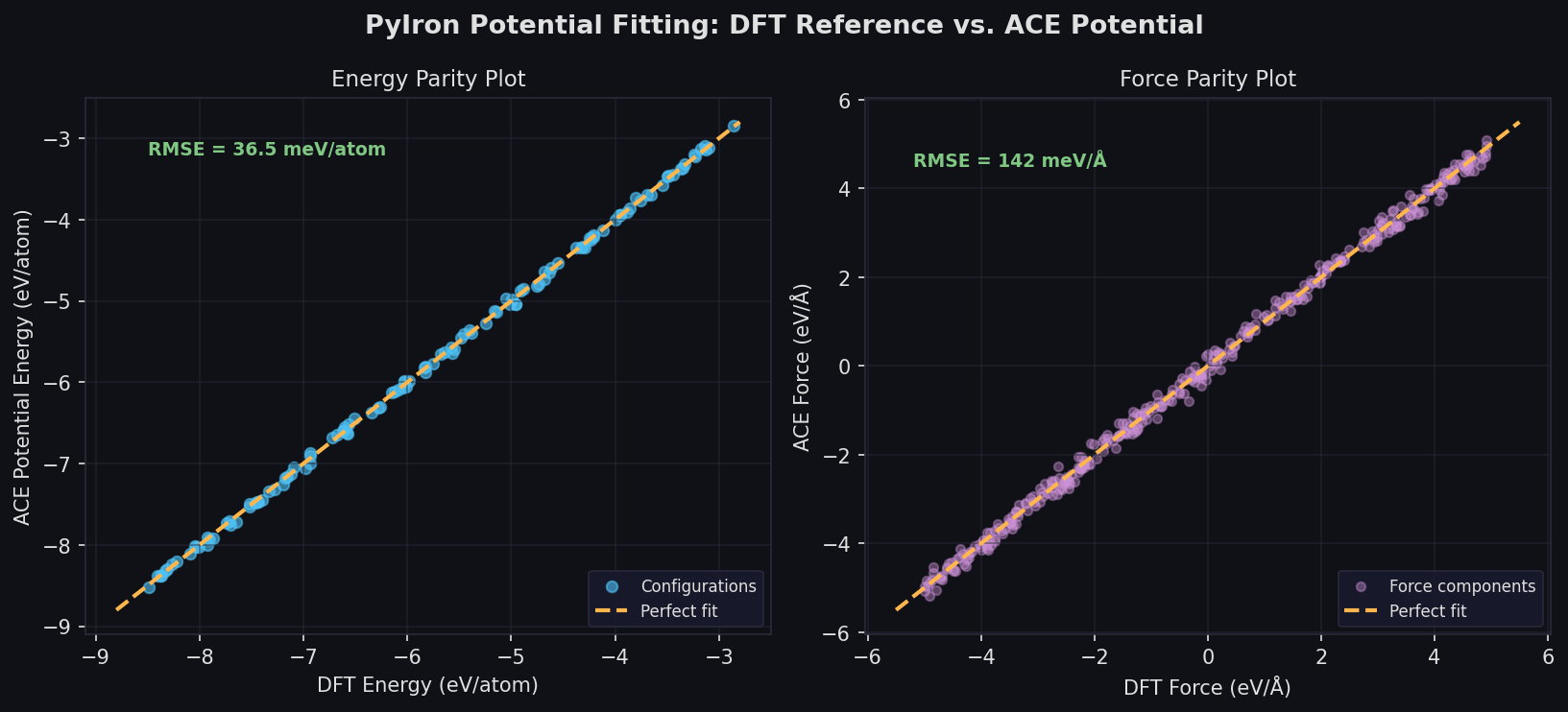
One of PyIron's most powerful capabilities is enabling automated potential fitting workflows that connect DFT reference data to classical interatomic potentials. The pyiron_potentialfit module orchestrates:
- DFT reference generation: Systematic VASP or Quantum ESPRESSO calculations on diverse atomic configurations (bulk, surfaces, defects, liquids).
- Potential fitting: Integration with fitting codes such as atomicrex, pacemaker (for ACE potentials), and MEAM-fit.
- Validation: Automated benchmarking of the fitted potential against held-out DFT data and experimental properties.
This workflow, which previously required weeks of manual scripting, can be executed in a reproducible Jupyter Notebook in hours. The resulting machine-learned interatomic potentials (MLIPs) can then be deployed in large-scale LAMMPS simulations, closing the loop between quantum accuracy and classical simulation speed.
HPC Integration and Scalability
PyIron is designed for high-performance computing environments. It integrates with job schedulers including SLURM, PBS/Torque, and LSF through a queue adapter configuration. A single Python command can submit thousands of independent DFT calculations to an HPC cluster:
job.server.queue = "slurm_queue"
job.server.cores = 32
job.server.run_time = 3600  # seconds
job.run()
The pyiron_base layer monitors job states asynchronously, and results are automatically ingested into the HDF5 database upon completion.
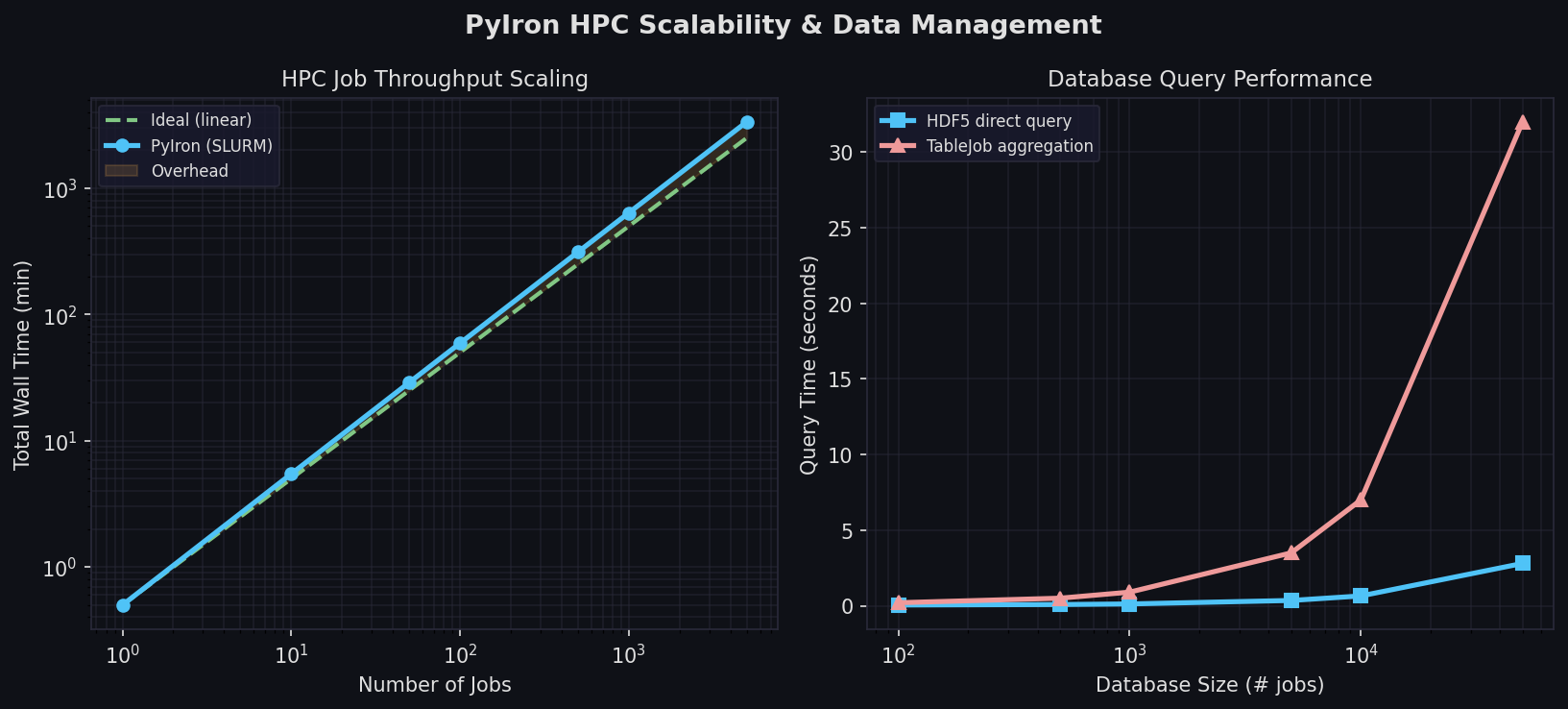 For embarrassingly parallel parameter studies, the
 TableJob pattern enables efficient post-processing:
table = pr.create.job.TableJob("eos_table")
table.add["volume"] = lambda job: job["output/generic/volume"][-1]
table.add["energy"] = lambda job: job["output/generic/energy_pot"][-1]
table.run()
df = table.output.table  # pandas DataFrame
Reproducibility and FAIR Data Principles
A distinguishing feature of PyIron is its commitment to FAIR data (Findable, Accessible, Interoperable, Reusable). Every job stores its complete provenance — code version, input parameters, compute environment, and output data — in a self-describing HDF5 file. The pyiron_atomistics package integrates with the NOMAD materials database, enabling one-command upload of simulation results to a publicly accessible repository:
job.to_nomad() # uploads to nomad-lab.euThis makes PyIron workflows directly compatible with open-science mandates increasingly required by funding agencies in Europe and North America.
Practical Considerations
Installation: PyIron is available via conda (conda install -c conda-forge pyiron) and pip. The modular architecture means users install only the sub-packages relevant to their simulation codes.
Learning curve: Users familiar with Python and Jupyter Notebooks can be productive within a day. The PyIron documentation includes extensive tutorials covering LAMMPS, DFT, and potential fitting workflows.
Limitations: PyIron's job management adds overhead for single, one-off calculations. Its greatest value emerges in systematic studies involving hundreds to thousands of calculations. The HDF5 database can also become unwieldy for very large output files (e.g., AIMD trajectories), requiring careful storage planning.
Conclusion
PyIron addresses a genuine pain point in computational materials science: the fragmentation of simulation workflows across incompatible codes, file formats, and computing environments. By providing a unified Python interface, structured data management, and seamless HPC integration, it enables researchers to focus on scientific questions rather than workflow logistics. For groups running systematic materials property databases, potential fitting campaigns, or multi-scale simulations, PyIron represents a significant productivity multiplier.
Further reading: