
Renode: Full-System Embedded Simulation for Multi-Node IoT and SoC Development
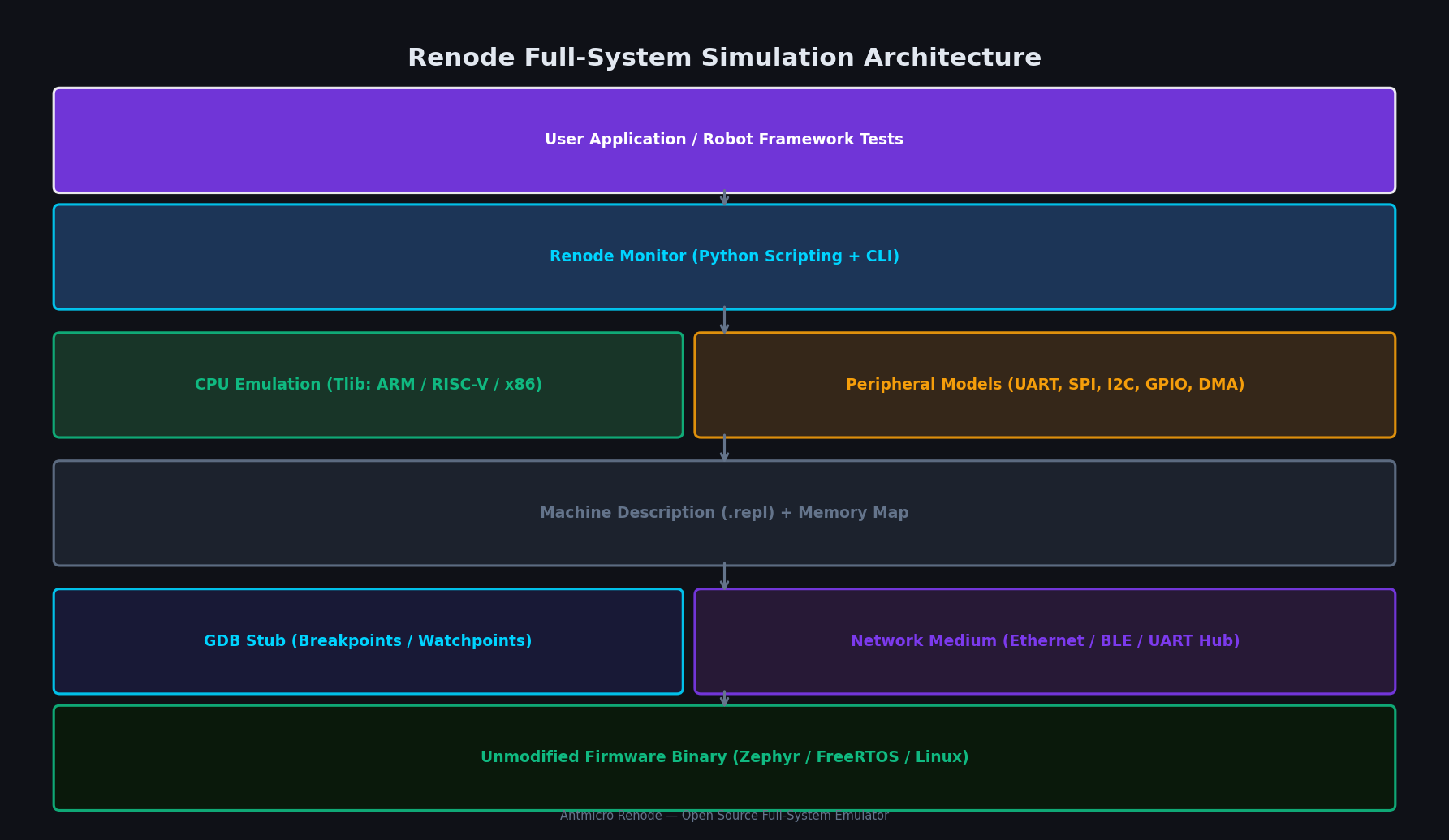
Renode is an open-source, full-system simulation framework developed by Antmicro that enables engineers to run unmodified embedded firmware on virtual hardware platforms. Unlike instruction-set simulators that model only a CPU core, Renode simulates complete systems—including peripherals, buses, sensors, and multi-node network topologies—making it a powerful tool for IoT, SoC, and RTOS-based development workflows.
What Renode Simulates
At its core, Renode uses a modular machine description language (.repl files) to define hardware platforms. Each platform specifies:
- CPU cores: ARM Cortex-M/A/R, RISC-V (32/64-bit), x86, SPARC, and others via the Tlib translation library
- Memory maps: Flash, SRAM, and memory-mapped I/O regions
- Peripherals: UART, SPI, I2C, GPIO, timers, DMA controllers, USB, Ethernet MACs, and custom IP blocks
- Sensors and actuators: Modeled as peripheral backends that respond to register reads/writes
This architecture allows Renode to boot real RTOS images (Zephyr, FreeRTOS, Mbed OS, NuttX) and Linux kernels without modification, executing the same binary that will run on physical silicon.

Multi-Node Network Simulation
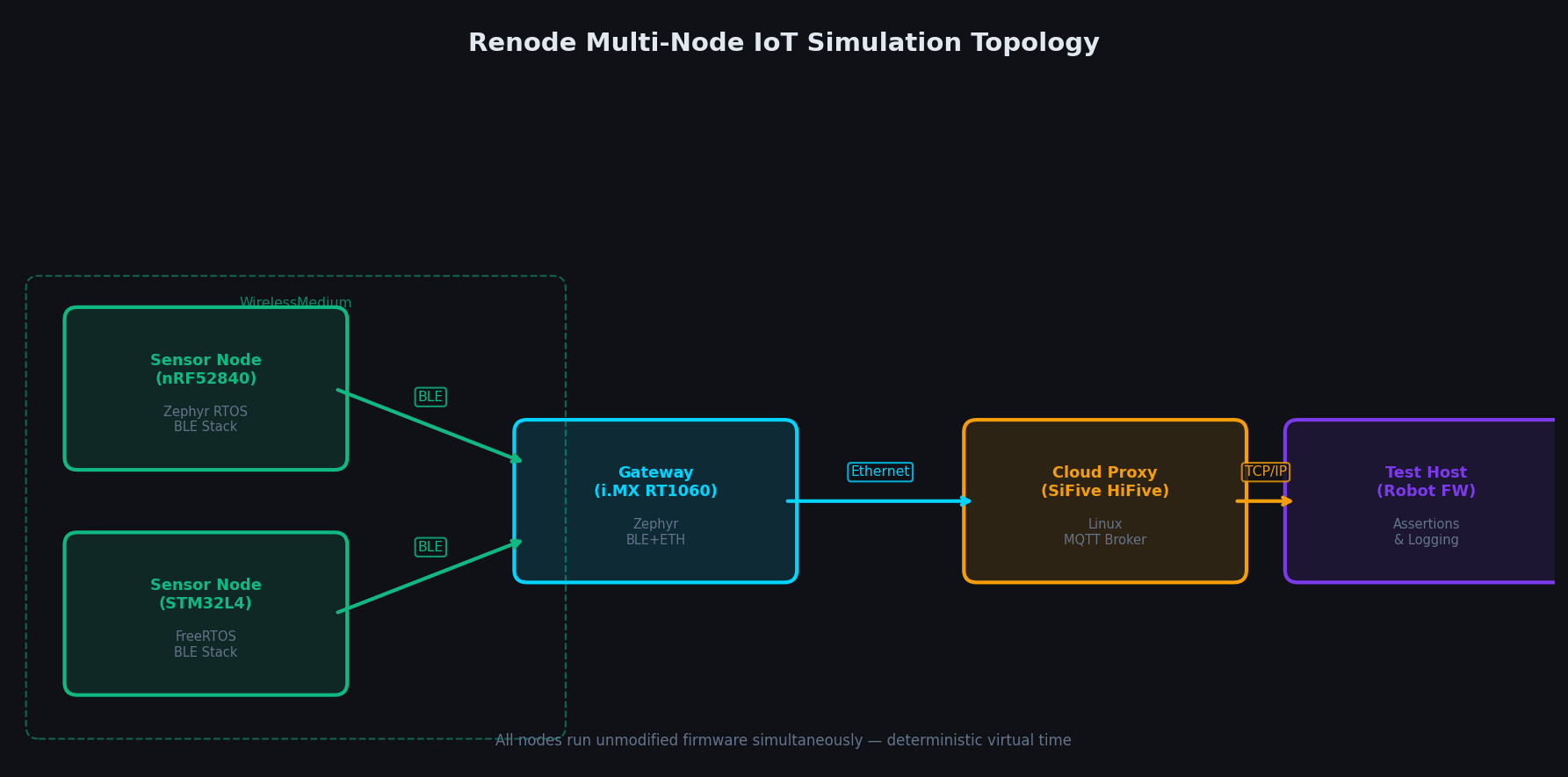
One of Renode's most distinctive capabilities is its support for simulating entire networks of embedded devices within a single session. Using the EthernetSwitch, WirelessMedium, or UARTHub constructs, engineers can wire together dozens of virtual nodes and observe their interactions in real time.
A typical IoT scenario might include:
(machine-0) sensor node → BLE → (machine-1) gateway → Ethernet → (machine-2) cloud proxyAll three nodes run their respective firmware simultaneously, with packet-level fidelity across the simulated medium. This enables end-to-end protocol stack testing—including MQTT, CoAP, and custom application layers—without any physical hardware.
Deterministic Execution and Reproducibility
Renode's time-synchronization model is a key differentiator for CI/CD integration. The framework advances virtual time in discrete, deterministic steps, ensuring that:
- Race conditions are reproducible: Timing-sensitive bugs that appear intermittently on hardware can be reliably triggered and debugged in simulation.
- Test results are stable: The same firmware binary produces identical execution traces across runs, enabling regression testing with binary-level precision.
- Execution can be paused and replayed: Snapshots capture the complete machine state, allowing engineers to rewind to a known-good point and replay a failure scenario.
This determinism is particularly valuable when debugging multi-node synchronization issues, where the relative ordering of events across nodes must be controlled precisely.
GDB Integration and Peripheral Debugging
Renode exposes a GDB stub for each simulated CPU, allowing standard debuggers (GDB, VS Code with Cortex-Debug, SEGGER Ozone) to connect and perform:
- Breakpoint and watchpoint insertion
- Register and memory inspection
- Step-through execution across peripheral register accesses
Beyond CPU-level debugging, Renode's Monitor console provides a Python-scriptable interface to inspect peripheral state, inject GPIO events, and simulate sensor readings at runtime. For example, injecting a temperature value into a simulated I2C sensor:
sysbus.i2c0.sensor.Temperature = 85.0This capability enables fault injection testing—simulating out-of-range sensor values, bus errors, or power glitches—without specialized hardware.
Robot Framework Integration for Automated Testing
Renode ships with a Robot Framework library (renode-test) that integrates simulation control into automated test suites. Test cases can:
- Start and configure virtual machines declaratively
- Assert on UART output patterns using regex matching
- Verify GPIO state transitions at specified virtual timestamps
- Measure execution timing against expected bounds
A minimal Robot Framework test for a Zephyr blinky application might assert that the LED GPIO toggles within 100 ms of boot, providing a hardware-independent acceptance criterion that runs in CI without any physical board.
Platform Support and Ecosystem
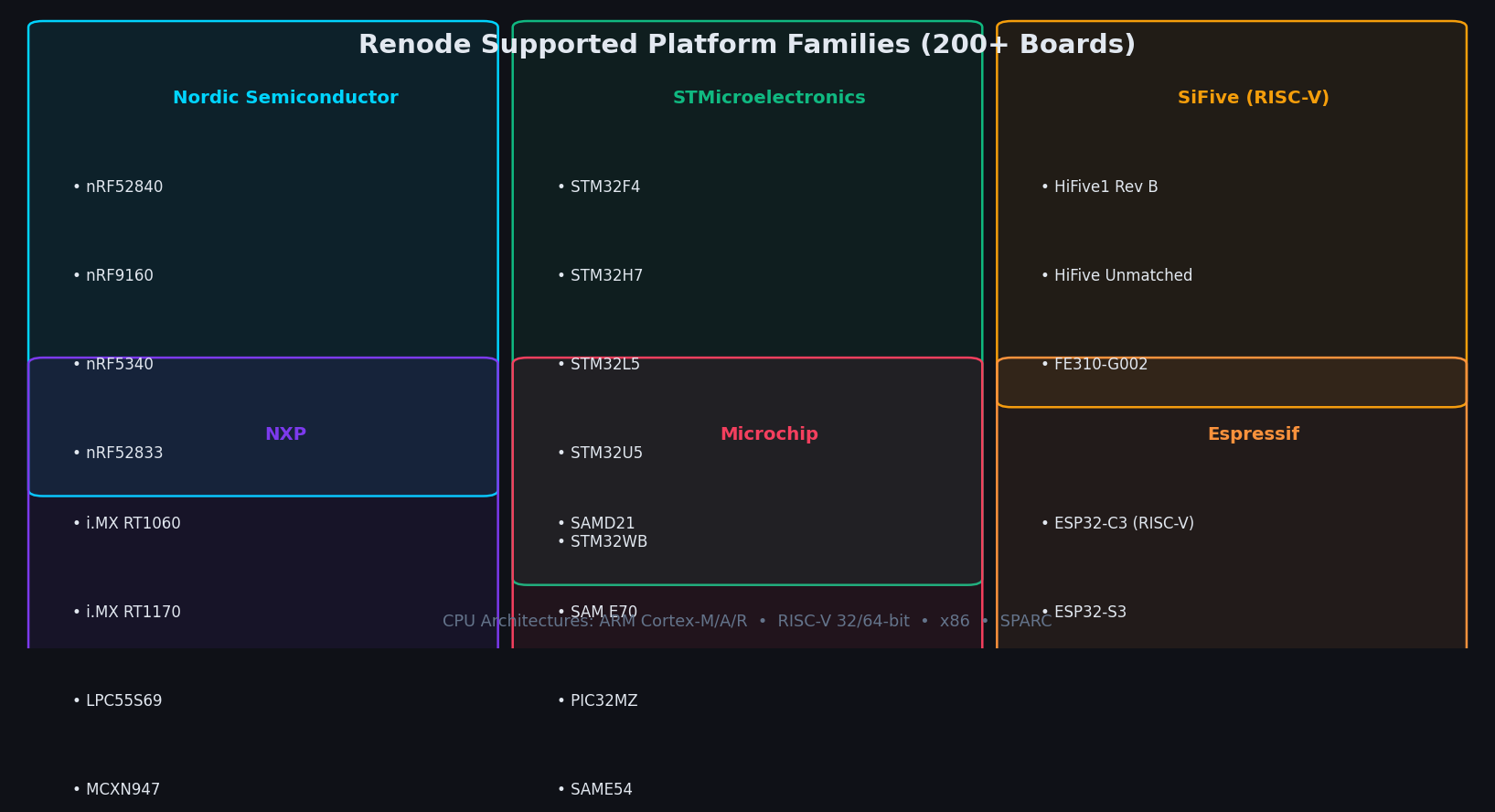
Renode ships with over 200 pre-built platform definitions covering popular development boards and SoCs, including:
- Nordic Semiconductor: nRF52840, nRF9160
- STMicroelectronics: STM32 families (F0–F7, H7, L0–L5, U5)
- SiFive: HiFive1, HiFive Unmatched (RISC-V)
- NXP: i.MX RT series, LPC families
- Microchip: SAMD21, SAM E70
Custom platforms are added by writing .repl files and, if needed, implementing peripheral models in C# (Renode's native language) or Python via the peripheral scripting interface.
Practical Workflow: From Simulation to Hardware
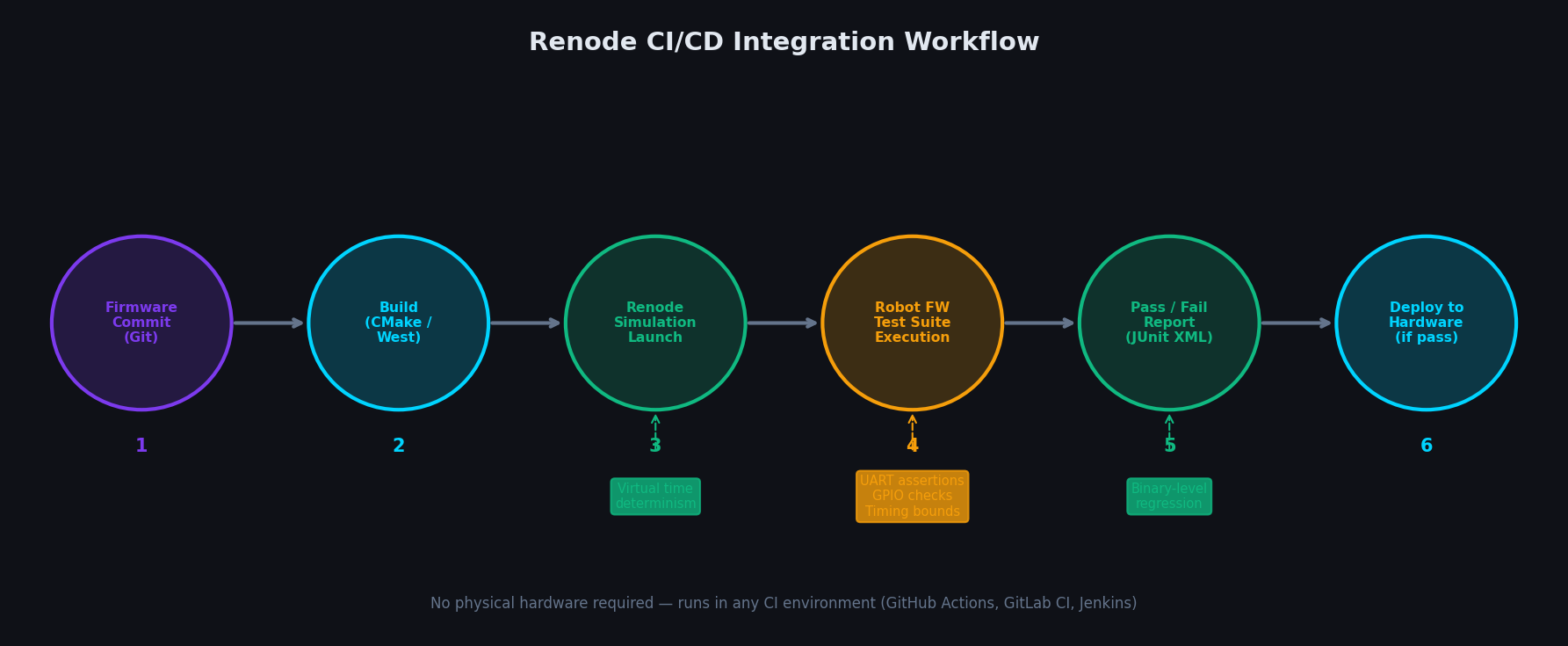
A recommended workflow for teams adopting Renode:
- Model the target SoC using an existing platform definition or by extending the closest match.
- Boot the RTOS and verify driver initialization sequences against the hardware reference manual.
- Run automated Robot Framework tests in CI on every firmware commit.
- Use snapshots to capture the post-boot state, reducing test startup time for large test suites.
- Transfer to hardware with confidence that peripheral driver logic has been validated against a faithful model.
This approach shifts hardware-dependent testing left in the development cycle, reducing the number of hardware debug sessions required and accelerating time-to-market for embedded products.
Limitations and Considerations
Renode's peripheral models vary in fidelity. High-level protocol behavior (register semantics, interrupt generation) is typically accurate, but analog characteristics, precise timing jitter, and RF propagation physics are abstracted. For RF-intensive applications, coupling Renode with a dedicated RF channel simulator (e.g., ns-3 or a custom channel model) is recommended.
Additionally, Renode does not currently support cycle-accurate simulation; its timing model is instruction-count-based with configurable MIPS ratings. Applications with hard real-time constraints should validate final timing on physical hardware.
Further Resources
- Renode Documentation — Platform modeling, peripheral scripting, and Robot Framework integration
- Antmicro GitHub — Source code, platform definitions, and issue tracker
- Renode Platform Catalog — Searchable index of supported boards and SoCs
- Zephyr + Renode Tutorial — Official Zephyr integration guide