

Cadence Genus Synthesis Solution: RTL-to-Gates Optimization and Timing Closure for Advanced-Node SoC Design
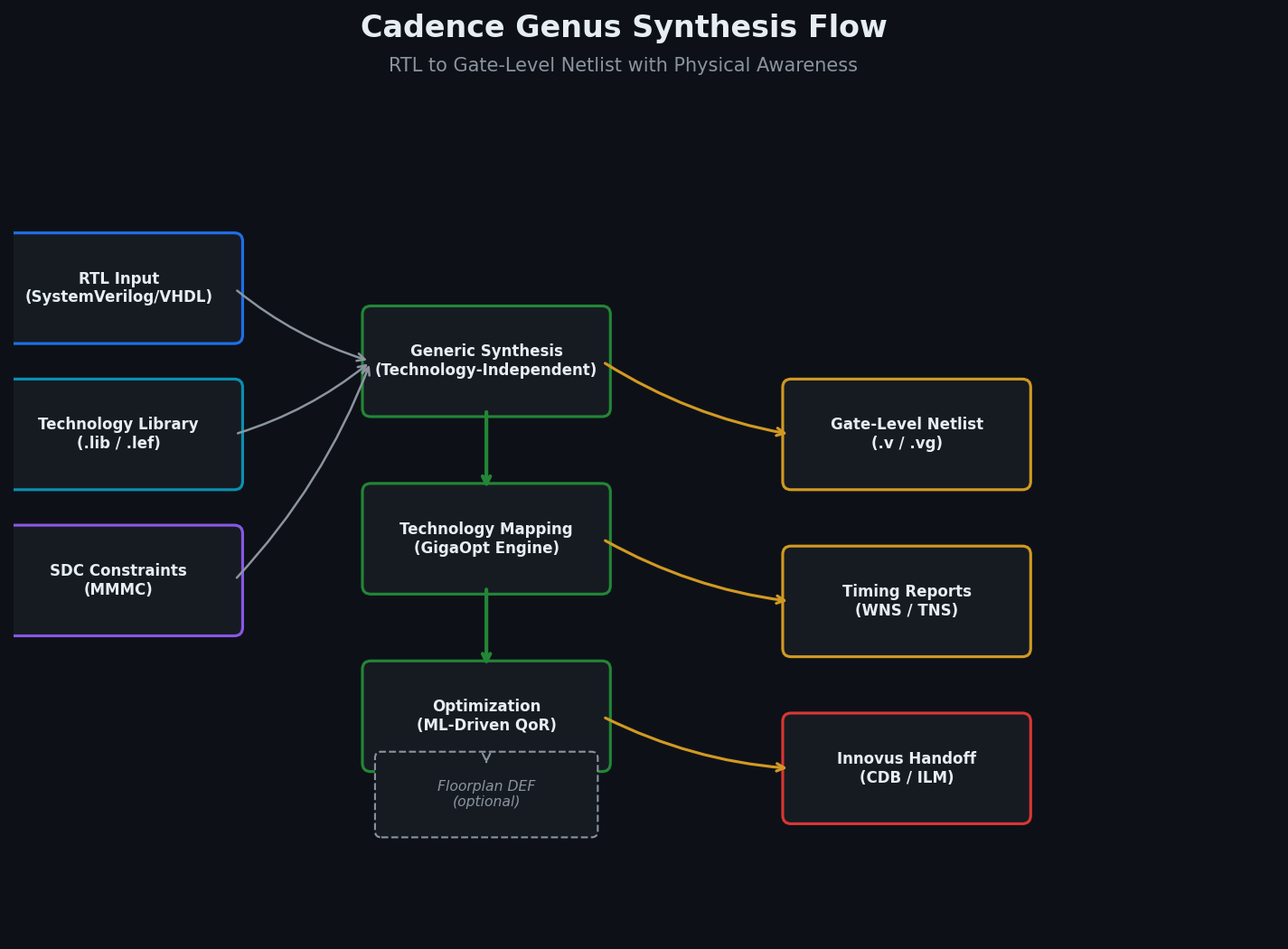
Modern SoC designs targeting 7 nm and below face a convergence crisis: RTL that simulates correctly often fails to meet timing after synthesis, forcing costly late-stage ECOs. Cadence Genus Synthesis Solution addresses this by combining a physically-aware synthesis engine with machine-learning-driven optimization, enabling engineers to achieve timing closure in synthesis rather than deferring it to place-and-route.
What Is Genus?
Genus is Cadence's flagship RTL synthesis tool, positioned between RTL simulation and physical implementation in the digital design flow. It ingests synthesizable RTL (SystemVerilog, VHDL, or mixed), maps it to a target technology library, and produces a gate-level netlist optimized for timing, area, and power. Unlike legacy synthesis tools that treat physical effects as afterthoughts, Genus integrates parasitic estimation and floorplan awareness directly into its optimization engine.
Genus is tightly coupled with Cadence Innovus Implementation System, sharing a common data model (the Cadence Design Database, or CDB) that eliminates netlist translation overhead and enables true round-trip optimization between synthesis and place-and-route.

Key Capabilities
1. Physically-Aware Synthesis (GigaOpt Engine)
The GigaOpt optimization engine estimates wire parasitics using virtual-route-based RC extraction during synthesis. Rather than relying on wire-load models — which can be off by 2–5× at advanced nodes — GigaOpt uses floorplan dimensions and placement density estimates to predict interconnect delay with accuracy approaching post-route extraction. This dramatically reduces the timing correlation gap between synthesis and final sign-off.
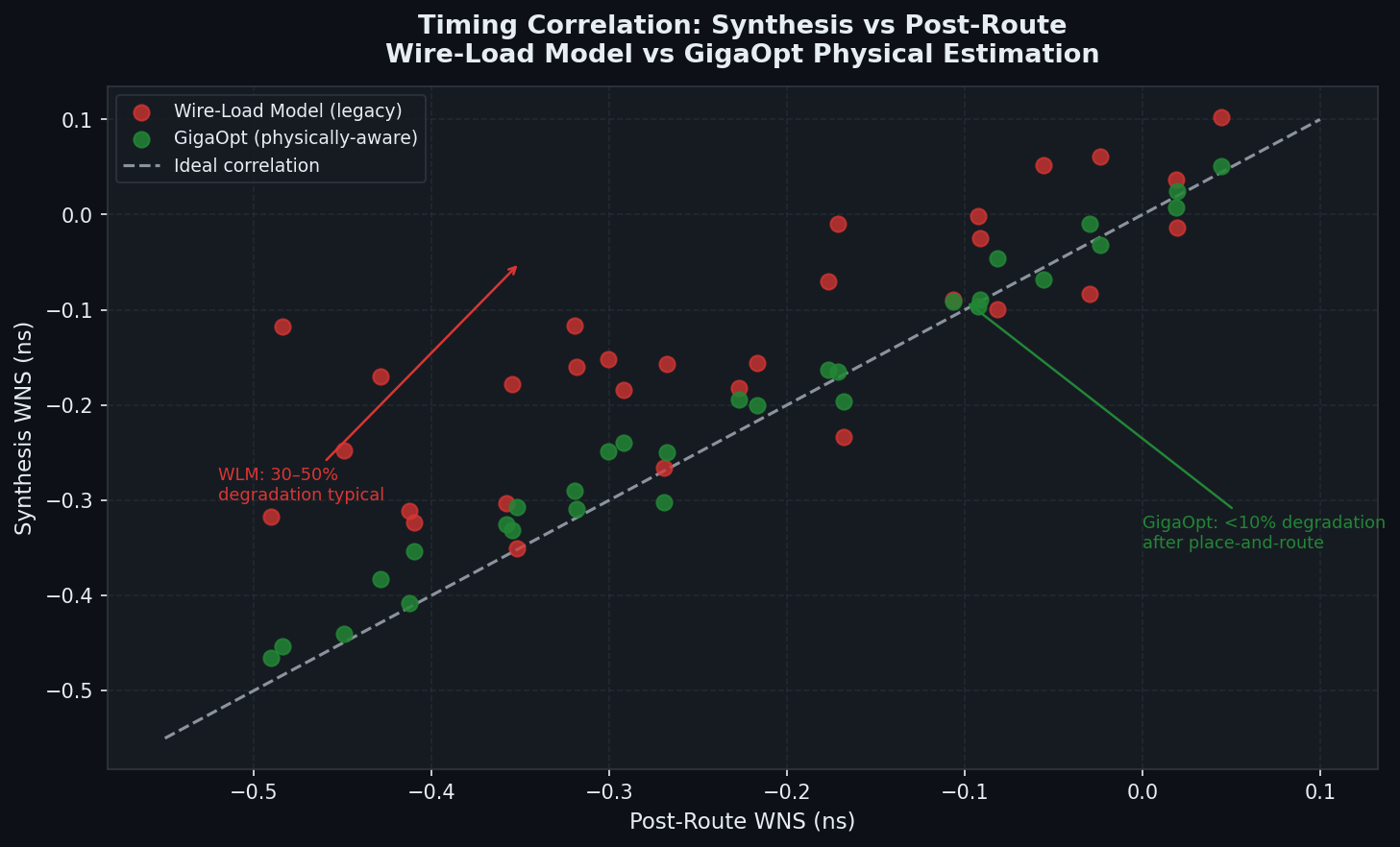
Practical impact: Designs synthesized with GigaOpt typically show less than 10% timing degradation after full place-and-route, compared to 30–50% degradation common with wire-load-model-based synthesis.
2. Machine Learning Timing Prediction (ML-Driven QoR)
Genus incorporates a machine learning model trained on historical design data to predict post-route Quality of Results (QoR) from early synthesis metrics. The ML engine adjusts optimization effort allocation — spending more compile time on paths statistically likely to fail timing — without requiring the designer to manually tune effort knobs.
To enable ML-driven optimization:
set_db / .auto_ungroup none
set_db / .use_tiehilo_for_const true
set_db syn_generic_effort high
set_db syn_map_effort high
set_db syn_opt_effort high
set_db / .enable_ml_prediction true
synthesize -to_mapped -effort high
3. Hierarchical Synthesis and Block-Level Budgeting
For multi-million-gate SoCs, flat synthesis is impractical. Genus supports hierarchical synthesis with automatic interface logic model (ILM) generation. Each block is synthesized independently with timing budgets derived from the top-level constraints, and ILMs capture the block's timing interface without exposing internal logic — enabling parallel synthesis across teams.
# Generate ILM for a synthesized block
write_design -innovus -basename ./outputs/block_ilm
Top-level synthesis then uses ILMs as black boxes, achieving full-chip timing analysis in a fraction of the runtime of flat synthesis.
4. Multi-Mode Multi-Corner (MMMC) Optimization
Advanced-node designs must meet timing across multiple operating modes (functional, test, low-power) and process-voltage-temperature corners simultaneously. Genus MMMC analysis evaluates all corner/mode combinations in a single synthesis run, preventing the common pitfall of fixing timing in one corner while breaking another.
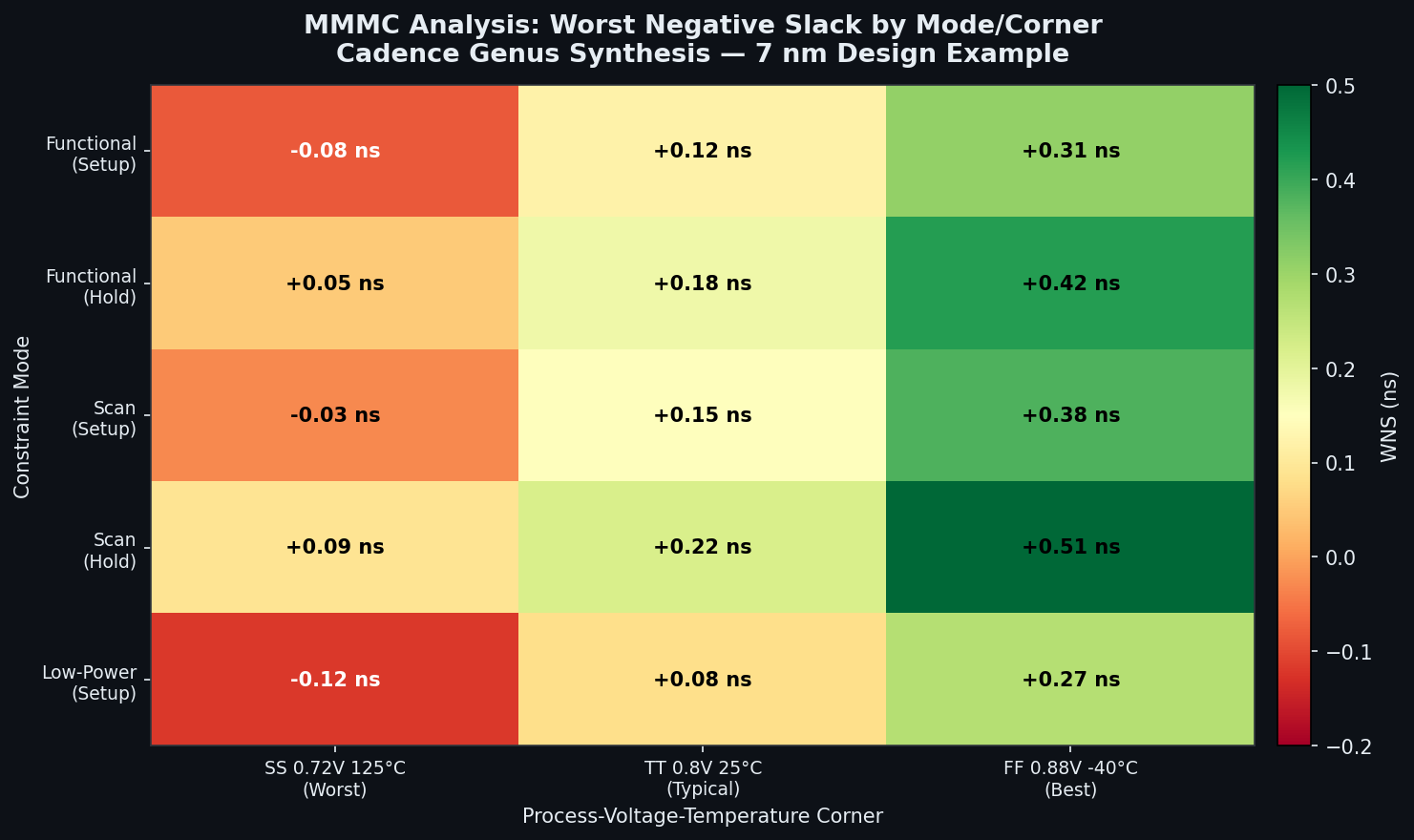
A typical MMMC constraint setup:
create_library_set -name tt_lib -timing [list $LIB_DIR/tt_0p8v_25c.lib]
create_library_set -name ss_lib -timing [list $LIB_DIR/ss_0p72v_125c.lib]
create_constraint_mode -name func_mode -sdc_files [list func.sdc]
create_constraint_mode -name scan_mode -sdc_files [list scan.sdc]
create_delay_corner -name worst -library_set ss_lib -opcond_library ss_lib
create_delay_corner -name best  -library_set tt_lib -opcond_library tt_lib
create_analysis_view -name func_worst -constraint_mode func_mode -delay_corner worst
create_analysis_view -name scan_best  -constraint_mode scan_mode -delay_corner best
set_analysis_view -setup [list func_worst] -hold [list scan_best]
5. Power-Driven Synthesis and Clock Gating
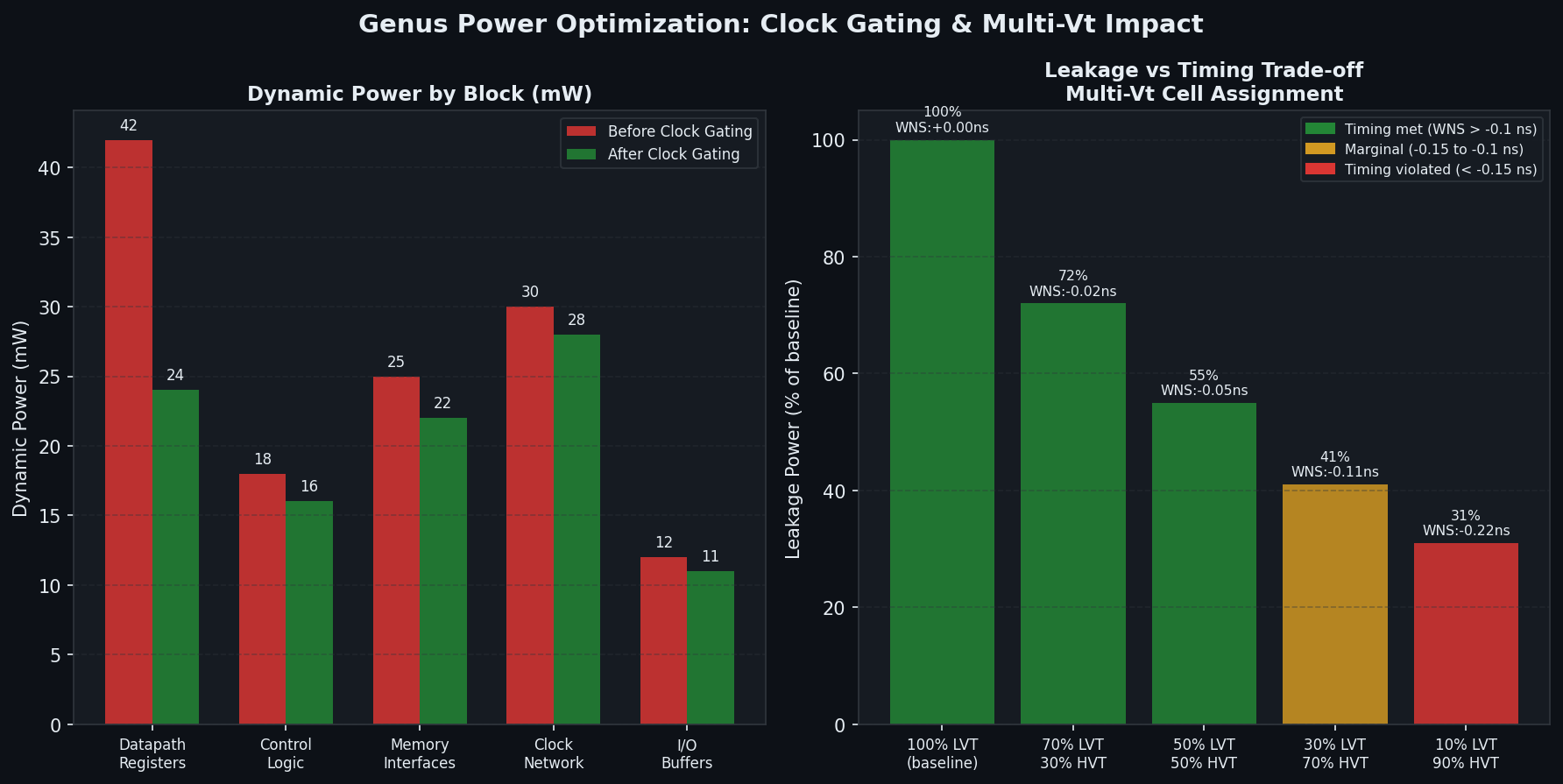
Genus integrates power optimization directly into the synthesis flow. Automatic clock gating insertion reduces dynamic power by 20–40% in typical datapath-heavy designs. The tool also supports multi-threshold voltage (multi-Vt) cell assignment, swapping high-Vt cells into non-critical paths to reduce leakage without timing impact.
```tcl
set_db / .lp_insert_clock_gating true
set_db / .lp_clock_gating_min_flops 4
set_db / .lp_multi_vt_optimization_effort highSynthesis-to-Implementation Handoff
The Genus–Innovus handoff uses the Cadence Common UI, meaning both tools share the same Tcl scripting environment and database format. After synthesis, the netlist, constraints, and physical guidance are passed to Innovus with a single command:
write_design -innovus -basename ./handoff/topInnovus reads this directly, preserving synthesis intent — including don't-touch attributes, scan chain ordering, and clock gating enable signals — without lossy DEF/SDC translation.
Integrating Genus into a CI/CD Verification Flow
Modern digital design teams run synthesis as part of nightly regression to catch RTL changes that degrade timing or area. A minimal Jenkins/GitLab CI integration:
- Trigger: RTL commit to main branch
- Run:
genus -batch -files run_synthesis.tcl > synthesis.log - Parse: Extract worst negative slack (WNS), total negative slack (TNS), and area from the log
- Gate: Fail the pipeline if WNS < −0.1 ns or area exceeds budget by >5%
- Archive: Store the gate-level netlist and timing reports as build artifacts
This shift-left approach catches synthesis-breaking RTL changes within hours rather than discovering them during tape-out preparation.
Practical Recommendations
- Start with
effort highon all three phases (generic, map, opt) for tapeout-bound designs; reservemediumfor exploration runs. - Always use MMMC even for single-mode designs — it costs little runtime and prevents corner-specific surprises.
- Enable GigaOpt with a floorplan DEF as soon as one is available; even a rough floorplan improves parasitic estimation significantly.
- Review the
report_timingoutput critically — paths with high logic depth (>20 levels) are candidates for architectural pipelining, not just synthesis optimization. - Use
report_powerafter synthesis to establish a power budget baseline before physical implementation inflates dynamic power estimates.
Further Reading
- Cadence Genus Synthesis Solution Product Page
- Cadence Online Support: Genus User Guide (login required)
- IEEE Xplore: Machine Learning Applications in RTL Synthesis
- Cadence Community: Genus Synthesis Forum
Cadence Genus represents the current state of the art in RTL synthesis for advanced-node digital design. Its combination of physically-aware optimization, ML-driven QoR prediction, and seamless Innovus integration makes it the synthesis engine of choice for teams targeting sub-10 nm tapeouts where timing closure margin is measured in picoseconds.