

SimScale Lattice Boltzmann Method: High-Fidelity External Aerodynamics at Cloud Scale
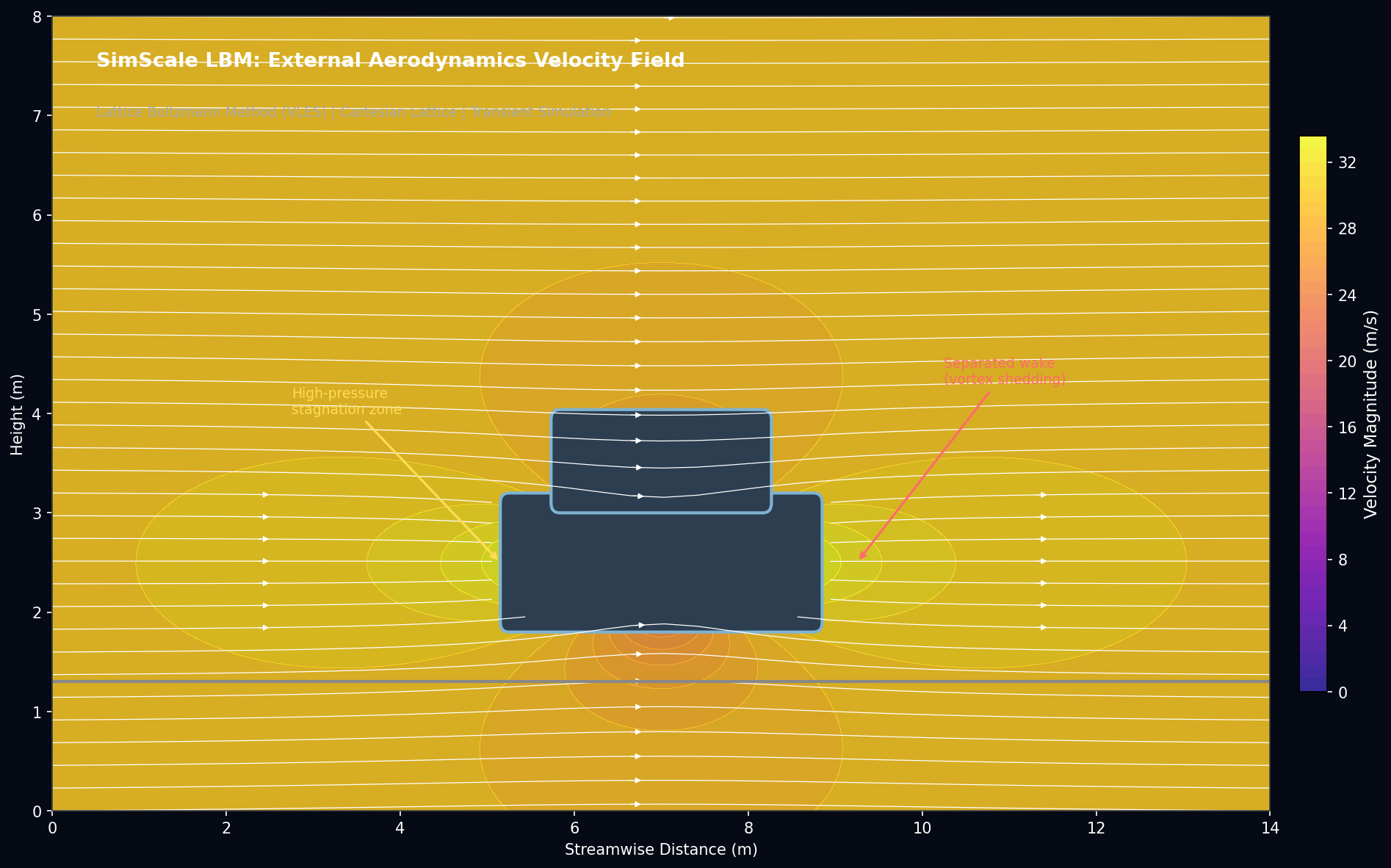
The Lattice Boltzmann Method (LBM) has emerged as one of the most powerful approaches for external aerodynamics simulation, and SimScale's cloud-native implementation brings this capability to engineering teams without the overhead of on-premise HPC infrastructure. Unlike traditional Navier-Stokes solvers, LBM operates on a mesoscopic kinetic model that naturally handles complex geometries, transient flow phenomena, and acoustic effects — making it particularly well-suited for automotive aerodynamics, building wind analysis, and drone/UAV design.
What Makes LBM Different from RANS-Based CFD?
Traditional Reynolds-Averaged Navier-Stokes (RANS) solvers — including ANSYS Fluent's k-ω SST and OpenFOAM's simpleFoam — time-average turbulent fluctuations, which works well for attached flows but struggles with massively separated regions, bluff bodies, and transient vortex shedding. LBM, by contrast, resolves the mesoscopic distribution of fluid particle populations on a Cartesian lattice, recovering macroscopic flow quantities (velocity, pressure, density) through statistical moments.
SimScale's LBM solver is based on the PowerFLOW-lineage approach, using a D3Q19 or D3Q27 lattice with Very Large Eddy Simulation (VLES) turbulence closure. Key advantages over RANS for external aerodynamics include:

- Transient accuracy: Captures time-dependent wake structures, vortex shedding frequencies, and buffeting loads that RANS cannot resolve
- Acoustic coupling: Pressure fluctuations on the lattice directly yield aeroacoustic sources, enabling Ffowcs Williams–Hawkings (FW-H) far-field noise predictions without a separate acoustic solver
- Geometry tolerance: The Cartesian lattice with volumetric boundary conditions (VBCs) eliminates the need for watertight CAD — a significant productivity gain over body-fitted mesh approaches
- Scalability: LBM's local communication pattern scales near-linearly on distributed cloud compute, enabling billion-cell simulations that would be impractical on traditional solvers
Setting Up an External Aerodynamics Case in SimScale
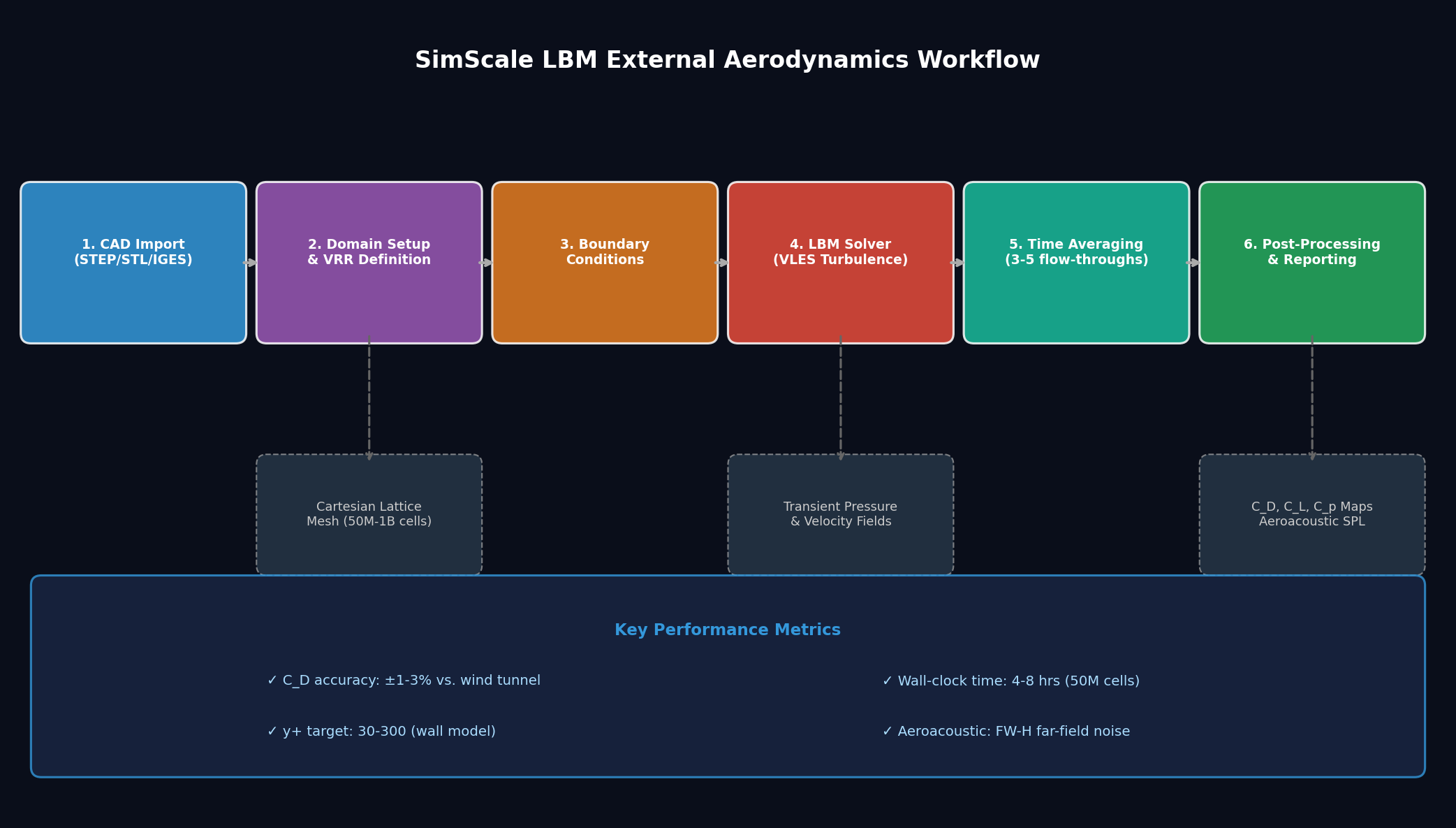
1. Geometry Preparation and Import
SimScale accepts STEP, IGES, STL, and Parasolid formats. For LBM, the geometry does not need to be watertight — the solver's volumetric boundary condition algorithm automatically identifies solid regions. However, best practice is to:
- Remove internal cavities not relevant to external flow (engine bay, cabin) unless underbody flow is critical
- Ensure surface normals are consistently outward-facing for STL imports
- Simplify small features (bolts, panel gaps < 2 mm) that would require excessive lattice refinement without meaningful aerodynamic contribution
2. Simulation Domain and Lattice Resolution
The computational domain should extend at least 5× the vehicle/body length upstream, 10× downstream, and 3× the frontal height laterally and vertically to avoid blockage effects (target < 3% blockage ratio).
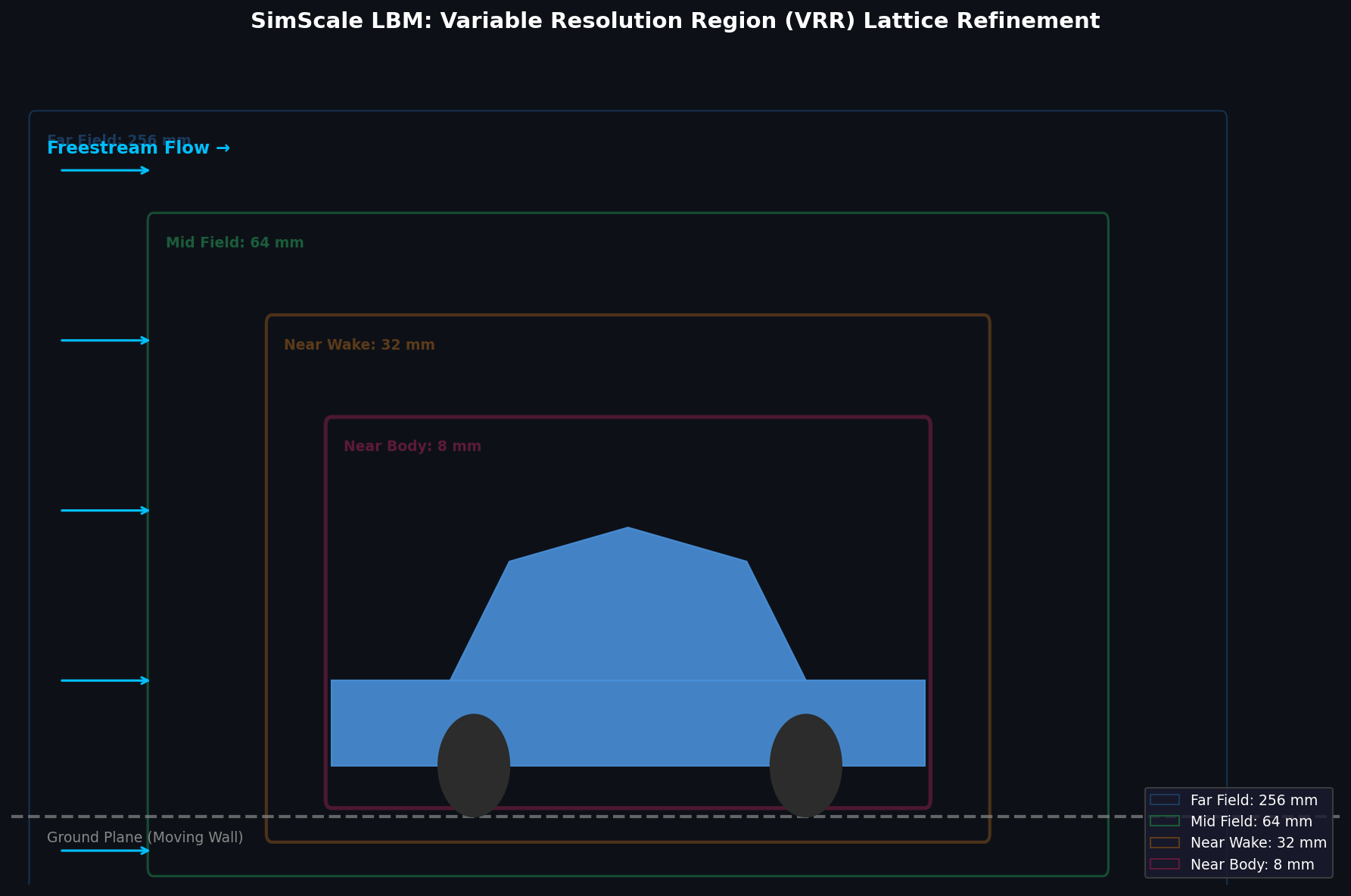
SimScale's LBM uses a hierarchical Cartesian lattice with variable resolution regions (VRRs). A typical automotive setup uses:
| Region | Lattice Resolution | Purpose |
|---|---|---|
| Far field | 256 mm | Background flow |
| Near-body wake | 32 mm | Vortex capture |
| Surface boundary layer | 4–8 mm | Skin friction, separation |
| Mirror/ground plane | 8 mm | Ground effect |
The wall model in SimScale LBM uses a generalized law-of-the-wall approach, targeting y+ values of 30–300 — significantly more forgiving than wall-resolved LES which requires y+ < 1.
3. Boundary Conditions
For external aerodynamics:
- Inlet: Uniform velocity profile with turbulence intensity 0.1–0.5% (representative of wind tunnel or open road)
- Outlet: Zero-gradient pressure (convective outflow)
- Ground plane: Moving wall at freestream velocity (for on-road simulation) or stationary (wind tunnel correlation)
- Rotating wheels: Angular velocity boundary condition on wheel surfaces, with rotating reference frame for wheel arches
4. Run Configuration and Convergence
SimScale LBM runs are inherently transient. A typical workflow:
- Initialization phase (≈ 1 flow-through time): Establish mean flow field from rest
- Averaging phase (≈ 3–5 flow-through times): Accumulate time-averaged forces, pressures, and velocity fields
Convergence is monitored via running-average drag coefficient (C_D) and lift coefficient (C_L). Acceptable convergence is typically ±0.002 C_D variation over the final averaging window.
For a mid-size sedan at 140 km/h with a 50M-cell lattice, SimScale typically requires 8–16 cloud compute cores for 4–8 hours of wall-clock time — competitive with overnight RANS runs on dedicated HPC clusters.
Post-Processing: Extracting Aerodynamic Insights
SimScale's integrated ParaView-based post-processor supports:
- Surface pressure coefficient (Cp) maps: Identify high-drag regions, separation bubbles, and pressure recovery zones
- Isosurface visualization of Q-criterion: Reveal coherent vortex structures in the wake (A-pillar vortices, C-pillar trailing vortices, underbody diffuser flow)
- Velocity streamlines: Trace flow attachment/separation on hood, roof, and rear deck
- Force/moment time histories: Export to CSV for spectral analysis of buffeting frequencies
The aeroacoustic post-processing module computes sound pressure level (SPL) spectra at virtual microphone locations, enabling wind noise assessment for HVAC inlets, side mirrors, and A-pillar regions without additional solver runs.
Practical Benchmarking: LBM vs. RANS for Automotive Applications
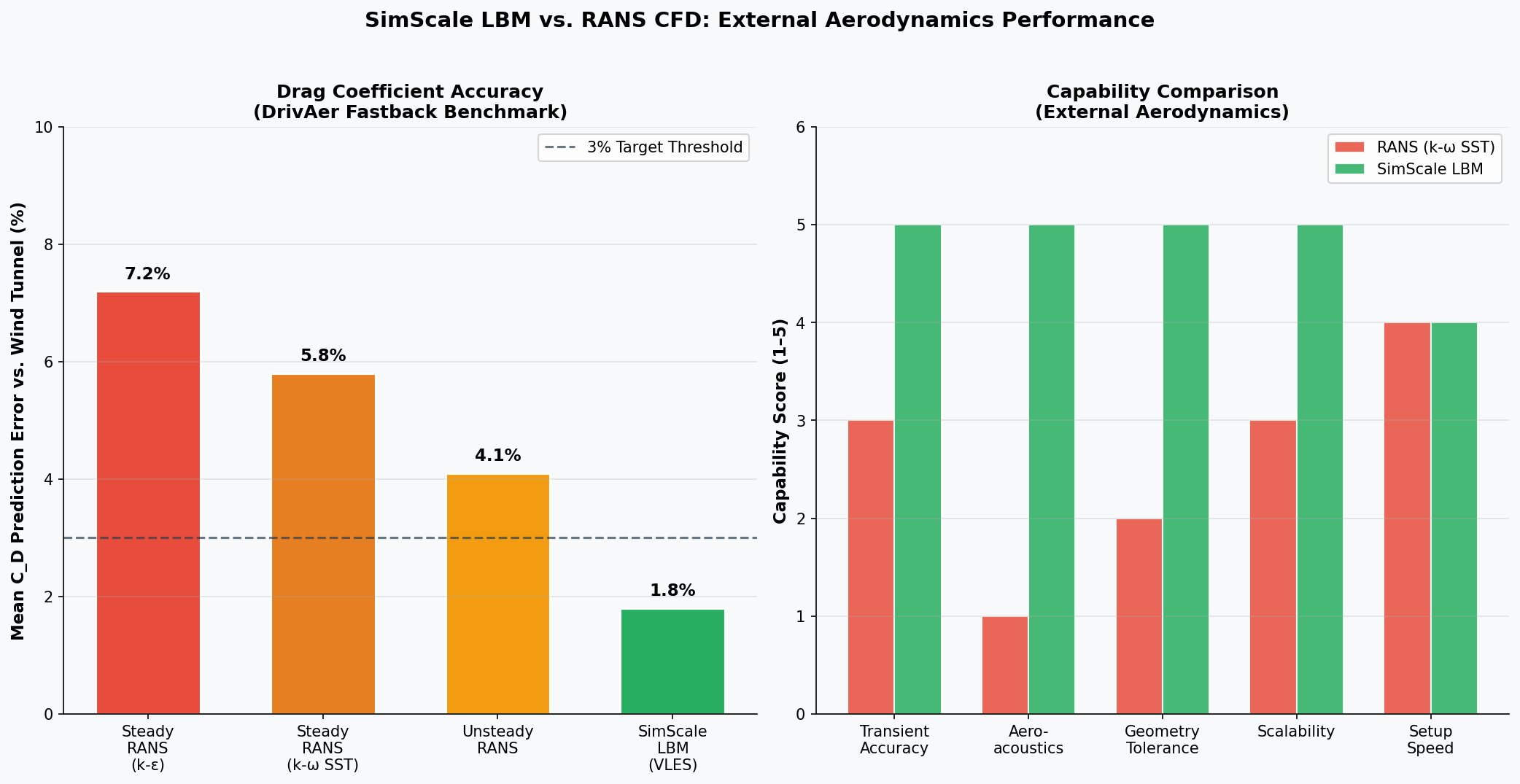
Independent validation studies on the DrivAer fastback geometry (a standard automotive benchmark) show SimScale LBM achieving C_D predictions within 1–3% of wind tunnel measurements, compared to 3–8% typical error for steady-state RANS. The LBM approach also correctly predicts the bimodal wake behavior (wake bistability) that RANS models systematically miss.
For building wind comfort analysis (pedestrian wind assessment per ISO 22009), LBM's transient capability captures gust factors and turbulent kinetic energy distributions that are essential for regulatory compliance — areas where steady RANS is fundamentally inadequate.
When to Choose SimScale LBM vs. Traditional CFD
| Criterion | SimScale LBM | RANS (Fluent/OpenFOAM) |
|---|---|---|
| External bluff body aerodynamics | ✅ Excellent | ⚠️ Moderate |
| Internal flow (pipes, HVAC ducts) | ⚠️ Less efficient | ✅ Excellent |
| Aeroacoustics | ✅ Native | ❌ Requires coupling |
| Geometry preparation effort | ✅ Low (non-watertight) | ❌ High (watertight mesh) |
| Steady-state convergence speed | ⚠️ Slower (transient) | ✅ Fast |
| Cloud-native scalability | ✅ Excellent | ⚠️ Moderate |
Further Resources
- SimScale LBM Documentation
- DrivAer Benchmark Validation Study
- PowerFLOW LBM Technical Background (Exa Corporation)
- ISO 22009: Pedestrian Wind Comfort Assessment
- OpenLB: Open-Source LBM Reference Implementation
SimScale's LBM solver represents a significant step forward in democratizing high-fidelity external aerodynamics simulation. By combining the physical accuracy of transient, scale-resolving flow simulation with cloud-native scalability and reduced geometry preparation burden, it enables engineering teams to perform wind tunnel-quality CFD studies earlier in the design cycle — where aerodynamic insights have the greatest impact on product performance.