
Vensim: System Dynamics Modeling for Social Policy and Organizational Behavior
Vensim, developed by Ventana Systems, is one of the most widely used system dynamics (SD) platforms for modeling feedback-driven social systems. Unlike agent-based tools that simulate individual actors, Vensim operates at the aggregate level—capturing how stocks, flows, and feedback loops govern the long-run behavior of populations, organizations, and policy environments. For analysts working on workforce planning, public health policy, organizational change management, or market dynamics, Vensim provides a rigorous, equation-based framework that excels where individual-level detail is less important than systemic feedback structure.
Core Architecture: Stocks, Flows, and Causal Loops
Vensim's modeling paradigm centers on three primitives:
- Stocks (levels): accumulations that represent the current state of a system—population in a labor market segment, budget reserves, organizational headcount, or public trust in an institution.
- Flows: rates that change stocks over time—hiring rates, attrition, policy adoption speed.
- Auxiliary variables and feedback loops: intermediate calculations and causal connections that close the feedback structure, enabling reinforcing (positive) and balancing (negative) loops.
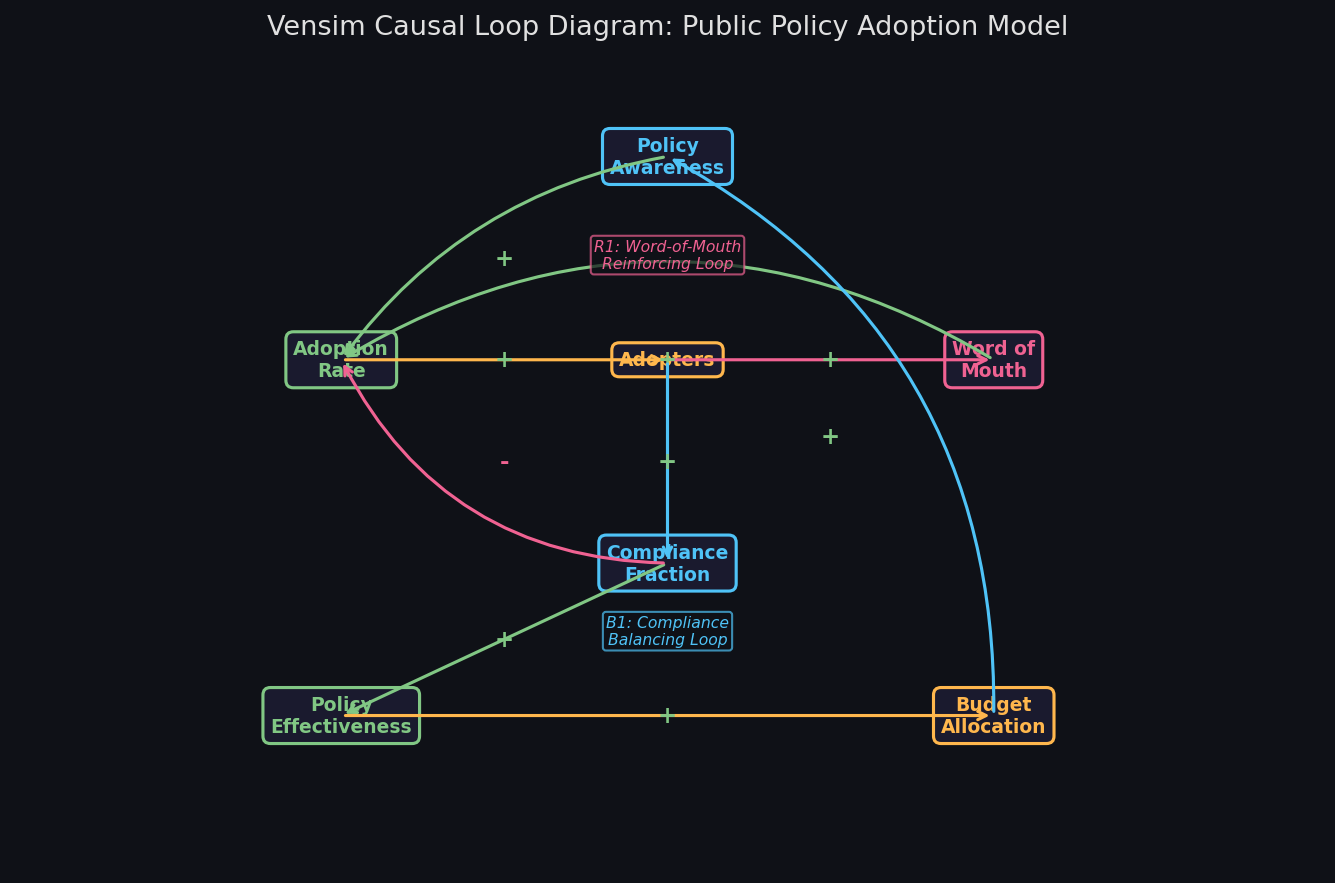
The Causal Loop Diagram (CLD) editor in Vensim lets modelers sketch feedback structure before committing to equations, making it an effective communication tool with non-technical stakeholders. Once the CLD is validated, the model is formalized using DYNAMO-style equations in the Model Editor, where each variable is assigned a mathematical expression, units, and documentation.

Workforce and Organizational Dynamics
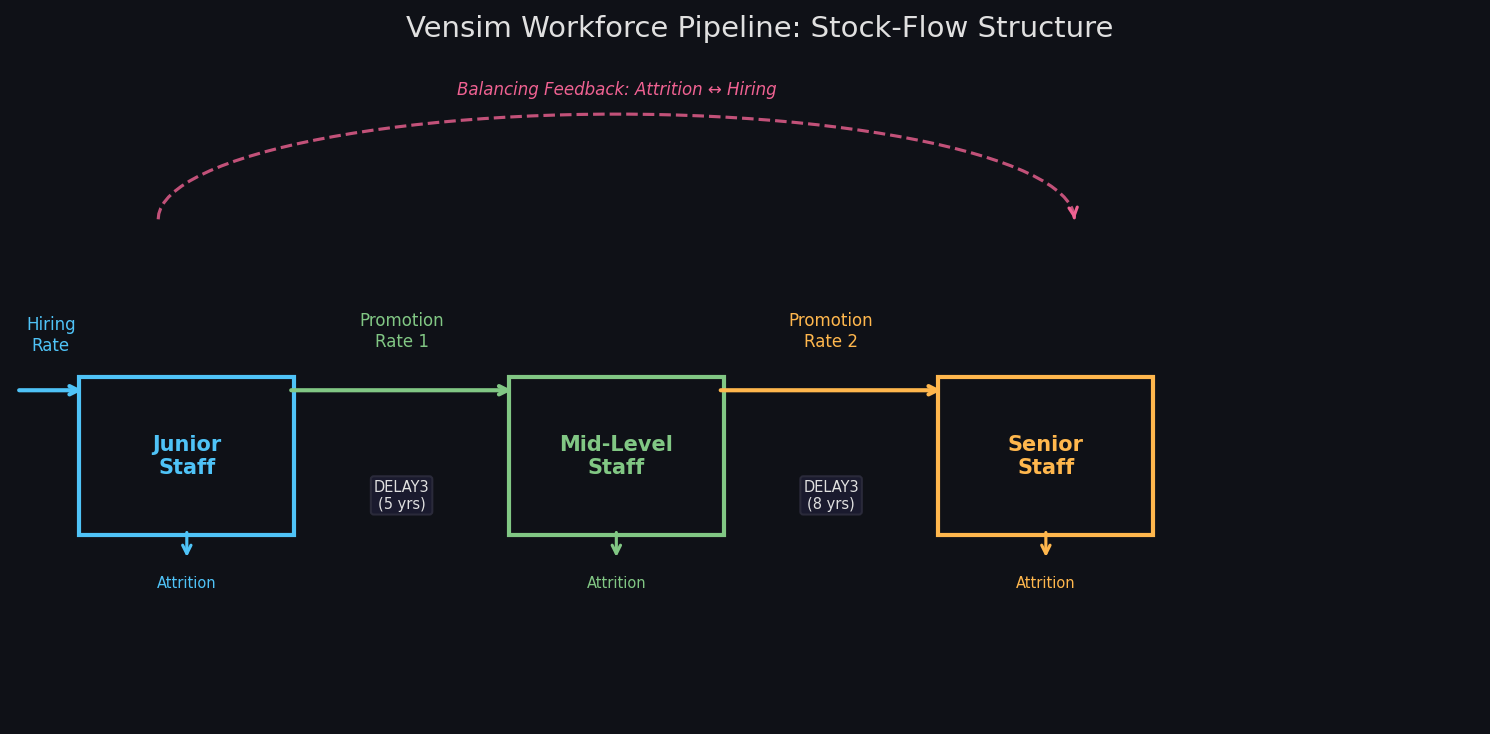
One of Vensim's strongest use cases in social systems is workforce pipeline modeling. A canonical HR model tracks employees across career stages (junior, mid-level, senior, leadership) as stocks, with promotion rates, attrition, and external hiring as flows. The key insight from SD is that promotion pipelines have inherent delays: a decision to increase hiring today does not produce experienced senior staff for 5–10 years. Vensim's DELAY3 and SMOOTH functions make these pipeline delays explicit and tunable.
A typical workforce model might include:
Promotion Rate = Junior Staff / Avg Time to Promotion
Senior Attrition = Senior Staff * Attrition Fraction
Net Senior Change = Promotion Rate - Senior Attrition
Vensim's Reality Check feature allows modelers to define boundary conditions and logical tests (e.g., "stocks should never go negative," "total headcount should equal sum of all career stages") that run automatically after each simulation, catching structural errors before they propagate into policy recommendations.
Policy Analysis with Sensitivity and Optimization
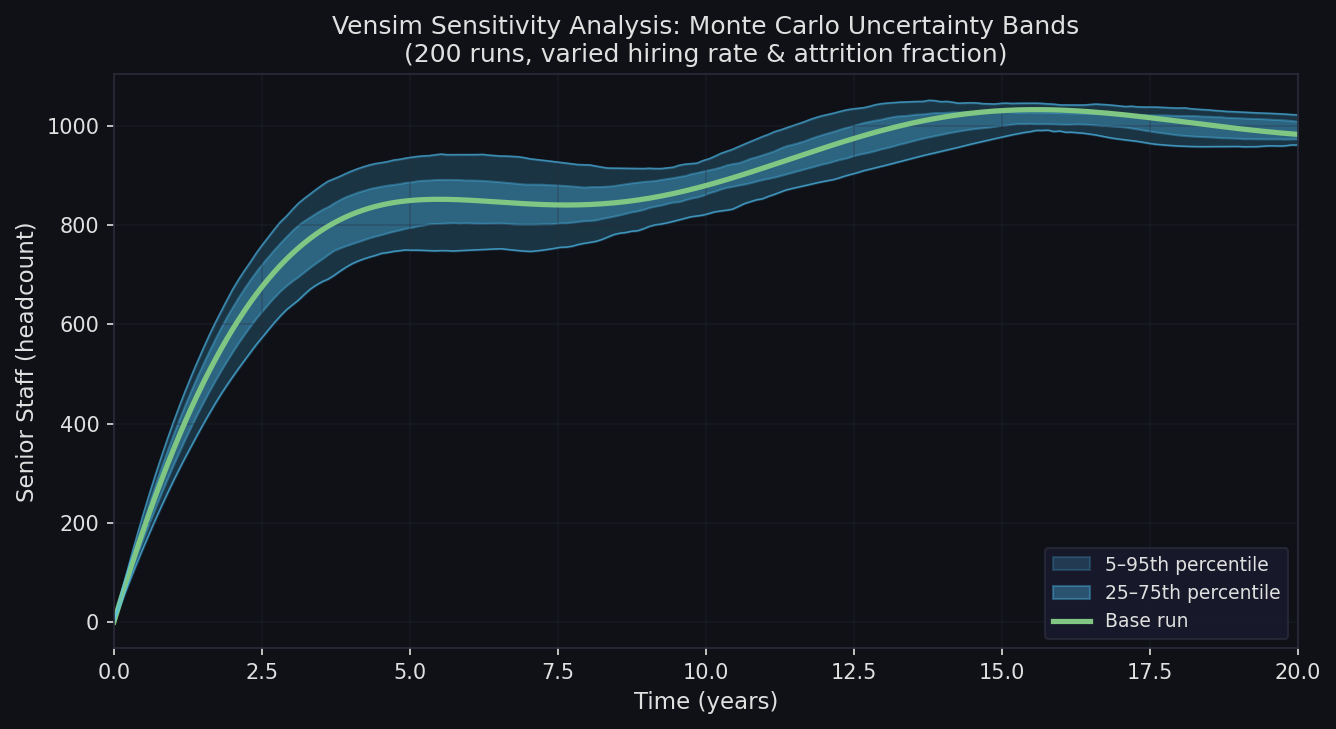
Vensim Professional and DSS editions include Sensitivity Analysis and Optimization modules that are particularly valuable for social policy work. Sensitivity analysis runs Monte Carlo simulations across uncertain parameter ranges—for example, varying public compliance rates, policy adoption delays, or budget elasticities—and produces payoff distributions and confidence bands around key outcomes.
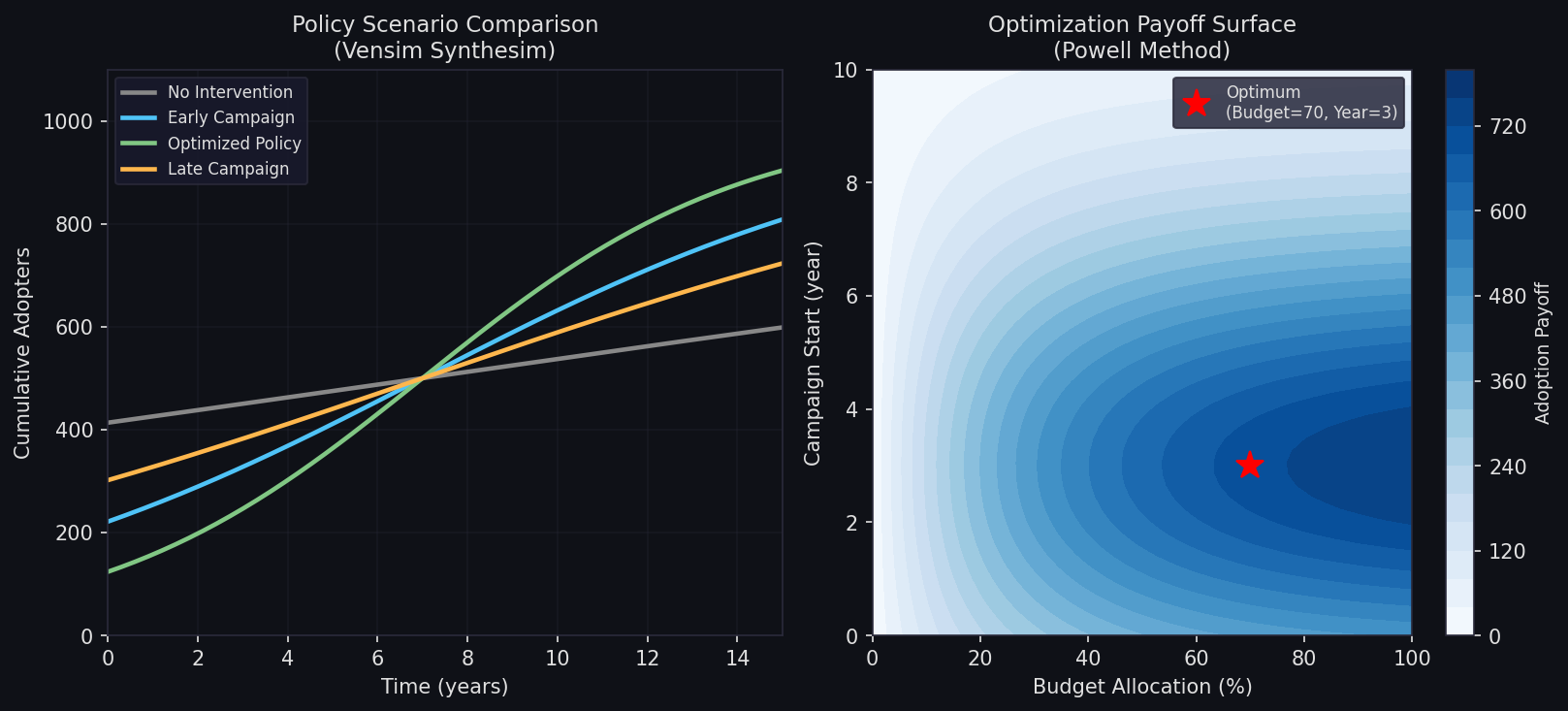
The Optimization module uses Powell's method or conjugate gradient search to find parameter values that minimize a user-defined payoff function. In a public health context, this might mean finding the combination of intervention timing and intensity that minimizes cumulative disease burden subject to budget constraints. In organizational modeling, it could identify the hiring and training investment schedule that minimizes time-to-full-capacity for a new business unit.
Vensim's Policy Optimization workflow:
- Define decision variables (levers the policy-maker controls).
- Specify a payoff function (e.g., minimize cost, maximize adoption rate).
- Set constraints (budget caps, minimum service levels).
- Run optimization across the simulation horizon.
Results are saved as .voc (optimization control) files and can be compared across scenarios using the Synthesim interface, which allows real-time slider-based exploration of parameter space.
Causal Tracing and Model Transparency
A distinguishing feature of Vensim is its Causal Tracing tool, which traces the causal chain from any variable back through the model structure. For a social policy model where a particular outcome (e.g., unemployment rate) is behaving unexpectedly, causal tracing identifies which upstream variables and feedback loops are driving the behavior. This is invaluable for model validation and for explaining model behavior to decision-makers who need to understand why a policy recommendation emerges from the model.
The Causes Tree and Uses Tree views provide hierarchical maps of variable dependencies, while the Loops tool enumerates all feedback loops passing through a selected variable and computes their loop gain—a measure of how strongly each loop is driving current behavior.
Integration with Python and External Data
Vensim DSS supports the Vensim DLL (venDLL), which exposes the simulation engine to external programs via a C-compatible API. The pysd Python library provides a higher-level interface, translating Vensim .mdl files into Python/Pandas-compatible objects:
import pysd
model = pysd.read_vensim('workforce_model.mdl')
result = model.run(params={'Hiring Rate': 50, 'Attrition Fraction': 0.12})
result[['Senior Staff', 'Junior Staff']].plot()
This enables Vensim models to be embedded in larger analytical pipelines—for example, feeding SD model outputs into machine learning classifiers, or calibrating SD parameters against empirical time-series data using scipy optimization routines.
Practical Considerations
- Units checking: Vensim enforces dimensional consistency across all equations. Enabling units checking from the start of model development prevents a class of structural errors common in large models.
- Subscripts: Vensim's subscript system allows a single equation to apply across multiple sectors (e.g., age cohorts, geographic regions, product lines) without duplicating model structure—essential for scaling social models to realistic complexity.
- Version control:
.mdlfiles are plain text and diff cleanly in Git, making collaborative model development tractable. - Vensim PLE: The free Personal Learning Edition supports full model building and simulation but excludes optimization, sensitivity analysis, and the DLL interface—sufficient for learning and prototyping.
Further Resources
- Vensim Documentation and User Guide
- Ventana Systems Model Library — includes reference models for workforce, public health, and supply chain dynamics
- pysd Documentation — Python interface for Vensim models
- System Dynamics Society — peer-reviewed models and conference proceedings
- Sterman, J. D. (2000). Business Dynamics: Systems Thinking and Modeling for a Complex World. McGraw-Hill — the definitive SD reference text
Vensim occupies a distinct niche in the social simulation toolkit: where agent-based models excel at capturing heterogeneity and emergent behavior from individual interactions, Vensim's system dynamics approach is superior for understanding the aggregate feedback structure that governs long-run system behavior. For policy analysts, organizational strategists, and social scientists who need to communicate model insights to non-technical audiences while maintaining rigorous mathematical foundations, Vensim remains the platform of choice.