
ABAQUS/Explicit: High-Velocity Impact and Crash Simulation Capabilities
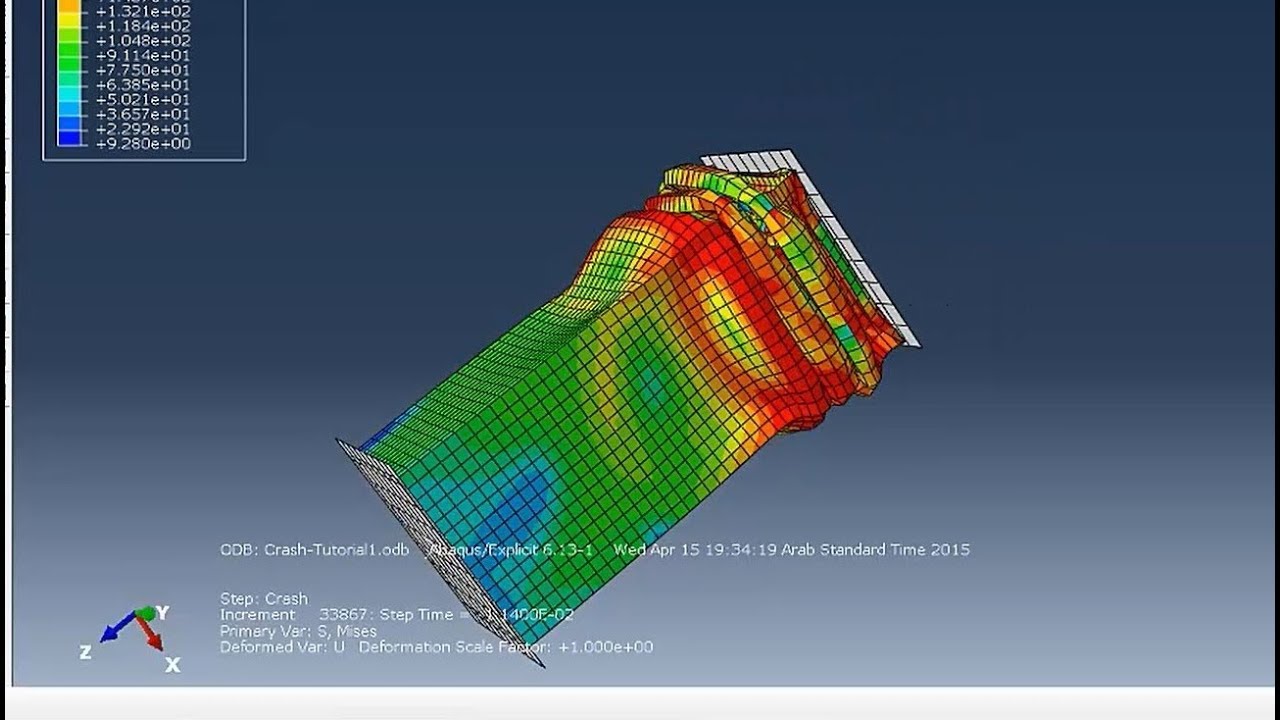
Introduction
When engineering structures face extreme loading conditions—vehicle crashes, ballistic impacts, or explosive events—traditional implicit finite element analysis often struggles with convergence and computational efficiency. ABAQUS/Explicit addresses these challenges through its specialized explicit time integration scheme, making it the industry standard for simulating high-velocity, short-duration dynamic events where material nonlinearity and contact interactions dominate.
The Explicit Integration Advantage
Unlike implicit solvers that require iterative matrix inversions at each time step, ABAQUS/Explicit employs a central difference time integration method that advances the solution explicitly. This approach eliminates the need for tangent stiffness matrix factorization, making each time increment computationally inexpensive. For problems involving severe material distortion, complex contact, and wave propagation, this translates to robust convergence where implicit methods would fail.
The explicit method's stability depends on the Courant-Friedrichs-Lewy (CFL) condition, requiring time steps smaller than the time for a stress wave to traverse the smallest element. While this necessitates many small time steps, the computational cost per step is so low that explicit analysis becomes more efficient than implicit for highly nonlinear transient problems lasting less than a few seconds.

Advanced Contact Algorithms
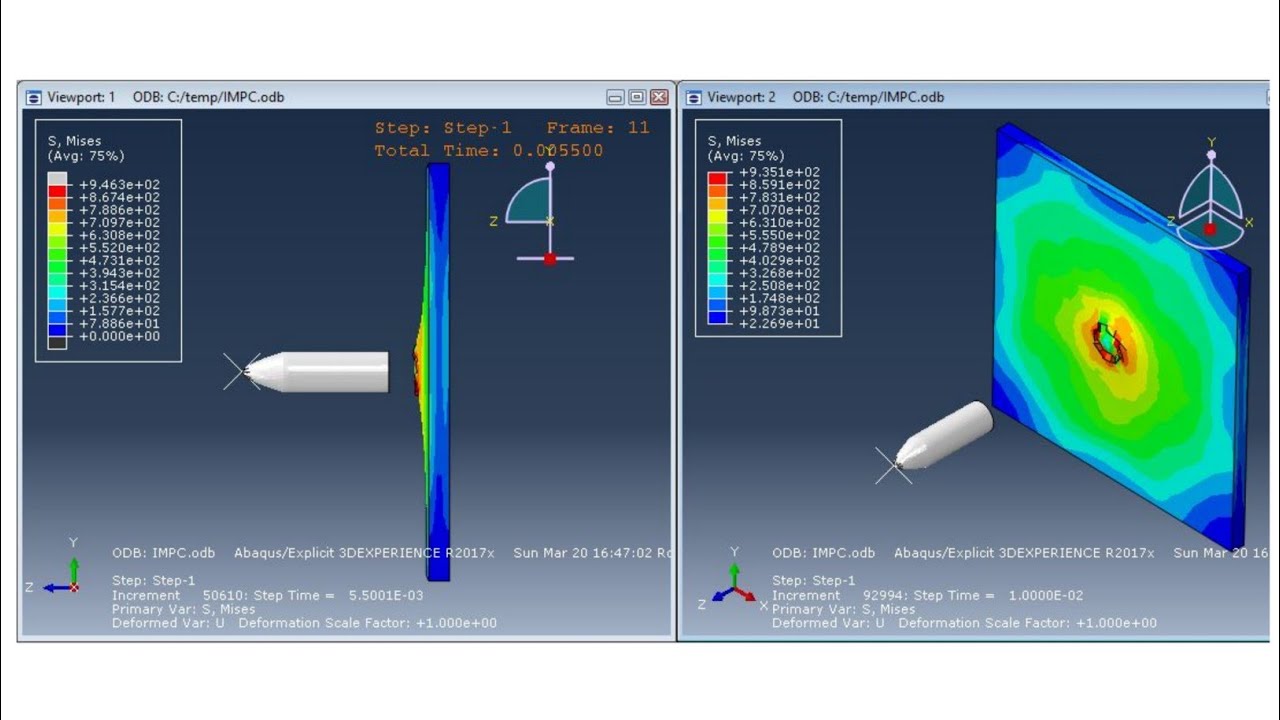
ABAQUS/Explicit's general contact algorithm represents a significant advancement in handling complex interaction scenarios. Rather than requiring users to define individual contact pairs, the general contact feature automatically detects and manages all potential interactions within a model. This capability is particularly valuable in crash simulations where hundreds of components may come into contact in unpredictable sequences.
The contact algorithm employs a penalty-based enforcement method with sophisticated tracking algorithms that handle finite sliding, separation, and self-contact. Surface-to-surface discretization ensures accurate stress distributions across contact interfaces, critical for predicting failure initiation in impact zones. The solver's ability to handle eroding contact—where elements are removed due to failure while maintaining contact continuity—enables realistic simulation of penetration and perforation events.
Material Modeling for Extreme Conditions
High-velocity impacts subject materials to strain rates orders of magnitude higher than quasi-static loading. ABAQUS/Explicit provides extensive material models that capture rate-dependent behavior, including the Johnson-Cook plasticity model for metals under high strain rates and temperatures, and various equation-of-state (EOS) models for materials experiencing shock loading.
The Johnson-Cook model incorporates strain hardening, strain rate sensitivity, and thermal softening in a single constitutive framework. For ballistic applications, the Mie-Grüneisen EOS coupled with strength models enables accurate prediction of shock wave propagation and material response under extreme pressures. Progressive damage and failure models, including ductile damage criteria and element deletion capabilities, allow simulation of material separation and fragmentation.
Computational Efficiency and Scalability
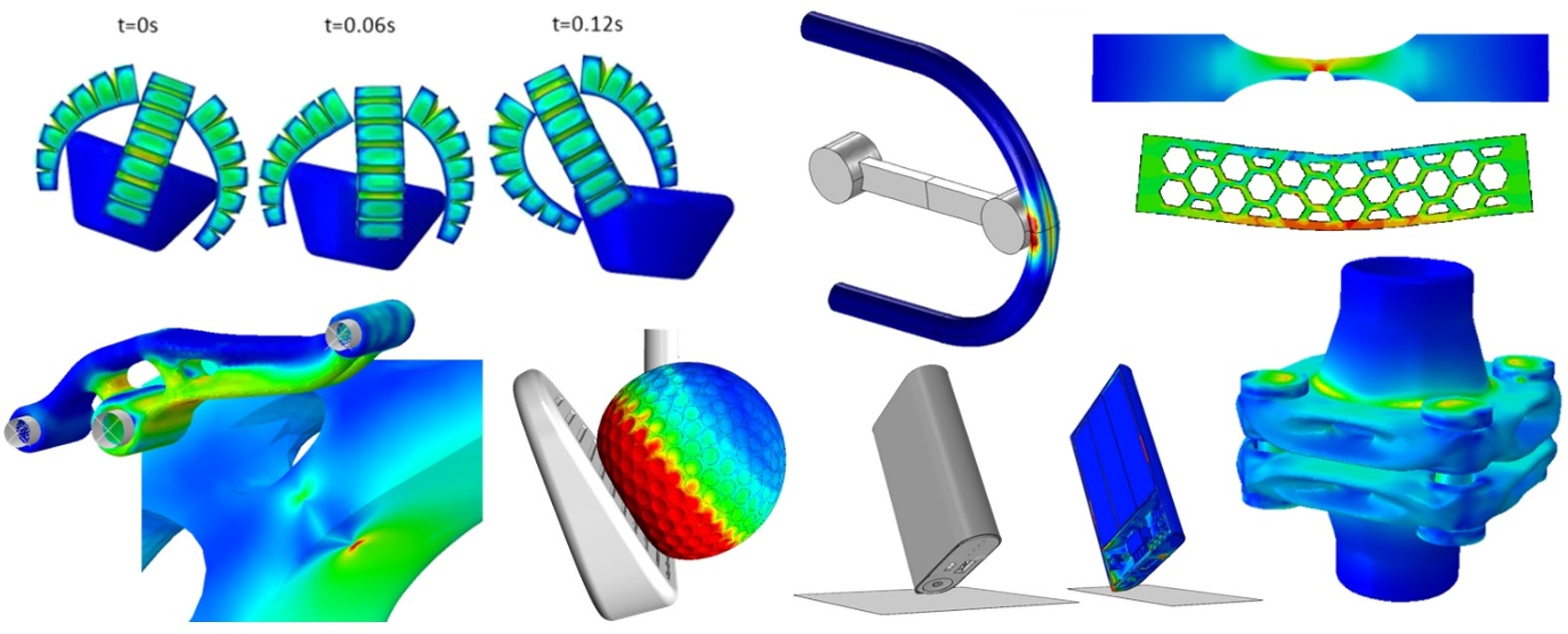
Modern crash and impact simulations often involve millions of elements, demanding efficient parallel processing. ABAQUS/Explicit implements domain decomposition parallelization that scales effectively across multiple CPU cores and distributed computing clusters. The explicit algorithm's local nature—where element calculations depend only on neighboring elements—makes it inherently suitable for parallel execution.
Mass scaling techniques provide additional computational efficiency by artificially increasing material density in small elements, thereby increasing the stable time increment without significantly affecting solution accuracy for problems where inertial effects dominate. Selective mass scaling, applied only to elements limiting the time step, offers a balanced approach to reducing computational cost while maintaining physical fidelity.
Industry Applications and Best Practices
Automotive manufacturers rely on ABAQUS/Explicit for full-vehicle crash simulations, validating occupant safety systems and structural crashworthiness. Aerospace engineers use it to analyze bird strike impacts on engine components and fuselage structures. Defense applications include armor penetration studies and blast loading analysis.
Best practices for explicit analysis include careful mesh refinement in impact zones, appropriate element formulations (reduced integration elements with hourglass control), and validation against experimental data. Engineers should verify that artificial energy (hourglass and contact stabilization) remains below 5-10% of internal energy to ensure solution accuracy.
Integration with the ABAQUS Ecosystem
ABAQUS/Explicit seamlessly integrates with ABAQUS/Standard for sequential analysis workflows. A common approach involves using Explicit for the high-velocity impact phase, then importing the deformed state into Standard for subsequent quasi-static analysis of residual stresses or post-impact structural integrity. This hybrid approach leverages each solver's strengths for comprehensive analysis of complex loading scenarios.
Conclusion
ABAQUS/Explicit's specialized capabilities for high-velocity impact and crash simulation make it indispensable for industries where product safety and structural integrity under extreme conditions are paramount. Its explicit time integration scheme, advanced contact algorithms, and comprehensive material models enable engineers to predict structural response in scenarios where traditional analysis methods fail. As computational resources continue to advance, explicit dynamics simulation will play an increasingly central role in virtual testing and design optimization.