
Altair OptiStruct Topology Optimization: Generating Manufacturable Lightweight Structures
Topology optimization has transformed structural design by letting engineers discover optimal material distributions rather than iterating on predefined geometries. Altair OptiStruct is the industry benchmark for this capability, combining density-based SIMP (Solid Isotropic Material with Penalization) methods with a rich set of manufacturing constraints that bridge the gap between mathematically optimal and physically producible designs.
How OptiStruct's SIMP Engine Works
OptiStruct assigns a pseudo-density variable (ρ) between 0 and 1 to every finite element in the design space. The stiffness of each element is penalized as E(ρ) = ρ^p · E₀, where the penalization exponent p (typically 3) drives intermediate densities toward 0 or 1, producing crisp solid/void boundaries. The optimizer minimizes a user-defined objective—most commonly weighted compliance (the inverse of global stiffness)—subject to a volume fraction constraint and any additional responses such as stress, displacement, or natural frequency.
The sensitivity of the objective with respect to each density variable is computed via the adjoint method, making the cost of a gradient evaluation independent of the number of design variables. This allows OptiStruct to handle models with millions of elements without prohibitive compute times.

Manufacturing Constraints: From Math to Shop Floor
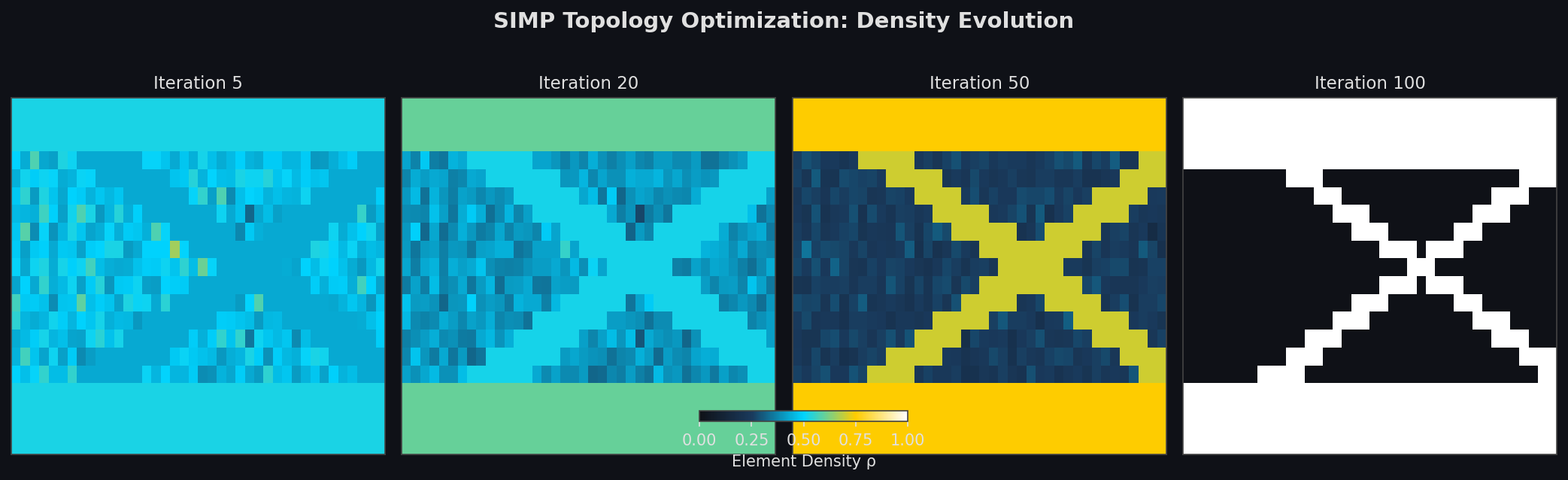
Raw topology results often contain thin floating members, undercuts, or internal voids that cannot be cast, machined, or 3D-printed without modification. OptiStruct addresses this with a suite of manufacturing constraints applied directly inside the optimization loop:
- Minimum member size control — enforces a lower bound on feature thickness, preventing mesh-dependent micro-structures that would be impossible to manufacture.
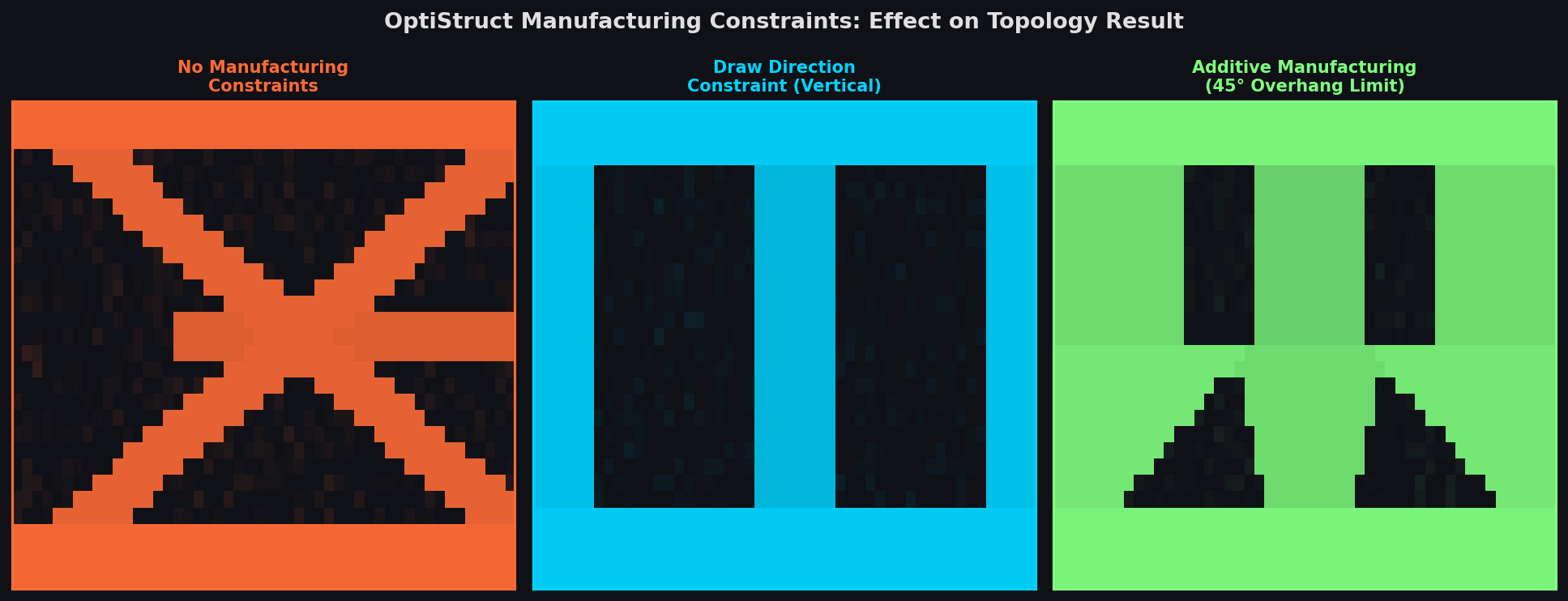
- Draw direction constraints — restrict material removal to a specified pull direction, ensuring the optimized part can be demolded in one or two directions. A split-draw option handles two-piece tooling.
- Extrusion constraints — force a constant cross-section along a sweep axis, ideal for extruded aluminum profiles or sheet-metal stampings.
- Symmetry planes — mirror the design about one, two, or three planes, or enforce cyclic/rotational symmetry for components like turbine discs or wheel hubs.
- Overhang angle control for additive manufacturing — limits unsupported overhangs to a user-specified build angle (commonly 45°), reducing support material and post-processing effort.
These constraints are not post-processing filters; they modify the sensitivity fields during each iteration so the final density field already respects the manufacturing intent.
Setting Up a Practical Topology Run
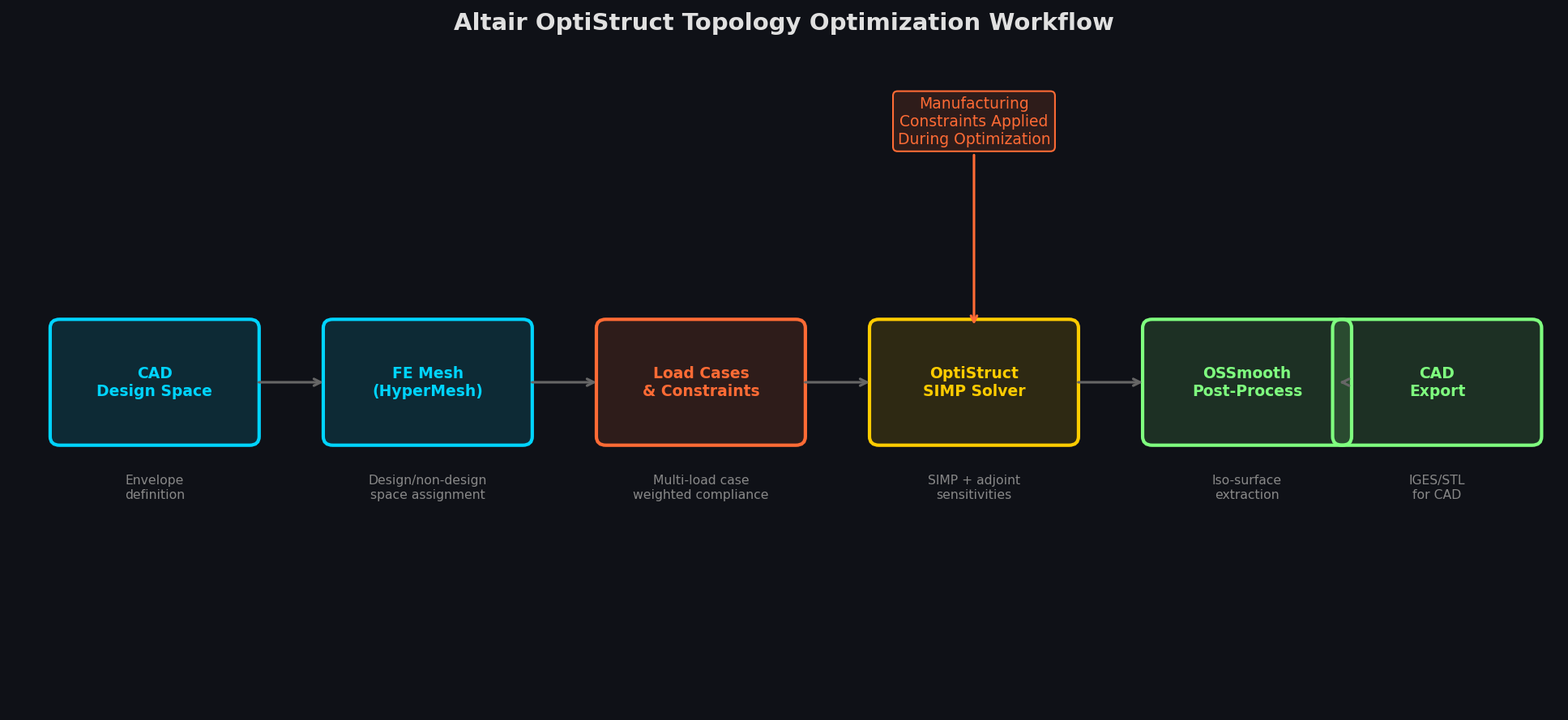
A typical OptiStruct topology study in HyperMesh or HyperWorks follows this workflow:
- Define design and non-design spaces — Bolt holes, bearing surfaces, and interface regions are flagged as non-design; the surrounding envelope is the design space.
- Apply load cases — Multiple load cases (e.g., bending, torsion, combined) can be combined into a weighted compliance objective, ensuring the result is robust across the operating envelope.
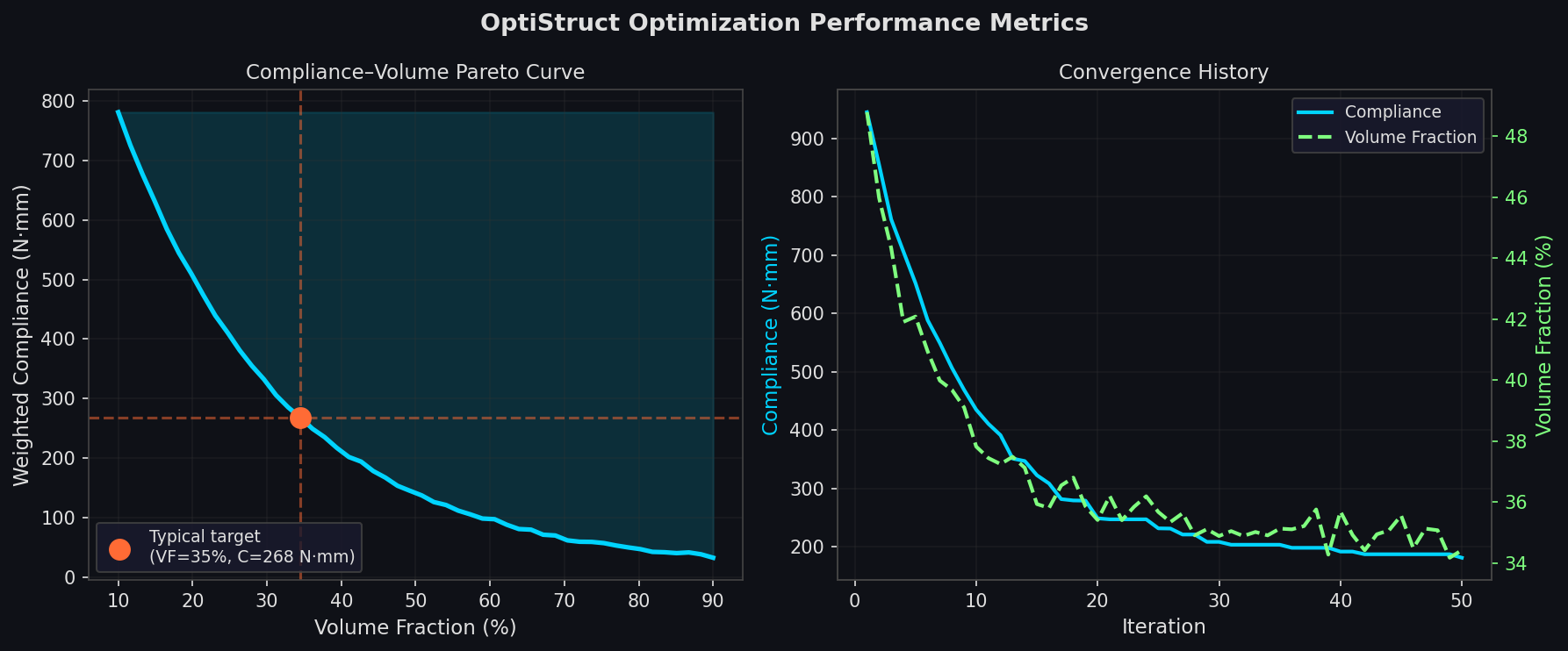
- Set the volume fraction — A target of 30–40% of the original design space is a common starting point; the optimizer will distribute that material where it contributes most to stiffness.
- Activate manufacturing constraints — For a die-cast bracket, a single draw direction with minimum member size of 3 mm is typical.
- Run and interpret — OptiStruct outputs an OSSmooth or HyperMesh result file. The iso-surface at ρ = 0.3 is extracted and smoothed to create a CAD-ready surface for downstream detailed design.
Stress-Constrained and Multi-Objective Formulations
Beyond compliance minimization, OptiStruct supports stress-constrained topology optimization using a P-norm aggregation of element von Mises stresses. This prevents the optimizer from creating slender members that are stiff but highly stressed. For NVH-driven applications, frequency response optimization (minimizing dynamic compliance or maximizing the first natural frequency) is available through the same SIMP framework.
Multi-model optimization (MMO) extends this further: a single set of design variables can simultaneously optimize across different load cases defined in separate FE models, useful when a component must meet both static strength and crash energy absorption targets.
Practical Results and Benchmarks
In automotive body-in-white applications, OptiStruct topology runs on full-vehicle models (5–15 million elements) typically complete in 4–8 hours on a 32-core workstation. Mass savings of 20–35% relative to the baseline design are routinely achieved while meeting stiffness and modal frequency targets. For aerospace brackets, weight reductions of 40–60% are common when additive manufacturing is the intended process, since the overhang constraint replaces the more restrictive draw-direction constraint.
Integration with the Altair HyperWorks Ecosystem
OptiStruct results feed directly into Altair's broader simulation chain. The OSSmooth module generates a smooth STL or IGES surface from the density field, which can be imported into solidThinking Inspire for further refinement or exported to any CAD system. Altair SimSolid can then perform rapid FEA on the smoothed geometry to validate the optimized design before detailed modeling. For additive manufacturing, the result can be passed to Altair Inspire Print3D for build orientation and support optimization.
Further Resources