
ANSYS Fluent: Advanced Turbulence Modeling with Scale-Resolving Simulations
Computational Fluid Dynamics (CFD) practitioners frequently encounter flow scenarios where traditional Reynolds-Averaged Navier-Stokes (RANS) turbulence models fall short. ANSYS Fluent addresses these limitations through its comprehensive suite of Scale-Resolving Simulation (SRS) methods, offering engineers unprecedented accuracy in predicting complex turbulent phenomena.
Understanding Scale-Resolving Simulations
Scale-Resolving Simulations represent a paradigm shift from statistical turbulence modeling to direct resolution of turbulent structures. While RANS models average all turbulent fluctuations, SRS methods resolve the larger, energy-containing eddies while modeling only the smallest scales. This approach proves essential for flows dominated by large-scale unsteadiness, separation, and vortex shedding—phenomena common in aerospace, automotive, and energy applications.
ANSYS Fluent implements three primary SRS methodologies: Large Eddy Simulation (LES), Detached Eddy Simulation (DES), and Scale-Adaptive Simulation (SAS). Each method occupies a distinct position in the accuracy-computational cost spectrum, enabling engineers to balance fidelity requirements against available resources.

Large Eddy Simulation: Maximum Fidelity
LES in ANSYS Fluent directly resolves turbulent structures down to the grid scale, employing subgrid-scale models for smaller eddies. The software offers multiple subgrid models including the Smagorinsky-Lilly model, Wall-Adapting Local Eddy-viscosity (WALE) model, and dynamic Smagorinsky model. The WALE model has gained particular traction for wall-bounded flows, as it correctly predicts zero eddy viscosity in laminar regions without requiring dynamic procedures.
Implementing LES requires careful attention to grid resolution. ANSYS Fluent provides built-in quality metrics such as the LES Index of Quality (LES_IQ), which quantifies the ratio of resolved to total turbulent kinetic energy. Engineers should target LES_IQ values above 0.8 in regions of interest, ensuring that the grid adequately captures the turbulent cascade. The software's adaptive mesh refinement capabilities can automatically refine regions where resolution proves insufficient.
Detached Eddy Simulation: Practical Hybrid Approach
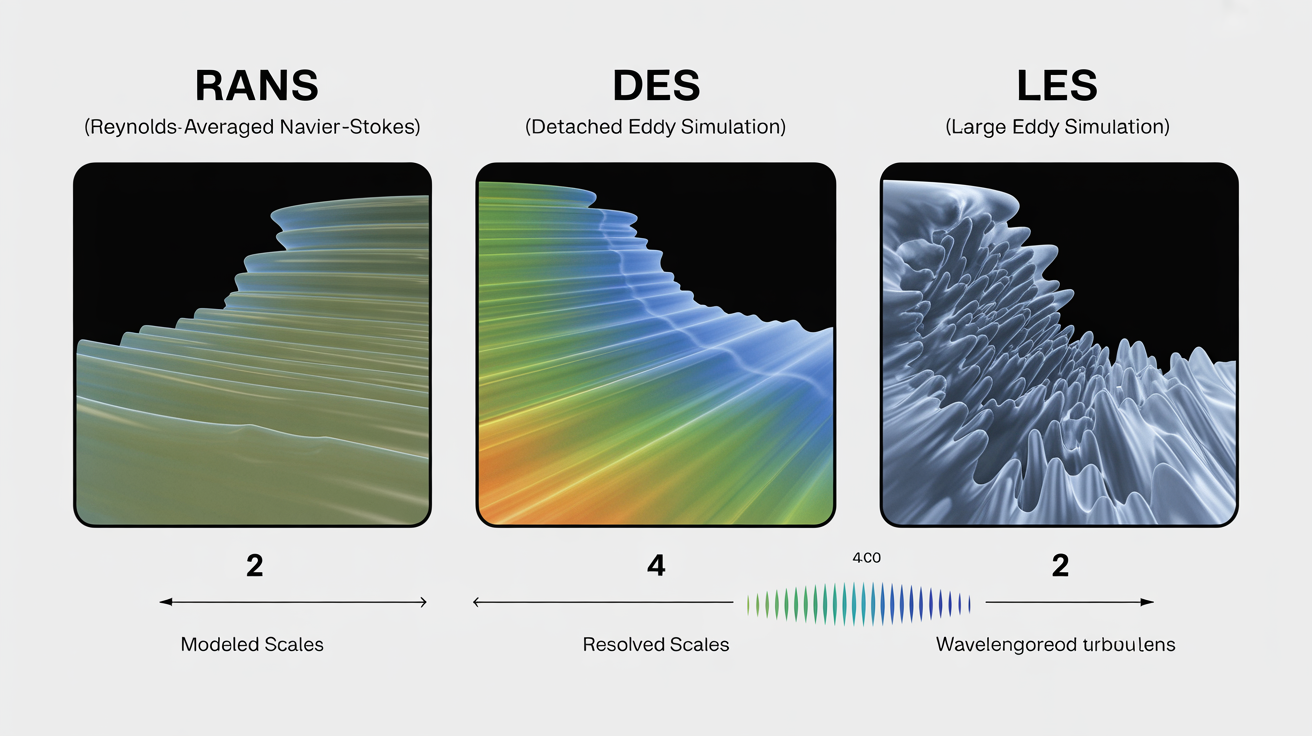
For industrial applications where full LES remains computationally prohibitive, ANSYS Fluent's DES implementation offers an elegant compromise. DES employs RANS modeling in attached boundary layers while switching to LES-like behavior in separated regions. This hybrid strategy dramatically reduces cell count requirements compared to pure LES while maintaining high accuracy in flow separation zones.
Fluent implements several DES variants including Delayed DES (DDES) and Improved DDES (IDDES). DDES addresses the original DES formulation's tendency toward premature separation by incorporating a delay function that shields boundary layers from LES treatment. IDDES extends this further, enabling wall-modeled LES capability that allows coarser near-wall grids while preserving accuracy in separated regions.
The IDDES formulation proves particularly valuable for external aerodynamics applications. Engineers analyzing automotive aerodynamics, for instance, can employ relatively coarse boundary layer meshes on vehicle surfaces while resolving wake structures with LES-like accuracy. This approach typically reduces computational cost by 60-70% compared to wall-resolved LES while capturing critical unsteady phenomena affecting drag and lift.
Scale-Adaptive Simulation: RANS-Based Alternative
ANSYS Fluent's SAS model provides another pathway to unsteady turbulence resolution without requiring LES-grade meshes. Based on the SST k-ω turbulence model, SAS introduces a von Kármán length-scale term that allows the model to dynamically adjust to resolved scales. In regions where the grid can support it, SAS automatically transitions to scale-resolving behavior.
The primary advantage of SAS lies in its robustness on industrial meshes. Unlike LES or DES, SAS does not impose strict grid resolution requirements and gracefully degrades to RANS behavior when resolution proves insufficient. This characteristic makes SAS an excellent starting point for organizations transitioning from steady RANS to unsteady scale-resolving methods.
Practical Implementation Considerations
Successful SRS implementation in ANSYS Fluent demands attention to several critical factors. Time step selection proves crucial—engineers should target Courant numbers below 1.0 in regions where scale resolution matters, often requiring time steps 10-100 times smaller than typical RANS simulations. Fluent's automatic time-stepping feature can adapt the time step to maintain specified Courant number limits.
Inlet boundary conditions require special consideration for SRS methods. Fluent provides synthetic turbulence generation methods including the Spectral Synthesizer and Vortex Method, which create realistic turbulent fluctuations at inflow boundaries. Without proper inlet turbulence, SRS solutions may require excessive development lengths or fail to transition to fully turbulent behavior.
Post-processing SRS results differs fundamentally from RANS analysis. Engineers must perform time-averaging over sufficient periods to obtain meaningful statistics—typically requiring 5-10 flow-through times after initial transients decay. ANSYS Fluent's built-in time-statistics capabilities automate this process, computing mean and RMS values during the solution process.
Conclusion
ANSYS Fluent's Scale-Resolving Simulation capabilities empower engineers to tackle flow problems beyond the reach of traditional RANS modeling. By offering a spectrum of methods from full LES to hybrid approaches like IDDES and SAS, the software enables organizations to balance accuracy requirements against computational constraints. As computing resources continue to expand, these advanced turbulence modeling techniques are transitioning from research tools to standard industrial practice.
For engineers seeking to implement SRS methods, ANSYS provides extensive documentation and validation cases demonstrating best practices. The ANSYS Learning Hub offers detailed tutorials on SRS setup, while the ANSYS Customer Portal hosts validation studies comparing SRS predictions against experimental data for canonical flows.
Further Resources:
- ANSYS Fluent Theory Guide - Turbulence Modeling
- ANSYS Innovation Courses - Advanced CFD
- NASA Turbulence Modeling Resource: https://turbmodels.larc.nasa.gov