

Ansys FreeFlow 2026 R1: SPH Adaptive Sizing, IISPH Default Solver, and Expanded Multiphysics Integration
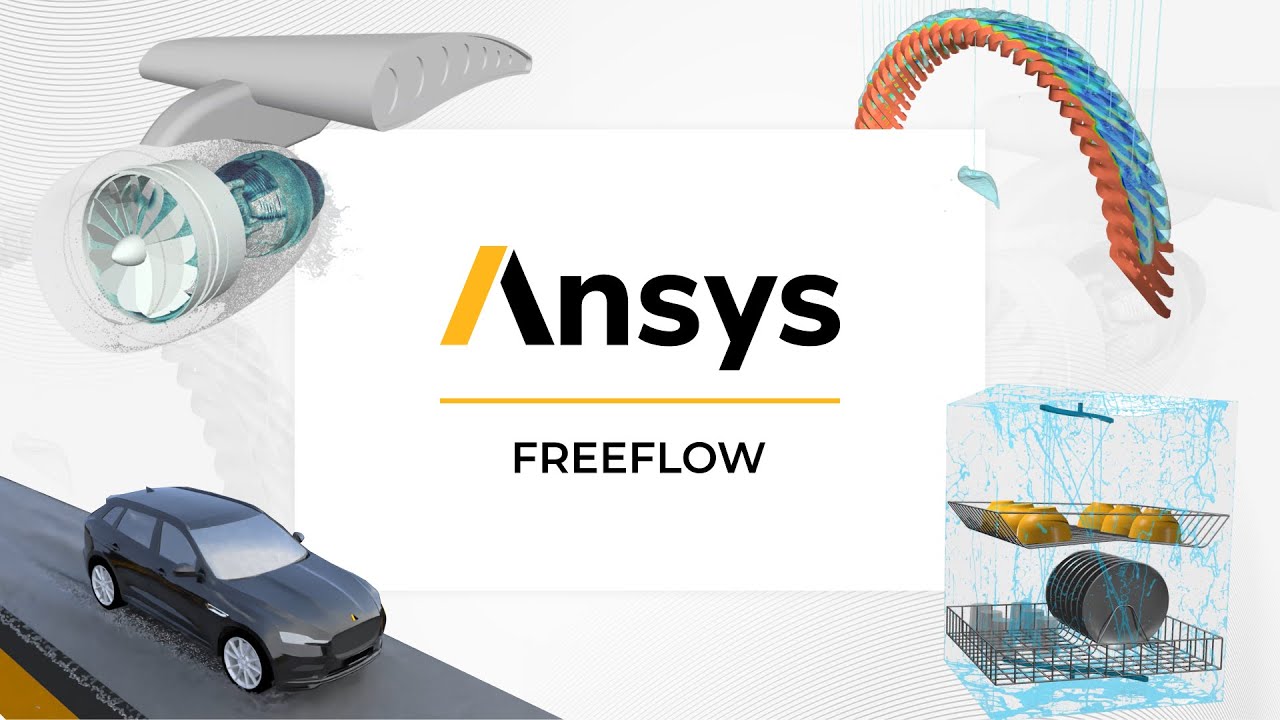
Ansys has released FreeFlow 2026 R1, a significant update to its smoothed-particle hydrodynamics (SPH) simulation platform. The release targets engineers working with complex free-surface flows, high-viscosity fluids, and multiphase systems where traditional mesh-based CFD approaches struggle. Two headline features—SPH Adaptive Size and the promotion of the Implicit Incompressible SPH (IISPH) solver to default status—substantially improve both accuracy and throughput for production workflows.
SPH Adaptive Size: Resolution Where It Matters
The most anticipated addition in 2026 R1 is SPH Adaptive Size, which brings dynamic particle refinement to FreeFlow analogous to adaptive mesh refinement (AMR) in grid-based CFD. During a simulation, the solver automatically adjusts SPH element sizes based on user-defined criteria, concentrating resolution in critical regions while using coarser particles elsewhere to control computational cost.
Two refinement strategies are available:

- Region-based refinement: Users define a volume of interest; particles entering that region are refined and coarsened as they exit.
- Boundary-based refinement: Particle size adapts automatically as elements approach walls or complex geometric features such as narrow gaps, nozzle throats, or valve seats.
This capability is particularly valuable for hydraulic valve simulations, spray nozzle characterization, and impact/sloshing studies where localized high-gradient regions coexist with large quiescent fluid volumes.
IISPH Promoted to Default Solver
The Implicit Incompressible SPH (IISPH) solver, previously available as a beta feature, is now the default solver in FreeFlow 2026 R1. Compared to the legacy Weakly Compressible SPH (WCSPH) formulation, IISPH can support timesteps up to an order of magnitude larger, directly translating to faster wall-clock times for production runs. The WCSPH solver remains available for cases where its explicit formulation is preferred.
Implicit Viscous Forces and Thermal Enhancements
FreeFlow 2026 R1 extends its physics coverage with implicit viscous force treatment for both Newtonian and non-Newtonian fluids. Previously, high-viscosity fluids imposed prohibitively small explicit timesteps; the implicit formulation removes this constraint, enabling stable and efficient simulation of polymer melts, slurries, and other viscous media.
A new Flat Plate Heat Transfer Coefficient (HTC) correlation module automates heat transfer estimation on surface triangles using flat-plate correlations, simplifying conjugate heat transfer setups and fluid-structure thermal interaction studies.
Periodic Continuous Injection boundary conditions allow users to define time-periodic inlet flows with configurable injection period and duration, enabling accurate reproduction of pulsating injections, cyclic filling operations, and oscillating flow systems without manual scripting.
Multiphysics and Performance
Integration with Ansys optiSLang has been upgraded with a dedicated FreeFlow node, streamlining parametric design studies, sensitivity analyses, and reduced-order model (ROM) generation directly from SPH results. Simulation data can now also be exported to Ansys EnSight for advanced post-processing and high-fidelity visualization.
On the performance side, initialization times for large-scale simulations involving millions of SPH elements have been reduced through optimizations in volumetric particle generation. SPH Flowmeters have been extended to measure average velocity and temperature across defined surfaces, improving instrumentation for process simulation workflows.
Practical Implications
FreeFlow 2026 R1 positions SPH as a more competitive alternative to Volume-of-Fluid (VOF) and Lattice Boltzmann methods for free-surface and multiphase problems. The combination of adaptive particle sizing and the IISPH default solver addresses the two most common objections to SPH in production environments: resolution control and computational efficiency. Engineers working on lubrication, filling, washing, and spray applications will find the 2026 R1 feature set directly applicable to their workflows.
For full release notes and documentation, visit the Ansys FreeFlow product page and the 2026 R1 release highlights on Ansys Innovation Space.