

AVEVA Process Simulation: Pressure Relief and Safety System Design
AVEVA Process Simulation (formerly SimSci PRO/II): Pressure Relief and Safety System Design
Pressure relief systems are the last line of defense in chemical plant safety. Sizing relief valves, rupture discs, and flare headers incorrectly can lead to catastrophic overpressure events or costly over-engineering. AVEVA Process Simulation—the successor to SimSci PRO/II—provides a rigorous, standards-compliant environment for designing and validating pressure relief and safety systems across refining, petrochemical, and gas processing facilities.
Why Dedicated Relief System Simulation Matters
General-purpose steady-state simulators handle normal operating conditions well, but relief scenarios introduce unique challenges: two-phase flashing flow, choked conditions, rapidly changing compositions, and simultaneous relief from multiple sources. AVEVA Process Simulation addresses these with dedicated relief device models and a tightly integrated flare network solver that handles compressible, two-phase, and supercritical flows within a single unified model.
Relief Device Modeling Capabilities
AVEVA Process Simulation supports the full spectrum of pressure-relieving devices:

- Pressure Safety Valves (PSVs): API 520/521-compliant sizing for vapor, liquid, and two-phase service. The solver automatically determines the governing relief scenario (fire case, blocked outlet, cooling failure, etc.) and selects the worst-case required relieving rate.
- Rupture Discs: Modeled as instantaneous full-bore openings with user-defined burst pressure and combination factors when installed in series with a PSV.
- Pilot-Operated Relief Valves (PORVs): Modeled with back-pressure sensitivity curves, enabling accurate sizing in high back-pressure flare headers.
- Emergency Pressure Control Valves (EPCVs): Modeled as modulating devices for scenarios where staged depressurization is preferred over instantaneous relief.
Each device can be linked directly to its protected vessel or heat exchanger, so the simulator automatically propagates the relieving stream composition and thermodynamic state to the downstream flare network.
Flare Header and Knockout Drum Sizing
One of the most powerful features is the integrated flare network module. Engineers can build a complete tree-structured flare header model—from individual tail pipes through sub-headers to the main flare stack—and solve for:
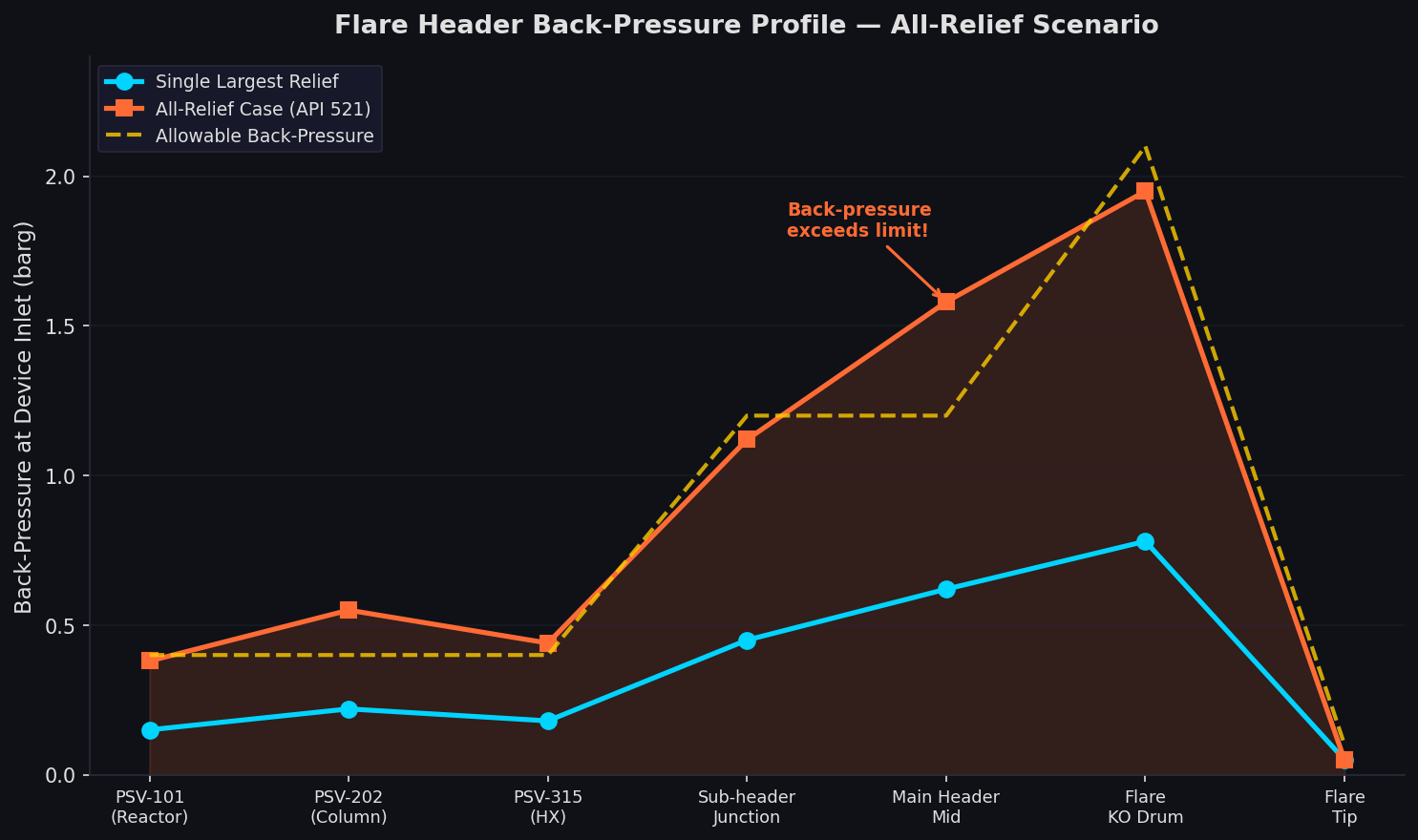
- Pressure drop distribution under simultaneous relief from multiple sources (the "all-relief" case required by API 521 §5.15)
- Back-pressure at each PSV inlet, which feeds back into the relief valve sizing loop to ensure the set pressure is not exceeded
- Liquid carryover to the knockout drum using two-phase flow correlations (Beggs-Brill, Lockhart-Martinelli) appropriate for inclined and horizontal pipe segments
- Flare tip velocity and radiation using integrated combustion models that account for wind effects and Mach number constraints
The solver iterates between the relief device models and the flare network until a self-consistent solution is reached, eliminating the manual back-and-forth that characterizes spreadsheet-based approaches.
Scenario Management and API 521 Compliance
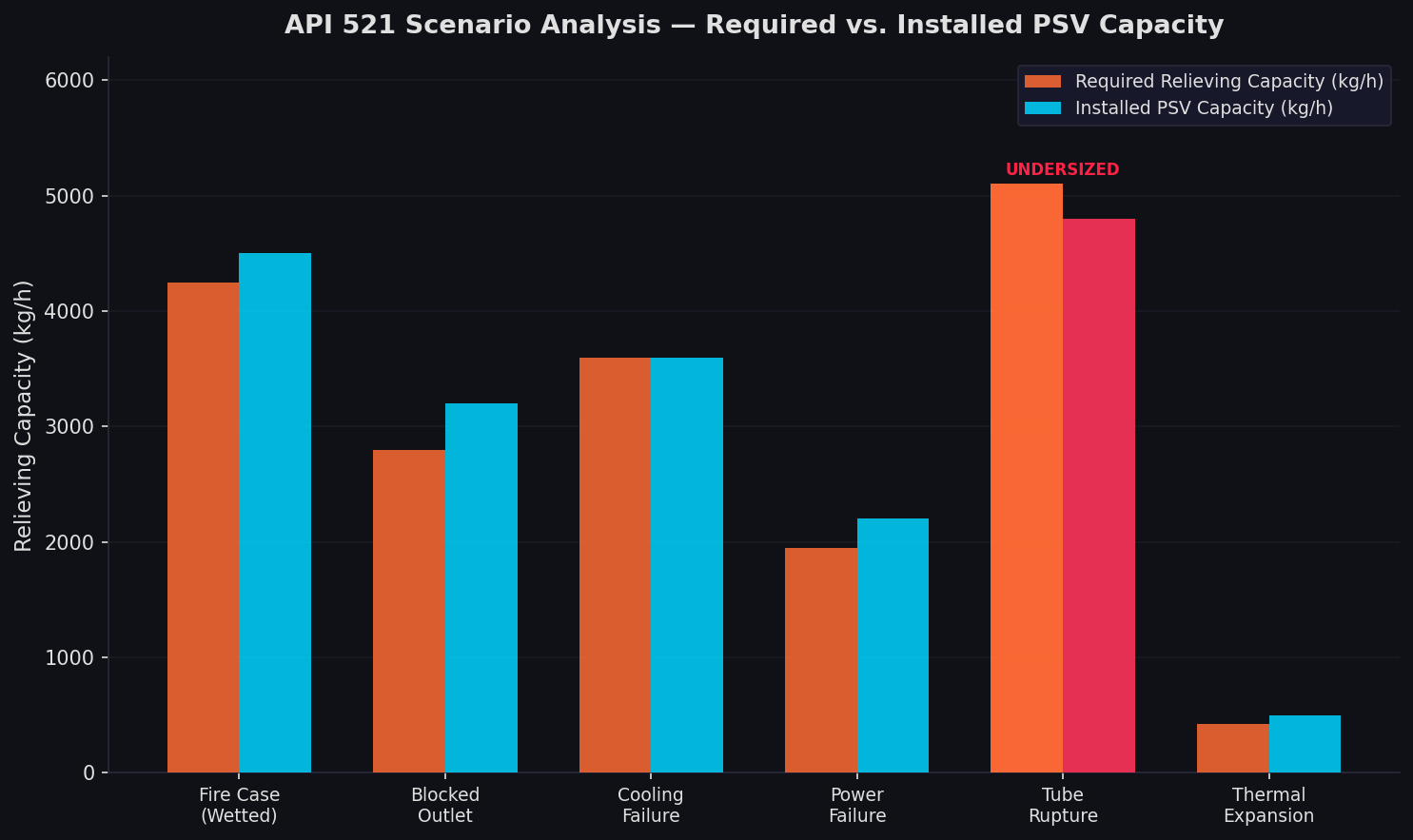
AVEVA Process Simulation includes a scenario manager that systematically evaluates all credible overpressure scenarios defined in API 521 Table 1:
| Scenario | Typical Governing Equipment |
|---|---|
| Fire (wetted surface) | Storage vessels, heat exchangers |
| Blocked outlet | Pumps, compressors |
| Cooling/reflux failure | Distillation columns, condensers |
| Power failure | Rotating equipment, control valves |
| Thermal expansion | Liquid-full systems |
| Tube rupture | Shell-and-tube heat exchangers |
For each scenario, the simulator calculates the required relieving capacity, compares it against the installed device capacity, and flags any deficiencies. The built-in documentation module generates API 521-formatted data sheets directly from the simulation results, reducing the manual transcription errors that frequently occur when simulation and documentation are handled in separate tools.
Two-Phase and Reactive Relief
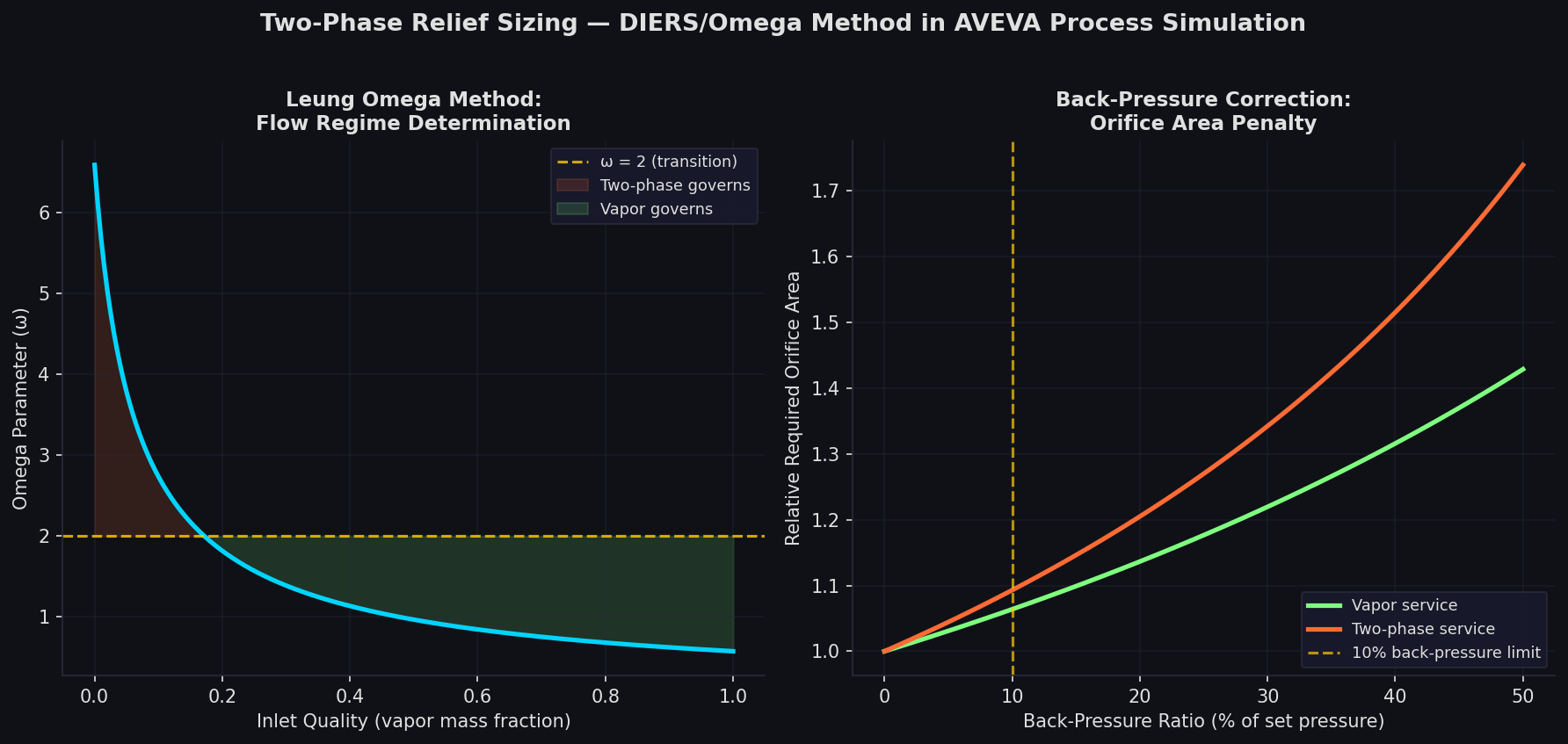
Two-phase relief—particularly for reactive systems—is notoriously difficult to size correctly. AVEVA Process Simulation integrates the DIERS (Design Institute for Emergency Relief Systems) methodology for reactive systems, allowing engineers to specify reaction kinetics and adiabatic calorimetry data (from VSP2 or ARSST experiments) directly in the model. The simulator then calculates the tempered or gassy relief scenario, determines whether vapor or two-phase flow governs, and sizes the relief device accordingly.
For non-reactive two-phase flashing systems, the Omega method (Leung, 1986) and homogeneous equilibrium model (HEM) are both available, with the option to apply non-equilibrium correction factors for subcooled inlet conditions.
Integration with Plant Safety Workflows
AVEVA Process Simulation connects to the broader AVEVA safety ecosystem:
- AVEVA Unified Engineering: Relief device data sheets flow directly into the instrument index and P&ID management tools, maintaining a single source of truth across disciplines.
- AVEVA PDMS/E3D: Pipe routing and support data from the 3D model can be imported to refine flare header pressure drop calculations with actual pipe lengths and fittings.
- Third-party HAZOP/LOPA tools: The simulator exports scenario data in formats compatible with BowTie XP and PHAWorks for layer-of-protection analysis.
Practical Workflow: Revamp of an Existing Flare System
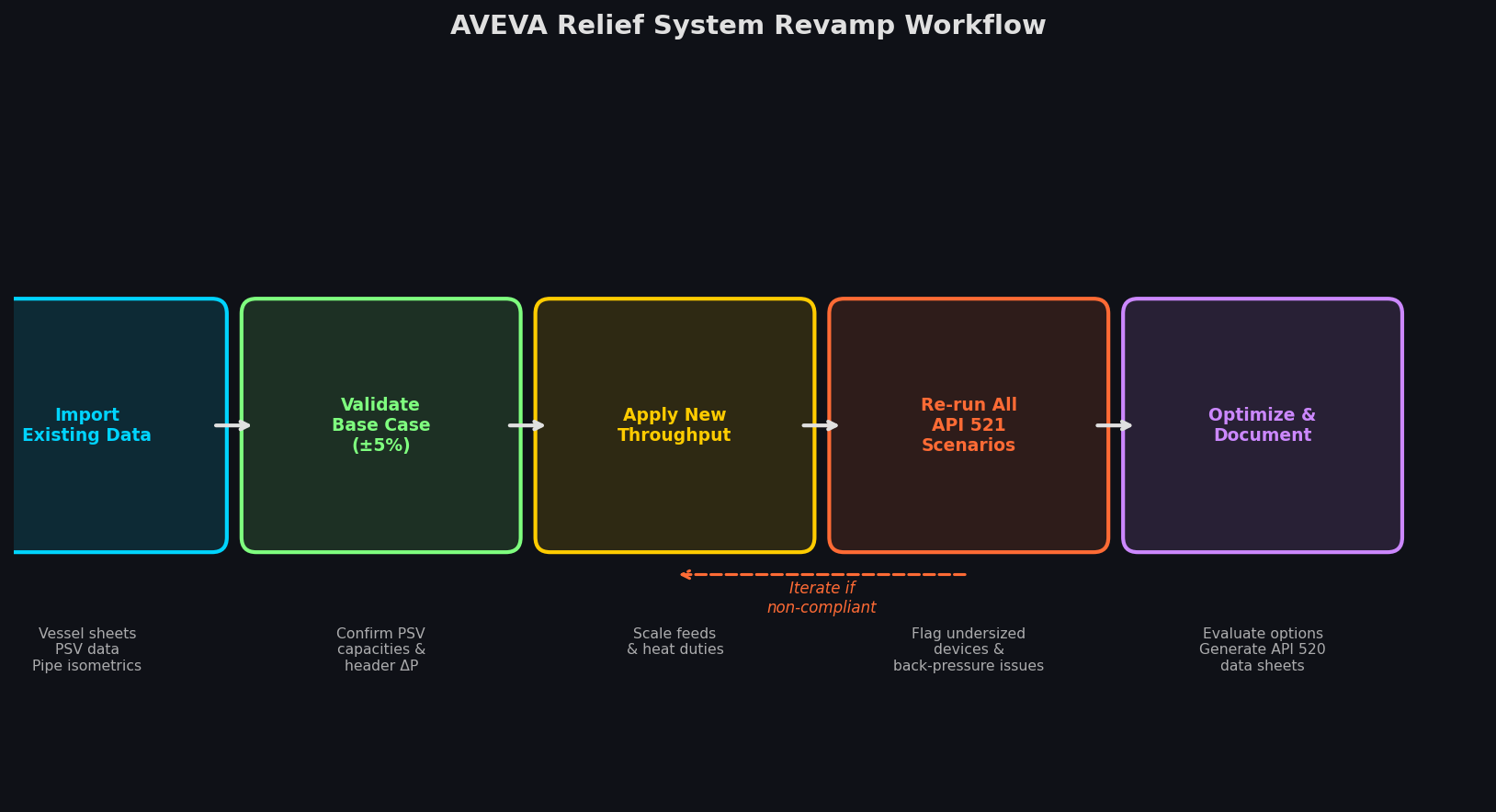
A common application is evaluating whether an existing flare system can accommodate increased throughput after a debottlenecking project. The workflow typically proceeds as follows:
- Import existing data: Pull vessel data sheets, PSV data sheets, and pipe isometrics into the model.
- Validate base case: Confirm that the model reproduces the as-built PSV capacities and header pressure drops within ±5%.
- Apply new throughput: Scale feed rates and heat duties to the debottlenecked case.
- Re-run all scenarios: Identify which PSVs are now undersized and which header segments exceed the allowable back-pressure.
- Optimize: Evaluate options—larger PSV orifices, parallel devices, header upsizing—and select the minimum-cost solution that restores compliance.
This structured approach, supported by AVEVA's scenario manager and automated data sheet generation, can reduce the engineering time for a mid-size revamp from several weeks to a few days.
Key Takeaways
AVEVA Process Simulation provides a rigorous, integrated environment for pressure relief and safety system design that goes well beyond what general-purpose process simulators offer. Its combination of API 520/521-compliant relief device models, a self-consistent flare network solver, DIERS-based reactive relief capability, and automated documentation makes it a strong choice for facilities where safety system integrity is non-negotiable.
Further Reading: