
OpenLCA for Life Cycle Assessment in Chemical Process Industries: Quantifying Environmental Footprints from Cradle to Gate
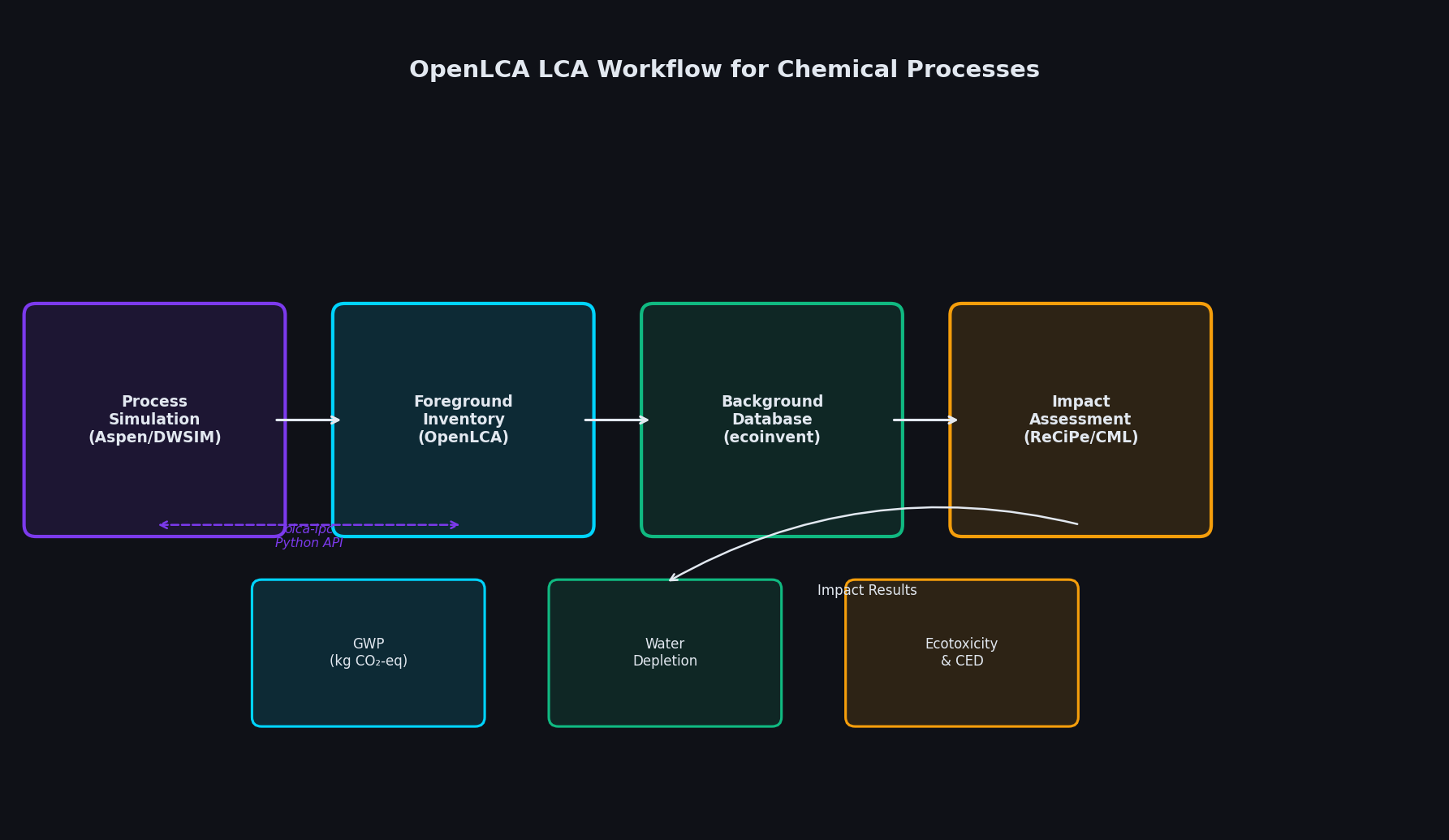
Life cycle assessment (LCA) has become an indispensable tool for chemical engineers and process designers who need to quantify the environmental impact of manufacturing routes before committing to capital investment. OpenLCA, the open-source LCA software developed by GreenDelta, provides a rigorous, database-agnostic platform for conducting ISO 14040/14044-compliant assessments—making it particularly well-suited for chemical and process industry applications where feedstock choices, energy integration, and waste streams dramatically shape environmental performance.
Why LCA Matters in Chemical Process Design
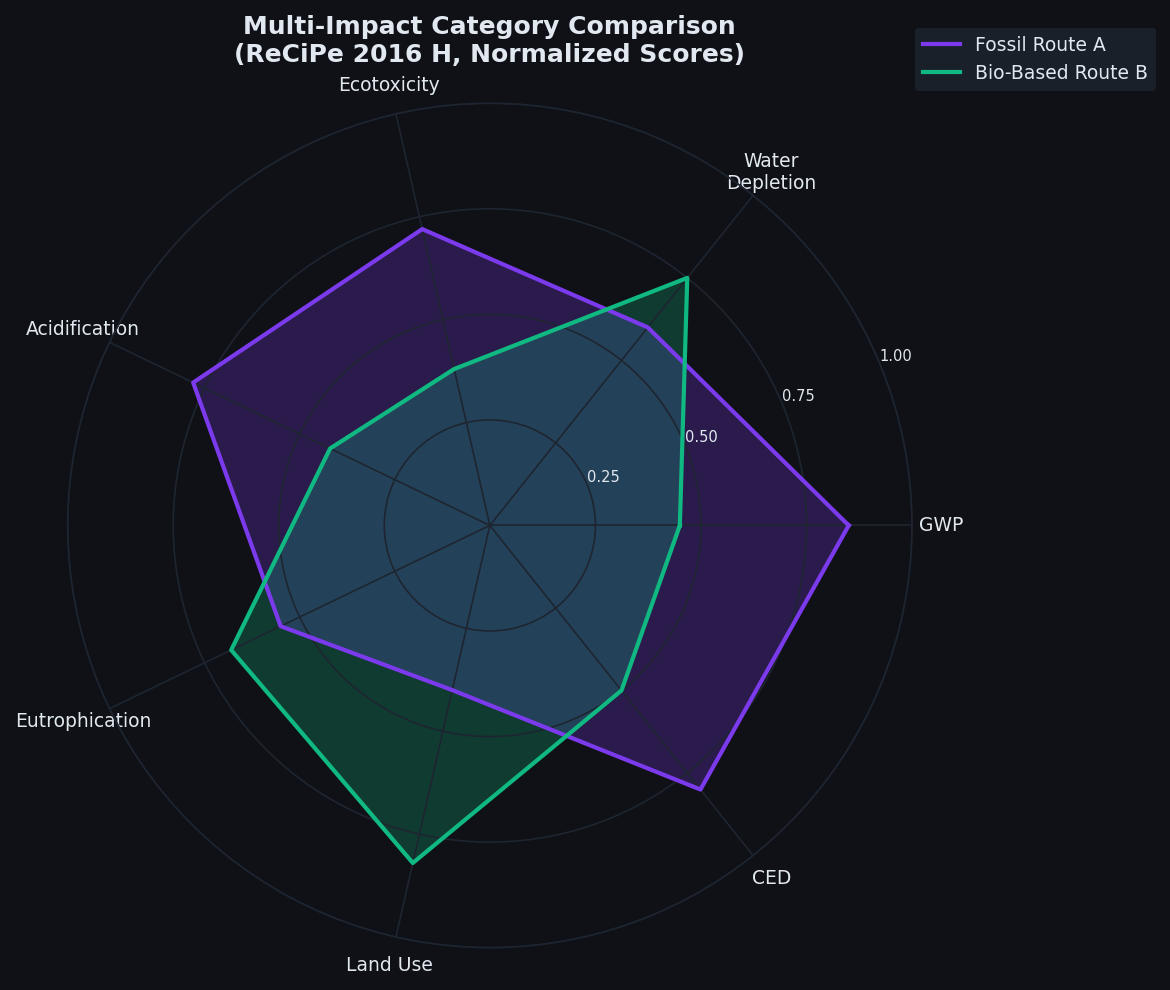
Traditional process simulation tools (Aspen Plus, HYSYS, CHEMCAD) excel at mass and energy balances but offer no native pathway to environmental impact metrics. OpenLCA bridges this gap by accepting process-level inventory data—material inputs, energy consumption, emissions, and waste—and propagating them through a background system model to compute impact categories such as global warming potential (GWP), cumulative energy demand (CED), water depletion, and ecotoxicity.
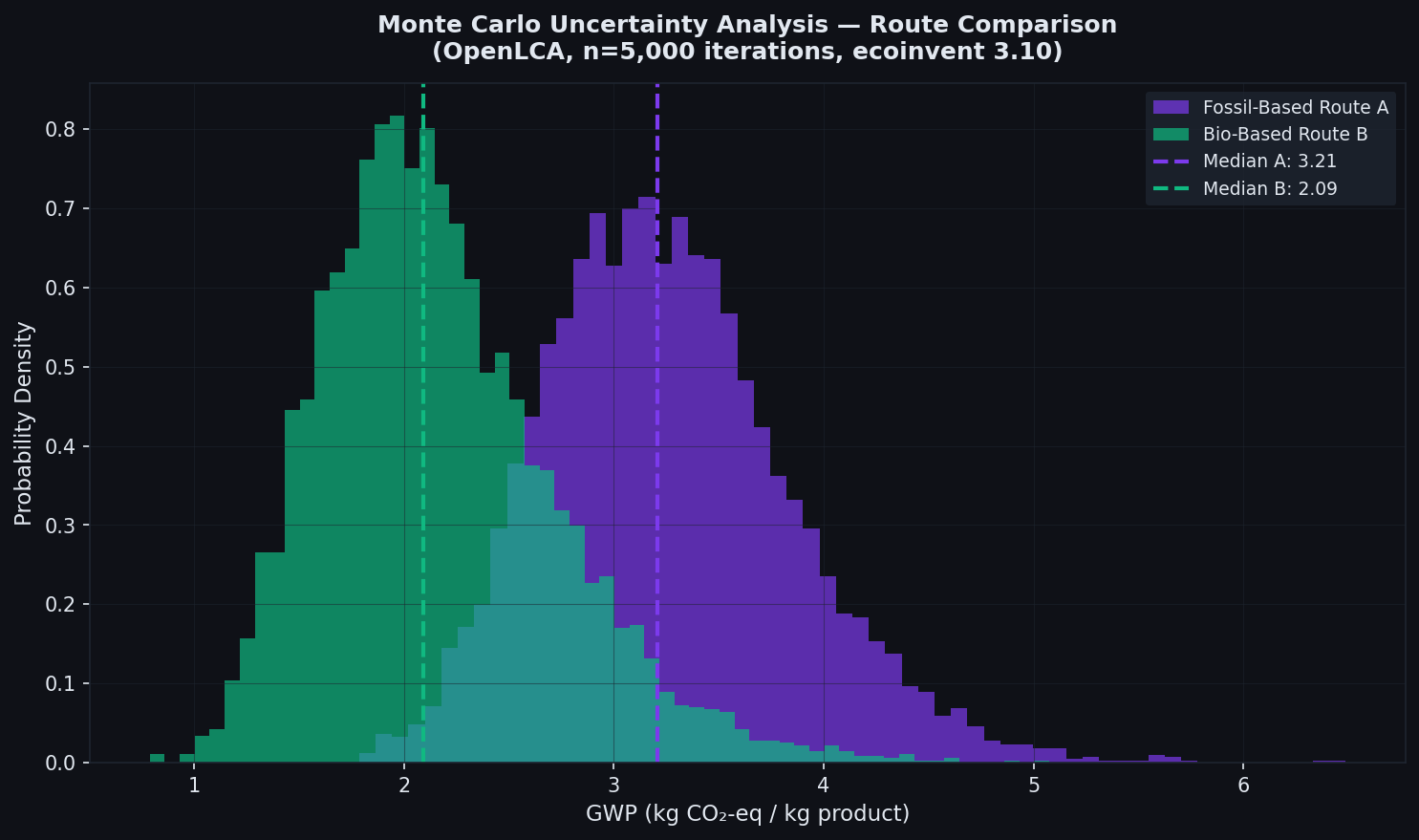
For a chemical plant, this means a process engineer can compare two synthesis routes—say, a conventional fossil-based route versus a bio-based alternative—on a common environmental basis, expressed per kilogram of product, per tonne of CO₂-equivalent, or per unit of economic value added.

Core Workflow: From Process Simulation to Impact Results
1. Foreground System Inventory
The foreground system captures the unit operations directly under study. In OpenLCA, each unit process is defined by:
- Inputs: raw materials (e.g., ethylene, methanol, steam), energy carriers (natural gas, electricity by grid mix), and ancillary chemicals
- Outputs: products, co-products, emissions to air/water/soil, and solid waste streams
Process simulation exports (material and energy balance reports from Aspen Plus or DWSIM) can be imported directly as CSV or Excel, then mapped to OpenLCA's exchange format. The openLCA Collaboration Server supports team-based inventory management for large projects.
2. Background Database Linkage
OpenLCA is database-agnostic and supports all major LCI databases:
| Database | Coverage | License |
|---|---|---|
| ecoinvent 3.x | Global, >18,000 processes | Commercial |
| GaBi Professional | Industry-specific datasets | Commercial |
| ELCD / EF 3.1 | EU Environmental Footprint | Free |
| USLCI | US manufacturing processes | Free |
| Agribalyse | Agricultural commodities | Free |
For chemical processes, ecoinvent is the de facto standard, providing background datasets for commodity chemicals, utilities, and transport. Linking a foreground process to ecoinvent is as simple as selecting the matching provider in the exchange editor.
3. Impact Assessment Methods
OpenLCA ships with all major characterization methods. For chemical industry applications, the most commonly applied are:
- ReCiPe 2016 (H): Hierarchist perspective; covers 18 midpoint and 3 endpoint categories. Preferred for global supply chain assessments.
- CML-IA Baseline: Mature, peer-reviewed method; widely accepted in peer-reviewed publications.
- TRACI 2.1: US EPA method; required for North American regulatory submissions.
- EF 3.1: Mandatory for EU Product Environmental Footprint declarations.
Switching between methods requires only a single dropdown selection—OpenLCA recalculates all impact scores instantly without re-running the inventory.
4. Contribution Analysis and Hotspot Identification
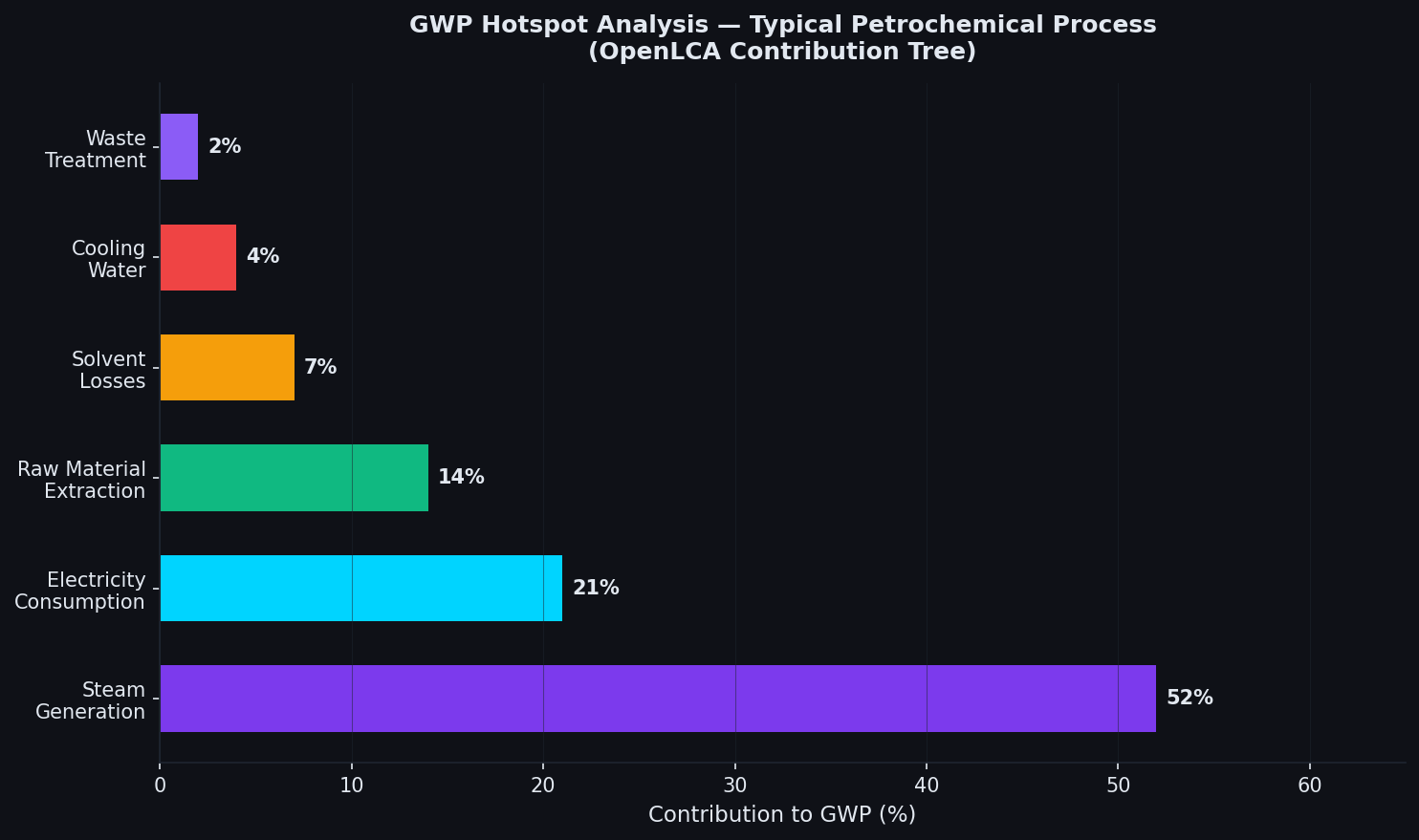
Once results are computed, OpenLCA's contribution tree decomposes each impact category down to the elementary flow level. For a typical petrochemical process, this reveals that:
- Steam generation (natural gas combustion) often dominates GWP by 40–60%
- Cooling water withdrawal drives freshwater consumption
- Solvent losses to air contribute disproportionately to photochemical ozone formation
This granularity allows engineers to prioritize process modifications—heat integration, solvent recovery, renewable electricity procurement—with quantified environmental payback before any physical changes are made.
Sensitivity and Uncertainty Analysis
Chemical LCAs are sensitive to background data vintage, geographic scope, and allocation choices. OpenLCA supports:
-
Monte Carlo simulation: Propagates uncertainty distributions (lognormal for most ecoinvent datasets) through the entire supply chain. Typical runs of 1,000–10,000 iterations complete in seconds for mid-complexity systems.
-
Parameter sets: Named parameter configurations allow rapid scenario switching (e.g., 2025 grid mix vs. 2035 decarbonized grid) without duplicating process models.
-
Allocation methods: Economic, mass, and energy allocation are all configurable at the process level, enabling sensitivity checks on co-product handling—a critical issue in biorefinery and chlor-alkali assessments.
Integration with Process Simulation Tools
A practical integration workflow for chemical engineers:
- Export the mass/energy balance from Aspen Plus or DWSIM as a structured report
- Map streams to OpenLCA exchanges using the built-in import wizard or a Python script via the olca-ipc API
- Run the LCA calculation and export results to Excel or JSON for reporting
- Iterate: Modify the process simulation, re-export, and re-run—enabling LCA-in-the-loop design optimization
The olca-ipc Python library exposes OpenLCA's calculation engine via a local IPC server, enabling automated LCA runs within optimization loops (e.g., Pyomo or SciPy minimize routines that co-optimize cost and GWP simultaneously).
Practical Considerations
Allocation in multi-output processes: Chemical plants rarely produce a single product. OpenLCA's system expansion and substitution methods are preferable to simple mass allocation when co-products have well-defined market alternatives.
Regionalization: ecoinvent 3.8+ includes regionalized characterization factors for water stress and land use. For water-intensive processes (cooling towers, wet scrubbers), selecting the correct geographic water stress factor can change the water depletion score by an order of magnitude.
Data quality: The Data Quality System (DQS) in OpenLCA allows engineers to score each exchange on reliability, completeness, and temporal correlation—producing a data quality indicator alongside impact results, which is increasingly required by EPD program operators.
Further Resources
- OpenLCA official documentation
- GreenDelta GitHub repositories — source code, olca-ipc, and schema definitions
- ecoinvent database — background LCI data
- ISO 14040:2006 and ISO 14044:2006 — LCA methodology standards
- PRé Sustainability SimaPro comparison — tool selection guidance
OpenLCA's combination of open-source accessibility, database flexibility, and Python API integration makes it a compelling choice for chemical process engineers who need to embed environmental performance metrics into their design workflow—without the licensing overhead of proprietary LCA platforms.