
ProMax: Rigorous Simulation of Gas Treating, Sweetening, and Dehydration Processes
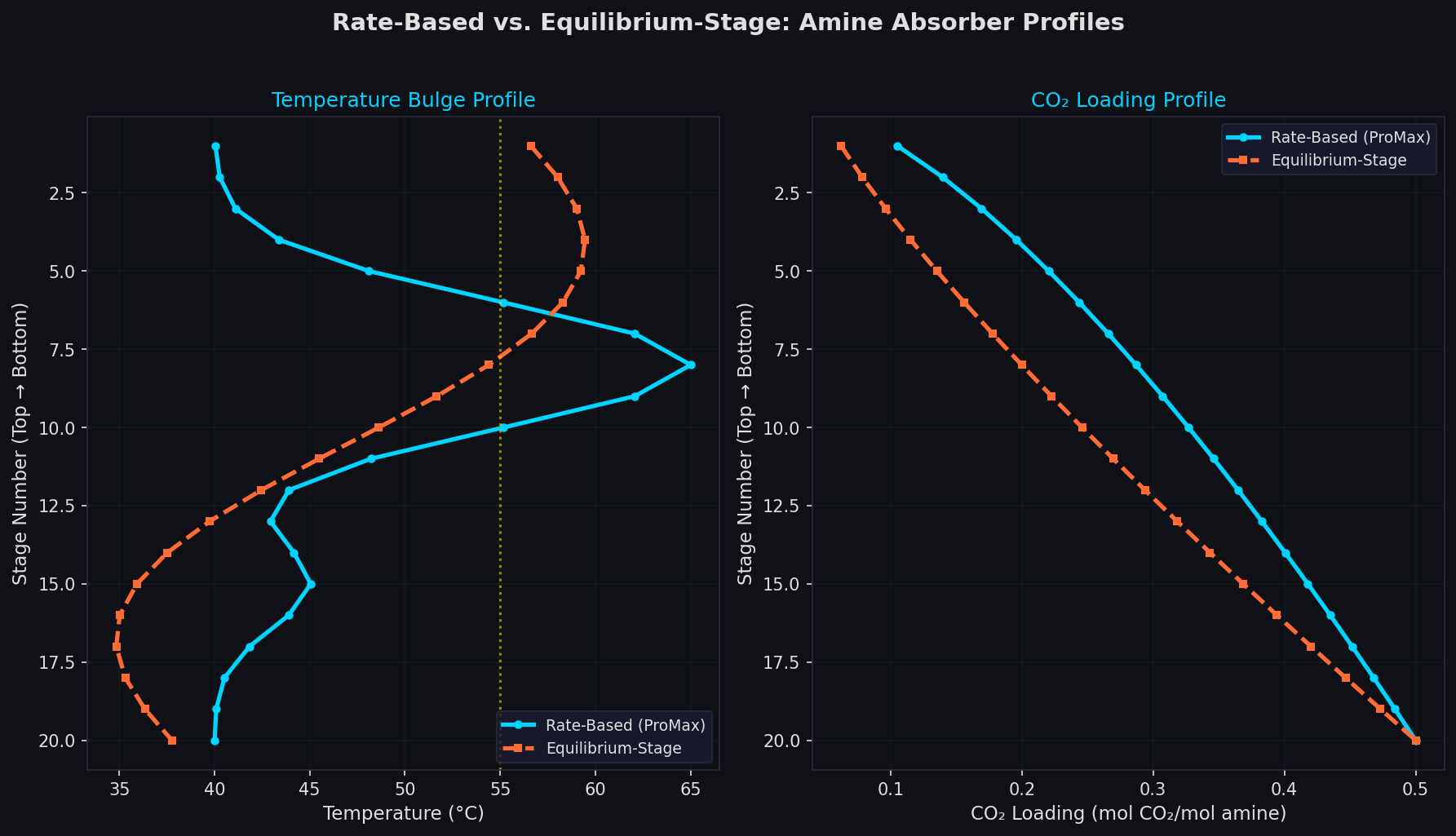
Natural gas processing plants face a persistent challenge: removing acid gases (H₂S and CO₂), water vapor, and other contaminants to meet pipeline specifications while minimizing energy consumption and solvent losses. ProMax, developed by Bryan Research & Engineering (BR&E), is the industry-standard process simulator purpose-built for these operations. Unlike general-purpose simulators that treat amine absorption as a simplified equilibrium stage, ProMax uses rigorous rate-based mass transfer models that accurately capture the kinetics of reactive absorption — a critical distinction when designing or troubleshooting gas treating units.
Why Rate-Based Modeling Matters for Amine Treating
Conventional equilibrium-stage models assume that vapor and liquid phases reach thermodynamic equilibrium at each tray or packing segment. In amine absorbers, this assumption breaks down because the absorption of CO₂ and H₂S is governed by reaction kinetics and mass transfer resistances, not just thermodynamics. ProMax's rate-based engine solves the Maxwell-Stefan diffusion equations coupled with reaction kinetics simultaneously, accounting for:
- Film diffusion resistances in both vapor and liquid phases
- Chemical reaction enhancement factors for fast reactions (e.g., CO₂ + MEA, CO₂ + MDEA/piperazine blends)
- Heat of absorption profiles along the column height
- Solvent degradation pathways including carbamate formation and thermal degradation
This approach yields accurate predictions of lean and rich amine loadings, absorber temperature bulge location, and regenerator reboiler duty — parameters that directly affect capital cost and operating expenditure.

Supported Solvent Systems and Thermodynamic Frameworks
ProMax maintains an extensive, validated database of amine solvents and physical solvents used in gas treating:
| Solvent Class | Examples |
|---|---|
| Primary amines | MEA (monoethanolamine) |
| Secondary amines | DEA (diethanolamine) |
| Tertiary amines | MDEA (methyldiethanolamine), TEA |
| Blended/promoted | MDEA + piperazine, MDEA + DEA |
| Physical solvents | Selexol (DMPEG), Rectisol (methanol) |
| Hybrid solvents | Sulfinol-M, Sulfinol-D |
The thermodynamic framework uses the Kent-Eisenberg model for amine systems and the Peng-Robinson equation of state for hydrocarbon-rich streams. For glycol dehydration (TEG, DEG, EG), ProMax applies the CPA (Cubic Plus Association) equation of state, which correctly handles hydrogen bonding and water activity in glycol-water systems.
Glycol Dehydration: TEG Contactor and Regenerator Design
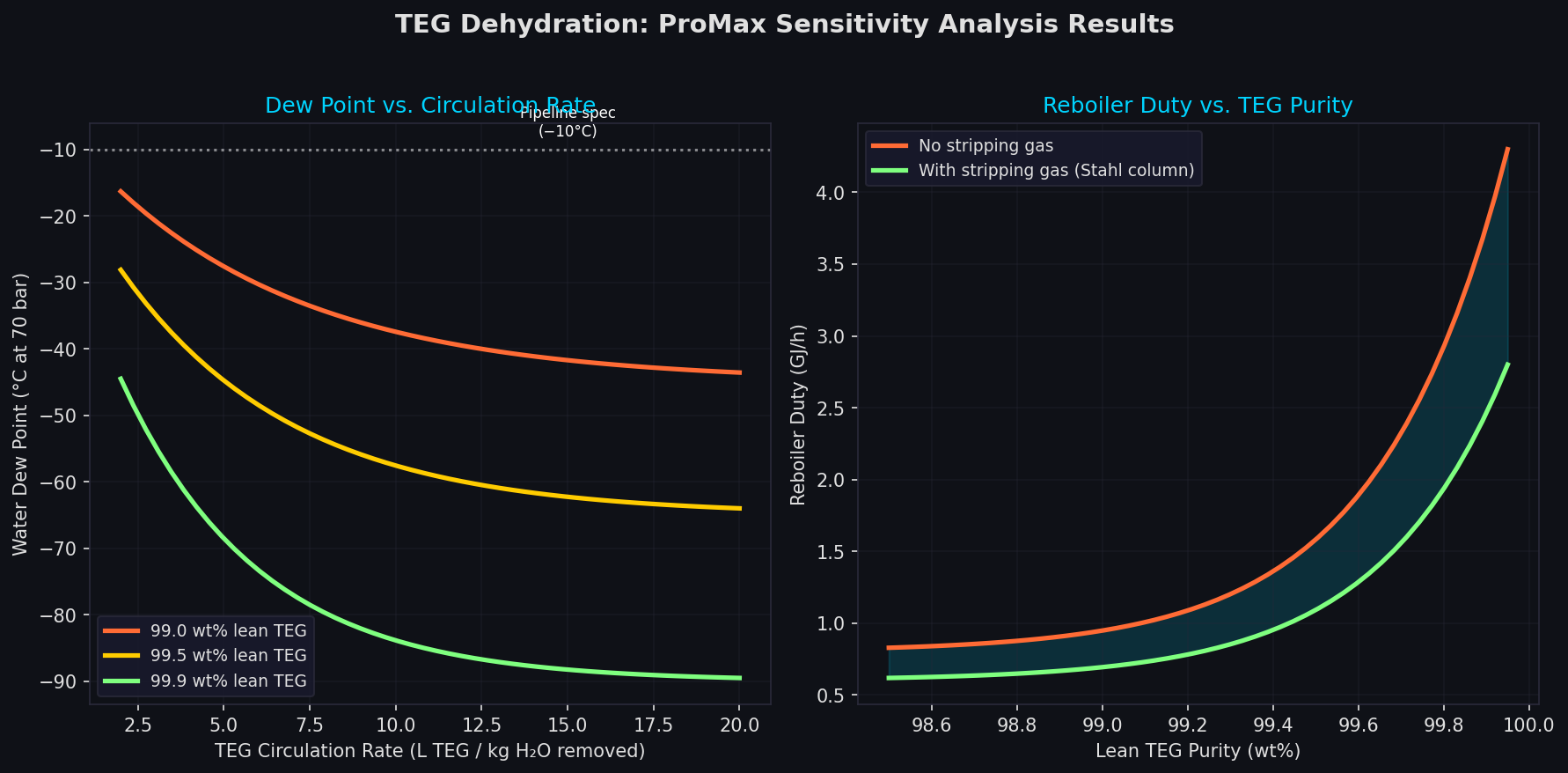
Triethylene glycol (TEG) dehydration is one of the most common unit operations in gas processing. ProMax models the full TEG loop including:
- Contactor column — structured or random packing with rigorous mass transfer coefficients; predicts outlet water dew point as a function of TEG circulation rate and lean TEG concentration
- Flash separator — hydrocarbon recovery from rich TEG before regeneration
- Regenerator (still column) — atmospheric or Stahl column configurations; calculates lean TEG purity (typically 99.0–99.99 wt%)
- Stripping gas injection — models the effect of dry stripping gas on lean TEG concentration
A key ProMax capability is the water dew point specification mode: the engineer specifies the required outlet dew point (e.g., −10°C at pipeline pressure), and the simulator back-calculates the required TEG circulation rate and lean TEG purity. This eliminates iterative manual calculations and directly supports equipment sizing.
Sulfur Recovery and Tail Gas Treating
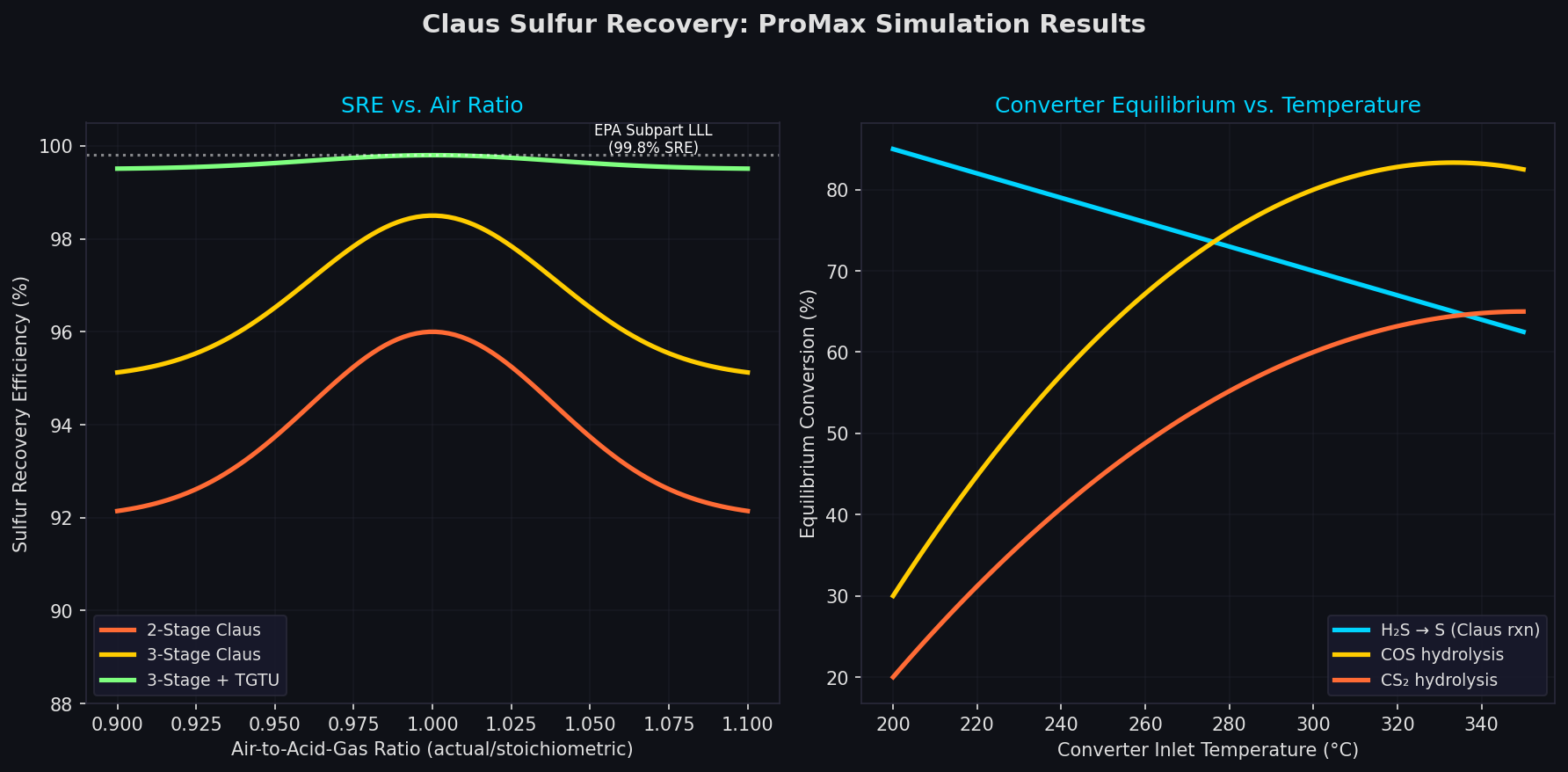
For sour gas plants, ProMax extends beyond amine treating to model the complete sulfur recovery train:
- Claus furnace — equilibrium reactor with detailed combustion chemistry including COS and CS₂ formation
- Claus catalytic converters — temperature-dependent equilibrium stages with catalyst deactivation modeling
- SCOT/TGTU (Tail Gas Treating Unit) — hydrogenation reactor followed by amine absorber for H₂S recycle
- Incinerator — thermal oxidation of residual sulfur compounds
ProMax calculates overall sulfur recovery efficiency (SRE) as a function of feed gas composition, air-to-acid-gas ratio, and converter temperatures — a critical metric for environmental compliance under regulations such as the US EPA Subpart LLL.
Sensitivity Analysis and Optimization Workflows
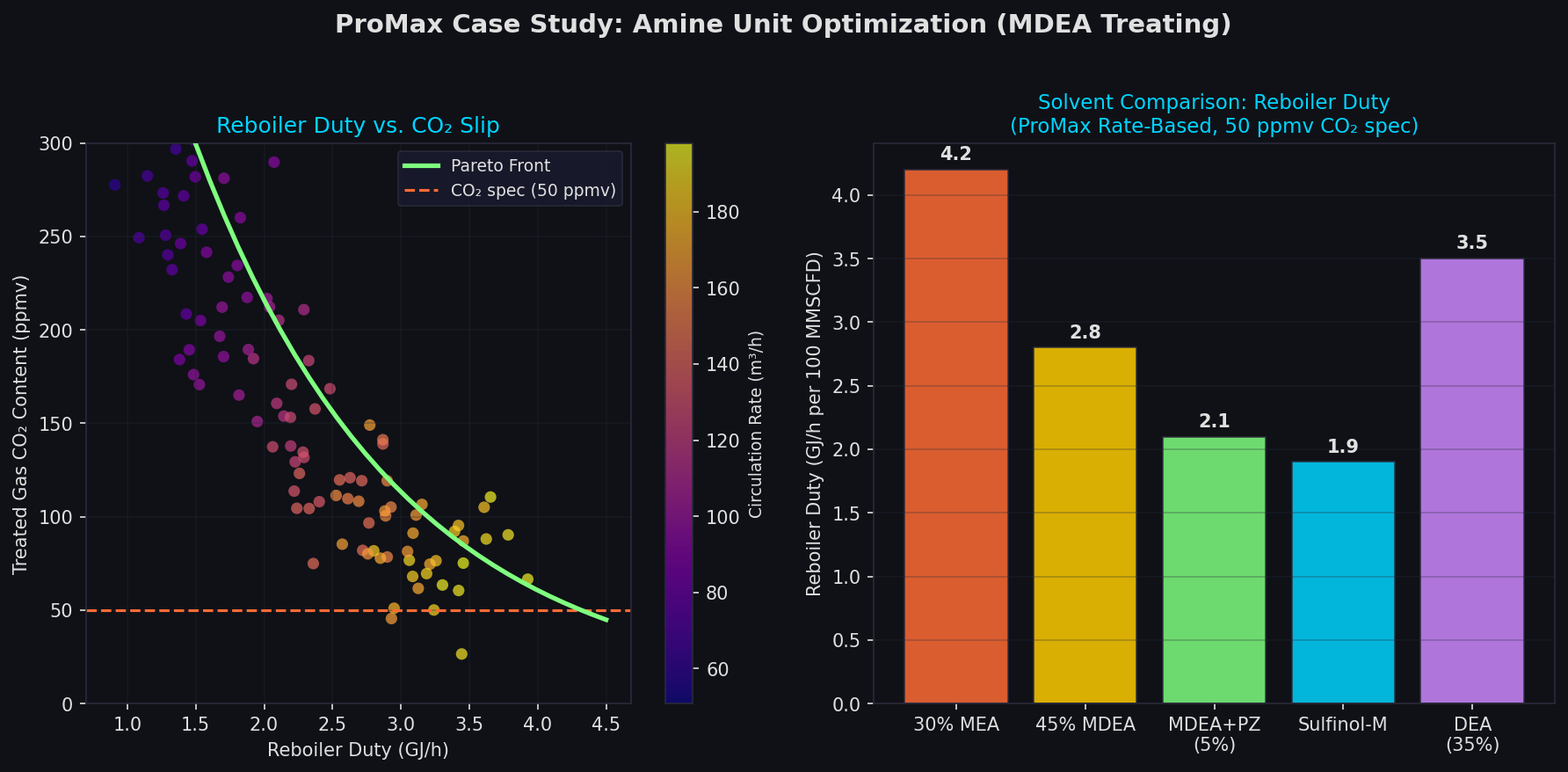
ProMax includes a built-in Case Study tool that performs parametric sweeps across multiple variables simultaneously. A typical workflow for amine unit optimization:
- Define independent variables: amine circulation rate (m³/h), lean amine loading (mol CO₂/mol amine), absorber pressure
- Define dependent variables: treated gas CO₂ content (ppmv), reboiler duty (GJ/h), solvent losses (kg/h)
- Run the case study matrix (e.g., 5×5×3 = 75 cases)
- Export results to Excel for Pareto front analysis
This workflow identifies the operating point that meets the CO₂ specification at minimum reboiler duty — directly translating to reduced fuel gas consumption and operating cost.
Integration with Plant Data and Validation
ProMax supports data reconciliation by accepting measured plant data (flow rates, temperatures, pressures, compositions) and adjusting model parameters (e.g., packing efficiency, heat loss coefficients) to match observed performance. Once calibrated, the model serves as a digital twin for:
- Predicting performance under feed gas composition upsets
- Evaluating solvent switch economics (e.g., MEA to MDEA/piperazine blend)
- Assessing debottlenecking options without plant trials
The simulator exports results in standard formats compatible with Aspen Plus, HYSYS, and PI ProcessBook, enabling integration into broader plant-wide simulation environments.
Getting Started
ProMax is available from Bryan Research & Engineering with academic and commercial licenses. The software includes an extensive library of validated case studies for common gas treating configurations. Engineers new to rate-based simulation should begin with the single-column amine absorber tutorial, which demonstrates the difference between equilibrium-stage and rate-based predictions for a 30 wt% MEA system treating a 5% CO₂ feed gas.
For further reading:
- BR&E ProMax Official Documentation
- Gas Processors Association (GPA) Engineering Data Book — Sections 20–22 cover amine treating design fundamentals
- Kohl & Nielsen, Gas Purification (5th ed.) — the definitive reference for amine and glycol system thermodynamics
- GPSA Engineering Data Book Online — practical design guidelines for TEG dehydration