

gPROMS ProcessBuilder: Equation-Oriented Simulation for Advanced Process Optimization and Parameter Estimation

gPROMS ProcessBuilder: Equation-Oriented Process Simulation for Advanced Optimization and Parameter Estimation
gPROMS ProcessBuilder, developed by Process Systems Enterprise (PSE), represents a fundamentally different approach to chemical process simulation compared to sequential-modular tools like Aspen Plus or HYSYS. By employing an equation-oriented (EO) architecture, gPROMS solves all model equations simultaneously rather than unit-operation by unit-operation, unlocking capabilities that sequential-modular simulators struggle to match — particularly for tightly integrated processes, dynamic optimization, and rigorous parameter estimation from plant data.
Equation-Oriented Architecture: Why It Matters
In a sequential-modular simulator, each unit operation is solved independently in a predefined sequence, with recycle loops handled through iterative convergence. This works well for straightforward flowsheets but becomes computationally expensive and sometimes unreliable for:
- Highly integrated heat-exchange networks with multiple recycles
- Simultaneous design and control optimization (e.g., finding the optimal column design while satisfying dynamic operability constraints)
- Processes with strong thermodynamic coupling across unit operations
gPROMS ProcessBuilder assembles all unit-operation equations — mass balances, energy balances, thermodynamic equilibria, transport equations — into a single large sparse system and solves it with a Newton-based solver. This means:

- Degrees of freedom can be assigned freely. Any variable can be specified as a fixed input; the solver determines the remaining unknowns. This makes it straightforward to specify a product purity and solve for the required reflux ratio, rather than specifying reflux and iterating to find purity.
- Convergence is typically faster for recycle-heavy flowsheets, because the solver exploits the full Jacobian structure rather than tearing recycle streams.
- Sensitivity and optimization are native. Gradient information is available analytically from the Jacobian, enabling efficient gradient-based optimization without finite-difference approximations.
Parameter Estimation from Plant Data
One of gPROMS ProcessBuilder's most distinctive capabilities is its built-in parameter estimation (PE) framework. Chemical engineers routinely face the challenge of fitting model parameters — reaction kinetics, heat-transfer coefficients, mass-transfer efficiencies — to measured plant or laboratory data. In most simulators, this requires external optimization loops or manual trial-and-error.
In gPROMS, the PE workflow is integrated directly into the modeling environment:
- Define the model parameters to be estimated (e.g., pre-exponential factor and activation energy for an Arrhenius rate expression).
- Import experimental datasets — multiple experiments with different operating conditions can be used simultaneously.
- Specify measurement variables and their uncertainties (temperature, composition, flow rate, etc.).
- Run the maximum likelihood estimation, which minimizes a weighted sum of squared residuals using the full model equations.
The output includes not only the best-fit parameter values but also 95% confidence intervals and a correlation matrix, giving engineers quantitative insight into parameter identifiability. If two parameters are highly correlated, the model is over-parameterized for the available data — a critical diagnostic that most ad-hoc fitting approaches miss entirely.
This capability is particularly valuable for:
- Fitting kinetic models to laboratory reactor data before scale-up
- Calibrating thermodynamic interaction parameters (e.g., NRTL or UNIQUAC binary parameters) to VLE measurements
- Updating heat-exchanger fouling factors from plant historian data
Dynamic Optimization and Optimal Control
gPROMS ProcessBuilder supports dynamic (time-varying) simulation and optimization within the same modeling framework used for steady-state work. Engineers can pose problems such as:
- Optimal batch reactor temperature profiles that maximize yield subject to safety constraints
- Startup and shutdown trajectory optimization to minimize off-spec production
- Grade transition optimization in continuous polymerization processes
The dynamic optimizer uses simultaneous collocation methods (specifically, orthogonal collocation on finite elements), which discretize the differential-algebraic equation (DAE) system in time and solve the resulting large-scale nonlinear program (NLP) in one shot. This is more robust than sequential dynamic optimization approaches and scales well to problems with hundreds of state variables and dozens of control degrees of freedom.
Thermodynamic Framework and Physical Property Integration
gPROMS ProcessBuilder integrates with Multiflash (from KBC, now part of Yokogawa) for thermodynamic property calculations, providing access to a wide range of equations of state and activity coefficient models:
- Cubic EOS: Peng-Robinson, Soave-Redlich-Kwong with advanced mixing rules
- Activity coefficient models: NRTL, UNIQUAC, UNIFAC (and modified variants)
- Electrolyte models: for systems with ionic species (acid gas treating, caustic scrubbing)
- Specialized models: CPA (Cubic-Plus-Association) for hydrogen-bonding systems, PC-SAFT for polymers
The tight coupling between the thermodynamic engine and the EO solver means that thermodynamic derivatives (needed for the Jacobian) are computed analytically where possible, improving both convergence speed and reliability.
Practical Workflow: Building a Reactive Distillation Column
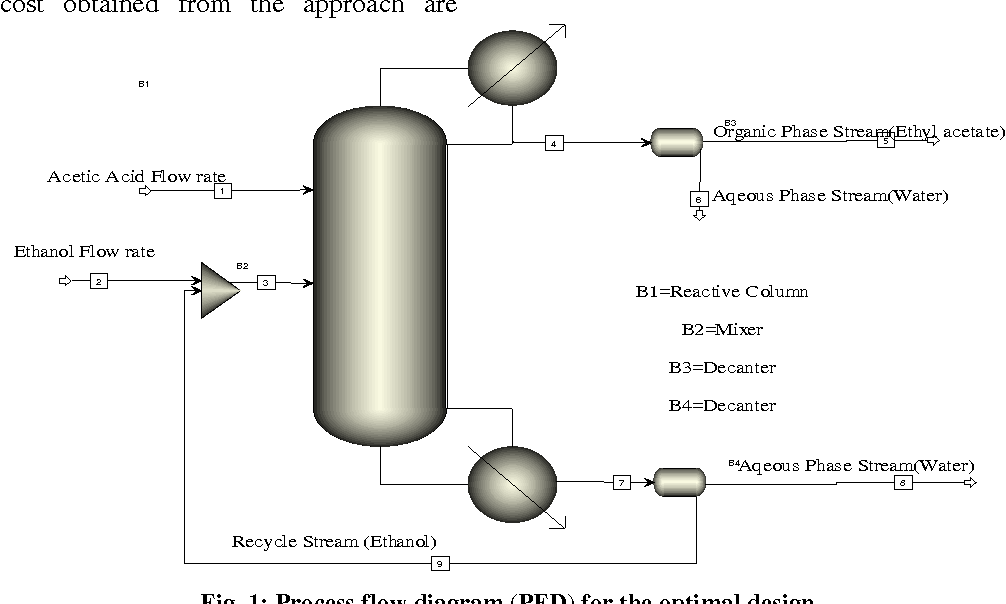
To illustrate the EO advantage concretely, consider modeling a reactive distillation column for methyl acetate synthesis. In a sequential-modular tool, this requires specialized reactive distillation unit operations with limited flexibility in specifying reaction kinetics and tray hydraulics simultaneously.
In gPROMS ProcessBuilder:
- Select the column model from the built-in library (rigorous tray-by-tray with MESH equations).
- Add reaction kinetics directly to the tray liquid phase — any user-defined rate expression is supported.
- Specify degrees of freedom: fix distillate purity and bottoms methanol content; let the solver find the required reflux ratio, reboiler duty, and feed tray location simultaneously.
- Run optimization: minimize total annualized cost (capital + energy) by varying column diameter, number of trays, and feed location, subject to product purity constraints.
This entire workflow — model building, specification, and optimization — runs within a single consistent mathematical framework, with no need to switch between a simulator and an external optimizer.
Licensing and Deployment
gPROMS ProcessBuilder is available under commercial license from Process Systems Enterprise (PSE). Academic licenses are available for university research. The software runs on Windows and supports integration with Python and MATLAB for custom pre/post-processing workflows. PSE also offers gPROMS FormulatedProducts and gPROMS Medicines variants tailored to pharmaceutical and consumer goods applications.
When to Choose gPROMS ProcessBuilder
gPROMS ProcessBuilder is the right tool when:
- Rigorous parameter estimation from experimental data is required
- Dynamic optimization of batch or continuous processes is needed
- Tightly integrated flowsheets with many recycles challenge sequential-modular convergence
- Custom thermodynamic or kinetic models need to be embedded directly in the simulation
For straightforward steady-state flowsheet simulation where sequential-modular tools converge reliably, Aspen Plus or HYSYS remain practical choices. But for advanced optimization, model-based design of experiments, and rigorous parameter fitting, gPROMS ProcessBuilder's equation-oriented foundation provides capabilities that are difficult to replicate elsewhere.
Further Reading
- PSE gPROMS ProcessBuilder Product Page
- gPROMS Model Library Documentation
- AIChE Journal: Equation-Oriented Flowsheet Simulation and Optimization
- Biegler, L.T. (2010). Nonlinear Programming: Concepts, Algorithms, and Applications to Chemical Processes. SIAM.
- Pantelides, C.C. (1988). The consistent initialization of differential-algebraic systems. SIAM Journal on Scientific and Statistical Computing, 9(2), 213–231.