
PRO/II by AVEVA: Steady-State Process Simulation for Refining and Petrochemical Applications
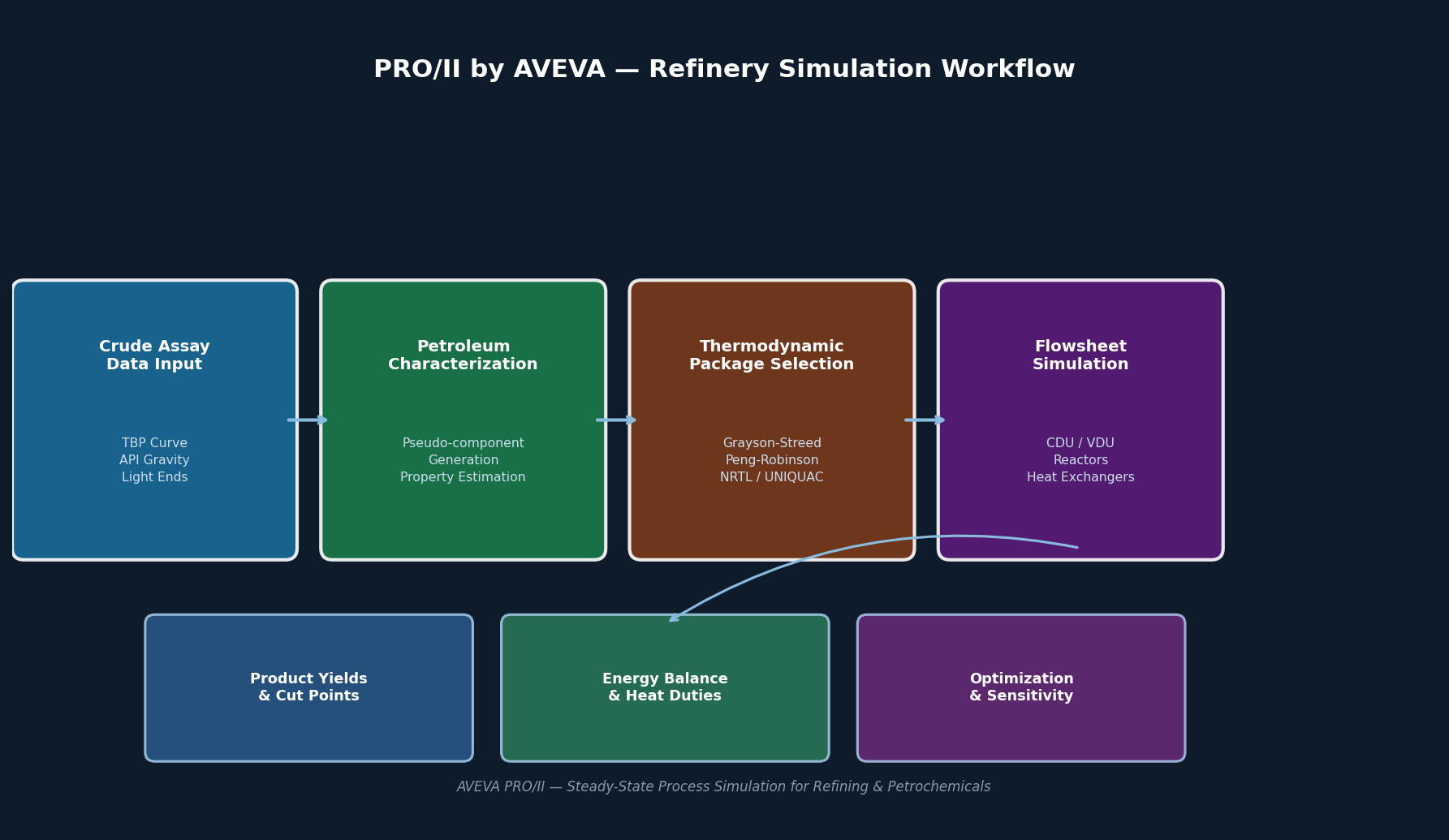
PRO/II by AVEVA (formerly SimSci PRO/II) is a rigorous steady-state process simulator widely used in refining, petrochemical, and gas processing industries. While Aspen Plus and HYSYS dominate many academic and general chemical engineering workflows, PRO/II has carved out a strong niche in petroleum refining and natural gas processing—domains where its specialized thermodynamic packages and petroleum characterization tools deliver exceptional accuracy. This article examines PRO/II's core capabilities, its petroleum-specific features, and best practices for building reliable refinery simulation models.
Why PRO/II for Refining?
Refinery simulation presents unique challenges: crude oil is a complex mixture of thousands of components that cannot be individually characterized. PRO/II addresses this through its petroleum characterization framework, which converts crude assay data (TBP curves, API gravity, viscosity, sulfur content) into pseudo-component representations. These pseudo-components are then used throughout the flowsheet, enabling engineers to model crude distillation units (CDUs), vacuum distillation units (VDUs), and downstream conversion units with high fidelity.
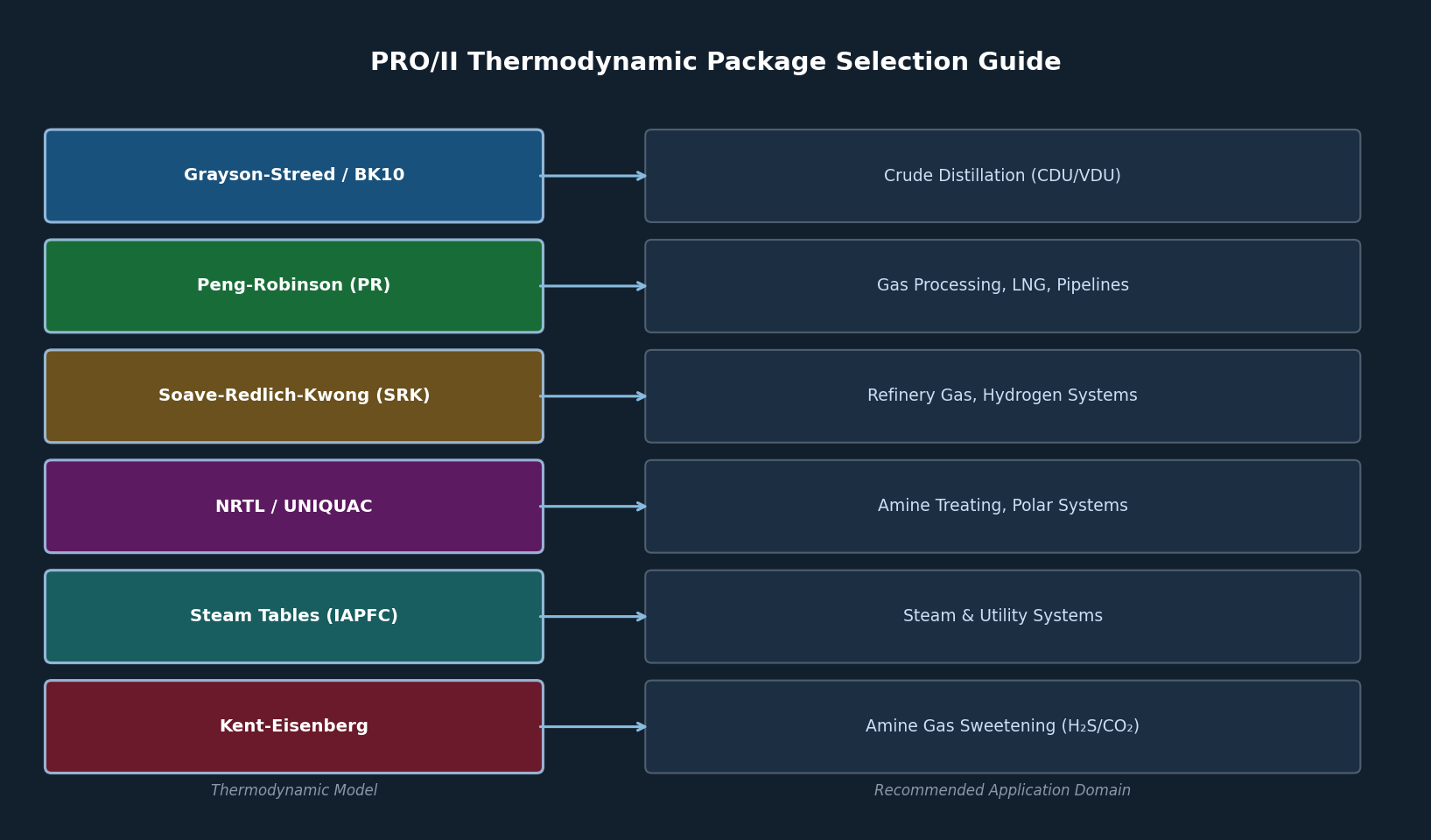
PRO/II supports over 30 thermodynamic packages, including:

- Grayson-Streed and Chao-Seader correlations for hydrocarbon-rich systems
- Peng-Robinson (PR) and Soave-Redlich-Kwong (SRK) equations of state for gas processing
- NRTL and UNIQUAC activity coefficient models for polar systems and amine treating units
- Steam tables (IAPFC/ASME) for utility and steam system modeling
Selecting the right thermodynamic package is the single most impactful decision in any PRO/II simulation. For atmospheric crude distillation, Grayson-Streed with the BK10 K-value method is the industry standard. For amine gas treating (DEA, MEA, MDEA), the Kent-Eisenberg or Li-Mather models are preferred.
Key Modeling Capabilities
Crude Distillation Unit (CDU) Modeling
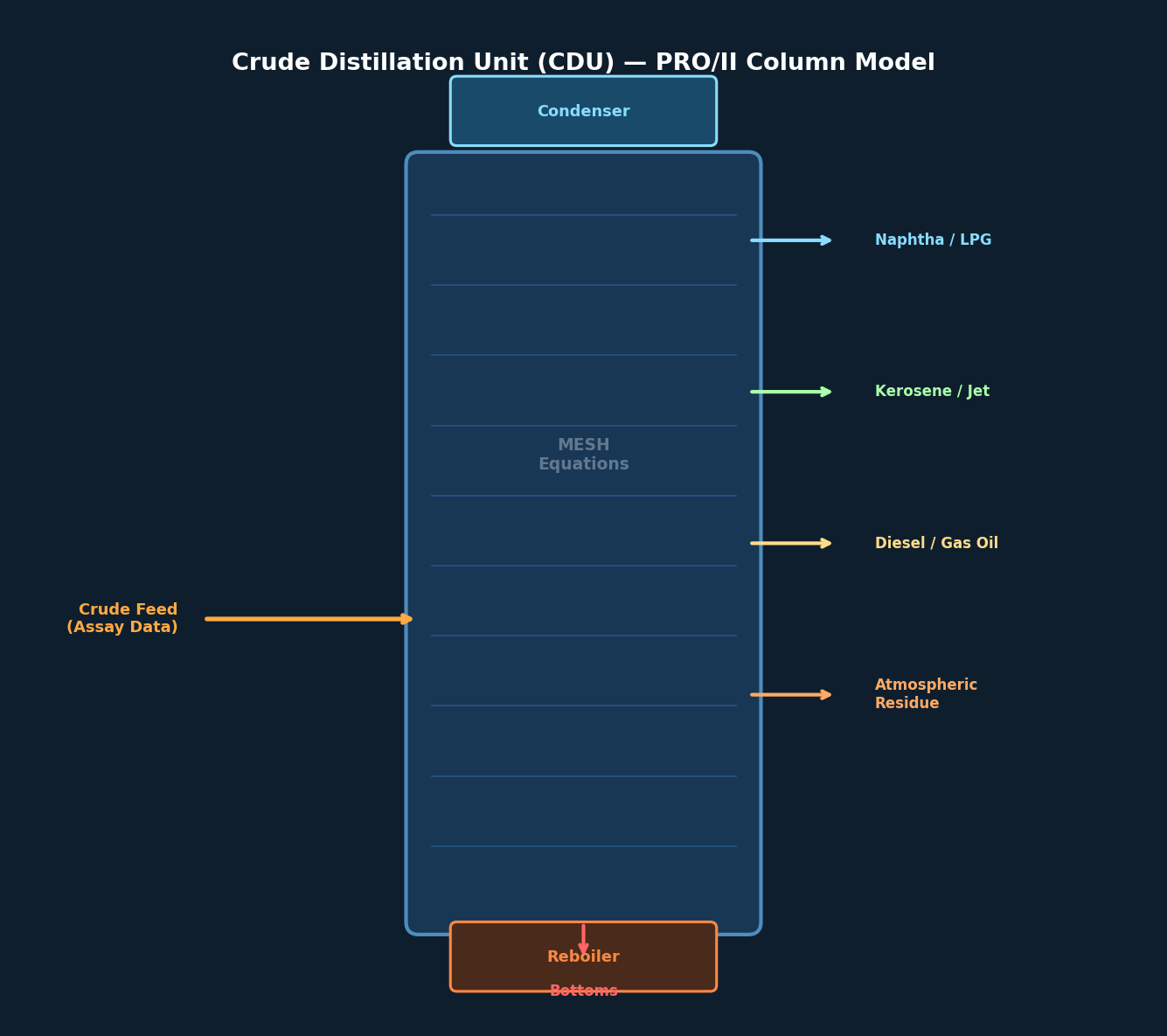
PRO/II's CRUDE unit operation allows engineers to define a crude oil feed using assay data directly within the simulator. The software automatically generates pseudo-components, assigns thermodynamic properties, and initializes the distillation column. Key inputs include:
- TBP (True Boiling Point) distillation curve
- Specific gravity or API gravity profile
- Light-end composition (C1–C6 components)
- Sulfur, nitrogen, and metals content for downstream unit feed specifications
The resulting column model solves the full MESH (Material balance, Equilibrium, Summation, Heat balance) equations simultaneously, providing accurate product cut points, draw temperatures, and heat duty profiles.
Reactor Modeling for Conversion Units
PRO/II includes specialized reactor models for refinery conversion units:
- Hydrocracker: Uses lumped kinetic models to predict product yield distributions from vacuum gas oil (VGO) feeds
- Fluid Catalytic Cracker (FCC): Supports four-lump and ten-lump kinetic schemes for gasoline, LCO, HCO, and coke yield prediction
- Reformer: Models catalytic reforming reactions for octane improvement and hydrogen production
For engineers requiring more detailed kinetics, PRO/II supports user-defined Fortran or Python subroutines via its USRKIN interface, enabling integration of proprietary kinetic models developed from pilot plant data.
Heat Exchanger Networks
Refinery energy integration is critical for profitability. PRO/II's HTXR (heat exchanger) unit operation supports:
- Shell-and-tube, air-cooled, and plate-frame configurations
- Rigorous rating mode using TEMA standards
- Integration with AVEVA's HTFS+ suite for detailed thermal-hydraulic calculations
The Energy Analysis module identifies heat recovery opportunities across the flowsheet, generating composite curves and pinch analysis results that guide heat exchanger network (HEN) design.
Best Practices for PRO/II Simulation
1. Validate Crude Assay Data First
Before building any flowsheet, verify that the crude assay data is complete and internally consistent. PRO/II's assay manager will flag missing data points, but interpolation errors in TBP curves can propagate significant errors into product property predictions. Cross-check light-end compositions against field gas chromatograph data.
2. Use Initialization Streams
Refinery columns are notoriously difficult to converge due to the wide boiling range of petroleum fractions. Always provide initialization estimates for key stream temperatures, pressures, and compositions. PRO/II's INIT feature allows engineers to specify starting values that guide the solver toward the correct solution.
3. Leverage the Convergence Diagnostics
When a simulation fails to converge, PRO/II's convergence diagnostics report identifies which tear streams or unit operations are causing difficulties. Common culprits include poorly specified column specifications (over-specified or conflicting product quality targets) and thermodynamic package mismatches at phase boundaries.
4. Sensitivity Studies for Optimization
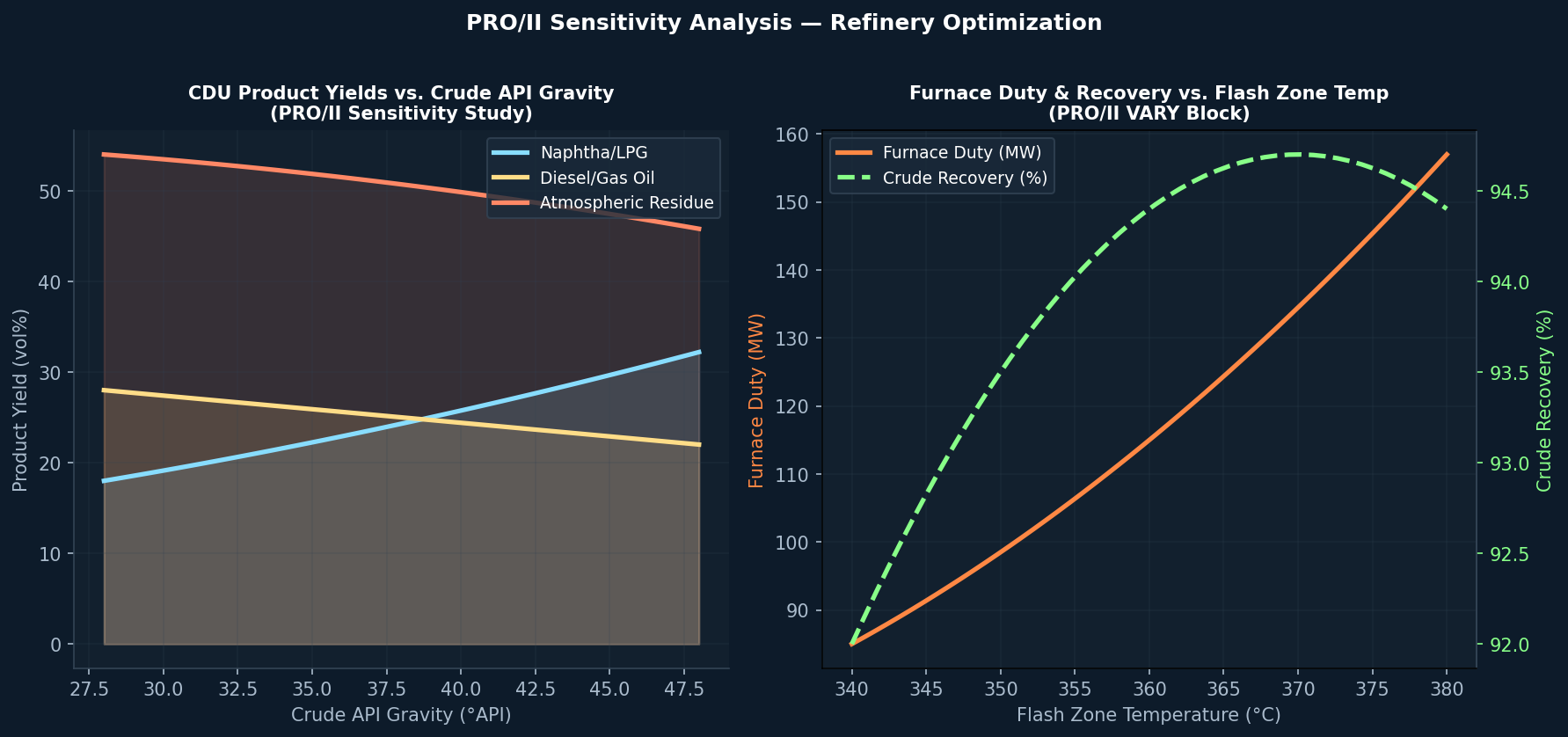
PRO/II's VARY block enables parametric sensitivity studies—systematically varying feed composition, operating conditions, or equipment parameters to map their effect on product yields and energy consumption. This is invaluable for crude switching studies, where refiners need to quickly assess the impact of processing a new crude blend.
Integration with AVEVA's Ecosystem
PRO/II integrates natively with AVEVA's broader engineering suite:
- AVEVA Process Optimization (APO): Connects steady-state PRO/II models to real-time plant data for online optimization
- AVEVA Unified Engineering: Enables data exchange between PRO/II flowsheets and P&ID tools, reducing manual data re-entry
- AVEVA Batch Management: For specialty chemical applications requiring batch process simulation alongside continuous refinery units
The OLE Automation interface also allows PRO/II to be driven programmatically from Python or MATLAB scripts, enabling Monte Carlo uncertainty analysis, automated case studies, and integration with machine learning workflows for predictive modeling.
Conclusion
PRO/II by AVEVA remains a premier choice for refinery and petrochemical simulation, particularly where petroleum characterization accuracy and specialized thermodynamic packages are paramount. Its deep integration with industry-standard crude assay workflows, combined with robust reactor and heat exchanger modeling capabilities, makes it an essential tool for process engineers working in downstream oil and gas. Engineers transitioning from other simulators will find PRO/II's convergence tools and diagnostics particularly valuable for tackling the complex, highly-integrated flowsheets typical of modern refineries.