

KBC Petro-SIM v7.6: AI-Integrated Digital Twin Platform Advances Process Simulation for Energy Transition
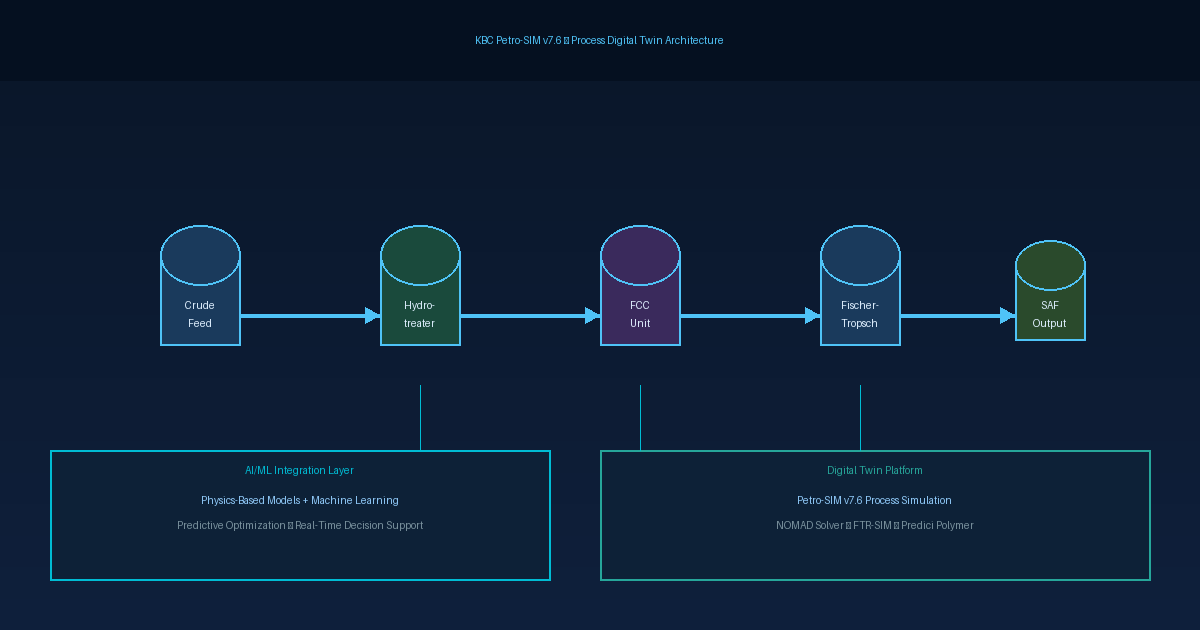
KBC (A Yokogawa Company) has launched Petro-SIM® v7.6, the latest release of its flagship digital twin process simulation platform targeting the upstream and downstream oil and gas sectors, including refining, petrochemical, polymer, and sustainable aviation fuel (SAF) industries. Released in August 2025, this version represents a significant step forward in combining high-fidelity physics-based modeling with artificial intelligence and machine learning (AI/ML) to support the energy transition and decarbonization goals.
Fischer-Tropsch Reactor Model for Sustainable Aviation Fuel
One of the headline additions in v7.6 is FTR-SIM, a kinetic-based reactor model specifically designed for Fischer-Tropsch synthesis in sustainable aviation fuel (SAF) production. Engineers can now simulate the complete SAF production value chain—from Fischer-Tropsch synthesis through downstream hydroprocessing—within a single integrated digital twin environment. This capability is particularly significant as the aviation industry faces mounting pressure to adopt low-carbon fuel alternatives, and accurate process simulation is critical for optimizing SAF plant economics and yield.
NOMAD Solver: Tackling Blackbox Optimization
The new NOMAD solver addresses a longstanding challenge in process optimization: handling "blackbox" problems where the objective function is not analytically differentiable. NOMAD (Nonlinear Optimization by Mesh Adaptive Direct Search) enables engineers to optimize energy efficiency, streamline production planning, and reduce emissions in scenarios where traditional gradient-based methods fail. This is especially relevant for complex refinery configurations with multiple interacting units and non-linear process constraints.

AI/ML Integration with First-Principles Models
Petro-SIM v7.6 deepens the integration between AI/ML models and first-principles physics-based simulation. Rather than replacing rigorous thermodynamic and kinetic models, the AI layer augments them—using historical operational data to improve predictions, accelerate convergence, and support real-time decision-making in scheduling and planning workflows. This hybrid modeling approach allows operators to maintain the accuracy of physics-based simulation while gaining the speed advantages of data-driven methods.
Hydroprocessing and Renewables Enhancements
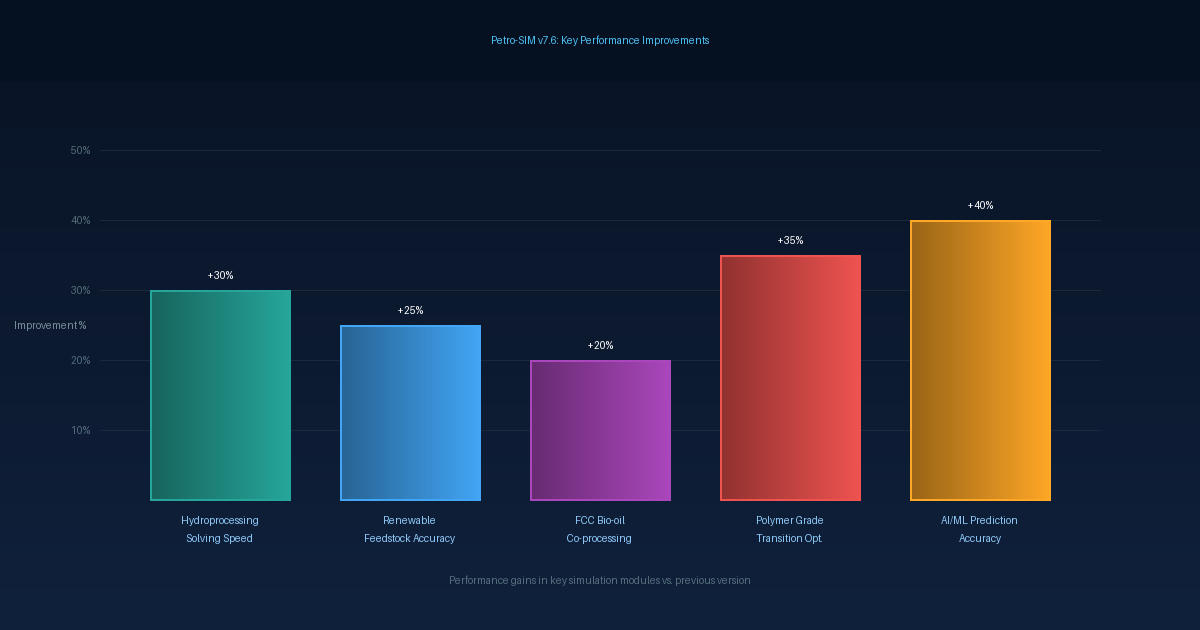
The release delivers measurable performance gains in hydroprocessing simulation. Enhancements to hydrotreating, isomerization, and hydrocracking modules—including improved liquid recycling and external gas quenching models—reduce solving times by up to 30% compared to the previous version. For renewable feedstocks, improved kinetic modeling enables more accurate simulation of bio-oil co-processing in FCC units, with better oxygen balance modeling and assessment of inert loads in FCC overheads.
Advanced Polymer Modeling with Predici
For polymer producers, v7.6 introduces advanced polymer modeling powered by Predici, a well-established polymer reaction engineering platform. This integration enables prediction of polymer properties, optimization of grade transitions, and monitoring of catalyst impacts—all within the Petro-SIM digital twin framework. The result is a dynamic production digital twin that can minimize downtime and reduce off-specification material production.
Industry Context
The oil and gas sector contributes approximately 5.1 gigatonnes of CO₂-equivalent emissions annually, according to the 2023 IEA World Energy Outlook Report. Process simulation tools like Petro-SIM play a direct role in reducing this figure by enabling engineers to identify and eliminate energy waste, optimize low-carbon pathways, and model emerging processes such as SAF production and plastic waste-to-polymer circular processes before committing to capital investment.