

COMSOL Multiphysics for Chemical Reactor Design: Coupling Transport Phenomena with Reaction Kinetics
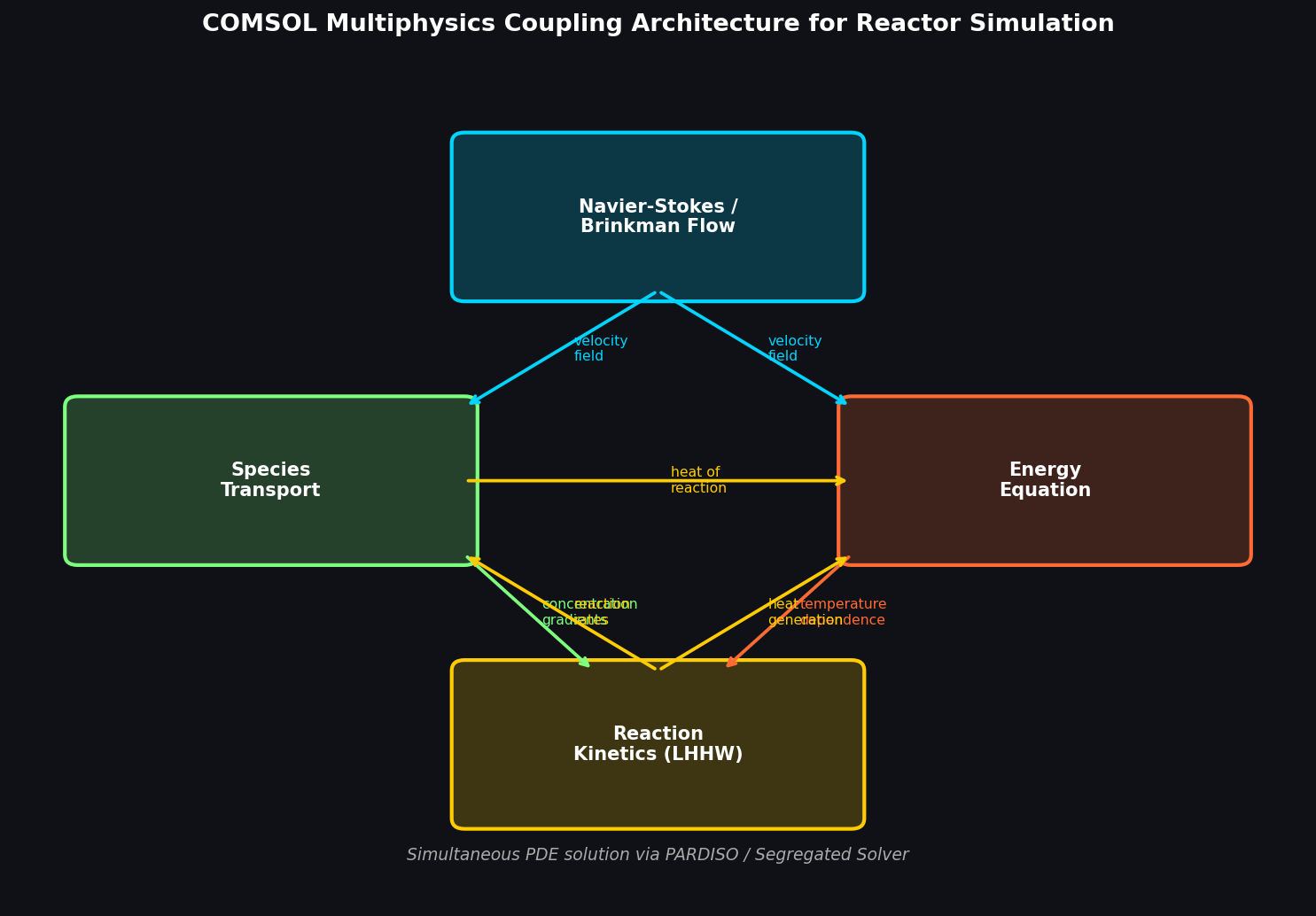
Chemical reactor design sits at the intersection of fluid dynamics, heat transfer, mass transport, and reaction kinetics — a multiphysics problem that single-physics simulators handle poorly. COMSOL Multiphysics, with its Chemical Reaction Engineering Module, provides a tightly coupled environment where all these phenomena interact simultaneously, enabling engineers to move beyond idealized CSTR/PFR assumptions and simulate real reactor geometries with spatial gradients, hot spots, and concentration profiles.
Why Coupled Multiphysics Matters in Reactor Design
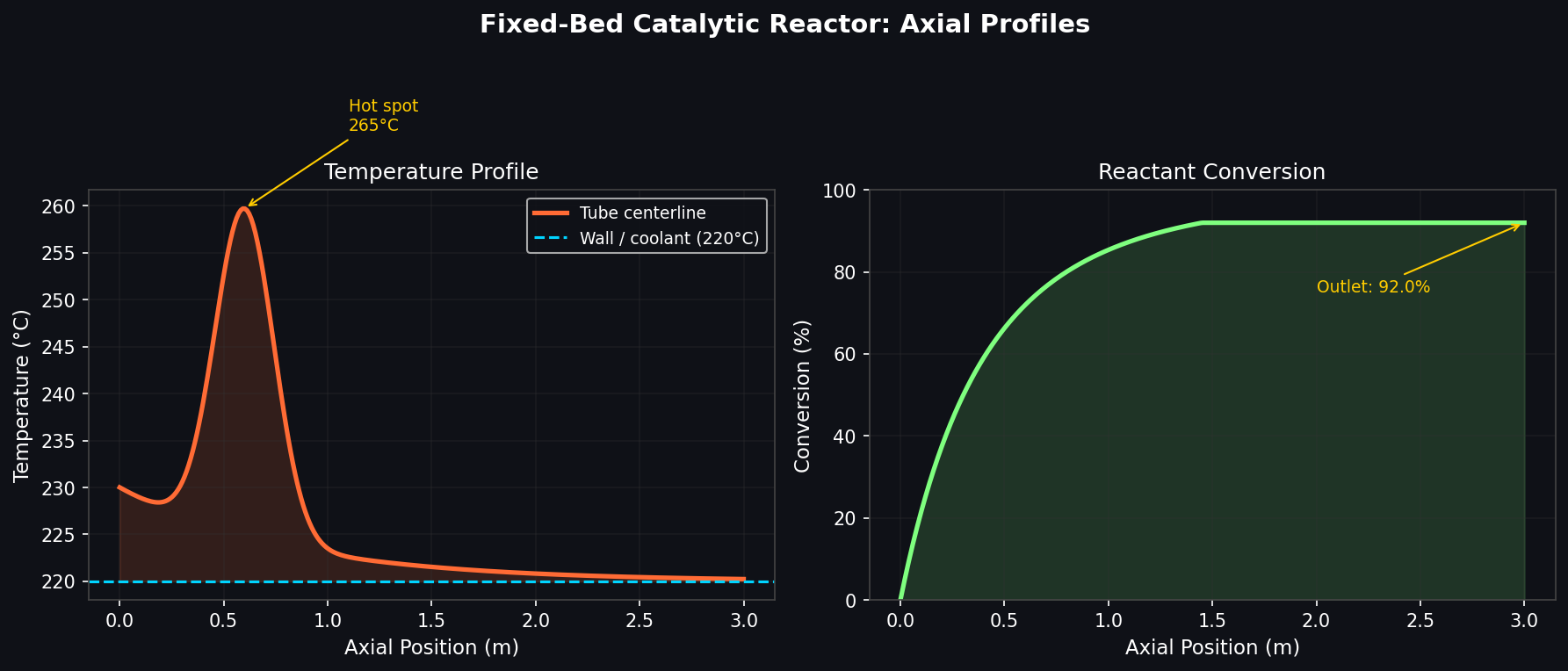
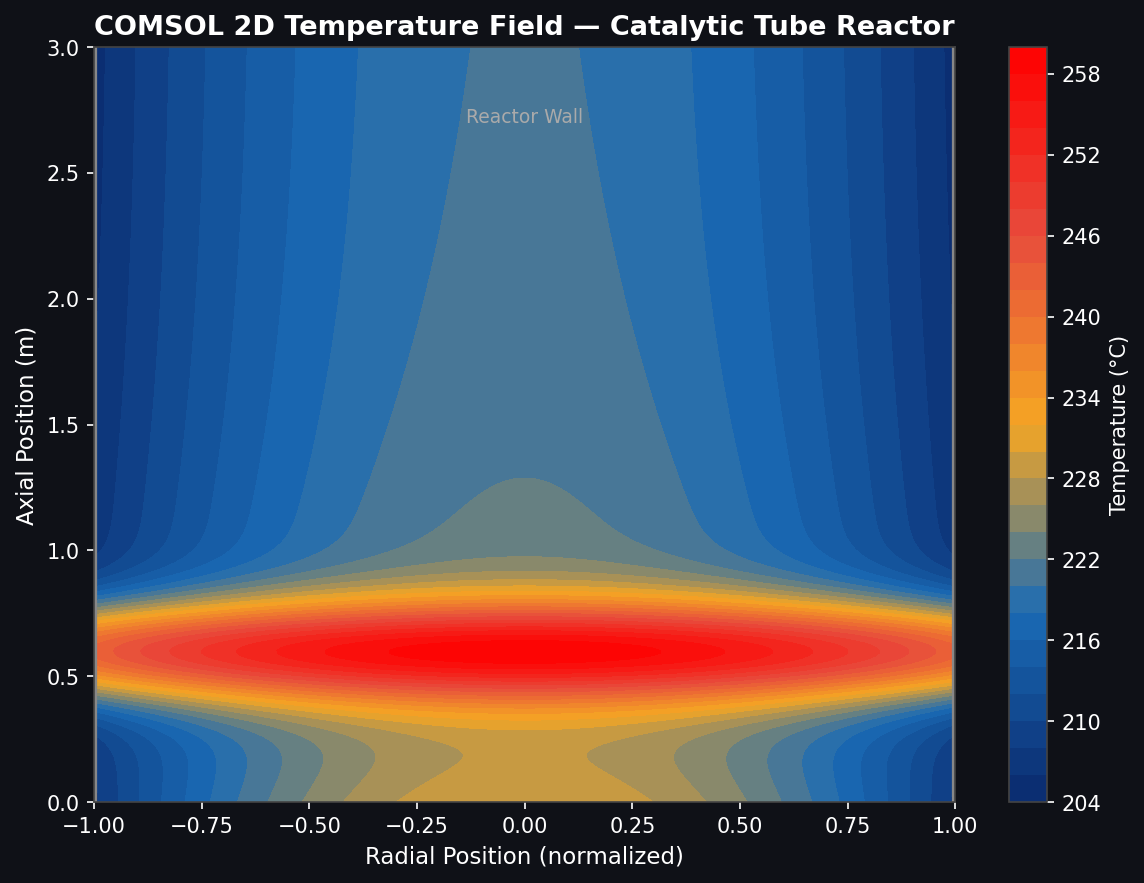
Traditional process simulators (Aspen Plus, HYSYS) treat reactors as lumped-parameter units — they compute overall conversion and heat duty but cannot resolve spatial non-uniformities. In practice, a fixed-bed catalytic reactor may develop temperature hot spots that deactivate catalyst, or a tubular reactor may exhibit radial concentration gradients that reduce selectivity. COMSOL resolves these effects by solving the governing PDEs on a 3D mesh:
- Navier-Stokes / Brinkman equations for flow through packed beds or free channels
- Species transport with convection, diffusion, and reaction source terms
- Energy equation with conductive, convective, and radiative heat transfer
- Reaction kinetics expressed as Arrhenius rate laws, Langmuir-Hinshelwood-Hougen-Watson (LHHW) expressions, or user-defined functions
All four sets of equations are solved simultaneously, so the velocity field affects species transport, which affects local reaction rates, which affect temperature, which feeds back into viscosity and density — the full coupling that real reactors exhibit.

Setting Up a Catalytic Fixed-Bed Reactor Model
Geometry and Mesh
COMSOL's geometry kernel supports parametric CAD import or direct construction of reactor internals — tube bundles, baffles, distributor plates, and catalyst bed regions. For a shell-and-tube reactor, the shell-side coolant and tube-side reacting flow are modeled in separate domains with conjugate heat transfer at the wall interface.
Meshing strategy is critical for accuracy:
- Use boundary layer elements near walls to resolve steep concentration and temperature gradients
- Apply swept meshes along tube axes for computational efficiency
- Employ adaptive mesh refinement in regions where reaction rates are highest (inlet zone for exothermic reactions)
A typical industrial-scale tube (25 mm ID, 3 m length) can be meshed with ~150,000 elements while maintaining y⁺ < 1 at the wall.
Reaction Kinetics Implementation
COMSOL's Reaction Engineering interface allows kinetic expressions to be defined symbolically. For a heterogeneous catalytic reaction such as methanol synthesis:
CO + 2H₂ → CH₃OH ΔH = −90.5 kJ/molThe LHHW rate expression is entered directly in the GUI or via the built-in kinetics library. Surface coverage equations for catalyst sites can be coupled to the bulk transport equations, enabling simulation of catalyst poisoning or competitive adsorption effects.
For complex reaction networks (e.g., steam methane reforming with 5+ reactions), COMSOL's Chemistry node automatically generates species transport equations and Jacobian entries, reducing setup time significantly.
Boundary Conditions and Solver Strategy
Inlet conditions specify velocity profile (plug flow or developed laminar/turbulent), species mole fractions, and temperature. Wall boundary conditions can be:
- Constant temperature (isothermal wall, e.g., boiling coolant)
- Heat flux (specified duty from process integration)
- Convective cooling with an overall heat transfer coefficient
For steady-state solutions, COMSOL's PARDISO direct solver handles the coupled nonlinear system robustly. For stiff kinetics (fast reactions with slow transport), the segregated solver approach — alternating between flow/transport and kinetics sub-problems — often converges faster. Pseudo-time stepping is recommended for highly exothermic systems where the initial guess is far from the solution.
Practical Application: Ethylene Oxide Reactor Hot-Spot Analysis
A silver-catalyst ethylene oxide reactor is a classic case where hot-spot formation determines both yield and safety margins. A COMSOL model of a single tube (representative of a multi-tube bundle) can:
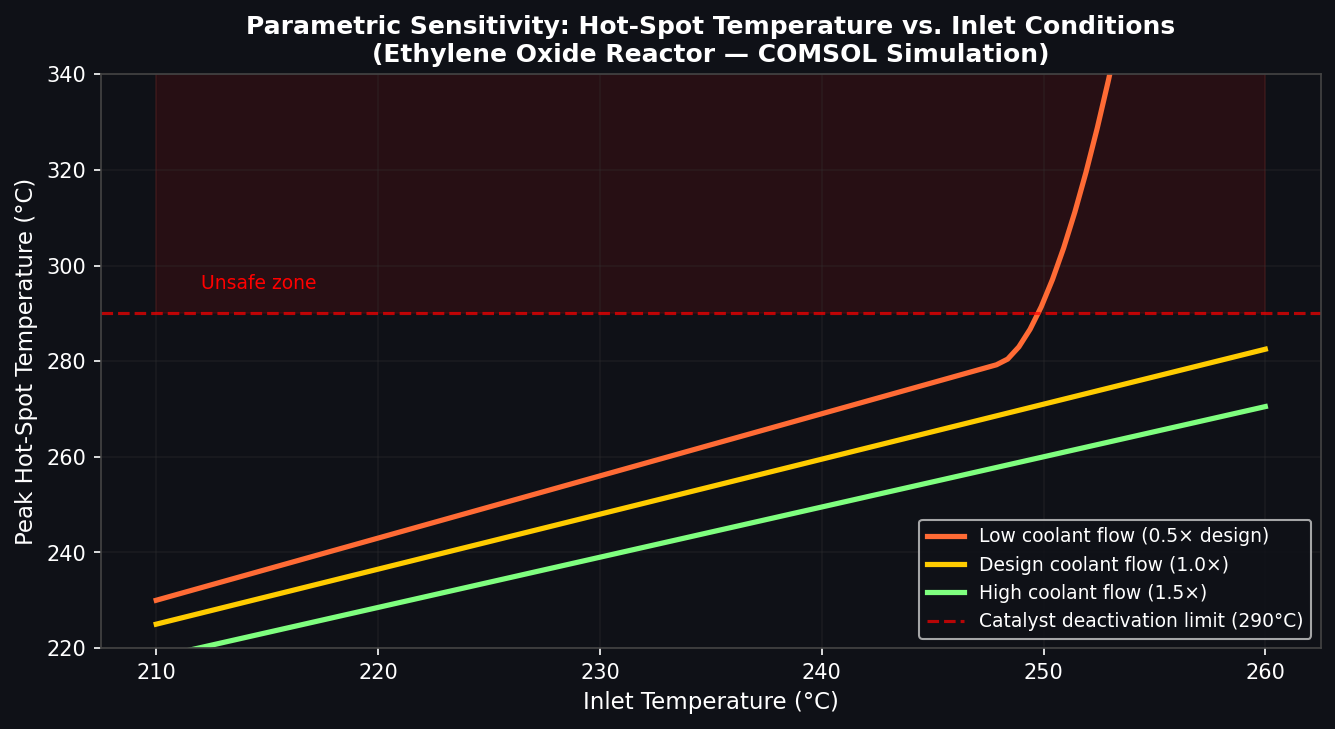
- Identify the axial hot-spot location as a function of feed temperature and coolant flow rate
- Quantify selectivity loss at elevated temperatures where CO₂ formation accelerates
- Evaluate runaway sensitivity — the parametric sensitivity of peak temperature to inlet temperature perturbations
- Optimize tube diameter and catalyst dilution to flatten the temperature profile
Results from such models have been validated against industrial plant data, showing peak temperature predictions within ±5°C and conversion predictions within ±2% — sufficient accuracy for design decisions.
Integration with Process Simulators
COMSOL models can be wrapped as External Functions or Surrogate Models and called from Aspen Plus or HYSYS via the CAPE-OPEN interface. This workflow — detailed CFD/reaction model in COMSOL, flowsheet integration in a process simulator — is increasingly common for reactor sections where spatial effects are critical but the rest of the plant can be modeled with lumped parameters.
The LiveLink for MATLAB add-on enables parametric sweeps and optimization loops: a MATLAB script drives COMSOL geometry parameters, mesh refinement, and boundary conditions, collects results, and feeds them to an optimizer (e.g., fmincon or a genetic algorithm) to maximize yield subject to temperature constraints.
Key Capabilities Summary
| Feature | Benefit |
|---|---|
| Fully coupled PDE solver | Captures feedback between flow, heat, and reaction |
| LHHW / Arrhenius kinetics | Handles heterogeneous and homogeneous reactions |
| 3D geometry support | Resolves spatial hot spots and concentration gradients |
| CAPE-OPEN compatibility | Integrates with Aspen Plus / HYSYS flowsheets |
| Parametric sweep & optimization | Enables design space exploration |
| Adaptive mesh refinement | Concentrates resolution where gradients are steepest |
Further Resources
- COMSOL Chemical Reaction Engineering Module documentation
- COMSOL Application Gallery — Reactor models
- Froment, G.F., Bischoff, K.B., De Wilde, J. Chemical Reactor Analysis and Design, 3rd ed. Wiley, 2010.
- Jakobsen, H.A. Chemical Reactor Modeling: Multiphase Reactive Flows, 2nd ed. Springer, 2014.
- CAPE-OPEN standard for process simulation interoperability
COMSOL's Chemical Reaction Engineering Module bridges the gap between idealized reactor models and the spatial complexity of real industrial reactors. For engineers designing catalytic converters, polymerization reactors, or electrochemical cells, the ability to resolve concentration and temperature fields within the reactor geometry — and couple those fields to rigorous kinetics — provides design insights that lumped-parameter simulators simply cannot deliver.