

EPANET Pressure Management: Optimizing Water Distribution Networks Through Hydraulic Simulation
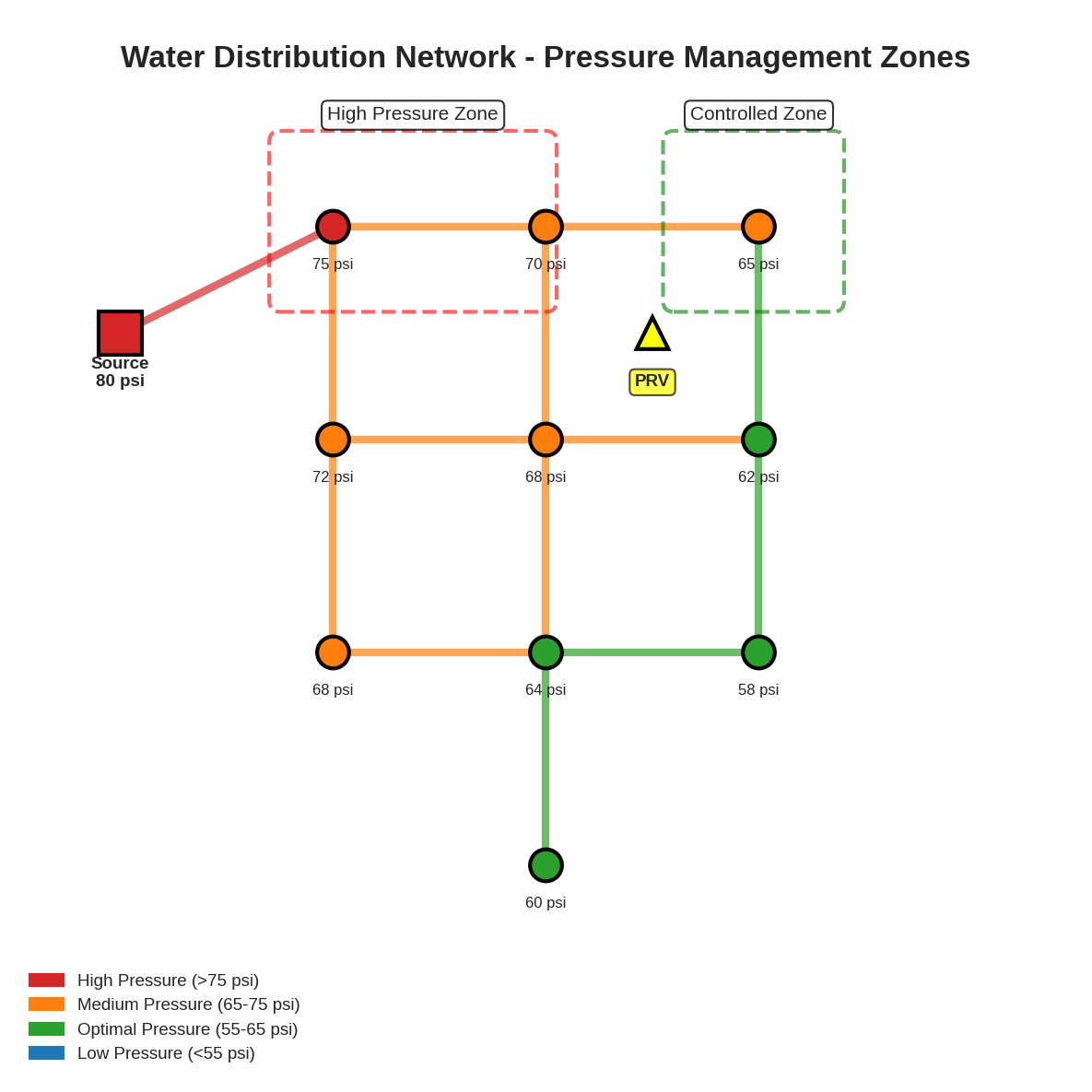
Water distribution networks face mounting challenges from aging infrastructure, population growth, and climate variability. EPANET, the industry-standard hydraulic modeling software developed by the U.S. Environmental Protection Agency, provides engineers with powerful pressure management capabilities that can reduce water loss, extend infrastructure life, and improve service reliability. This article explores advanced pressure management techniques using EPANET's simulation engine.
Understanding Pressure-Dependent Demand Analysis
Traditional water network models assume demand is independent of pressure—a simplification that breaks down during low-pressure events or pipe failures. EPANET 2.2 introduced Pressure-Dependent Demand Analysis (PDA), which models the realistic relationship between nodal pressure and actual water consumption. This feature is critical for analyzing system resilience during emergency conditions.
The PDA formulation uses a pressure-flow relationship where demand varies smoothly between zero (at minimum pressure) and full demand (at required pressure). Engineers can configure three key parameters: minimum pressure (Pmin), required pressure (Preq), and the pressure exponent. For residential areas, typical values are Pmin = 0 psi, Preq = 30 psi, and an exponent of 0.5, reflecting the square-root relationship between pressure and flow through orifices.

Implementing PDA requires adding [DEMANDS] section entries with the PATTERN and PDA keywords in the EPANET input file. This allows simulation of scenarios like main breaks, where downstream customers experience reduced service rather than the unrealistic full-demand assumption of traditional demand-driven analysis.
Pressure Reducing Valve Optimization
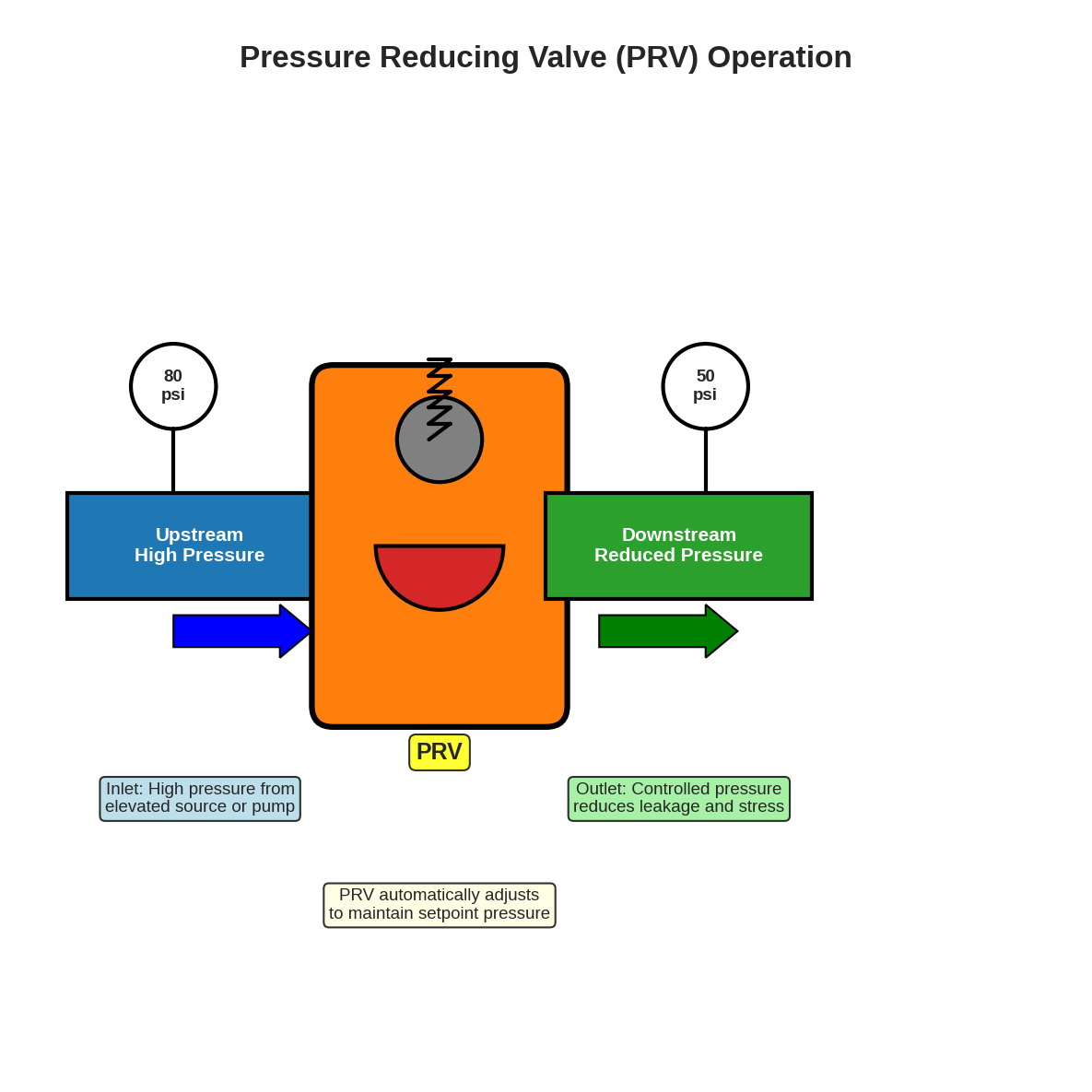
Pressure Reducing Valves (PRVs) are essential for managing excessive pressures in distribution systems, particularly in areas with significant elevation differences. EPANET models PRVs as control devices that maintain a specified downstream pressure setpoint, automatically adjusting flow resistance to achieve the target.
Strategic PRV placement can reduce leakage rates by 20-40% in systems with high static pressures. The optimal setpoint balances two competing objectives: maintaining adequate service pressure during peak demand while minimizing excess pressure during low-demand periods. EPANET's extended-period simulation (EPS) capability allows engineers to evaluate PRV performance across 24-hour demand cycles.
Advanced PRV strategies include time-modulated control, where setpoints vary by time of day to match demand patterns. This can be implemented using EPANET's [CONTROLS] section with time-based rules. For example, a PRV might maintain 50 psi during peak morning hours but reduce to 40 psi during nighttime low-demand periods, further reducing leakage without compromising service.
Transient Analysis and Surge Protection
While EPANET excels at steady-state and extended-period hydraulic analysis, pressure management must also consider transient events—rapid pressure changes caused by pump trips, valve closures, or demand fluctuations. Although EPANET itself does not perform full transient analysis, it serves as the foundation for transient modeling by providing the steady-state baseline.
Engineers use EPANET results to identify vulnerable locations where transient pressures may exceed pipe ratings or drop below minimum service levels. Critical points include high elevations (susceptible to low pressure), dead-ends (prone to water hammer), and locations immediately downstream of pumps or control valves. These insights guide the placement of surge protection devices like air valves, surge tanks, and pressure relief valves.
The EPANET-MSX extension enables modeling of water quality impacts from pressure variations, including intrusion risk during low-pressure transients. This multi-species extension tracks contaminant transport and reactions, allowing engineers to assess both hydraulic and water quality consequences of pressure management strategies.
Calibration and Real-Time Pressure Monitoring Integration
Effective pressure management requires accurate models calibrated against field measurements. EPANET supports calibration through comparison of simulated and observed pressures at monitoring points. Modern SCADA systems provide continuous pressure data that can validate model predictions and identify discrepancies indicating pipe roughness changes, unauthorized connections, or leaks.
The calibration process typically adjusts pipe roughness coefficients (Hazen-Williams C-factors or Darcy-Weisbach roughness) to match observed pressure patterns. EPANET's toolkit API enables automated calibration using optimization algorithms that minimize the difference between simulated and measured pressures. Python libraries like WNTR (Water Network Tool for Resilience) build on EPANET's engine to provide advanced calibration and uncertainty analysis capabilities.
Real-time integration takes this further by using live SCADA data to update model parameters dynamically. This enables predictive pressure management, where the model forecasts system behavior under anticipated demand scenarios and recommends control adjustments to maintain optimal pressure zones. Such systems can automatically adjust PRV setpoints or pump schedules to respond to changing conditions.
Leakage Reduction Through Pressure Management
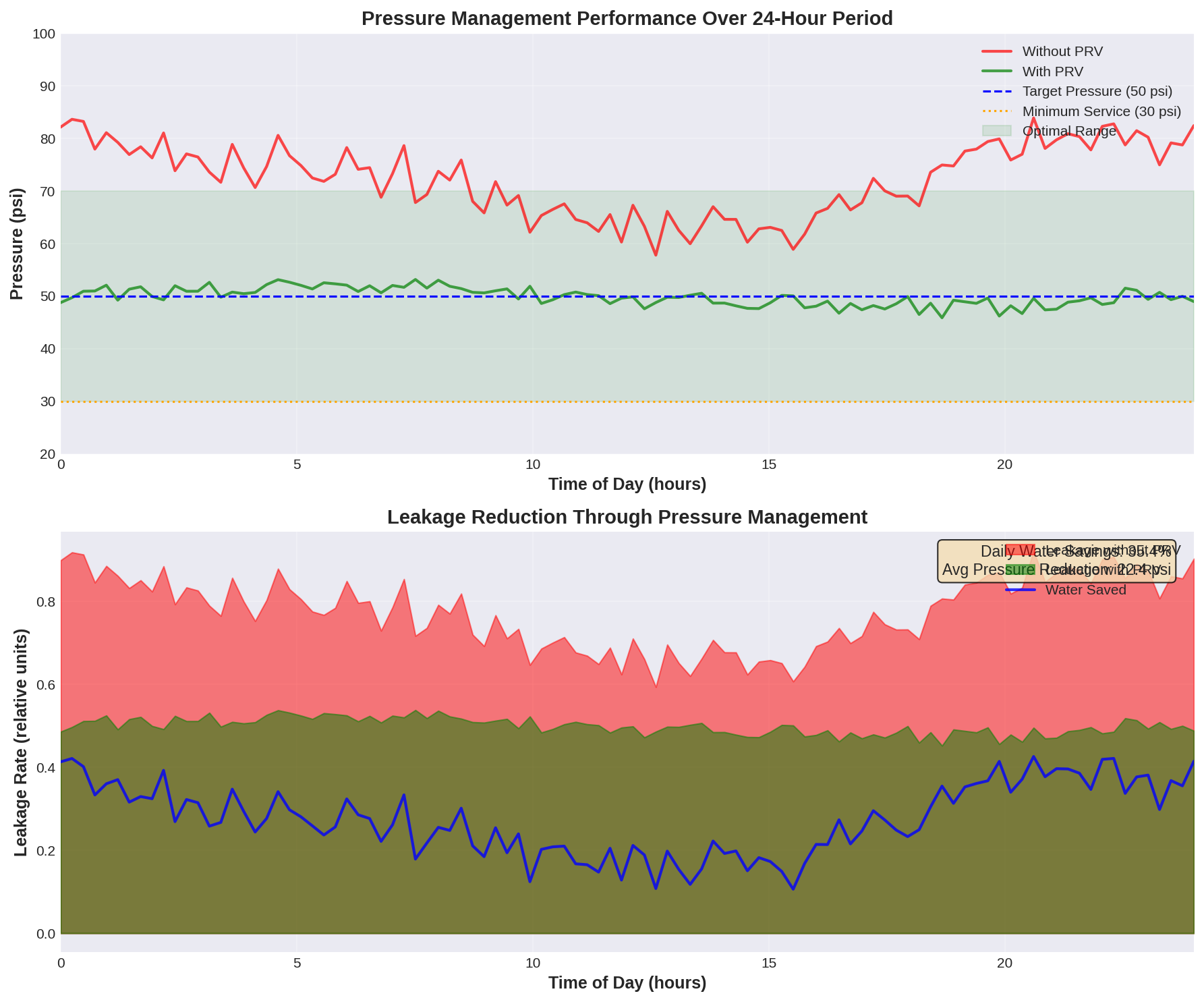
Leakage in water distribution systems correlates strongly with pressure through the FAVAD (Fixed and Variable Area Discharges) principle. Research shows that leakage flow rates typically vary with pressure raised to an exponent between 0.5 and 1.5, depending on pipe material and failure mode. EPANET can model this relationship using emitter coefficients at nodes, where the emitter exponent represents the pressure-leakage relationship.
Pressure management zones (PMZs) divide the network into hydraulically isolated areas, each with controlled inlet pressures. EPANET simulations help design PMZ boundaries by analyzing flow patterns and identifying optimal locations for boundary valves and PRVs. Effective PMZ design can reduce system-wide leakage by 30-50% while maintaining service standards.
The economic analysis of pressure management strategies uses EPANET results to quantify water savings, energy reductions, and infrastructure life extension. These benefits typically justify PRV installation costs within 2-3 years, making pressure management one of the most cost-effective interventions for aging water systems.
Further Resources
For detailed EPANET documentation and tutorials, visit the EPA EPANET website. The EPANET Users Manual provides comprehensive guidance on hydraulic modeling principles and software features. The open-source WNTR Python package extends EPANET capabilities with resilience analysis, optimization, and advanced visualization tools. For pressure management best practices, consult the IWA Water Loss Specialist Group resources and publications.