

Gambit: Computing Nash Equilibria and Analyzing Strategic Interactions in Social Systems
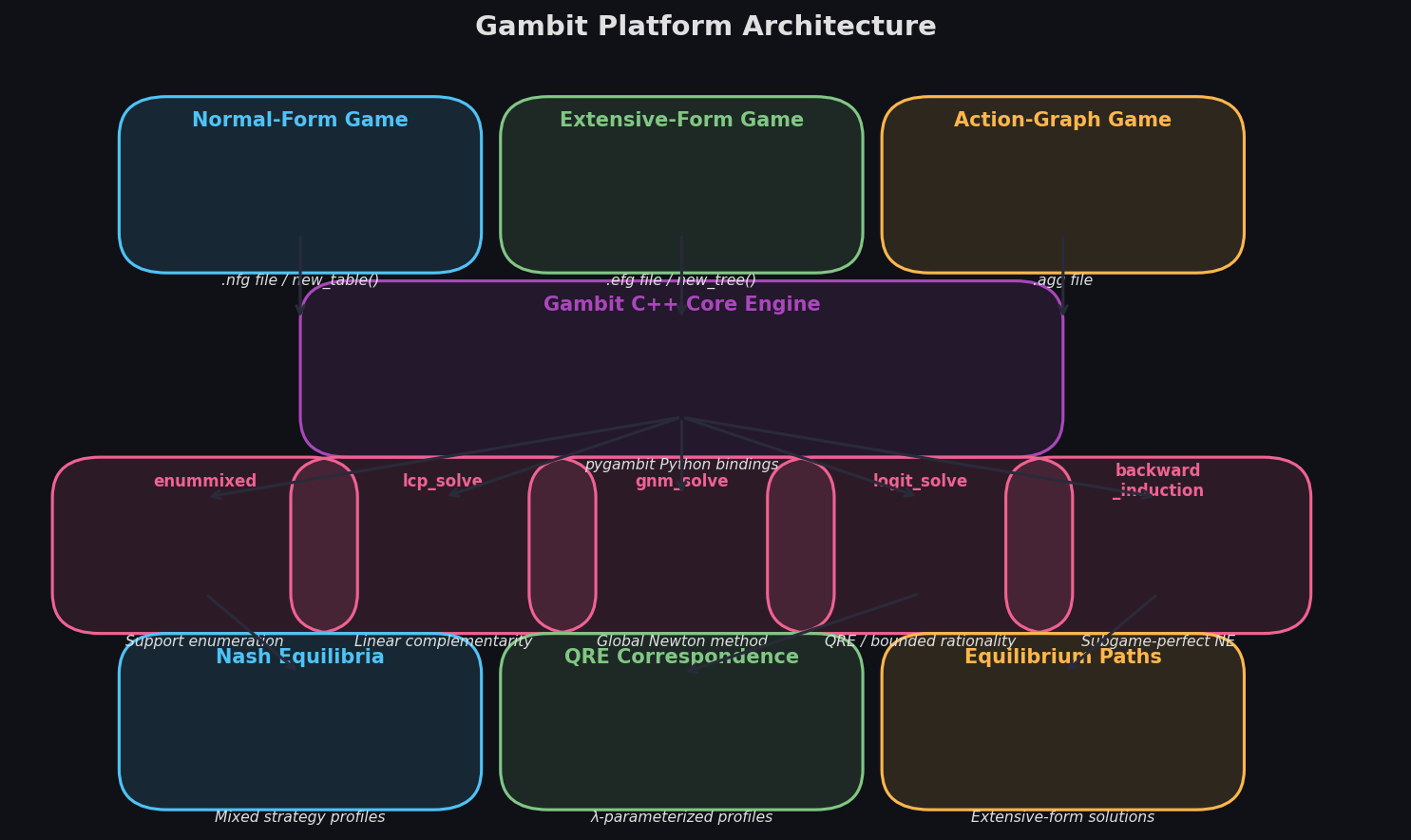
Strategic interaction is at the heart of social systems. Whether modeling market competition, voting behavior, arms races, or negotiation protocols, game theory provides the mathematical scaffolding for understanding how rational agents make decisions when outcomes depend on the choices of others. Gambit is the leading open-source platform for constructing, solving, and analyzing finite games — offering both a graphical interface and a Python API that make it indispensable for researchers in computational social science, economics, and multi-agent systems.
What Gambit Does
Gambit supports the full lifecycle of game-theoretic analysis:

- Game construction: Define normal-form (strategic) and extensive-form (sequential) games with arbitrary numbers of players, strategies, and information sets.
- Equilibrium computation: Compute Nash equilibria using a suite of algorithms including support enumeration, Lemke-Howson, Quantal Response Equilibrium (QRE), and the global Newton method.
- Refinements: Identify subgame-perfect equilibria, sequential equilibria, and trembling-hand perfect equilibria in extensive-form games.
- Parametric analysis: Trace equilibrium correspondences as payoffs or parameters vary — critical for comparative statics in policy models.
The platform ships as a C++ core with Python bindings (pygambit), a command-line suite of solvers, and a cross-platform GUI (gambit-gui) built on wxWidgets.
Installing and Getting Started with pygambit
pip install pygambitA minimal two-player coordination game in Python:
import pygambit as gbt

# Create a 2-player normal-form game
g = gbt.Game.new_table([2, 2])
g.title = "Stag Hunt"
g.players[0].label = "Hunter A"
g.players[1].label = "Hunter B"

# Label strategies
g.players[0].strategies[0].label = "Stag"
g.players[0].strategies[1].label = "Hare"
g.players[1].strategies[0].label = "Stag"
g.players[1].strategies[1].label = "Hare"

# Set payoffs (row player, col player)
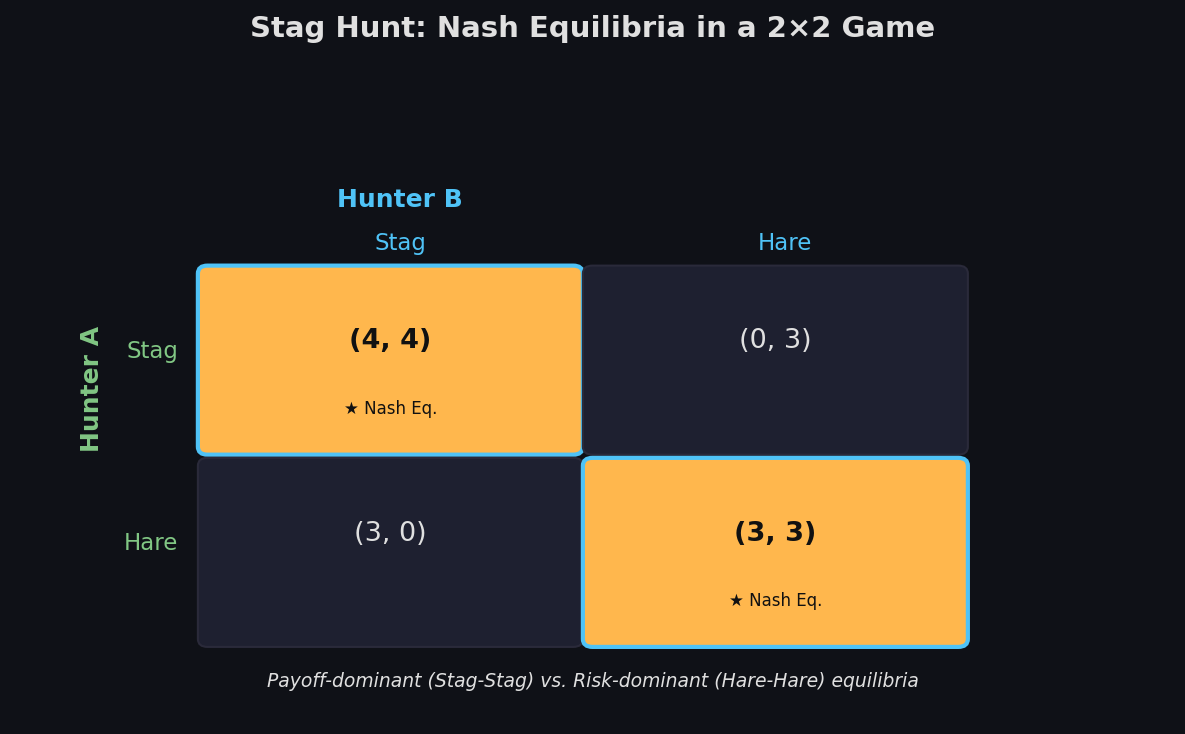
g[0, 0][0], g[0, 0][1] = 4, 4   # Stag-Stag: cooperative optimum
g[0, 1][0], g[0, 1][1] = 0, 3   # Stag-Hare: sucker's payoff
g[1, 0][0], g[1, 0][1] = 3, 0   # Hare-Stag
g[1, 1][0], g[1, 1][1] = 3, 3   # Hare-Hare: risk-dominant equilibrium

# Enumerate all Nash equilibria
solver = gbt.nash.enummixed_solve(g)
for eq in solver.equilibria:
    print(eq)
The Stag Hunt has two pure Nash equilibria (Stag-Stag and Hare-Hare) and one mixed equilibrium — Gambit finds all three.
Extensive-Form Games and Sequential Rationality
For modeling dynamic social processes — bargaining, signaling, repeated interaction — extensive-form games capture the temporal structure of decisions. Gambit's Game.new_tree() constructor builds game trees with information sets that encode what each player knows when they act.
g = gbt.Game.new_tree(players=["Sender", "Receiver"], title="Cheap Talk")
# Add nodes, information sets, and payoffs programmatically
# or load from .efg / .nfg files
g = gbt.Game.read_game("cheap_talk.efg")

# Compute subgame-perfect equilibria via backward induction
result = gbt.nash.backward_induction_solve(g)
This workflow is directly applicable to models of political communication, labor negotiation, and mechanism design — areas where the order of moves and private information are central.
Quantal Response Equilibrium for Bounded Rationality
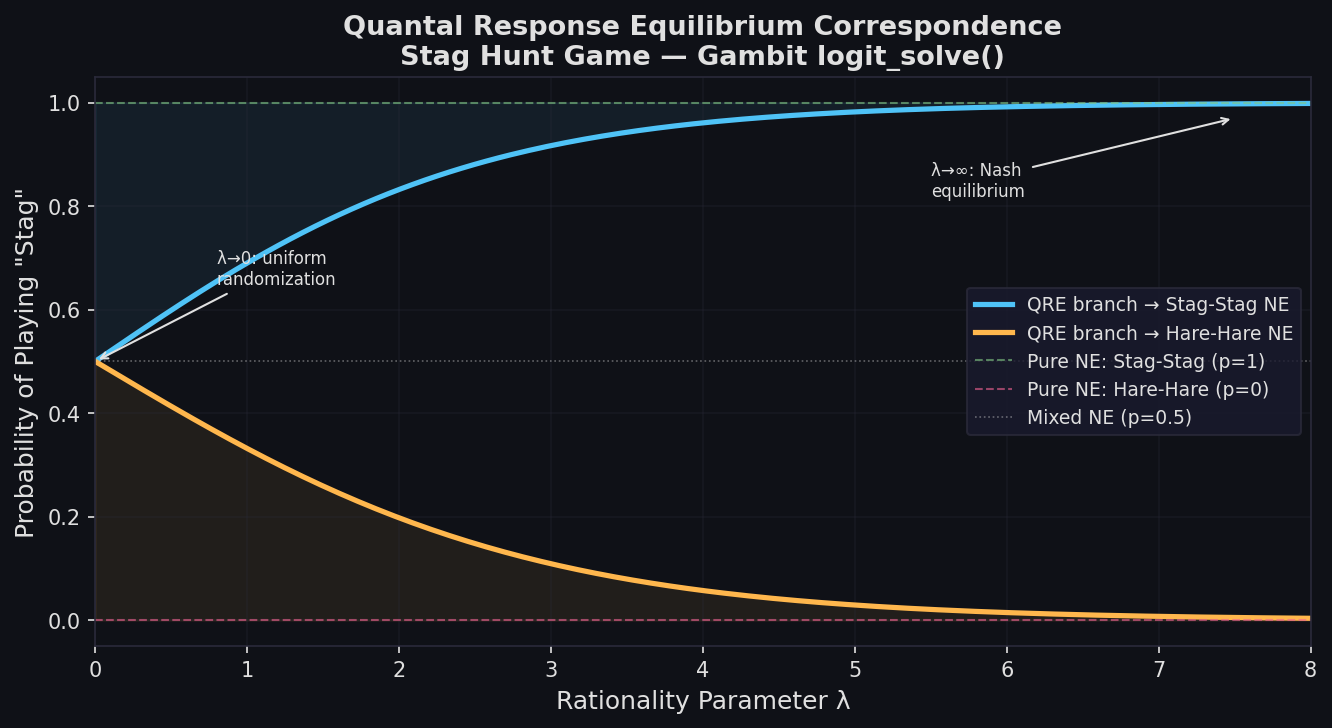
Real social agents are not perfectly rational. The Quantal Response Equilibrium (QRE) relaxes the best-response assumption: agents choose better strategies more often, but not exclusively. As the rationality parameter λ → ∞, QRE converges to Nash equilibrium; at λ = 0, agents randomize uniformly.
# Trace the QRE correspondence from λ=0 to λ=10
result = gbt.qre.logit_solve(g, lam=10.0)
for profile in result.correspondence:
    print(f"λ={profile.lam:.2f}: {profile}")
QRE is widely used in experimental economics to fit observed behavior in laboratory social dilemmas, public goods games, and auction experiments — providing a principled bridge between theoretical prediction and empirical data.
Equilibrium Tracing for Policy Analysis
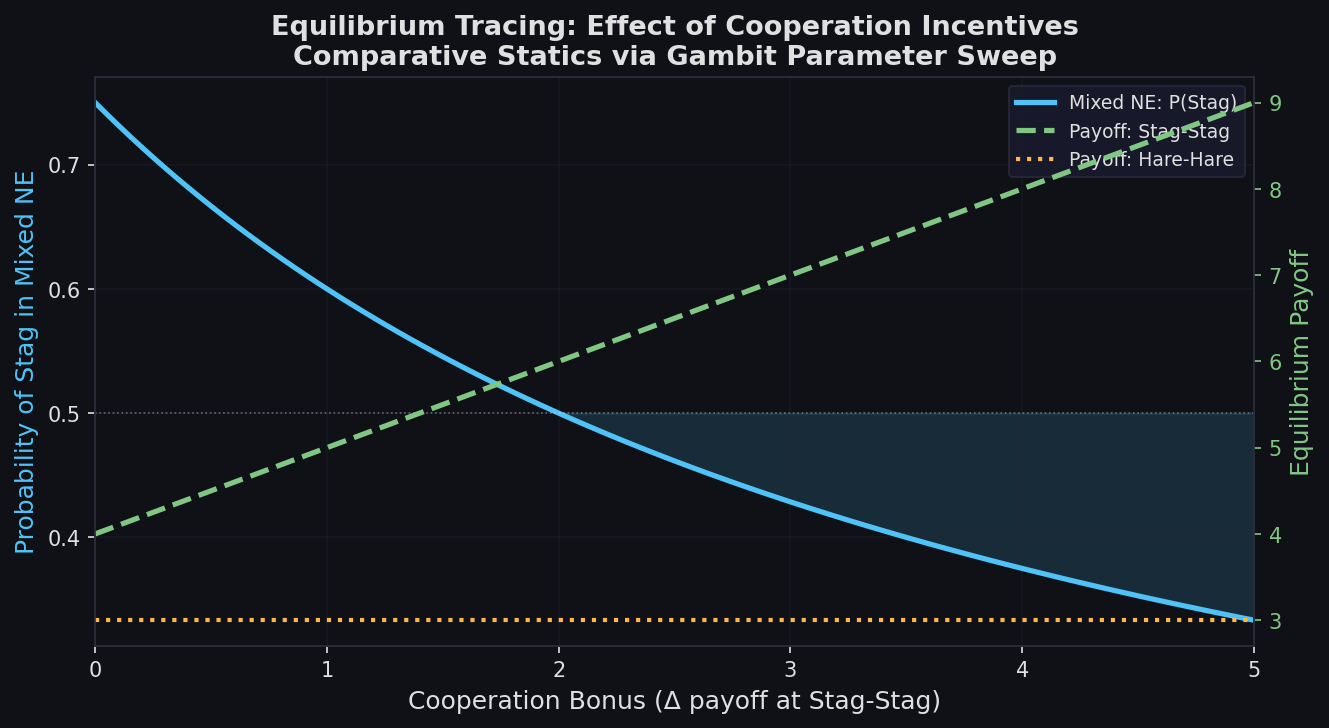
A key strength of Gambit is its ability to trace how equilibria shift as game parameters change. The support_enumeration and lcp_solve algorithms can be embedded in parameter sweeps:
import numpy as np

results = []
for cooperation_bonus in np.linspace(0, 5, 50):
    g[0, 0][0] = 4 + cooperation_bonus  # Vary the Stag-Stag payoff
    g[0, 0][1] = 4 + cooperation_bonus
    eqs = gbt.nash.enummixed_solve(g).equilibria
    results.append((cooperation_bonus, len(eqs), eqs))
This pattern supports comparative statics studies — for example, how increasing the benefit of collective action shifts a population from a risk-dominant to a payoff-dominant equilibrium, directly informing the design of incentive mechanisms in public policy.
Integration with Agent-Based Models
Gambit is increasingly used as a game-theoretic solver embedded within agent-based simulations. Rather than assuming agents play a fixed strategy, an ABM can call Gambit at each time step to compute the local Nash equilibrium for a subgame defined by the current neighborhood payoffs:
# Inside an ABM update loop
local_game = build_local_game(agent_i, neighbors)
eq = gbt.nash.lcp_solve(local_game).equilibria[0]
agent_i.strategy = eq[local_game.players[0]]
This hybrid approach — used in models of market microstructure, norm emergence, and institutional evolution — combines the scalability of ABM with the analytical rigor of equilibrium theory.
Practical Considerations
| Aspect | Detail |
|---|---|
| Complexity | NE computation is PPAD-hard; tractable for games with ≤ ~8 strategies per player |
| File formats | .nfg (normal form), .efg (extensive form), .agg (action-graph games) |
| Solvers | enummixed, lcp, lp, gnm, ipa, simpdiv, logit |
| License | GNU GPL v2 |
| Documentation | gambitproject.readthedocs.io |
| Source | github.com/gambitproject/gambit |
When to Use Gambit
Gambit is the right tool when your social system model requires exact equilibrium computation rather than heuristic strategy updating. It excels in:
- Mechanism design: Verifying incentive compatibility of auction or voting rules.
- Evolutionary game theory: Computing evolutionarily stable strategies (ESS) as special Nash equilibria.
- Experimental economics: Fitting QRE to behavioral data from social dilemma experiments.
- Policy modeling: Analyzing strategic responses to regulatory interventions in oligopolistic markets or commons governance.
For large populations where individual rationality is less critical, pair Gambit's equilibrium analysis with Mesa or Agents.jl for the population dynamics layer.
Conclusion
Gambit occupies a unique niche in the social simulation toolkit: it brings the full power of algorithmic game theory to bear on problems where strategic rationality matters. Its Python API makes it straightforward to integrate equilibrium computation into larger simulation pipelines, while its GUI supports rapid prototyping and teaching. For researchers modeling negotiation, cooperation, competition, or institutional design, Gambit provides the rigorous analytical foundation that purely simulation-based approaches cannot offer.
Further reading:
- McKelvey, R.D., McLennan, A.M., & Turocy, T.L. (2016). Gambit: Software Tools for Game Theory. gambitproject.org
- Shoham, Y. & Leyton-Brown, K. (2008). Multiagent Systems: Algorithmic, Game-Theoretic, and Logical Foundations. Cambridge University Press.
- Turocy, T.L. (2005). A dynamic heuristic for the quantal response equilibrium. Games and Economic Behavior, 51(2), 665–685.