
Hardware-in-the-Loop Testing with dSPACE: Real-Time Validation for Embedded Controllers
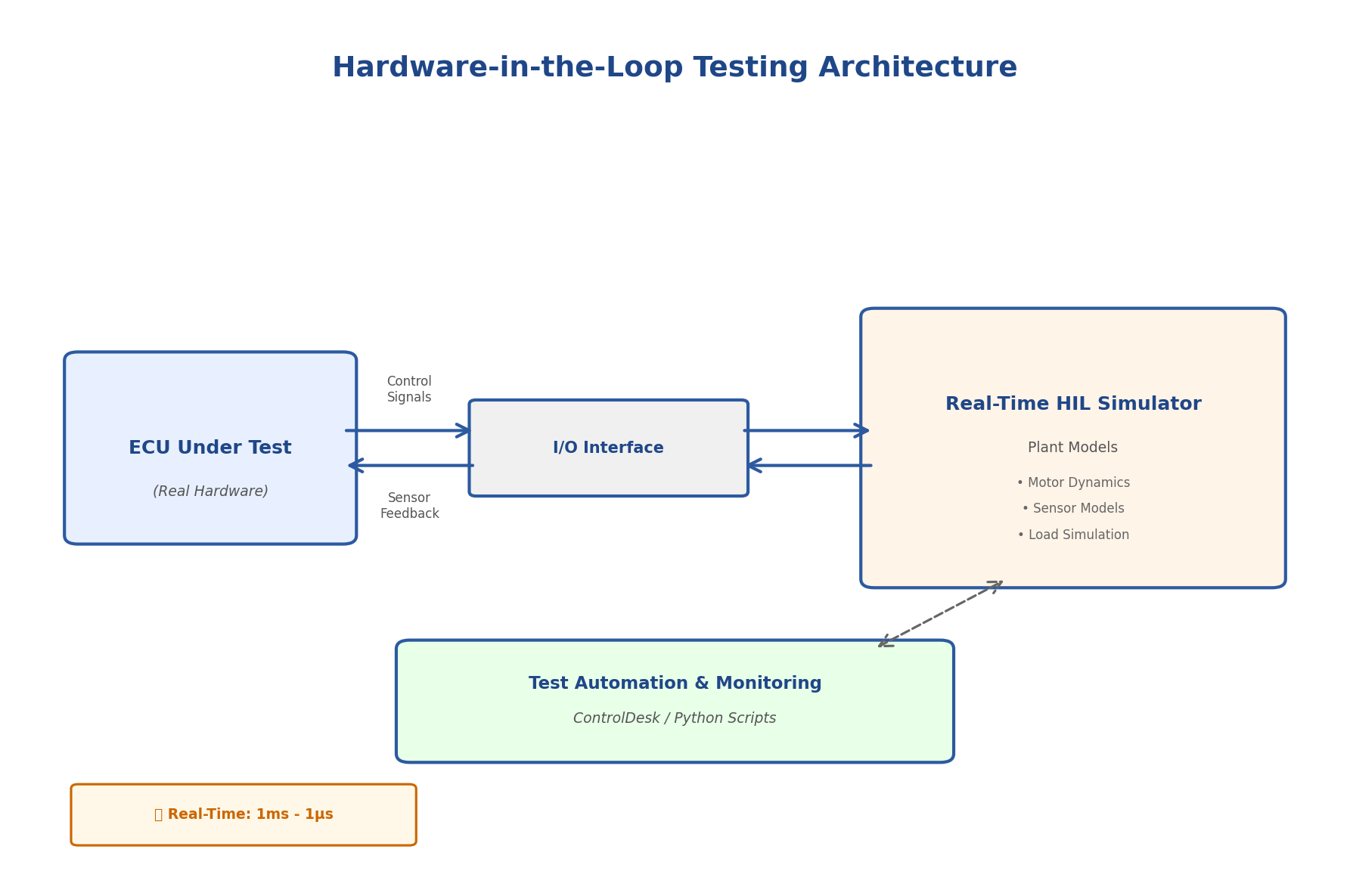
Hardware-in-the-Loop (HIL) simulation has become an indispensable methodology for validating embedded control systems before deployment. dSPACE, a leading provider of HIL simulation platforms, offers comprehensive solutions that enable engineers to test electronic control units (ECUs) under realistic operating conditions without the risks and costs associated with physical prototypes.
The Critical Role of HIL in Embedded Systems Development
Modern embedded controllers—from automotive ECUs to industrial automation systems—must operate reliably under diverse and often extreme conditions. Traditional testing approaches that rely solely on physical prototypes are time-consuming, expensive, and limited in their ability to reproduce edge cases and fault scenarios. HIL simulation bridges this gap by creating a virtual environment that mimics real-world system behavior while allowing the actual embedded hardware to execute its control algorithms in real-time.
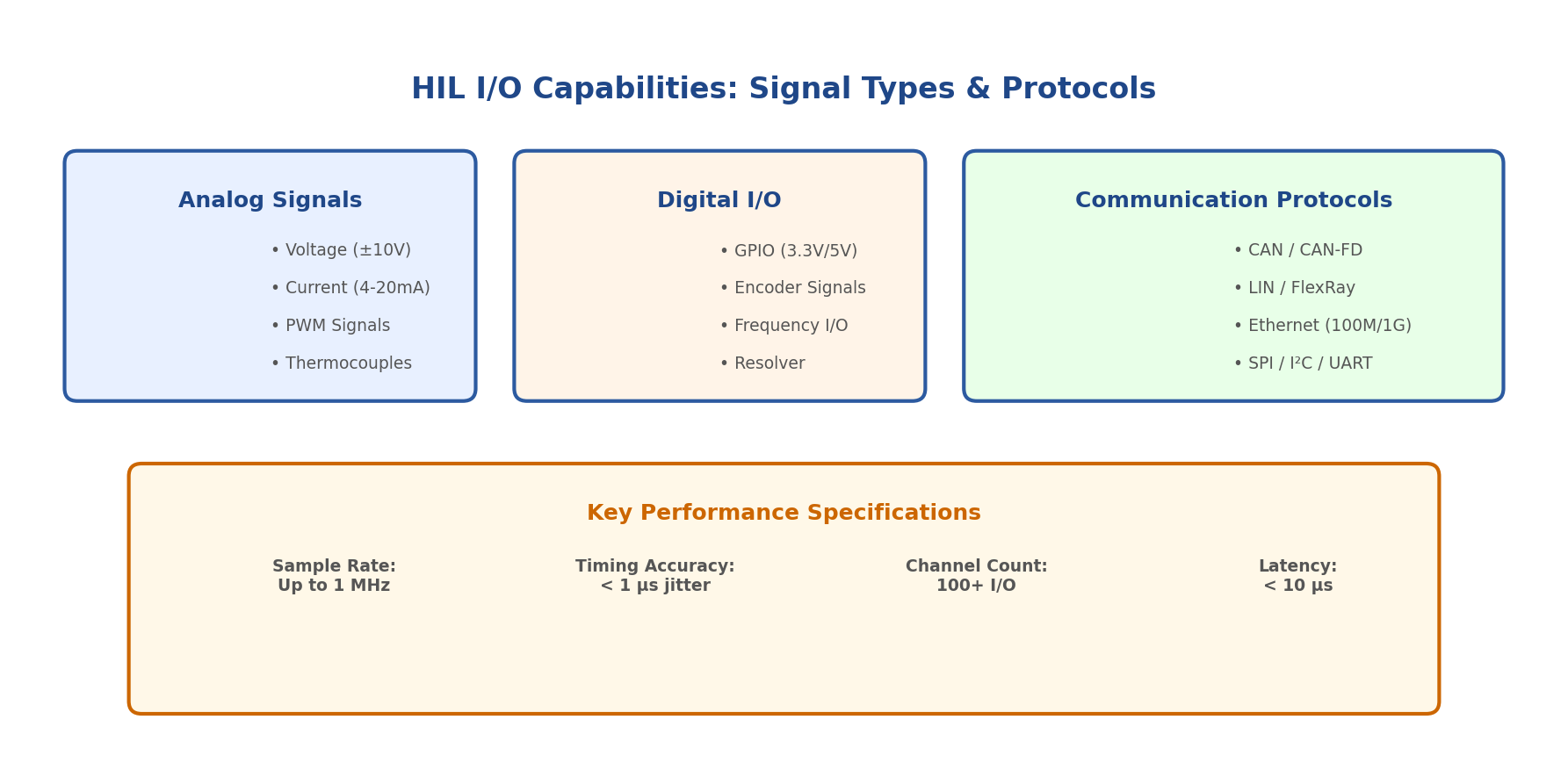
dSPACE's HIL systems excel at this task by providing deterministic, real-time simulation capabilities with microsecond-level timing accuracy. This precision is crucial for testing fast control loops in applications such as motor control, power electronics, and sensor fusion algorithms where timing jitter can mask critical issues.

Key Capabilities of dSPACE HIL Platforms
The dSPACE SCALEXIO platform represents the current state-of-the-art in modular HIL testing. Its architecture supports parallel processing across multiple processor cores, enabling simulation of complex multi-domain systems including electrical networks, mechanical dynamics, and thermal behavior—all synchronized to real-time constraints.
One particularly powerful feature is the platform's ability to perform fault injection testing. Engineers can programmatically introduce sensor failures, communication bus errors, or power supply disturbances while monitoring how the ECU responds. This capability is essential for validating safety-critical systems that must meet functional safety standards such as ISO 26262 in automotive or IEC 61508 in industrial applications.
The platform's signal conditioning and I/O capabilities deserve special attention. dSPACE provides specialized I/O boards that can emulate various sensor types—from simple analog voltage signals to complex protocols like CAN, LIN, FlexRay, and Ethernet. This flexibility allows a single HIL system to test multiple ECU variants without hardware modifications.
Integration with Model-Based Development Workflows
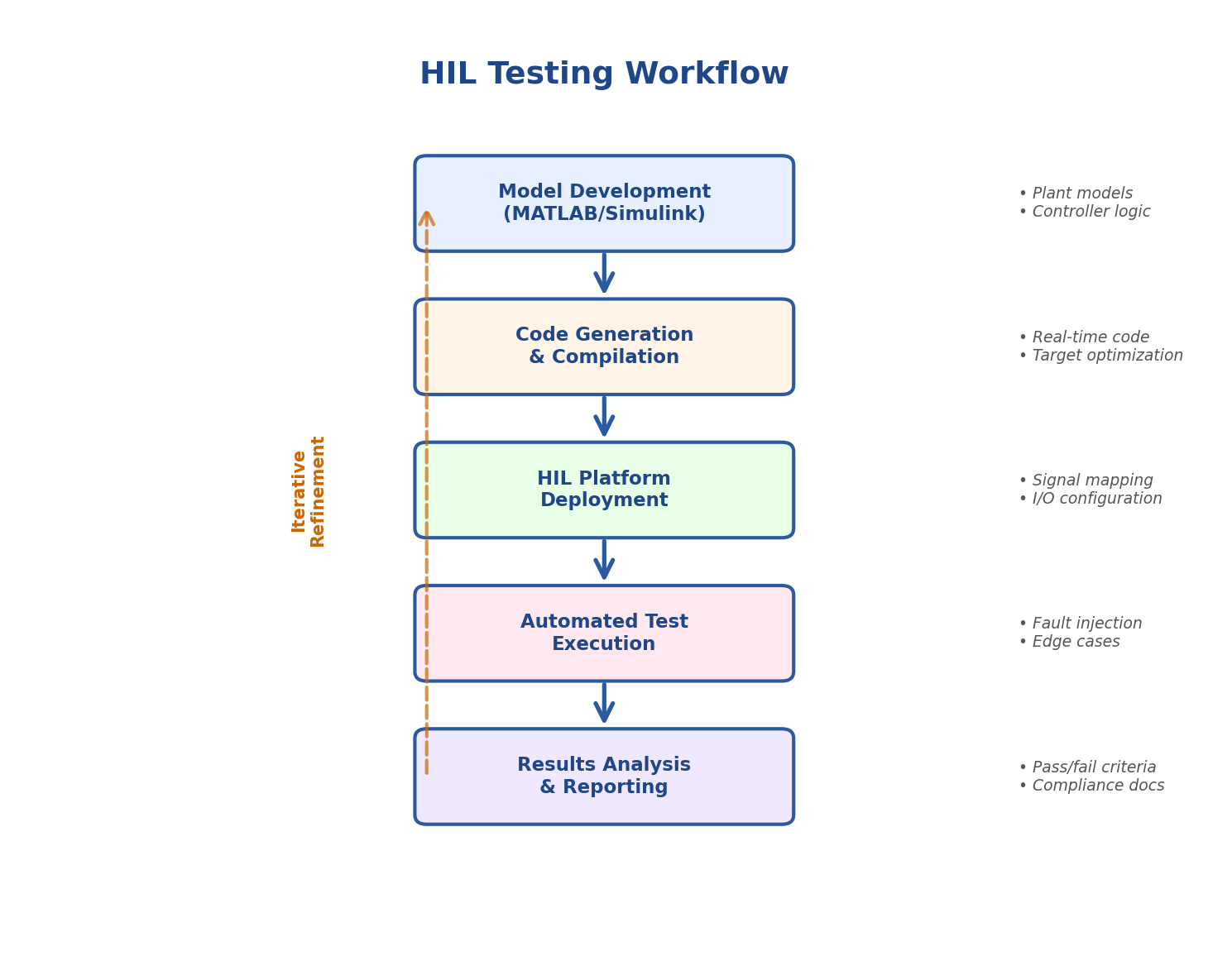
dSPACE HIL systems integrate seamlessly with MATLAB/Simulink, enabling a continuous workflow from model development through HIL validation. Engineers can compile their plant models directly to the HIL platform using automatic code generation, significantly reducing the time between model updates and test execution.
The ControlDesk software provides a comprehensive test automation and visualization environment. Test engineers can create scripted test sequences, define pass/fail criteria, and generate detailed reports—all essential for regulatory compliance and design verification. The software's Python API further extends automation possibilities, allowing integration with continuous integration/continuous deployment (CI/CD) pipelines.
Best Practices for HIL Test Development
Successful HIL testing requires careful attention to model fidelity and computational efficiency. Plant models must be accurate enough to expose real ECU issues while remaining simple enough to execute within real-time constraints. dSPACE recommends a tiered approach: use high-fidelity models for critical subsystems and reduced-order models for peripheral components.
Timing analysis is another critical consideration. Engineers should validate that their simulation models meet real-time deadlines with margin to spare, typically targeting 70-80% CPU utilization to accommodate model complexity growth. dSPACE's real-time profiling tools help identify computational bottlenecks before they cause timing violations.
Industry Applications and Future Directions
dSPACE HIL systems are deployed across industries. In automotive development, they validate everything from engine control modules to advanced driver assistance systems (ADAS). In aerospace, they test flight control computers and avionics. Industrial automation relies on HIL for validating programmable logic controllers (PLCs) and motion control systems.
Looking forward, the integration of HIL with digital twin technologies promises even greater testing capabilities. By maintaining synchronized virtual representations of physical systems throughout their lifecycle, engineers can perform regression testing against evolving requirements and validate software updates for deployed systems.
For organizations developing safety-critical embedded systems, investing in a robust HIL testing infrastructure like dSPACE provides measurable returns through earlier defect detection, reduced physical testing costs, and faster time-to-market. The platform's scalability—from desktop development systems to full-scale production test rigs—makes it accessible to teams at various stages of organizational maturity.
Further Resources
For detailed technical specifications and application examples, visit the dSPACE website. The company also offers comprehensive training programs and technical support to help teams maximize their HIL testing effectiveness. Additionally, the dSPACE User Forum provides a community resource for sharing best practices and troubleshooting guidance.