
IES VE 2026: HVAC Design Navigator, Liquid-Cooled Data Centre Simulation, and BIM-to-BEM Interoperability
Released on 4 September 2026, IES VE 2026 is a significant update to the Virtual Environment building performance simulation platform. Built directly on user feedback, the release targets four high-impact workflow areas: HVAC design, data centre thermal modelling, regulatory compliance, and BIM-to-BEM interoperability.
HVAC Design Navigator: Geometry to Sized Equipment in Under an Hour
The headline feature of VE 2026 is the HVAC Design Navigator, a guided end-to-end workflow that consolidates key VE and ApacheHVAC tasks into a single, sequenced flow. Mechanical engineers who need HVAC loads and sizing—without running full whole-building energy models—can now move from fully formed geometry to sized equipment and defensible reporting in approximately one hour.
Phase 1 of a new Zone Manager eases room-to-zone assignment with auto-creation and zone visualisation. HVAC sizing preferences have been decoupled from performance simulation defaults, and an updated ASHRAE 90.1, 62.1, and 55 reference database ensures projects start with accurate reference data rather than a manual data-entry task. Climate-filtered construction templates further reduce setup time by surfacing only templates relevant to the project location.

Tabular editing for room-unit controllers—covering radiators, radiant panels, chilled ceiling panels, and direct-acting heaters and coolers—replaces one-by-one editing with a spreadsheet-style interface, a significant time saving on heat pump conversions and decarbonisation retrofits where controller counts run high.
First-to-Market: Dynamic Liquid and Hybrid Data Centre Cooling
As AI workloads push data centre thermal densities beyond what air cooling alone can handle, IES VE 2026 introduces a new Premium Feature for liquid and hybrid cooling strategies—the only dynamic simulation solution currently capable of modelling these approaches directly within a building energy model.
Powered by ApacheHVAC, the feature supports direct-to-chip, sidewall, rear-door, immersion tank, and top-of-rack fan strategies. Engineers can assess thermal, power, and cooling performance hourly across a full year under real-world and future climate scenarios. A new Server Rack component connects directly to a building's chilled-water loop through a heat exchanger, coolant distribution unit, and fluid pump, with support for non-water and glycol coolants and configurable fluid properties. New data centre thermal templates are aligned to ASHRAE 90.1 and 90.4.
Compliance Coverage: ASHRAE, CIBSE, and Regulatory Updates
IES VE remains the only non-government software approved for regulatory compliance in California (Title 24), New York (ECCCNYS), and Florida. VE 2026 extends this foundation with a dedicated Ventilation tab that centralises all ventilation inputs and covers ASHRAE 62.1 (2019, 2022, and 2025 editions) and ASHRAE 170 (2017, 2021, and 2025 editions). A simplified Ventilation Rate Procedure option, automatic air-density correction by altitude, and a standardised ASHRAE ventilation report in HTML, PDF, and spreadsheet formats are included.
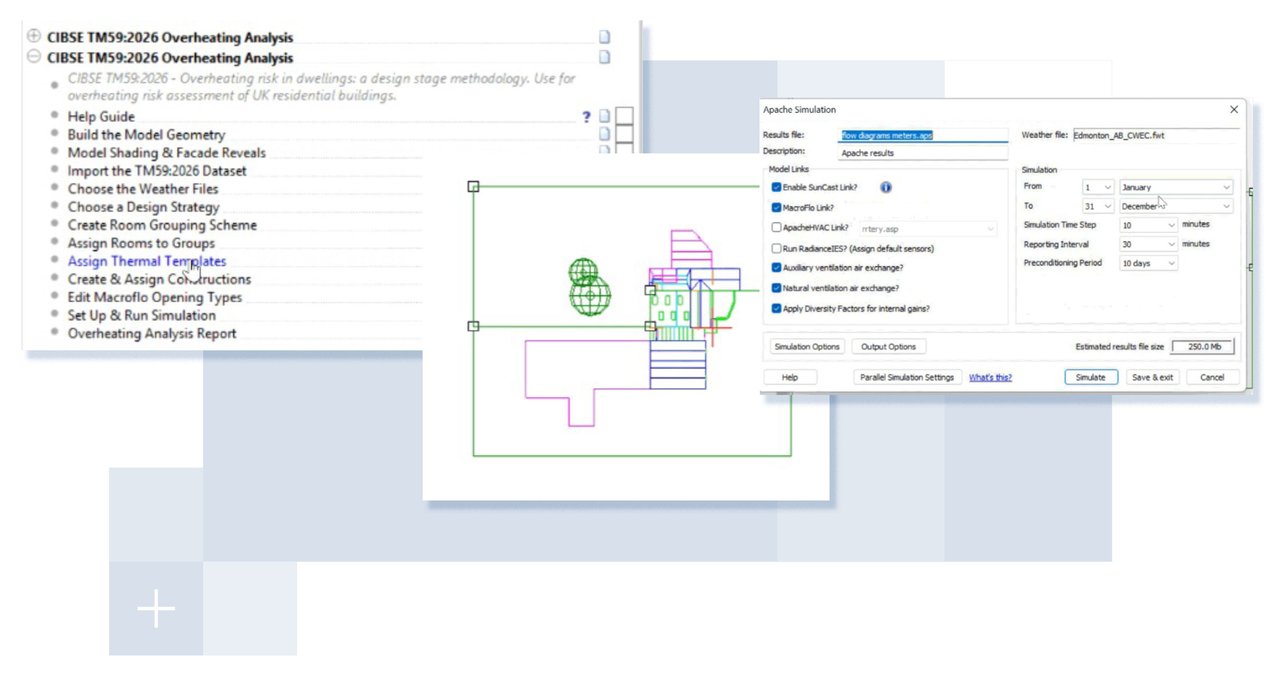
CIBSE TM59:2026 overheating assessment has been added as a Content Store download. A guided Navigator with premade templates, automated room-group creation, and a dedicated analysis dialog produces a client-ready PDF report covering Approved Document O requirements.
IES Sync for Revit: BIM-to-BEM Without Manual Rework
Launched at Autodesk University (15–17 September 2026), IES Sync for Revit is a new product that connects Revit models and IES VE workflows through a shared intelligence layer native to IES. Version 1 covers geometry import including voids and air plenums, with model review and validation. Version 2 will add transfer of energy-relevant data such as constructions and materials, further reducing the time teams spend recreating geometry between platforms.
Parametric Simulation and Python Scripting Enhancements
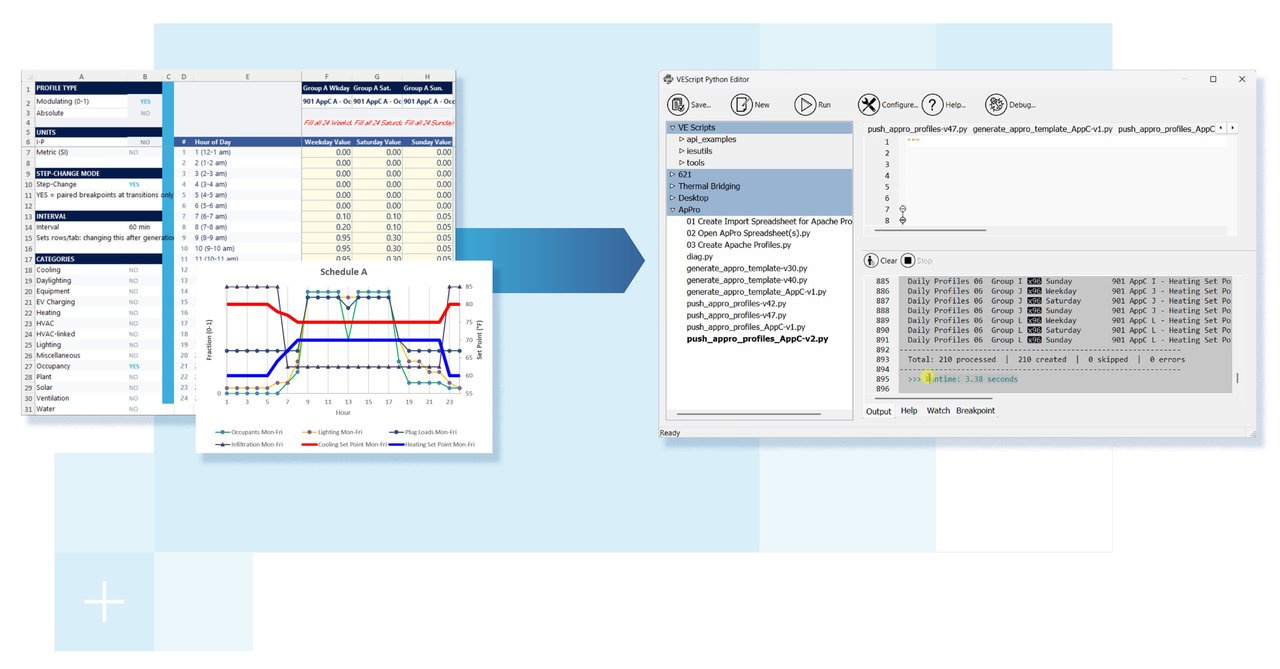
Parametric simulation now automatically backs up the base model before each run, allows permutations to be previewed and exported to Excel before committing, and returns partial results if a run fails mid-batch. Python Scripting has been upgraded to v3.13.12, with built-in type hints to catch errors before code runs and a growing Content Store of ready-to-use tools including a new Waterside Heat Recovery Analysis Report.
IES VE 2026 is available for download now. Further details are available at iesve.com.